A rising majority of university students around the world are women (HT @cblatts) http://t.co/6loTmSgrk9—
William Easterly (@bill_easterly) June 15, 2015
A rising majority of university students around the world are women
26 Oct 2015 Leave a comment
in development economics, discrimination, economic history, economics of education, gender, growth disasters, growth miracles, human capital, labour economics Tags: College premium, compensating differentials, education premium, graduate premium, marriage and divorce, reversing gender gap
Tertiary educational attainment by age and gender, USA, UK, Canada and Australia, 2013
25 Oct 2015 Leave a comment
in discrimination, economics of education, gender, human capital, labour economics, occupational choice, politics - Australia, politics - USA Tags: Australia, British economy, Canada, reversing gender gap
There are marked differences in progress in tertiary educational attainment between countries and across the generations. For example, while a few more American women have tertiary degrees as compared to their mothers, there’s been no change for American men for a generation.

Source: Indicators of Gender Equality in Education – OECD.
Canada is firing ahead in both tertiary educational attainment and reversing the gender gap in education for good. Two thirds of prime age Canadian women have a tertiary degree as compared to half of their mothers.
The number of British women with tertiary degrees is also much higher than their mothers. British men are trying their best to keep up.
The reverse gender gap in black education
22 Oct 2015 Leave a comment
in discrimination, economics of education, human capital, labour economics, labour supply, occupational choice, poverty and inequality, welfare reform Tags: reversing gender gap
Has the gender gap closed for graduates over the last generation? @greencatherine
19 Oct 2015 Leave a comment
in discrimination, economics of education, gender, human capital, labour economics, occupational choice Tags: asymmetric marriage premium, compensating differentials, economics of fertility, gender wage gap, marriage and divorce, reversing gender gap
Today’s women who are well-established in their careers in their 30s and 40s are doing better than their mothers who are also tertiary educated in terms of closing the gender wage gap. The gender wage gap in the chart below is unadjusted. It is the raw gender wage gap for women aged 35 to 44 and for women aged 55 to 64.

In Canada and the USA there is been no progress at all. In New Zealand, the gender gap between male and female tertiary educated workers is a little larger for today’s prime age women graduates than for older female workers who completed a tertiary education.
I suspect that gender gap be no smaller for today’s career women as compared to two decades ago has something to do with compensating differentials.

Today’s career women want it all: both motherhood and a career. They trade-off work-life balance for wages.
Women choose university degrees and occupations that are more agreeable to a balancing motherhood and a career.

Tertiary education premium by gender in the English-speaking countries, 2012
19 Oct 2015 1 Comment
in discrimination, economics of education, gender, human capital, labour economics, occupational choice, politics - Australia, politics - New Zealand, politics - USA Tags: Australia, British economy, Canada, College premium, education premium, gender wage gap, Ireland, New Zealand, reversing gender gap
There are large differences in the education premium between English speaking countries and also by gender. The tertiary premium in New Zealand is pretty poor compared to the USA, UK or Ireland and is still mediocre when compared to Australia and Canada.
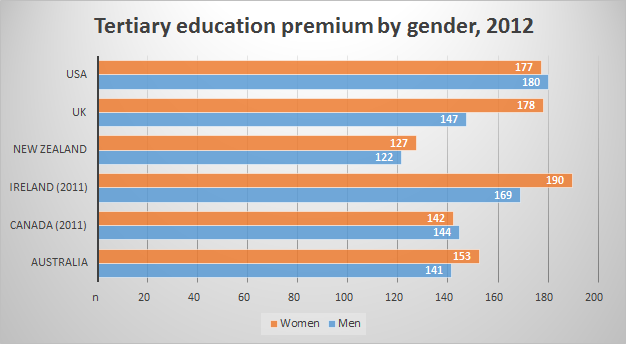
Source: Education at a Glance 2014.
@BernieSanders are the rich getting richer & poor getting poorer or are just men getting their comeuppance?
16 Oct 2015 Leave a comment
in applied welfare economics, economic history, politics - USA Tags: 2016 presidential election, expressive voting, gender wage gap, Leftover Left, middle class stagnation, reversing gender gap, top 1%, Twitter left, wage stagnation
The Typical Male U.S. Worker Earned Less in 2014 Than in 1973: blogs.wsj.com/washwire/2015/… http://t.co/PmTmmfsfbE—
Demos Action (@DemosAction) September 21, 2015
For the first time ever, women are more likely to have bachelor's degrees than men. vox.com/2015/10/13/951… http://t.co/ffK7iiU2Kq—
Demos (@Demos_Org) October 14, 2015
The dating gap on campus
06 Oct 2015 Leave a comment
in economics of education, economics of love and marriage, gender, health and safety, labour economics Tags: assortative mating, asymmetric marriage premium, College premium, dating market, marriage market, power couples, reversing gender gap, search and matching
Why dating in America for college-educated women is completely unfair wapo.st/1L1lULW http://t.co/hTCYCR5GCm—
Know More (@knowmorewp) September 09, 2015
The reversing gender gap in graduate education
01 Oct 2015 Leave a comment
in discrimination, economics of education, gender, human capital, labour economics, occupational choice, politics - USA Tags: College premium, graduate premium, reversing gender gap
6 years of women earning most PhDs, outnumbering men in grad school 136 to100 @Mark_J_Perry khttp://goo.gl/4uoYLV http://t.co/1hYfbDpdST—
AEIdeas Blog (@AEIdeas) September 17, 2015
Aggregate New Zealand European human capital of graduates, 1981-2001
26 Sep 2015 Leave a comment
in economic history, gender, human capital, labour economics, labour supply, politics - New Zealand Tags: female labour force participation, graduate premium, male labour force participation, postgraduate premium, reversing gender gap
There was rapid growth in the human capital of graduates and postgraduates in New Zealand between 1981 and 2001 according to the census data. The growth in female human capital was particularly rapid and especially so at the postgraduate level.
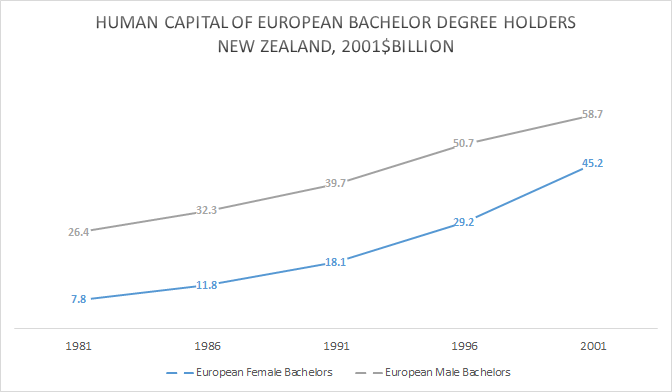
Source: Lˆe Thi. Vˆan Tr`ınh, Estimating the monetary value of the stock of human capital for New Zealand, thesis submitted in partial fulfilment of the requirements for the Degree of Doctor of Philosophy at the University of Canterbury (September 2006).
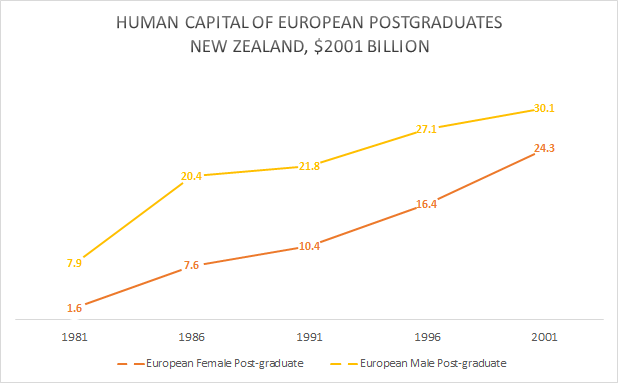
Source: Lˆe Thi. Vˆan Tr`ınh, Estimating the monetary value of the stock of human capital for New Zealand, thesis submitted in partial fulfilment of the requirements for the Degree of Doctor of Philosophy at the University of Canterbury (September 2006).
The biggest #gendergap of them all
19 Sep 2015 Leave a comment
in discrimination, economic history, gender, health economics, labour economics Tags: female life expectancy, gender gap, life expectancies, male life expectancy, reversing gender gap
https://twitter.com/ONS/status/641642361664237569/photo/1
Explore the changing gap between male & female life expectancy over time ow.ly/RXWfC http://t.co/OjZuSlcmOI—
(@ONS) September 09, 2015
Why are Asian females so good at maths?
18 Sep 2015 Leave a comment
in economics of education Tags: reversing gender gap, SAT scores
Asian girls score nearly 60 points higher on Math SATs than all boys. http://t.co/907pRiwSvi—
Ninja Economics (@NinjaEconomics) September 06, 2015
The mancession
06 Sep 2015 Leave a comment
in business cycles, economic history, global financial crisis (GFC), great recession, job search and matching, labour economics, labour supply, macroeconomics, unemployment Tags: reversing gender gap
The trouble with boys
31 Aug 2015 1 Comment
in applied welfare economics, labour economics, politics - Australia, politics - New Zealand, politics - USA, welfare reform Tags: economics of the family, lost boys, reversing gender gap, single mothers, single parents
The Trouble w Boys: U Chicago study: boys fr non-intact homes esp likely to struggle in school nber.org/papers/w17541 http://t.co/31xyA4BVQH—
W Bradford Wilcox (@WilcoxNMP) June 18, 2015
Is there a gender gap in the Dunning-Kruger effect?
10 Aug 2015 Leave a comment
in applied price theory, economics of education, economics of media and culture, gender, human capital, labour economics, personnel economics Tags: cognitive psychology, Dunning-Kruger effect, economics of personality traits, reversing gender gap
Great scientists know what they don't know. 1st step to learning. Female economists winning. blogs.lse.ac.uk/impactofsocial… http://t.co/xcfCvMNU3U—
S Dynarski (@dynarski) July 03, 2015
Why did the top 1% only pick on men in the great wage stagnation?
27 Jul 2015 Leave a comment
in discrimination, economic history, gender, labour economics Tags: middle class stagnation, reversing gender gap, top 1%, wage stagnation
Average & median incomes diverged more for men than for women as income inequaltiy grew bit.ly/16XXzQq http://t.co/Tp0IAXqxH8—
Catherine Mulbrandon (@VisualEcon) August 20, 2013
 Utopia, you are standing in it!
Recent Comments