
Claudia Goldin’s pollution theory of sex discrimination
10 Dec 2014 Leave a comment
in discrimination, gender, human capital, labour economics, labour supply, occupational choice Tags: Claudia Goldin, co-worker discrimination, credentialisation, employer discrimination, occupational segregation, sex discrimination, signalling
Claudia Goldin argues that it is difficult to rationalise sex segregation and wage discrimination on the basis of men’s taste for women in the same way as discrimination based on race or ethnicity. Goldin developed a pollution theory of discrimination in which new female hires may reduce the prestige of a previously all-male occupation.
When work took more brawn than brain, the distributions of skills and natural talents of men and women were further apart. Women were not as physically strong as men. This counted for more both before the Industrial Revolution and at the height of the Industrial Revolution when most factory work involved a considerable amount of brawn.
As machines substituted for strength, as brain replaced brawn and as educational attainment increased, the distributions of attributes, skills and natural talents narrowed by sex.
Because there is asymmetric information regarding the value of the characteristic of an individual woman, a new female hire may reduce the prestige of a previously all-male occupation.
Prestige is conferred by some portion of society and is based on the level of a productivity-related characteristic (e.g., strength, skill, education, ability) that originally defines the minimum needed to enter a particular occupation. People had to have a minimum amount of the socially prestigious strength or skill before they are hired.
Male fire fighters or police officers, to take two examples, may perceive their occupational status to depend on the sex composition of their police station or firehouse. These occupations are socially prestigious because of the strength and courage of police and fire-fighters. Men in an all-male occupation might be hostile to allowing a woman to enter their occupation even if the woman meets the qualifications for entry.
A reason for this hostility of the existing male members of the occupation is the rest of society may be slow to learn of the qualifications of these female newcomers. Their entry against this background of ignorance in the wider society may downgrade the occupation as still carrying prestigious characteristics such as physical strength. As Goldin explains:
Because they feel that the entry of women into their occupations would pollute their prestige or status in that occupation. Very simply, some external group is the arbiter of prestige and status.
Let’s take an example of firemen, and let’s say we begin not that long ago when there were no women who were firemen—which is why they’re called firemen.
And to become a fireman you have to take a test, lifting a very heavy hose and running up many flights of stairs. And every night, the firemen get off from work and go to the local bar.
Everyone slaps them on the back and says what great brawny guys they are and what a great occupation they are in, and everybody knows that to be a fireman requires certain brawny traits and lots of courage.
But nobody knows when there’s a technological shock to this occupation. And in this case it might be that fire hoses become really light or the local fire department changes the test. There are information asymmetries. But they do note that for this “brawny” characteristic, the median woman is much lower.
So if we observe a woman entering the occupation and we don’t know how to judge women, we’re going to assume that her skills are those of the median woman. Or it may be that we can observe something having to do with her muscles and that may up it a little bit.
But chances are we’re going to assume that some technological shock has happened to this occupation. And so her entry into the occupation is going to pollute it.
Then when they go to the bar, people will say, “oh you’ve got a woman in the firehouse; now fire fighting has become women’s work.” That’s where the pollution comes in.
Union rules also played a role in preventing the entry of women into some occupations
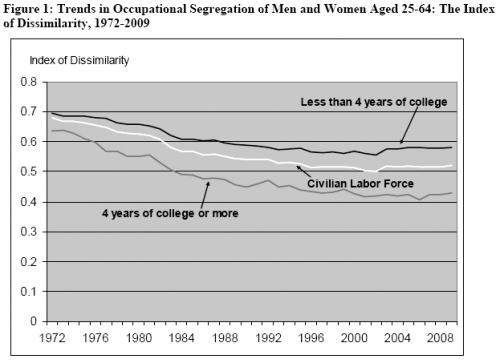
Many occupations have changed sex over time e.g., librarians, bank tellers, teachers, telephone operators, and sales positions. New occupations and industries are less like to be segregated on the basis of sex because they have not developed a social image regarding the prestige of workers.
Occupational segregation came to an end because credentialisation, which spreads information about individual women’s productivities and shatters old stereotypes, can help expunge this pollution of the prestige of specific occupations and jobs both within the industry and in wider society .
The visibility successful women today and in the past may help shatter old stereotypes and increase knowledge about the true distribution of female attributes in this prestigious occupation.

Goldin found that when typists were primarily men, it was claimed that typing required physical stamina so woman need not apply.
But later, when the occupational sex segregation reversed, when typing became a female occupation, it was said that typing required a woman’s dexterity, which men did not have! When I was at school, only women were taught to type.

How Some Women Benefit From Marrying a Man Who Makes Less Money – The Atlantic
09 Dec 2014 Leave a comment
in discrimination, gender, labour economics Tags: asymmetric marriage premiumClick add, gender wage gap, power couples, sex discrimination

The large and growing gap is not due to timid female MBAs.
Some of it is attributed to different skills, jobs before the MBA, and that male business students typically take more finance classes and women more marketing classes.
But a majority of the difference is due to women taking time out of the labor force and then working less after having children.
Women without children usually don’t take time off, and most of their earnings disparity with men can be explained by differences in their skills.
It’s notable that the earnings of some women did not fall very much after they had children and any drop in income did not persist after a few years.
But these women often had a “lower” earning spouse (income under $100,000). A large and sustained drop in income is highly correlated with having children and a high-earning husband.
via How Some Women Benefit From Marrying a Man Who Makes Less Money – The Atlantic.
Claudia Goldin and the power of the pill
04 Dec 2014 1 Comment
in economics of education, economics of love and marriage, gender, human capital, labour economics, labour supply Tags: Claudia Goldin, engines of liberation, gender wage gap, sex discrimination, single parenthood
Claudia Goldin has documented well that the availability of reliable contraception in the late 1960s led to an explosion in female investment in higher education, and in particular, long duration professional educations.
Although rapidly disseminated among married women once it came on the market in 1960, the pill at first was almost inaccessible to single females, due to the prevailing state laws on prescriptions of drugs.
Liberalisation of availability for single females was on a state-by-state basis and was staggered over a few years. This allowed Claudia Goldin to study what happened to investment in professional education by young women in each of those states as they reformed their laws on the dispensing of contraception to single females.

As contraception was made lawful for single women on a state-by-state basis in the USA in the late 60s and 1970s, young women started investing in long duration professional educations at an explosive rate. They stayed in high school the longer, more young women went on to college, and more of these college female students majored in long duration professional degrees.

In the 1960s, it was common to get engaged and even marry while at college in the USA. As Claudia Goldin, and her co-author Larry Katz explain:
It was a stark choice, you could be celibate, get your career started, and potentially face a very thin marriage market once you were done.
Or, you could have fun, get married earlier, and not necessarily have a career.
The availability of the pill allowed college-age women to have certainty in their career investments and therefore the payoff of investing in professional educations was much greater.

By decoupling sex for marriage, women could afford to defer marriage and shop around looking for better partners. Postponing marriage for at least a few years didn’t mean all the “good guys” would be taken. In addition, with higher career incomes for female college graduates, as Goldin explained:
You might think of it as the decline of the trophy wife, as women with careers who might not be as intrinsically good-looking became more highly valued than—or at least as equally valued as—women for whom appearance was a primary asset.
But as Goldin’s co-author Larry Katz explained:
Potential losers in this equation, in addition to trophy wives, are women with poor career prospects.
The clear winners are women with careers and, of course, the men they marry… Guys have more money, more sex, and less responsibility.
One side effect of the availability of contraception to better educated women was that young women with poor career prospects were also left with a pool of more unattractive men to marry.
Many of these young women who wanted to have baby chose just to have the child, and perhaps marry the father later if the responsibilities of fatherhood turned him into marriage material.
This reversal in order of parenthood and marriage among less well educated young women was one of the surprising social developments in the mid to late 20th century.

The link between paid parental leave generosity and a larger gender pay gap-updated
09 Nov 2014 4 Comments
in discrimination, economics, gender, human capital, labour economics, labour supply, occupational choice Tags: gender pay gap, labour economics, occupation choice, sex discrimination

But it also turns out that some countries that offer more liberal parental leave policies have higher pay gaps among men and women ages 30 to 34, according to analyses of 16 countries conducted by the Organization for Economic Cooperation and Development.
OECD theorizes that this link may be driven by the fact that women are more likely than men to actually use their parental leave, and that time out of the workforce is associated with lower wages.
It is rather obvious if you pay women not to work, they will accumulate less job experience and miss out on promotional and other career advancement opportunities in their prime of their career.

As this OECD paper in 2012 found with regard to paid parental leave and gender gaps in employment and earnings:
…the provision and gradual lengthening of paid leave have contributed to a widening in the gender pay gap of full-time employees.
This may reflect the fact that women experience slower career and earnings progression on returning from leave to full-time employment than men, much fewer of whom take leave.
In sum, the development of parental leave policies in most countries appears to have had a positive, albeit marginal, role in the rise of female employment, although women pay a price in the form of reduced earnings progression.
Claudia Golden found that in some high-powered professions, any career interruption at all, can greatly reduce lifetime earnings.

via The link between parental leave and the gender pay gap | Pew Research Center.
Happy Birthday Marie Curie!
08 Nov 2014 Leave a comment
in discrimination, gender Tags: gender, Marie Curie, sex discrimination, The Great Fact
That Catcalling Video and Why “Research Methods” is such an Exciting Topic (Really!) — The Message — Medium
07 Nov 2014 1 Comment
in discrimination, economics of media and culture, gender, labour economics Tags: research design, sex discrimination, sexual harassment
The filmmakers claim to have shot this video while walking the streets of Manhattan for 10 hours, but over half of the shots in the video are actually taken from just one street, namely 125th St. in Harlem.

The reversing gender gap: why women choose not to be scientists, engineers and IT professionals
05 Nov 2014 4 Comments
in discrimination, economics of education, gender, human capital, labour economics, labour supply, occupational choice Tags: do gooders, occupation choice, sex discrimination, The fatal conceit, The pretence to knowledge
Concerns about the lack of women undertaking careers in science and engineering are based on one simple false premise: that science and engineering are the most prestigious choices available to women with great ability in maths and science at high school.
We themed our roundup this week: 5 Plots on Gender You Have to See blog.plot.ly/post/976775676… @randal_olson @katy_milkman http://t.co/B5suLXIPkz—
plotly (@plotlygraphs) September 16, 2014
If relatively more prestigious career options are open to women who also happen to qualify for science and engineering, women will be underrepresented in science and engineering simply because they have better career options than the men who become scientists and engineers.
In New Zealand, just as many women as men qualify for science and engineering and the IT degrees. Not as many women who have qualified take up this option simply because they also qualify for medicine and law in greater numbers than the men who happen to qualify for science, engineering and IT degrees.
In the United States, the Association for Psychological Science found that:
Women may be less likely to pursue careers in science and math because they have more career choices, not because they have less ability, according to a new study published in Psychological Science.
Although the gender gap in mathematics has narrowed in recent decades, with more females enrolling and performing well in math classes, females are still less likely to pursue careers in science, technology, engineering, and mathematics (STEM) than their male peers.
Researchers tend to agree that differences in math ability can’t account for the underrepresentation of women in STEM fields. So what does?
Developmental psychologist Ming-Te Wang and his colleagues at the University of Pittsburgh and University of Michigan wondered whether differences in overall patterns of math and verbal ability might play a role.
The researchers examined data from 1490 college-bound US students drawn from a national longitudinal study. The students were surveyed in 12th grade and again when they were 33 years old. The survey included data on several factors, including participants’ SAT scores, various aspects of their motivational beliefs and values, and their occupations at age 33.
Looking at students who showed high math abilities, Wang and colleagues found that those students who also had high verbal abilities — a group that contained more women than men — were less likely to have chosen a STEM occupation than those who had moderate verbal abilities.
This outcome is no surprise for those familiar with the gap between men and women in verbal and reading abilities – a gap that is strongly in favour of women
The OECD PISA tests at the age of 15 find that teenage boys have a slight advantage in maths – a few percentage points – teenage girls have a serious advantage in reading.

The OECD PISA tests at the age of 15 find that this superior verbal and reading abilities of teenage girls the equivalent of six months extra schooling. One half year’s education goes a long way towards explaining many wage gaps by gender,ethnicity in race. This six-month edge in schooling is a serious advantage when qualifying for university.
Young women choose to not pursue science, engineering and IT careers because there are other career options that allow them to use their superior verbal and reading abilities – other careers is that allow them to be more successful in life than being a scientist, an engineer or an IT geek. As the Association for Psychological Science explains in the same press release cited above:
Our study shows that it’s not lack of ability or differences in ability that orients females to pursue non-STEM careers, it’s the greater likelihood that females with high math ability also have high verbal ability,” notes Wang. “Because they’re good at both, they can consider a wide range of occupations.
To put it bluntly, science, engineering and IT degrees are for young people who lack the verbal and reading abilities to get into medicine and law. Science, engineering and IT good degrees are for those who can’t get into medicine and law. They could have been contenders if they were more articulate and well-read.
There is a gender disparity in science, engineering and IT because teenage girls find these degrees to be inferior choices – inferior choices given the set of abilities they have when considering their career options.
HT: Mark J. Perry
The day that sex discrimination died – Solomon Polachek on the gender wage gap
04 Nov 2014 1 Comment
in discrimination, gender, human capital, labour economics, occupational choice Tags: asymmetric marriage premium, Gary Becker, gender wage gap, habits and traditions, human capital, labour economics, motherhood penalty, sex discrimination, Solomon Polachek
Solomon Polachek was minding his own business back in 1975 looking for evidence to show occupational crowding and that women were pushed into low paid occupations by sex discrimination, and in particular, employer discrimination. About 60 per cent of women still work in just 10 occupations. the occupations which are female-dominated are often relatively poorly paid jobs
By chance, Polachek departed from the usual empirical strategy for estimating the male-female wage gap at that time.
Rather than include a dummy variable to estimate discrimination after various factors have been taken into account, he introduced dummy variables that took account of both gender and marital status. His results were startling.
He previously was able to explain about 35% of the wage gap using the data at hand and variables he was using.
This 35% gap dropped to 18% for single never married males and females, but his ability to explain the gender wage gap increased dramatically to over 60% for married spouse present males and females.
What more, the presence of children exacerbated the gender wage gap. Each child of less than 12 years old widened the female male pay disparity by 10%. Furthermore, large spacing intervals between children widened this gender wage disparity even further.
Subsequent research showed that marital status had the same effects on gender wage gaps in Germany, the UK, Austria, Switzerland, Sweden, Norway and Australia. Factors associated with dropping out of the labour market to care for children could explain up to 93% of the gender wage gap.
These findings are devastating to the notion that there is some sort of discrimination against women on the demand side of the labour market. As Polachek explains:
The gender wage gap for never marrieds is a mere 2.8%, compared with over 20% for marrieds. The gender wage gap for young workers is less than 5%, but about 25% for 55–64-year-old men and women.
If gender discrimination were the issue, one would need to explain why businesses pay single men and single women comparable salaries. The same applies to young men and young women.
One would need to explain why businesses discriminate against older women, but not against younger women. If corporations discriminate by gender, why are these employers paying any groups of men and women roughly equal pay?
Why is there no discrimination against young single women, but large amounts of discrimination against older married women?
… Each type of possible discrimination is inconsistent with negligible wage differences among single and younger employees compared with the large gap among married men and women (especially those with children, and even more so for those who space children widely apart).
The main drivers of the gender wage gap is simply unknown to employers such as whether the would-be recruit or employer is married, their partner is present, how many children they have, how many of these children are under 12, and how many years are there between the births of their children. These are the main drivers of the gender wage gap – all of which are factors totally unknown to employers and of no relevance to them in making a profit.
The drivers of the gender wage gap on the supply side of the labour market regarding the choices women make about having children, when they have children, and how this influences their investment in human capital, and in particular, in human capital that does not depreciate by that much because of intermittent labour force participation due to motherhood.
Occupational crowding hypotheses of the gender wage gap have the drawback of being an invisible hand explanation of social outcomes. Each individual, acting only to best secure her own rights and interests, act in such a way that the unintended outcome of a complex social interaction.
The specific unintended outcome that must arise from millions of choices of people acting in their own interest throughout their lives is occupational segregation.
The market process of the invisible hand has both a filter and and equilibrating mechanism. The filter is profits and loss to exclude through insolvency and bankruptcy those entrepreneurial choices that do not further consumer’s interests. The equilibrating mechanism – the mechanism that tells people which choices they should make – is price signals. Price signals guide individual choices towards the unintended outcome.
Those that argue that women are socialised to make particular choices such as mother were not paying attention to the 20th century and the radical social change over the course of that century, in particular in the role of women. As Gary Becker explains:
… major economic and technological changes frequently trump culture in the sense that they induce enormous changes not only in behaviour but also in beliefs.
A clear illustration of this is the huge effects of technological change and economic development on behaviour and beliefs regarding many aspects of the family.
Attitudes and behaviour regarding family size, marriage and divorce, care of elderly parents, premarital sex, men and women living together and having children without being married, and gays and lesbians have all undergone profound changes during the past 50 years.
Invariably, when countries with very different cultures experienced significant economic growth, women’s education increased greatly, and the number of children in a typical family plummeted from three or more to often much less than two.

Why the Gender Pay Gap is a Myth
29 Oct 2014 Leave a comment
in discrimination, gender, health and safety, human capital, labour economics, labour supply, occupational choice Tags: employment discrimination, gender wage gap, labour economics, sex discrimination
Men are far more likely to choose careers that are more dangerous, so they naturally pay more under the principle of compensating differences. Top 10 most dangerous jobs: Fishers, loggers, aircraft pilots, farmers and ranchers, roofers, iron and steel workers, refuse and recyclable material collectors, industrial machinery installation and repair, truck drivers, construction labourers. They are male-dominated jobs.
Men are far more likely to enter higher-paying fields and occupations (by choice). Men are far more likely to take work in uncomfortable, isolated, and undesirable locations that pay more. Men work longer hours than women do. The average fulltime working man works 6 hours per week or 15 percent longer than the average fulltime working woman.

Women tend to work in fields dominated by women because these fields best satisfy women’s’ dual careers as workers and household managers. This can include less stressful work environments (noise, strenuous activity, etc.), more flexible policies regarding time off, and a number of other factors.

Men work longer hours than women do. The average fulltime working man works 6 hours per week or 15 percent longer than the average fulltime working woman. Even within the same career category, men are more likely to pursue high-stress and higher-paid areas of specialisation.

Despite all of the above, unmarried women who’ve never had a child actually earn more than unmarried men. In 2008, single, childless women between ages 22 and 30 were earning more than their male counterparts in most U.S. cities, with incomes that were 8% greater on average.
Women business owners make less than half of what male business owners make, which, since they have no boss, means it’s independent of discrimination. The reason for the disparity is money is the primary motivator for 76% of men versus only 29% of women. Women place a higher premium on shorter work weeks, proximity to home, fulfillment, autonomy, and safety.
Women lean toward jobs with fewer risks, more comfortable conditions, regular hours, more personal fulfillment and greater flexibility. Many women are willing to trade higher pay for other desirable job characteristics.
Men often take on jobs that involve physical labour, outdoor work, overnight shifts and dangerous conditions (which is why men suffer the overwhelming majority of injuries and deaths at the workplace). They choose to put up with unpleasant factors because they can earn more.
An Analysis of Reasons for the Disparity in Wages Between Men and Women for the U.S. Department of Labor in 2009 concluded that:
This study leads to the unambiguous conclusion that the differences in the compensation of men and women are the result of a multitude of factors and that the raw wage gap should not be used as the basis to justify corrective action.
Indeed, there may be nothing to correct. The differences in raw wages may be almost entirely the result of the individual choices being made by both male and female workers.

 Utopia, you are standing in it!
Recent Comments