I frequently make the point that America’s tax system is more progressive than European tax systems. But not because the United States imposes higher tax rates on upper-income households. Instead, the big difference is that lower-income and middle-class households in the United States face much lower tax burdens than their European counterparts. In those columns, […]
Is it time to pack our belongings and head to Argentina, where Javier Milei is dramatically improving economic policy and cultural attitudes? I’m joking, but also not joking. The reason I’m not joking is that there’s a very depressing scenario for America’s near-term economic outlook. It involves these six potential developments. Thanks in part to […]
Class-warfare tax policy is always a bad idea. Economists generally don’t like class-warfare policies because it is foolish to impose high marginal tax rates on productive behaviors such as investment and entrepreneurship. Politicians should not like class-warfare policies because of the negative impact on jobs and wages for ordinary people as well as the potential negative […]
I’m a big fan of tax migration. I cheer when productive people escape high-tax states or high-tax nations. And when the geese with the golden eggs fly away, it thwarts the plans of greedy politicians. The latest example of this is the exodus of billionaires – worried about a wealth tax – from California (the […]
Below is my column in the California Post and New York Post on the exodus of wealthy taxpayers from the state as Democrats seek to trap them with a retroactive wealth tax. They are engineering a type of reverse Gold Rush as up to a trillion dollars leave the state with a line of U-Hauls […]
The death tax presumably is the most destructive tax on a per-dollar-collected basis, but I suspect the capital gains tax is in second place. Like the death tax, the capital gains tax is pure double taxation, thus exacerbating the tax code’s bias against saving and investment. And the capital gains tax is particularly foolish since […]
There can be honest and constructive debates about the size of government, such as when I cross swords with someone on the left who understands Arthur Okun’s efficiency-equity tradeoff. Another legitimate debate is about the impact of tax policy, specifically whether higher or lower tax rates have big effects or small effects. But to have […]
I wrote a column about taxes and growth in 2020. Let’s augment that analysis by digging into some details. I decided to address the issue today after seeing a tweet with this helpful summary of how different taxes cause different levels of economic damage (the Tax Foundation also has a table that ranks different taxes, […]
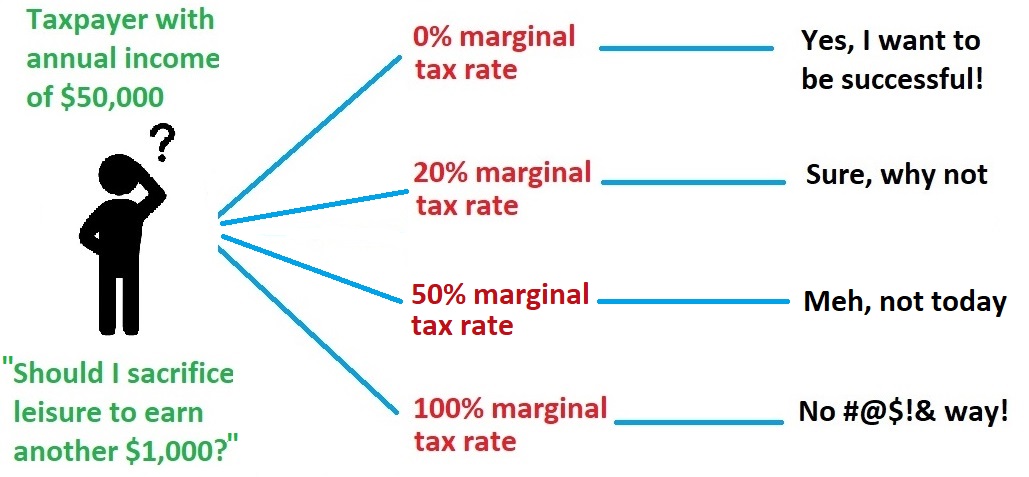
There are several visual ways of helping people understand how fiscal policy (and especially marginal tax rates) can change behavior. The philoso-raptor meme. The questioning worker. Supply-and-demand curves. The Wizard-of-Id parody. To augment these examples, I’ve started a series that is based on real-world examples. Part I of the series highlighted how the capital gains […]
From a big-picture economic perspective, I worry most about the damage of high tax burdens on innovation, entrepreneurship, and investment. Those are things that generate enormous benefits for society, yet also things that are very sensitive to bad tax policy (specifically high marginal tax rates and the tax code’s bias against saving and investment). Sadly, […]
The super-rich are super-mobile. So, if a country decides to increase taxes on the super-rich (for example, with a wealth tax), some (but not all) of the super-rich will simply move elsewhere. This should not be a surprise to anyone. And yet, simplistic proposals to tax the super-rich are a favourite policy for some political…
Here is his comment on the paper presented here: Summary: The U.S. tax system is highly progressive. Effective tax rates increase from 2% for the bottom quintile of income to 45% for the top hundredth of one percent. But rates may be lower among those with the highest wealth. This comment starts with the “top 400” […]
Roger Partridge writes – The Greens’ coronation of Chlöe Swarbrick at last weekend’s AGM delivered a manifesto for economic transformation that would make Soviet economists nostalgic for their glory days.
Back in 2013, I debated Joe Biden’s top economist on the death tax. Everything I said then (and wrote four years before then) is still true today. In the interview, I mentioned nations that have abolished their death taxes, including Australia. I should have mentioned Sweden as well. As a general rule, I don’t want […]
Why Evolution is True is a blog written by Jerry Coyne, centered on evolution and biology but also dealing with diverse topics like politics, culture, and cats.
“We do not believe any group of men adequate enough or wise enough to operate without scrutiny or without criticism. We know that the only way to avoid error is to detect it, that the only way to detect it is to be free to inquire. We know that in secrecy error undetected will flourish and subvert”. - J Robert Oppenheimer.


 Utopia, you are standing in it!
Recent Comments