
Chad Jones’ awkward remarks on top tax rates and innovation spillovers
09 Jan 2019 Leave a comment
in applied price theory, applied welfare economics, economic growth, economics of education, entrepreneurship, fiscal policy, human capital, income redistribution, industrial organisation, labour economics, labour supply, macroeconomics, occupational choice, politics - USA, poverty and inequality, Public Choice, public economics, rentseeking Tags: creative destruction, taxation and entrepreneurship, taxation and investment, taxation and labour supply, top 1%
Steven Landsburg Discusses Incentives and Taxes
05 Dec 2018 Leave a comment
in applied price theory, applied welfare economics, development economics, economic growth, economic history, entrepreneurship, fiscal policy, human capital, labour economics, labour supply, macroeconomics, public economics Tags: taxation and entrepreneurship, taxation and investment, taxation and labour supply
Finn Kydland on the Great Recession
27 Nov 2018 1 Comment
in budget deficits, business cycles, economic growth, fiscal policy, great recession, macroeconomics, public economics Tags: monetary policy, taxation and entrepreneurship, taxation and investment, taxation and labour supply

“You’re all a bunch of socialists” Mises on Friedman
08 Aug 2018 Leave a comment
in applied price theory, applied welfare economics, Austrian economics, comparative institutional analysis, F.A. Hayek, income redistribution, Ludwig von Mises, Milton Friedman, Public Choice, public economics Tags: taxation and investment, taxation and labour supply
Piketty is a supply-side economists?
12 Jul 2018 Leave a comment
in applied price theory, entrepreneurship, human capital, labour economics, labour supply, occupational choice, poverty and inequality, public economics Tags: taxation and investment, taxation and labour supply, top 1%
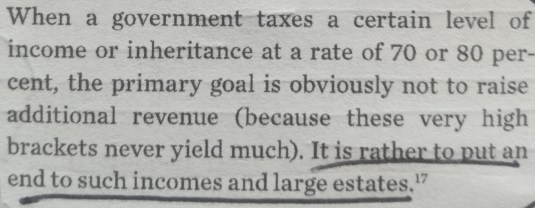
Facts About Taxes: Michael Keane
12 Oct 2017 Leave a comment
in applied price theory, fiscal policy, human capital, labour economics, labour supply, macroeconomics Tags: taxation and labour supply
Macroeconomic Consequences of Taxing the Rich
11 May 2017 Leave a comment
in fiscal policy, macroeconomics, politics - USA, Public Choice, public economics, sports economics Tags: taxation and labour supply, top 1%
Important to mention tax credits when discussing the working poor? @JordNZ
21 Apr 2017 Leave a comment
in labour economics, politics - New Zealand, poverty and inequality, public economics, welfare reform Tags: child poverty, family poverty, family tax credits, taxation and labour supply
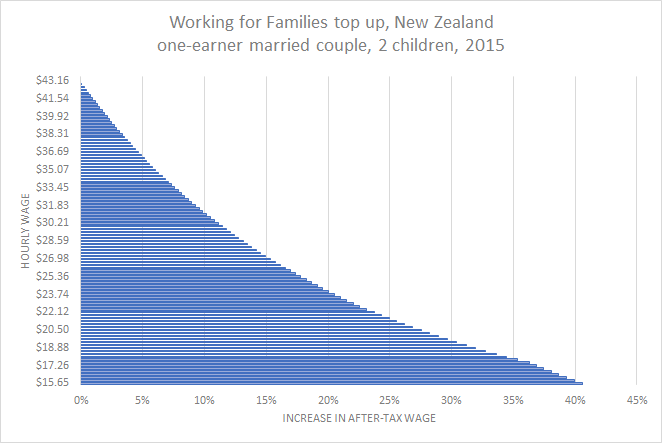
Which matters more to the incentive effects of income tax? @JordNZ
20 Apr 2017 Leave a comment
in politics - New Zealand, public economics Tags: average tax rates, family taxation, Marginal tax rates, taxation and labour supply
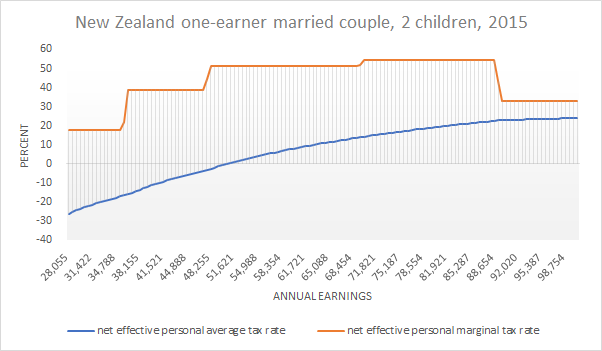
So New Zealanders do not pay much income tax @TaxpayersUnion
19 Apr 2017 Leave a comment
in politics - USA, public economics Tags: family tax credits, family taxation, Marginal tax rates, taxation and labour supply
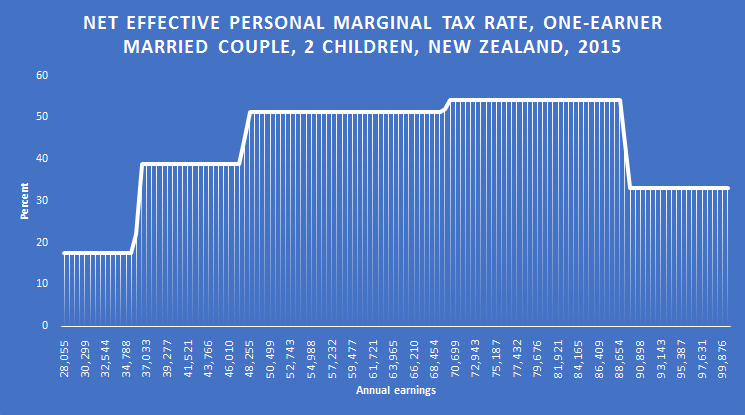
Maximum Wages: An absolutely terrible idea
11 Jan 2017 Leave a comment
in applied price theory, fiscal policy, labour economics, labour supply, macroeconomics Tags: British politics, envy, maximum wage, taxation and investment, taxation and labour supply
Taxman – The Beatles
07 Sep 2016 Leave a comment
in applied price theory, public economics Tags: superstar wages, taxation and labour supply, The Beatles
% employees working more than 50 hours per week, 2014 OECD area
15 Aug 2016 6 Comments
in labour economics, labour supply, occupational choice, public economics Tags: hours worked, taxation and labour supply
Not coincidentally, countries with high marginal income tax rates have low levels of long hours worked per week.
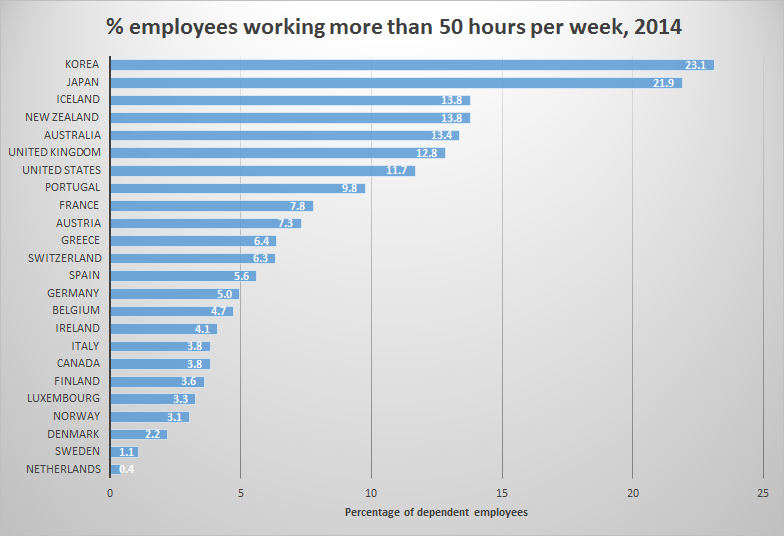
Data extracted on 14 Aug 2016 01:52 UTC (GMT) from OECD.Stat; Data does not include the self-employed.
% women age 25 to 54 working full-time in USA, UK, Canada, Germany, France, Italy, Australia, New Zealand, Ireland, Sweden, Norway and Denmark
11 Jul 2016 Leave a comment
in gender, labour economics, labour supply Tags: female labour force participation, female labour supply, part-time work, social insurance, taxation and labour supply
To account for full-time work being 35 hours per week in some countries but 40 hours others I have included both in the chart below. Not many Dutch women work full-time.
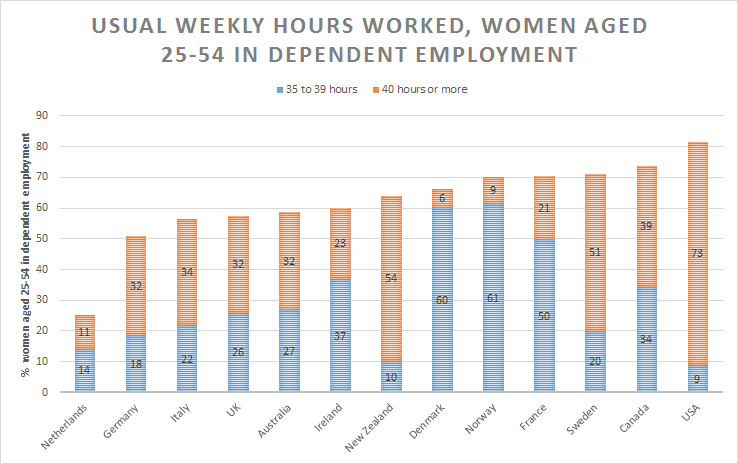
Data extracted on 11 Mar 2016 14:08 UTC (GMT) from OECD.Stat.
Gap in GDP per Australian, Canadian, French, German, Japanese, New Zealander and British hour worked with the USA
28 May 2016 Leave a comment
in economic growth, economic history, labour economics, labour supply, macroeconomics, politics - Australia, politics - New Zealand, politics - USA, public economics Tags: Australia, British economy, Canada, Eurosclerosis, France, Germany, Japan, labour productivity, measurement error, taxation and labour supply
This data tells more of a story than I expected. Firstly, New Zealand has not been catching up with the USA. Japan stopped catching up with the USA in 1990. Canada has been drifting away from the USA for a good 30 years now in labour productivity.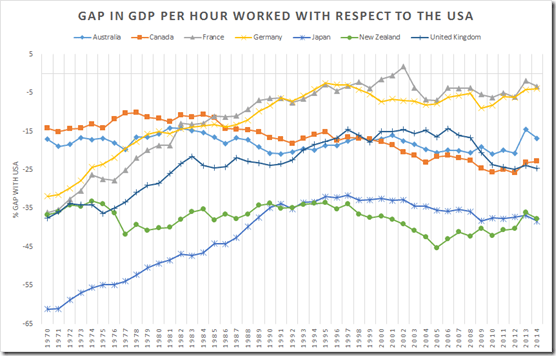
Data extracted on 28 May 2016 05:15 UTC (GMT) from OECD.Stat from OECD Compendium of Productivity Indicators 2016 – en – OECD.
Australia has not been catching up with the USA much at all since 1970. It has maintained a pretty consistent gap with New Zealand despite all the talk of a resource boom in the Australia; you cannot spot it in this date are here.
Germany and France caught up pretty much with the USA by 1990. Oddly, Eurosclerosis applied from then on terms of growth in income per capita.
European labour productivity data is hard to assess because their high taxes lead to a smaller services sector where the services can be do-it-yourself. This pumps up European labour productivity because of smaller sectors with low productivity growth.
 Utopia, you are standing in it!
Recent Comments