The #GlobalPOV Project: “Can Experts Solve Poverty?” With Khalid Kadir”
31 Aug 2016 Leave a comment
in constitutional political economy, development economics Tags: The fatal conceit
Doug Allen on same-sex divorce
30 Aug 2016 Leave a comment
in economics of love and marriage, law and economics Tags: child poverty, Doug Allen, family poverty, same-sex divorce, same-sex marriage, The fatal conceit, unintended consequences
Doug Allen argues that marriage is an institution designed and evolved to regulate incentive problems that arise between a man and a woman over the life cycle of procreation.
The real problem with same-sex marriage is same-sex divorce according to Allen. Marriage includes a set of exit provisions in terms of the possible grounds for divorce, rules for splitting property, alimony and child support rules, and custody rules. Allen also argues that:
- Many institutional rules within marriage are designed to restrict males from exploiting the specific investments women must make upfront in child bearing;
- Since same-sex marriages are not based as often on procreation, these restrictions are likely to be objected to and challenged in courts and legislatures;
- To the extent divorce laws are changed, they may hurt heterosexual marriages, and women in particular; and
- Given that same-sex relationships are often made up of two financially independent individuals, there will be litigation and political pressures for even easier divorce laws since the problem of financial dependency will be reduced.
Alterations in divorce laws to deal with issues of same-sex divorce necessarily apply to heterosexuals, and these new laws may not be optimal for heterosexuals, making marriage a more fragile institution for them. The actual outcomes of no-fault divorce laws, as an example, could hardly have been more different than what was expected and intended. The most obvious outcome was large increases in divorce rates.
No fault divorce laws influenced the rate at which women entered the workforce, the amount of hours worked in a week, the incidence of spousal abuse, the feminisation of poverty, and the age at which people married. No-fault divorce influenced a series of other laws related to spousal and child support, child custody, joint parenting, and the definition of marital property.
Marriage may provide a poor match for the incentive problems that arise in the relationships of gay and lesbian couples. Doug Allen is also of the view that putting all three relationships under the same law could lead to a sub-optimal law for all three types of marriages.
Allen in summary argues that marriage is an economically efficient institution moulded around the long-term interdependencies of child-rearing heterosexuals. He argues that homosexuals wishing to marry would be better served by a separate, gay-specific form of marriage.
I forgot to mention the second wives clubs which lobby for limits the length of time of alimony to the first wife. The British 2nd Wives club in their legal advice page starts with these points:
- Do you need to disclose your income or assets to an ex-wife?
- Should your income be taken into account when assessing child maintenance?
- Should child maintenance change when you and your husband have children of your own?
2nd wives clubs are natural allies for higher income gay divorcees wanting to pay less alimony. Nothing I have sent here is an argument against same-sex marriage willing as long as you are willing to live with the fact that it may have a few unintended consequences.
Where will land come from 4 @NZGreens housing plan? @GarethMP
05 Aug 2016 Leave a comment
in applied price theory, economics of regulation, politics - New Zealand, urban economics Tags: Auckland, housing affordability, land supply, New Zealand Greens, RMA, The fatal conceit, zoning
The Greens are at it again proposing to build 100,000 affordable houses without ever explaining where the additional new land will come from.

There would have to be an amendment to the proposed Auckland unitary plan to free up more land for there to be a net increase in the supply of land in Auckland.
Unless there is that such amendment, a government plan to build 100,000 affordable houses in Auckland and elsewhere will simply be competing for the same fixed supply of land. If the supply of land is constrained from expanding by much, the only thing that will happen is that the price will go up with more money chasing the same amount of land and housing.
The fatal conceit of do-gooders
02 Aug 2016 Leave a comment
in applied price theory Tags: Animal welfare, The fatal conceit

The iron law of prohibition
03 Jul 2016 Leave a comment
in economics of regulation, health economics Tags: alcohol regulation, black markets, economics of prohibition, economics of smoking, marijuana decriminalisation, offsetting behaviour, The fatal conceit, The pretense the knowledge
Adam Smith and the Follies of Central Planning
20 Jun 2016 Leave a comment
in Adam Smith, applied price theory, applied welfare economics, Austrian economics, comparative institutional analysis, constitutional political economy, development economics, history of economic thought, Public Choice Tags: central planning, The fatal conceit, The pretence to knowledge
Dr Mark Pennington – ‘Robust Political Economy’
20 May 2016 Leave a comment
in applied price theory, applied welfare economics, comparative institutional analysis, constitutional political economy, economics of media and culture, economics of regulation, entrepreneurship, environmental economics, industrial organisation, liberalism Tags: offsetting behaviour, The fatal conceit, The pretence to knowledge
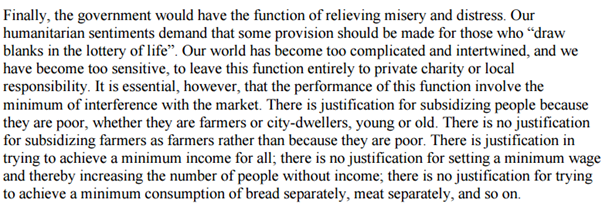
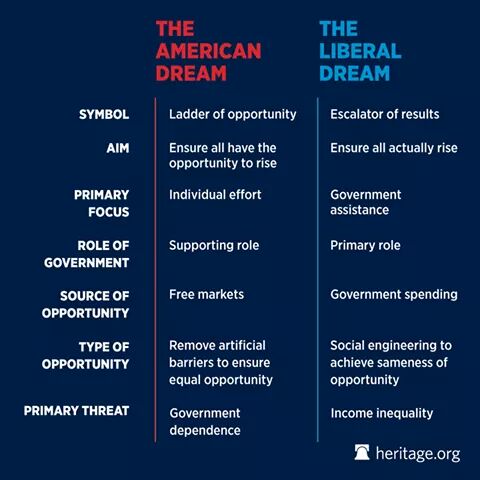
Milton Friedman on Neo-Liberalism and the welfare state
16 May 2016 Leave a comment
in liberalism, Milton Friedman Tags: neoliberalism, offsetting behaviour, social insurance, The fatal conceit, The pretense to knowledge, welfare state
Does invested $1 in retrofitting saves $6 in health expenditure? @PhilTwyford @PeterDunneMP @AndrewLittleMP
05 May 2016 Leave a comment
in economics of regulation, energy economics, health economics, politics - New Zealand, public economics Tags: cost benefit analysis, economics of housing, economics of insulation, energy efficiency gap, The fatal conceit, The pretense to knowledge, valuation of life
Various bold claims have been made about the payoff from investing more in retrofitting insulation into housing. The government recently spent $600 million on such retrofitting of insulation.
https://twitter.com/PhilTwyford/status/728137160113557505
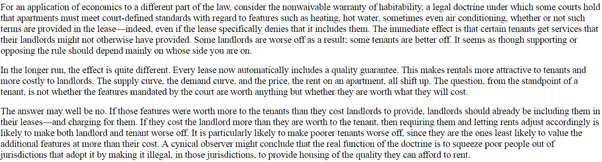
There is a private member’s bill before Parliament to introduce minimum standards for rental properties with regard to insulation and other matters. Little is by the Leader of the Opposition Andrew Little said for the consequences for rents of this additional expense to landlords.
Ian Harrison of Tail Risk Economics initially estimated that the $600 million invested in retrofitting of insulation will save barely half of that:
After correcting for this major error and taking a more realistic view of the benefit estimates in other studies, the net benefits of $630 million disappear.
The $600 million insulation investment will probably generate benefits of closer to $170 million, for an economic loss of $430 million.
After meeting with Ian, I read through the rather dull background documents behind a cost benefit analysis relied upon by the government to spend the $600 million dollars.
The most interesting part of the cost benefit analysis is most of the benefits come from fewer cardiovascular related hospitalisation of the elderly and not from respiratory diseases among children.
I found the error was far more fundamental than a incorrect transfer of a calculation between tables discussed in the first publication by Harrison. I had to read the background documents several times to understand what had been done wrong.
The cost benefit analysis for the Warm Up New Zealand Heat Smart Programme assumes that the number of elderly occupants of the newly insulated house increases by one each year and after 5 years, one of these dies but is replaced by a new elderly occupant.
We have modelled the probability of a vulnerable person avoiding mortality as a result of the intervention. The probability of this is (112.7/1000)*0.27= 0.03 (3%). We treat avoidance of mortality by treatment in each year as independent events.
The multi-year benefit calculated above would accrue based on the life years gained as a result of deaths avoided in year one.
However, we would expect these benefits to accrue in year two for different vulnerable individuals (aged 65 and over with a cardiovascular related hospitalisation in previous 18 months), and for different individuals again in every subsequent year that the treatment continues to have an effect, i.e. an on-going stream of benefits of $1,050.74 per year. This assumes a constant proportion of people aged 65+ who have recently been hospitalised with circulatory problems….( p.38).
In the first year of the new insulation, the first occupant benefits and the net present value is included in the benefit cost analysis calculation – the erroneous benefit cost analysis calculations which its authors still defend.
In the 2nd year, another elderly person moves into that same house and the same calculation is done for them. In the following year, yet another elderly person moves into the same house and the net present value calculation is repeated.
By the end of 5 years, there are 5 occupants in this house all benefiting from the same insulation investment. In the 6th year, the first elderly occupant dies to be replaced by a new elderly occupant who then gains from the insulation upgrade.
There was double counting of the number of people who benefited from the insulation as Iain Harrison explains
The analysis assumed that there was not one, but five occupants who had been hospitalised with a cardiovascular illness in the previous 18 months in each of the relevant insulated houses. There should have been only one such occupant.
The retrofitting of insulation was estimated to cost $600 million. Iain Harrison estimated the benefits to be $300 million, not $1.2 billion. That is a benefit cost ratio of 0.5.
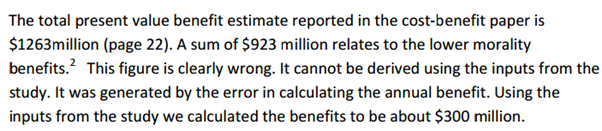
Source: Iain Harrison, The mortality reduction benefits of insulation: the error identified.
@jacindaardern @NZLabour’s Healthy Homes Bill will raise rents to poor tenants and students
05 May 2016 1 Comment
in David Friedman, economics of regulation, law and economics, politics - New Zealand Tags: avoiding difficult decisions, housing habitability laws, living standards, New Zealand Labour Party, offsetting, rent control, The fatal conceit, The pretense to knowledge, unintended consequences
Source: David Friedman, Chapter 1: What Does Economics Have to Do with Law?
Submission to Porirua City Council on proposed #livingwage
28 Apr 2016 Leave a comment
in labour economics, managerial economics, minimum wage, organisational economics, personnel economics Tags: expressive voting, living wage, local government, rational irrationality, The fatal conceit
A living wage at a local council will act as a hiring standard that stops low paid workers from being shortlisted for vacancies in the 129 council jobs affected by the proposed living wage increase.

The Council must hire on merit so only those who currently earn about $19 in other jobs will be shortlisted. That is the law. The Council must hire the best available applicant. The minimum wage workers who currently fill these minimum wage jobs simply could not cannot be lawfully shortlisted.
It is explicit in the living wage literature that a living wage improves the quality of applicants for future vacancies.
When a living wage job is advertised, more qualified applicants will apply. This will crowd-out the existing workers had who shortlisted for these Council jobs. They will have to apply for other minimum wage jobs but pay rates to fund council jobs they can never win.
There is no way around this because of the duty of the Council to hire on merit.
All future vacancies covered by the living wage increase will be filled by workers who are currently better paid than the existing applicants who won those jobs in the past.
Any employer who unilaterally introduces a living wage is simply raising their hiring standards saying they will not hire applicants who do not currently earn the equivalent of the living wage in their previous job.
A living wage will exclude low paid worker from council jobs in the future. I have attached a more detailed analysis of the economics of a living wage as proposed by the Wellington City Council.
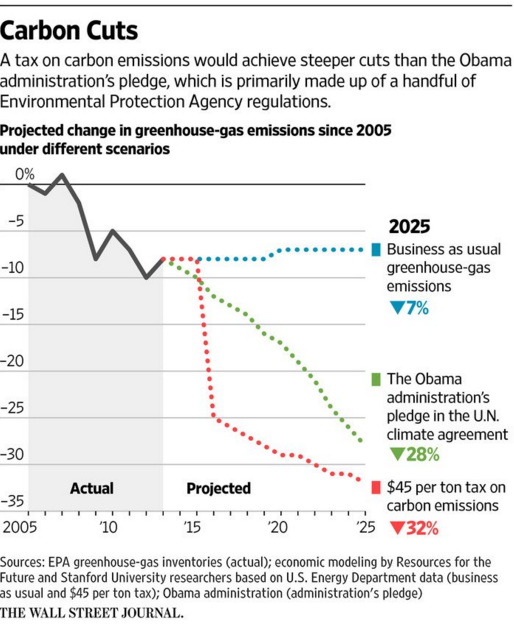
Why Private Investment Works & Govt. Investment Doesn’t
27 Apr 2016 1 Comment
in applied price theory, comparative institutional analysis, constitutional political economy, economic history, economics of media and culture, economics of regulation, industrial organisation, survivor principle Tags: industry policy, picking winners, The fatal conceit, The pretence to knowledge
What 3 skills do public policy analysts need?
27 Apr 2016 Leave a comment
in applied price theory, business cycles, economics of bureaucracy, economics of regulation, fiscal policy, macroeconomics, monetary economics Tags: anti-market bias, antiforeign bias, expressive voting, lags on monetary policy, makework bias, rational rationality, tax incidence, The fatal conceit, The pretense to knowledge
I used to argue that the quality of public policy making would double if public policy analysts remembered the first 6 weeks of microeconomics 101 but on reflection more than that is required.
Could we economists today ever show such self-restraint about our own expert recommendations? https://t.co/2UE12JuIgn—
William Easterly (@bill_easterly) November 24, 2015
I picked up my initial insight out when working as a graduate economist in the Australian Department of Finance. That was a few years ago.
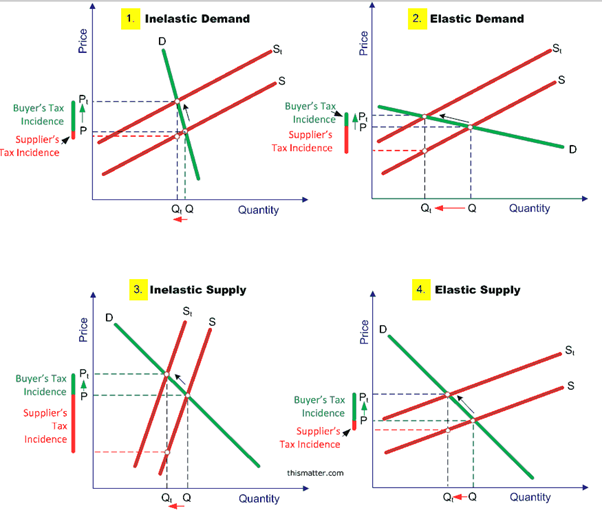
I am now concluded that policy analysts also need to know the basics of the economics of tax incidence. Who pays the tax depends on the elasticities of supply and demand rather than who writes the check to the taxman.
The number of times that I have read media and public policy analysis saying who pays the tax is the writer of the cheque to the taxman is beyond counting.
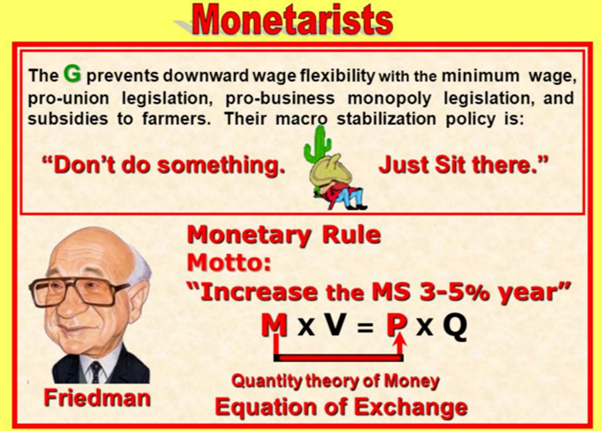
There is also what to do about unemployment and inflation. Do not just do something, sit there might be good advice on most occasions. As Tim Kehoe and Gonzalo Fernandez de Cordoba explain in the context of first do no harm:
Looking at the historical evidence, Kehoe and Prescott conclude that bad government policies are responsible for causing great depressions.
In particular, they hypothesize that, while different sorts of shocks can lead to ordinary business cycle downturns, overreaction by the government can prolong and deepen the downturn, turning it into a depression.
 Utopia, you are standing in it!
Recent Comments