Paul Samuelson’s repeated predictions of the Soviet Union economy catching up with the USA

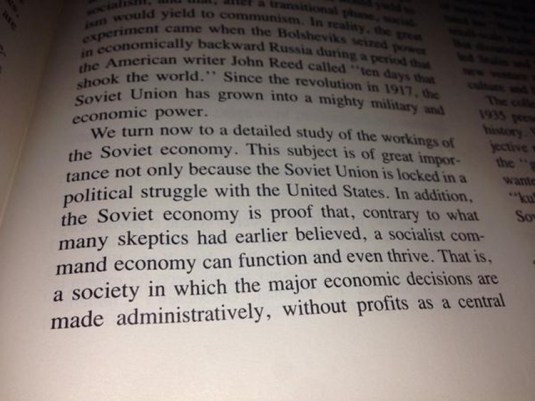
Paul Samuelson wrote in the 1961 edition of his famous economics textbook that GNP in the Soviet Union was about half that in the United States but the Soviet Union was growing faster.

Figure 1: Samuelson’s 1961 Forecast of Soviet catch up

Source:  Levy and Peart (2006)

As a result, Soviet GNP would exceed that of the United States by as early as 1984 or perhaps by as late as 1997, depending on whether you were reading the early 1960s or later editions of Samuelson’s immensely popular textbook. In the 1980 edition there was little change in the analysis, though the two dates were delayed to 2002 and 2012
Samuelson predicted that the Soviet Union would catch up with the United States and kept predicting this until 1989 in every edition of his textbook of which there are at least 14. Levy and Peart were good enough to tabulate these predictions by Samuelsson of Soviet catch up with the USA over the editions of his textbook in the table below.
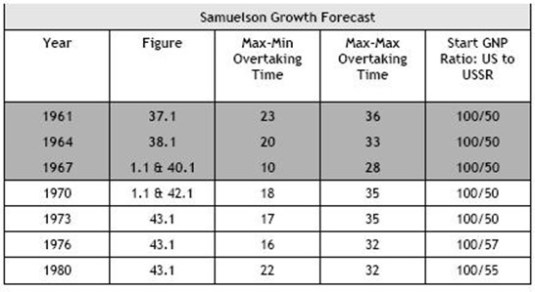
Source:  Levy and Peart (2009)

Samuelson’s predictions of the Soviet Union catching up to and overtaking the United States were echoed in most other major economics textbooks of his time.

Plainly, they all got it wrong except for the Austrian economists, Eastern bloc émigrés and G. Warren Nutter.

From 1956 to 1961, Nutter undertook a massive study of the history of the economy of the Soviet Union and published The Growth of Industrial Production in the Soviet Union in 1962.

Nutter’s study concluded that Soviet economic growth over the first half of the 20th Century was indeed remarkable, and that there had been periods of growth spurts, but when the entire Soviet period was taken into consideration, Soviet growth lagged behind Western economies and Soviet economic capacity showed every sign of falling further behind rather than catching up with the West.

Nutter’s conclusions were certainly not welcomed by the Sovietologists of his time. As the fall of the Soviet Union revealed more realistic data, Nutter’s estimates of Soviet growth rates have been vindicated, and in fact, if anything Nutter overstated rather than understated Soviet economic performance.

Paul Craig Roberts found worse exaggeration with the Romanian economy in 1979. A World Bank report, Romania: The Industrialization of an Agrarian Economy under Socialist Planning, credited central planning with achieving a 9.8 annual rate of economic growth over the quarter century from 1950 to 1975. It should be added that in the 1970s, Romania was a western favourite because of its independent stance within the Eastern European bloc.

The World Bank did not realize that using these growth rates to project backward these growth figures on Romanian income per capita quickly produced a figure too low to sustain life. This mistake provoked the Wall Street Journal observation:

We have heard exaggerated claims made for central economic planning, but never that it resurrected a whole nation from the dead.

Samuelson never reflected in his later textbooks after 1989 about how wrong he was for many decades about Soviet economic performance. Few people, thank you for admitting that there you’re wrong – they are more likely to dance on the grave of your error.

In Paul Samuelson’s case, he had more reasons of most to learn from his failed predictions because as his predictions didn’t work out, he had to rewrite and update his book and charts predicting the USSR was going to overtake the USA in about 20 years.

Rather than the suspect that there something wrong with the Soviet economic system, Paul Samuelson looked for excuses – increasingly pathetic excuses. As Larry White explained:

In the seven editions of his textbook published from 1961 to 1980, Samuelson kept including a chart indicating that Soviet output was growing faster that U.S. output, and predicting a catch-up in about twenty-five years.  He repeatedly had to move the predicted catch-up date forward from the previous edition because the gap had never actually begun to close.  In several editions he blamed low realized Soviet growth on bad weather.

What is more puzzling is Samuelson did update his views on the merits of fiscal and monetary policy in stabilising the economy, and the effectiveness of each over the decades in light of experience and between the 1960s and 1980s. In the 1948 edition of his best-selling textbook, Economics, Samuelson wrote that:

few economists regard Federal Reserve monetary policy as a panacea for controlling the business cycle.

In 1967 Samuelson said that monetary policy had “an important influence” on total spending. His 1985 edition states;

“Money is the most powerful and useful tool that macroeconomic policymakers have,” adding that the Fed “is the most important factor” in making policy.

Samuelson’s 1967 edition said policymakers faced a trade-off between inflation and unemployment. His 1980 edition said there was less of a trade-off in the long run than in the short run. The 1985 edition, he said there is no long-run trade-off between unemployment and inflation.

Samuelson gave quite compelling reasons as to why Keynesianism declined:

  1. Keynesian macroeconomists and policymakers made the mistake of projecting the experience of the Great Depression onto the post-war era;
  2. it turned out that, contrary to what Keynes had said, monetary policy mattered a lot; and
  3. The final blow to Keynesianism was stagflation: There is nothing in Keynesian macroeconomics that would allow you to solve stagflation.

Samuelson did not learn in the same way from brute experience regarding the economics of socialism.

Via Why Were American Econ Textbooks So Pro-Soviet? Bryan Caplan | EconLog | Library of Economics and Liberty and Soviet Growth & American Textbooks.

Thomas D. Willett on the power of back of the envelope economics

Image

Offsetting behaviour alert: only fools and politicians would believe that a minimum wage increase increases net pay and conditions

John Schmitt  lists 11 margins along which a minimum wage might cause changes in net pay and conditions:

  1. Reduction in hours worked (because firms faced with a higher minimum wage trim back on the hours they want),
  2. Reduction in non-wage benefits (to offset the higher costs of the minimum wage),
  3. Reduction in money spent on training (again, to offset the higher costs of the minimum wage),
  4. Change in composition of the workforce (that is, hiring additional workers with middle or higher skill levels, and fewer of those minimum wage workers with lower skill levels),
  5. Higher prices (passing the cost of the higher minimum wage on to consumers),
  6. Improvements in efficient use of labour (in a model where employers are not always at the peak level of efficiency, a higher cost of labour might give them a push to be more efficient),
  7. “Efficiency wage” responses from workers (when workers are paid more, they have a greater incentive to keep their jobs, and thus may work harder and shirk less),
  8. Wage compression (minimum wage workers get more, but those above them on the wage scale may not get as much as they otherwise would),
  9. Reduction in profits (higher costs of minimum wage workers reduces profits),
  10. Increase in demand (a higher minimum wage boosts buying power in overall economy), and
  11. Reduced turnover (a higher minimum wage makes a stronger bond between employer and workers, and gives employers more reason to train and hold on to worker.

Richard McKenzie argues that the biggest impact  of a minimum wage increase is reductions to paid and unpaid benefits for minimum wage workers, including  health insurance, store discounts, free food, flexible scheduling, and job security resulting from higher-skilled workers drawn to the higher minimum wage jobs:

  • Masanori Hashimoto found that under the 1967 minimum-wage hike, workers gained 32 cents in money income but lost 41 cents per hour in training—a net loss of 9 cents an hour in full-income compensation.
  • Other researchers in independently completed studies found more evidence that a hike in the minimum wage undercuts on-the-job training and undermines covered workers’ long-term income growth.
  • Wessels found that the minimum wage caused retail establishments in New York to increase work demands by cutting back on the number of workers and giving workers fewer hours to do the same work.
  • Fleisher, Dunn, and Alpert found that minimum-wage increases lead to large reductions in fringe benefits and to worsening working conditions.
  • Marks found that workers covered by the federal minimum-wage law were also more likely to work part time, given that part-time workers can be excluded from employer-provided health insurance plans.

McKenzie also argued that if the minimum wage does not cause employers to make substantial reductions in fringe benefits and increases in work demands, then an increased minimum should cause

(1) An increase in the labour-force-participation rates of covered workers (because workers would be moving up their supply of labour curves),

(2) A reduction in the rate at which covered workers quit their jobs (because their jobs would then be more attractive), and

(3) A significant increase in prices of production processes heavily dependent on covered minimum-wage workers.

Wessels found that minimum-wage increases had exactly the opposite effect as intended: labour force participation rates went down; job quit rates went up, and prices did not rise appreciably.

These are findings by Wessels are consistent only with the view that minimum-wage increases make workers worse off, rather than better off in terms of net pay and conditions. After the minimum wage increase, the net advantages and disadvantages of menial jobs are less than before. Fewer workers enter the workforce and more quit their jobs.

McKenzie was the first economist to argue that a minimum wage increase may actually reduce the labour supply of menial workers. Employment in menial jobs may go down slightly in the face of minimum-wage increases not so much because the employers don’t want to offer the jobs, but because fewer workers want these menial jobs that are offered.

The repackaging of monetary and non-monetary benefits, greater work intensities and fewer training opportunities make these jobs less attractive relative to their other options. This reduction in labour supply by low skilled workers is why the voluntary quit rate among low-wage workers goes up, not down, after a minimum wage increase. As McKenzie explains

Economists almost uniformly argue that minimum wage laws benefit some workers at the expense of other workers.

This argument is implicitly founded on the assumption that money wages are the only form of labour compensation. Based on the more realistic assumption that labour is paid in many different ways, the analysis of this paper demonstrates that all labourers within a perfectly competitive labour market are adversely affected by minimum wages.

Although employment opportunities are reduced by such laws, affected labour markets clear. Conventional analysis of the effect of minimum wages on monopsony markets is also upset by the model developed.

McKenzie argues that not accounting for offsetting behaviour led to a fundamental misinterpretation in the empirical literature on the minimum wage. That literature shows that small increases in the minimum wages does not seem to affect employment and unemployment by that much.

…. wage income is not the only form of compensation with which employers pay their workers. Also in the mix are fringe benefits, relaxed work demands, workplace ambiance, respect, schedule flexibility, job security and hours of work.

Employers compete with one another to reduce their labour costs for unskilled workers, while unskilled workers compete for the available unskilled jobs — with an eye on the total value of the compensation package.

With a minimum-wage increase, employers will move to cut labour costs by reducing fringe benefits and increasing work demands

Proponents and opponents of minimum-wage hikes do not seem to realize that the tiny employment effects consistently found across numerous studies provide the strongest evidence available that increases in the minimum wage have been largely neutralized by cost savings on fringe benefits and increased work demands and the cost savings from the more obscure and hard-to-measure cuts in nonmoney compensation.

McKenzie is correct in arguing that the empirical literature on the minimum wage is dewy-eyed. The first assumption about any regulation is the market will offset it significantly.

In the course of undoing the direct effects of the regulation, there will be unintended consequences such as the remixing of wage and nonwage components of remuneration packages of low skilled workers covered by the minimum wage. Greg Mankiw concludes that:

The minimum wage has its greatest impact on the market for teenage labour. The equilibrium wages of teenagers are low because teenagers are among the least skilled and least experienced members of the labour force.

In addition, teenagers are often willing to accept a lower wage in exchange for on-the-job training. . . . As a result, the minimum wage is more often binding for teenagers than for other members of the labour force.

Eric Hoffer on intellectuals

Image

Jack Hirshleifer on why the dismal science

Image

Murray Rothbard on the pretence to knowledge of environmentalists and conservationists

Image

Hayek on the fatal conceit of conservationists

Image

Mises on politics, politicians and the reforming zeal

Image

Housing habitability laws

Minimum standards for rental housing is back in the news in New Zealand. After some deaths in some rather nasty fires in rental houses without fire alarms, there are demands that landlords must put fire alarms in place and maintain those fire alarms. About a dozen people or so die in fires in New Zealand every year.

The fact that in the proposed regulation, landlords are also required to maintain those fire alarms – ensure they have batteries in them – is a microcosm of the economics of rental housing habitability laws.

Even when landlords put in fire alarms, low income tenants prefer to spend their money on something other than replacement batteries for those alarms. These tenants are presumed to be competent to vote and drive cars, but not manage the risk of fires in the houses in which they live.

Maybe the reason for the lack of interest of low income tenants in putting batteries and fire alarms is domestic household fires are relatively rare these days. Fire is buried in the green area of the diagram below and is similar to drowning and falls.

The American data below suggests that your chances of dying by fire are about the same as dying from choking and a little worse from dying from post surgery complications.

Rather than in need of nudging, your average low income tenants seems to have it pretty right regarding the risks of dying in a fire.

When I went looking for some economics of housing habitability laws, Google was a bit of a disappointment. There are some empirical work done in the 1970s and early 1980s and then it fell away.

My suspicion is there is not so much empirical work on the economics of housing habitability laws because proving the obvious is not a good investment in Ph.D. topics or tenure track economic research.

Walter Block wrote an excellent defence of slumlords in his 1971 book Defending the Undefendable:

The owner of ghetto housing differs little from any other purveyor of low-cost merchandise. In fact, he is no different from any purveyor of any kind of merchandise. They all charge as much as they can.

First consider the purveyors of cheap, inferior, and second-hand merchandise as a class. One thing above all else stands out about merchandise they buy and sell: it is cheaply built, inferior in quality, or second-hand.

A rational person would not expect high quality, exquisite workmanship, or superior new merchandise at bargain rate prices; he would not feel outraged and cheated if bargain rate merchandise proved to have only bargain rate qualities.

Our expectations from margarine are not those of butter. We are satisfied with lesser qualities from a used car than from a new car. However, when it comes to housing, especially in the urban setting, people expect, even insist upon, quality housing at bargain prices.

Richard Posner discussed housing habitability laws in his Economic Analysis of the Law. The subsection was titled wealth distribution through liability rules. Posner concluded that habitability laws will lead to abandonment of rental property by landlords and increased rents for poor tenants.

posner habitability

What do-gooder would want to know that a warranty of habitability for rental housing will lead to scarcer, more expensive housing for the poor! Surprisingly few interventions in the housing market work to the advantage of the poor.

Certainly, there will be less rental housing of a habitability standard below that demanded by do-gooders. In the Encyclopaedia of Law and Economics entry on renting, Werner Hirsch said:

It would be a mistake, however, to look upon a decline in substandard rental housing as an unmitigated gain. In fact, in the absence of substandard housing, options for indigent tenants are reduced. Some tenants are likely to end up in over-crowded standard units, or even homeless.

If you’re so smart, why aren’t you rich: Deirdre McCloskey on economists as forecasters

Image

How to argue against the minimum wage when genuinely trying to argue for it – OECD edition

The 2014 OECD employment outlook argued for modest minimum wage increases while at the same time setting out all the steps necessary to manage the unintended consequences of minimum wage regulation:

Mandatory minimum wages, which now exist – or are being implemented – in 26 OECD countries and a number of emerging economies, can help underpin the wages of low-paid workers.

Evidence suggests that, when set at an appropriate level, minimum wages tend to have only a small adverse effect on employment.

Sensible minimum-wage design includes: taking account of differences by region according to the average income level, as well as by age in experience and productivity; ensuring that the level and adjustments of the minimum wage involve independent commissions; and reducing social security contributions to lower non-wage labour costs at the minimum wage (Emphasis mine).

George Stigler made very similar criticisms of the impracticality of a single minimum wage in 1946:

If an employer has a significant degree of control over the wage rate he pays for a given quality of labour, a skilfully-set minimum wage may increase his employment and wage rate and, because the wage is brought closer to the value of the marginal product, at the same time increase aggregate output…

This arithmetic is quite valid but it is not very relevant to the question of a national minimum wage. The minimum wage which achieves these desirable ends has several requisites:

1. It must be chosen correctly… the optimum minimum wage can be set only if the demand and supply schedules are known over a considerable range…

2. The optimum wage varies with occupation (and, within an occupation, with the quality of worker).

3. The optimum wage varies among firms (and plants).

4. The optimum wage varies, often rapidly, through time.

A uniform national minimum wage, infrequently changed, is wholly unsuited to these diversities of conditions

Modest minimum wage increases must varying in their modesty by individual worker quality,  occupation, region, firm and plant and the extent to which this modesty can be excessively immodest can change rapidly through time. Little wonder that the OECD refers to minimum wage regulation as a careful balancing act.

In sum, to avoid throwing a good number of low paid, low skilled workers onto the scrapheap of society for the sake of their more employable co-workers, the minimum wage pretty much be set separately for each individual worker. The labour market does that now.

Must R&D be sacrosanct – beyond question?

Image

The reversing gender gap: why women choose not to be scientists, engineers and IT professionals

Concerns about the lack of women undertaking careers in science and engineering are based on one simple false premise: that science and engineering are the most prestigious choices available to women with great ability in maths and science at high school.

If relatively more prestigious career options are open to women who also happen to qualify for science and engineering, women will be underrepresented in science and engineering simply because they have better career options than the men who become scientists and engineers.

In New Zealand, just as many women as men qualify for science and engineering and the IT degrees. Not as many women who have qualified take up this option simply because they also qualify for medicine and law in greater numbers than the men who happen to qualify for science, engineering and IT degrees.

In the United States, the Association for Psychological Science found that:

Women may be less likely to pursue careers in science and math because they have more career choices, not because they have less ability, according to a new study published in Psychological Science.

Although the gender gap in mathematics has narrowed in recent decades, with more females enrolling and performing well in math classes, females are still less likely to pursue careers in science, technology, engineering, and mathematics (STEM) than their male peers.

Researchers tend to agree that differences in math ability can’t account for the underrepresentation of women in STEM fields. So what does?

Developmental psychologist Ming-Te Wang and his colleagues at the University of Pittsburgh and University of Michigan wondered whether differences in overall patterns of math and verbal ability might play a role.

The researchers examined data from 1490 college-bound US students drawn from a national longitudinal study. The students were surveyed in 12th grade and again when they were 33 years old. The survey included data on several factors, including participants’ SAT scores, various aspects of their motivational beliefs and values, and their occupations at age 33.

Looking at students who showed high math abilities, Wang and colleagues found that those students who also had high verbal abilities — a group that contained more women than men — were less likely to have chosen a STEM occupation than those who had moderate verbal abilities.

This outcome is no surprise for those familiar with the gap between men and women in verbal and reading abilities – a gap that is strongly in favour of women

The OECD PISA tests at the age of 15 find that teenage boys have a slight advantage in maths  – a few percentage points – teenage girls have a serious advantage in reading.

The OECD PISA tests at the age of 15 find that this superior verbal and reading abilities of teenage girls the equivalent of six months extra schooling. One half year’s education goes a long way towards explaining many wage gaps by gender,ethnicity in race. This six-month edge in schooling is a serious advantage when qualifying for university.

Young women choose to not pursue science, engineering and IT careers because there are other career options that allow them to use their superior verbal and reading abilities – other careers is that allow them to be more successful in life than being a scientist, an engineer or an IT geek. As the Association for Psychological Science explains in the same press release cited above:

Our study shows that it’s not lack of ability or differences in ability that orients females to pursue non-STEM careers, it’s the greater likelihood that females with high math ability also have high verbal ability,” notes Wang. “Because they’re good at both, they can consider a wide range of occupations.

To put it bluntly, science, engineering and IT degrees are for young people who lack the verbal and reading abilities to get into medicine and law. Science, engineering and IT good degrees are for those who can’t get into medicine and law. They could have been contenders if they were more articulate and well-read.

There is a gender disparity in science, engineering and IT because teenage girls find these degrees to be inferior choices – inferior choices given the set of abilities they have when considering their career options.

HT: Mark J. Perry

Are boffins in lab coats bit players in the game of innovation?

Image

The real reason why behavioural economics is so popular among politicians and bureaucrats

\

HT: David-k-Levine

Previous Older Entries Next Newer Entries

Bassett, Brash & Hide

Celebrating humanity's flourishing through the spread of capitalism and the rule of law

Truth on the Market

Scholarly commentary on law, economics, and more

The Undercover Historian

Beatrice Cherrier's blog

Matua Kahurangi

Celebrating humanity's flourishing through the spread of capitalism and the rule of law

Temple of Sociology

Celebrating humanity's flourishing through the spread of capitalism and the rule of law

Velvet Glove, Iron Fist

Celebrating humanity's flourishing through the spread of capitalism and the rule of law

Why Evolution Is True

Why Evolution is True is a blog written by Jerry Coyne, centered on evolution and biology but also dealing with diverse topics like politics, culture, and cats.

Down to Earth Kiwi

Celebrating humanity's flourishing through the spread of capitalism and the rule of law

NoTricksZone

Celebrating humanity's flourishing through the spread of capitalism and the rule of law

Homepaddock

A rural perspective with a blue tint by Ele Ludemann

Kiwiblog

DPF's Kiwiblog - Fomenting Happy Mischief since 2003

The Dangerous Economist

Celebrating humanity's flourishing through the spread of capitalism and the rule of law

Watts Up With That?

The world's most viewed site on global warming and climate change

The Logical Place

Tim Harding's writings on rationality, informal logic and skepticism

Doc's Books

A window into Doc Freiberger's library

The Risk-Monger

Let's examine hard decisions!

Uneasy Money

Commentary on monetary policy in the spirit of R. G. Hawtrey

Barrie Saunders

Thoughts on public policy and the media

Liberty Scott

Celebrating humanity's flourishing through the spread of capitalism and the rule of law

Point of Order

Politics and the economy

James Bowden's Blog

A blog (primarily) on Canadian and Commonwealth political history and institutions

Science Matters

Reading between the lines, and underneath the hype.

Peter Winsley

Economics, and such stuff as dreams are made on

A Venerable Puzzle

"The British constitution has always been puzzling, and always will be." --Queen Elizabeth II

The Antiplanner

Celebrating humanity's flourishing through the spread of capitalism and the rule of law

Bet On It

Celebrating humanity's flourishing through the spread of capitalism and the rule of law

History of Sorts

WORLD WAR II, MUSIC, HISTORY, HOLOCAUST

Roger Pielke Jr.

Undisciplined scholar, recovering academic

Offsetting Behaviour

Celebrating humanity's flourishing through the spread of capitalism and the rule of law

JONATHAN TURLEY

Res ipsa loquitur - The thing itself speaks

Conversable Economist

Celebrating humanity's flourishing through the spread of capitalism and the rule of law

The Victorian Commons

Researching the House of Commons, 1832-1868

The History of Parliament

Articles and research from the History of Parliament Trust

Books & Boots

Reflections on books and art

Legal History Miscellany

Posts on the History of Law, Crime, and Justice

Sex, Drugs and Economics

Celebrating humanity's flourishing through the spread of capitalism and the rule of law

European Royal History

Exploring the Monarchs of Europe

Tallbloke's Talkshop

Cutting edge science you can dice with

Marginal REVOLUTION

Small Steps Toward A Much Better World

NOT A LOT OF PEOPLE KNOW THAT

“We do not believe any group of men adequate enough or wise enough to operate without scrutiny or without criticism. We know that the only way to avoid error is to detect it, that the only way to detect it is to be free to inquire. We know that in secrecy error undetected will flourish and subvert”. - J Robert Oppenheimer.

STOP THESE THINGS

The truth about the great wind power fraud - we're not here to debate the wind industry, we're here to destroy it.

Lindsay Mitchell

Celebrating humanity's flourishing through the spread of capitalism and the rule of law

Alt-M

Celebrating humanity's flourishing through the spread of capitalism and the rule of law

croaking cassandra

Economics, public policy, monetary policy, financial regulation, with a New Zealand perspective

The Grumpy Economist

Celebrating humanity's flourishing through the spread of capitalism and the rule of law

International Liberty

Restraining Government in America and Around the World