The Rise and Fall of the Chinese Economy
16 May 2016 Leave a comment
in constitutional political economy, development economics, economics of media and culture, growth disasters, growth miracles Tags: China, The Great Escape
Giving birth in Australia was seriously dangerous until the mid-20th century
14 May 2016 Leave a comment
in economic history, gender, health economics, labour economics, labour supply Tags: maternal health, maternal labour force participation, The Great Escape
Medical progress contributed more than people realise to women’s liberation. The key area of progress was far fewer deaths in childbirth as the chart below for Australia shows. Deaths from childbirth disappeared from mortality statistics in the 1940s and 1950s.
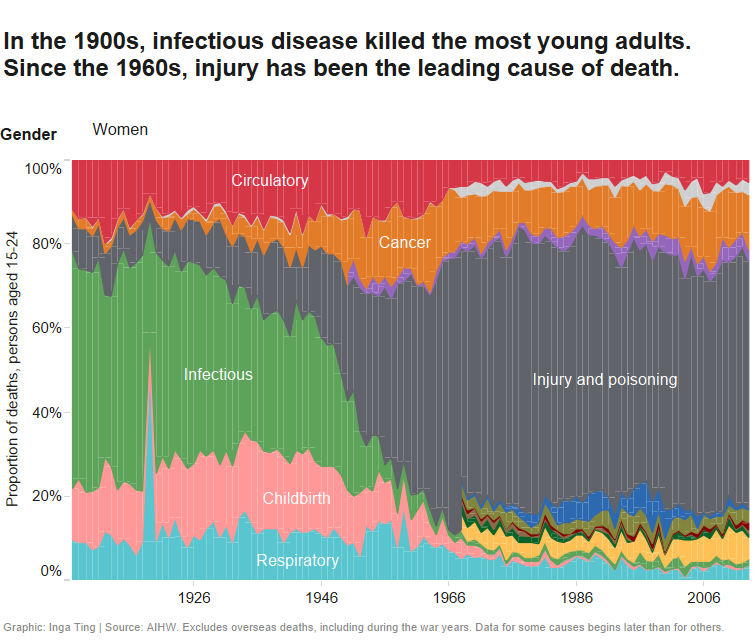
Source: Australian Institute of Health and Welfare via Sydney Morning Herald This chart shows how you will probably die, and it’s changed a lot in 100 years.
The next key area of medical progress was fewer disabling injuries subsequent because of childbirth that kept women out of the workforce for several years if not permanently. In Gender Roles and Medical Progress, Stefania Albanesi and Claudia Olivetti say
Consider a typical woman born around 1900. She married at 21 and gave birth to more than three live children between age 23 and 33. The high fetal mortality rate implied an even greater number of pregnancies, so that she would be pregnant for 36% of this time.
Health risks in connection to pregnancy and childbirth were severe. Septicemia, toxaemia, hemorrhages and obstructed labour could lead to prolonged physical disability and, in the extreme, death. In 1920 one mother died for each 125 living births. At a rate of 3.6 pregnancies per woman, the compounded risk of death from maternal causes was 2.9%.
For every death, twenty times as many mothers were estimated to suffer different degrees of disablement annually. Many maternal conditions had very long lasting or chronic effects on health, hindering women’s ability to work beyond their childbearing years.
Death in childbirth and serious complications from childbirth been forgotten in modern memory. So much so that there can be an entire year in New Zealand when no child nor mother dies in childbirth. When that does happen, there is a coroner’s enquiry.
The implications of medical progress around childbirth for female life expectancy has been equally forgotten as Albanesi and Olivetti explain
The development of bacteriology, the introduction of sulfominydes and antibiotics, and the diffusion of blood banks dramatically decreased the death rate from sepsis and hemorrhage. More specific interventions, such as the standardization of obstetric practices and the increased availability of pre-natal care, reduced the incidence of hypertensive disorders of pregnancy and obstructed labour, a causal factor for many forms of post-partum disability.
These developments lead to a stark decline in maternal mortality and a rise in the female-male differential in life expectancy at age 20 from 1.5 years in 1920 to 6 years in 1960.
At the beginning of the last century, the burden of childbirth and breastfeeding simply made it impossible for married women to work in any significant number as Albanesi and Olivetti explain
In addition, due to the lack of reliable alternatives, most infants were exclusively breast fed. Women would then be nursing for approximately a third of the time between age 23 and 33.
Since the average time required to feed one child ranges between 14 and 17 hours per week, with a 40 hour workweek, mothers would be nursing for 35%-43% of their potential working time in childbearing years.
Not surprisingly given this burden, few married women worked. Only 5.4% of married women aged 25 to 34 were in the labour force in 1900.
There was an extraordinary reduction in the number of years lost in disablement after childbirth in the early and mid-20th century as Albanese in Olivetti’s explain
…the years lost to disabilities associated with maternal conditions declined from 2.31 per pregnancy in 1920 to just 0.17 in 1960.
Medical progress around childbirth is the most important force driving the rise in the participation of married women during childbearing years and post-childbearing between 1935 and 1965. The health burden of giving birth is now measured in weeks rather than years.
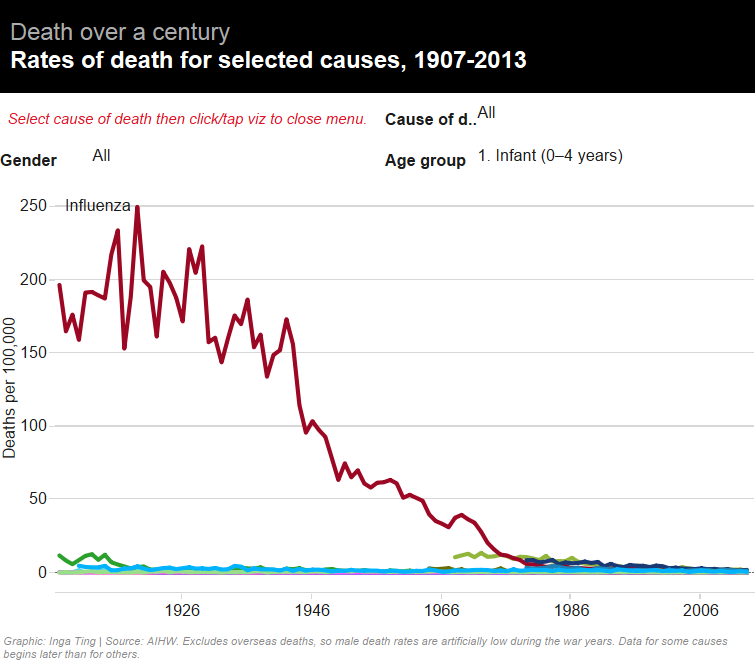
Basic Facts of Growth and Development
12 May 2016 Leave a comment
in applied welfare economics, development economics, economic history, economics of media and culture, growth disasters, growth miracles Tags: The Great Enrichment, The Great Escape, The Great Fact
In 1900, 25% died before age 20.
10 May 2016 Leave a comment
in economic history, health economics Tags: child mortality, good old days, infant mortality, living standards, The Great Escape
Tyler Cowen on Peter Bauer
03 May 2016 Leave a comment
in development economics, economics, growth disasters, growth miracles, P.T. Bauer Tags: The Great Escape
What role socialism in The Great Escape? @BernieSanders @JeremyCorbyn @JohnMcDonnellMP #feelthebern
26 Apr 2016 Leave a comment
in applied price theory, development economics, economic history, growth disasters, growth miracles, Public Choice, rentseeking Tags: anti-market bias, economics of socialism, rational irrationality, The Great Escape, The Great Fact
A new World Bank study shows the dramatic reductions in global poverty and inequality as a result of the spread of market institutions and freer trade.

Source: Capitalism, Global Trade, and the Reduction in Poverty and Inequality | Cato @ Liberty
Freedom as a solution to poverty @Oxfam
24 Apr 2016 Leave a comment
in Austrian economics, comparative institutional analysis, constitutional political economy, development economics, economic history, economics of media and culture, growth miracles Tags: Bill Easterly, The Great Escape, The pretence to knowledge
18.1% of all children born on this planet in 1960 died before they could celebrate their fifth birthday
18 Apr 2016 Leave a comment
in development economics, economic history, health economics Tags: infant mortality, The Great Escape
The future should sue today’s climate activists for slowing The Great Escape
16 Apr 2016 Leave a comment
in development economics, economic history, economics of media and culture, energy economics, environmental economics, global warming, growth miracles, law and economics Tags: climate activists, climate alarmism, extreme poverty, The Great Enrichment, The Great Escape, vexatious litigation

@CFigueres seriously mistaken on carbon emissions and global poverty
13 Apr 2016 Leave a comment
in applied welfare economics, development economics, economic history, energy economics, environmental economics, global warming, growth disasters, growth miracles, Public Choice, rentseeking Tags: climate alarmism, extreme poverty, global poverty, The Great Escape
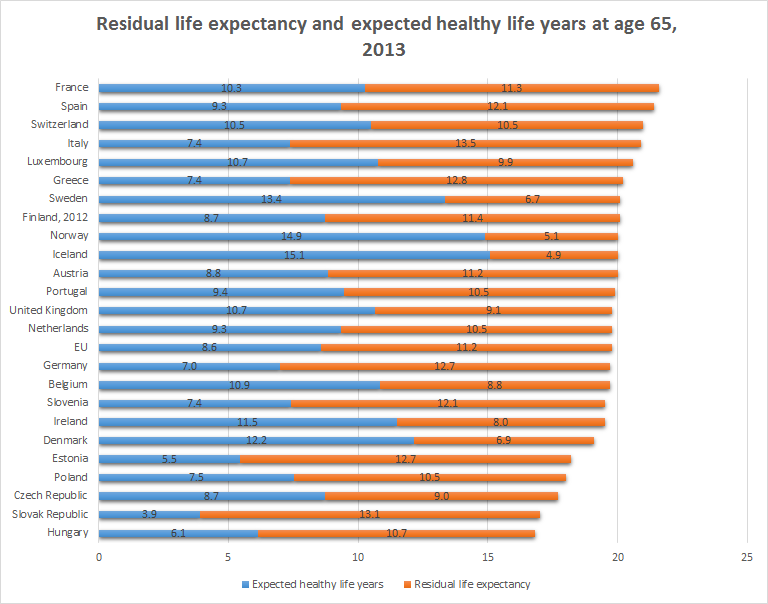
How long have you got in Europe when you are waiting for God?
13 Apr 2016 Leave a comment
in health economics Tags: European Union, healthy life expectancies, life expectancies, The Great Escape
Healthcare Triage: Antibiotics and Resistance | The Incidental Economist
12 Apr 2016 Leave a comment
in economic history, health economics Tags: The Great Escape
A century ago, the top three causes of death were infectious diseases. More than half of all people dying in the United States died because of germs.
Source: Healthcare Triage: Antibiotics and Resistance | The Incidental Economist
 Utopia, you are standing in it!
Recent Comments