What Do the Newly Released Poverty Figures Show?
20 Nov 2015 Leave a comment
in development economics, economic history, growth disasters, growth miracles Tags: extreme poverty, The Great Escape, World Bank
The global population by income
18 Nov 2015 Leave a comment
in development economics, economic history, growth miracles Tags: extreme poverty, global poverty, The Great Escape, The Great Fact
Deirdre McCloskey on Piketty, the Bourgeoisie Deal, the Bolshevik Deal, and the Bridal Deal
17 Nov 2015 Leave a comment
in applied price theory, applied welfare economics, comparative institutional analysis, constitutional political economy, development economics, economic history, economics of bureaucracy, growth disasters, growth miracles, Public Choice Tags: bourgeoisie deal, capitalism and freedom, Deirdre McCloskey, industrial revolution, The Great Enrichment, The Great Escape, The Great Fact, Thomas Piketty

.
@HelenClarkUNDP @OxfamGB @GreenpeaceUSA support energy poverty in Africa
14 Nov 2015 1 Comment
in development economics, energy economics, environmental economics, growth disasters, growth miracles Tags: Africa, child poverty, energy poverty, extreme hunger, extreme poverty, global hunger, Greenpeace, Oxfam, The Great Escape
Too many hippies study biology
12 Nov 2015 Leave a comment
in applied price theory, economic history, economics of media and culture, liberalism, movies Tags: agricultural economics, back to nature, expressive boating, hippies, Left-wing hypocrisy, Leftover Left Twitter left, The Great Enrichment, The Great Escape, The Great Fact
Facts about People Who Enjoy Eating Tasty Animals (PEETA)
10 Nov 2015 Leave a comment
in development economics, health economics Tags: economics of physiology, The Great Escape, The Great Fact, vagans, vegetarians

The Great Fact in 2 charts
10 Nov 2015 Leave a comment
in applied welfare economics, development economics, economic history, growth disasters, growth miracles Tags: China, India, The Great Escape, The Great Fact
Robert Lucas on income redistribution and economic growth
05 Nov 2015 Leave a comment
in development economics, growth disasters, growth miracles, macroeconomics, Robert E. Lucas Tags: capitalism and freedom, industrial revolution, The Great Enrichment, The Great Escape, The Great Fact

The Great Escape in European life expectancies
02 Nov 2015 Leave a comment
in economic history Tags: life expectancies, The Great Escape
Trends in life expectancy for Western European countries. Scotland in red. 😦 (From: sciencedirect.com/science/articl…) http://t.co/IEEyQdG9E1—
Stuart Ritchie (@StuartJRitchie) October 19, 2015
@Oxfam fewer people living in absolute poverty today than in 1820
29 Oct 2015 Leave a comment
in economic history Tags: capitalism and freedom, extreme poverty, industrial revolution, Leftover Left, The Great Enrichment, The Great Escape, The Great Fact, Twitter left
There are fewer people living in absolute poverty today than there were in 1820. buff.ly/1OlOpX3 #progress http://t.co/LfC8I5gEE9—
HumanProgress.org (@humanprogress) October 07, 2015
The Great Escape and #vegetarianism
25 Oct 2015 Leave a comment
in development economics, economic history, environmental economics, growth miracles, health economics, Public Choice, rentseeking Tags: expressive politics, The Great Enrichment, The Great Escape, The Great Fact, vegetarianism
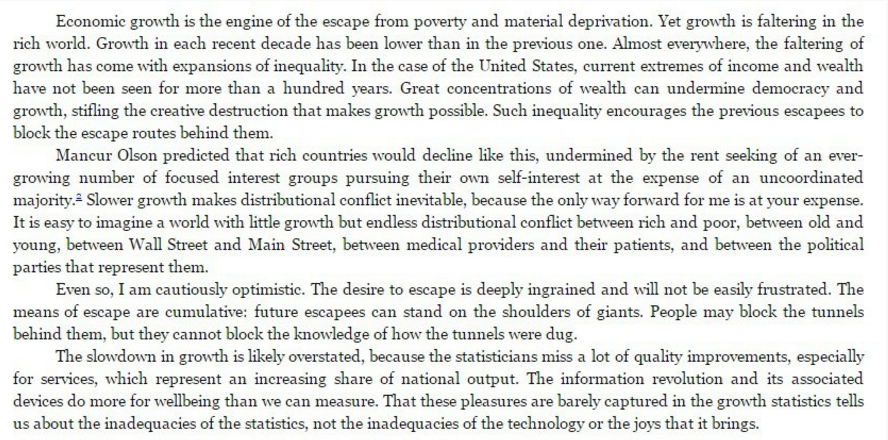
Angus Deaton on slow growth as a force for distributional conflict
25 Oct 2015 Leave a comment
in applied welfare economics, comparative institutional analysis, constitutional political economy, development economics, growth disasters, growth miracles, income redistribution, liberalism, Public Choice, rentseeking Tags: Angus Deaton, The Great Enrichment, The Great Escape, The Great Fact
RT @NaomiAKlein what’s changed since you left high school?
24 Oct 2015 Leave a comment
in development economics, economic history, growth miracles, Marxist economics Tags: Bill Easterly, Leftover Left, Naomi Klein, The Great Enrichment, The Great Escape, The Great Fact
.@worldbankdata allows us to see how our world has changed since 1985 #BackToTheFuture https://t.co/8t5DZDMFfz—
DFID Stats (@DFID_Stats) October 21, 2015
No matter how you measure it, the news on global poverty is great. From @EconBizFin http://t.co/qKM6suo4YO—
William Easterly (@bill_easterly) October 15, 2015
Special 5pm premiere screening in Los Angeles tonight Q&A with @avilewis & @NaomiAKlein sundancecinemas.com http://t.co/Oi4oeKoQHB—
Changes Everything (@thischanges) October 16, 2015
The essence of anthropology
24 Oct 2015 Leave a comment
in development economics, economics of media and culture, growth disasters, growth miracles, personnel economics Tags: academic bias, anthropology, Noble Savage, technological diffusion, The Great Escape, The Great Fact
@zoesqwilliams has great timing on capitalism not doing enough on poverty @worstall
23 Oct 2015 Leave a comment
in development economics, economic history, growth disasters, growth miracles, Marxist economics, poverty and inequality Tags: extreme poverty, global poverty, Leftover Left, life expectancies, The Great Escape, The Great Fact, Twitter left
When Zoe Williams was born in 1973, 60% of humanity lived in extreme poverty. That has dropped to 1 in 10.
When my father was born, 7 in 10 people lived in absolute poverty.
Today, it's 1 in 10! https://t.co/1Caqku3AY1—
Tim Fernholz (@TimFernholz) October 21, 2015
Just the other day, the World Bank estimated that extreme poverty has dropped below 10% of the world’s population for the first time in human history but some are still grumbling.
What will it take to finish the “Last Mile” in ending extreme #poverty? brook.gs/1LiFT8E http://t.co/YxSZ36VCSW—
Brookings (@BrookingsInst) October 07, 2015
Zoe Williams is not grumbling about the failed states and predatory government responsible for the last pockets of extreme poverty, but about the inequality from economic progress under capitalism.
The extreme poor live in conflict & rural areas: wrld.bg/Nynge #endpoverty http://t.co/43HDDI11JR—
World Bank (@WorldBank) May 31, 2015
Zoe Williams honestly believes that extreme poverty could have been reduced faster if we had taken on the socialist road.
These 4 nations are 50% of mankind. That's 3.5 billion people who are living longer. buff.ly/1Kle6mU #health http://t.co/949oqisMsL—
HumanProgress.org (@humanprogress) June 30, 2015
China and India escaped from extreme poverty by rejecting socialism.
Just released: new global poverty estimates from 1990-2015 using updated extreme poverty line http://t.co/LxD5q2n6Mg—
Laurence Chandy (@laurencechandy) October 04, 2015
China and India received next to no overseas development assistance in their Great Escape from extreme poverty.
Embrace the free market and overtake your socialist competitors. buff.ly/1PZ3yuN http://t.co/xfpF4vtqlv—
HumanProgress.org (@humanprogress) October 05, 2015
There’s been some clear-cut natural experiments such as between Chile and Venezuela and Japan, Hong Kong, Singapore and just about any other developing country in terms of capitalism as the only path to prosperity.


Recent Comments