The conservative case against capital punishment – George Will
15 Jun 2015 Leave a comment
in economics of bureaucracy, economics of crime, law and economics, politics - USA, Public Choice Tags: capital punishment, crime and punishment, criminal deterrence, The fatal conceit, The pretence to knowledge, unintended consequences
The ridiculous non-candidate charade in presidential primary elections
15 Jun 2015 Leave a comment
in economics of media and culture, economics of regulation, politics - USA, Public Choice Tags: 2016 presidential election, campaign finance regulation, offsetting behaviour, The fatal conceit, The pretence to knowledge, unintended consequences
![image_thumb[1]](https://utopiayouarestandinginit.com/wp-content/uploads/2015/06/image_thumb110.png "image_thumb[1]")
The NYT must be slipping with "When Family-Friendly Policies Backfire”
27 May 2015 2 Comments
in discrimination, economics of regulation, gender, labour economics, occupational choice Tags: gender wage gap, maternity leave, offsetting behaviour, The fatal conceit, The pretence to knowledge, unintended consequences
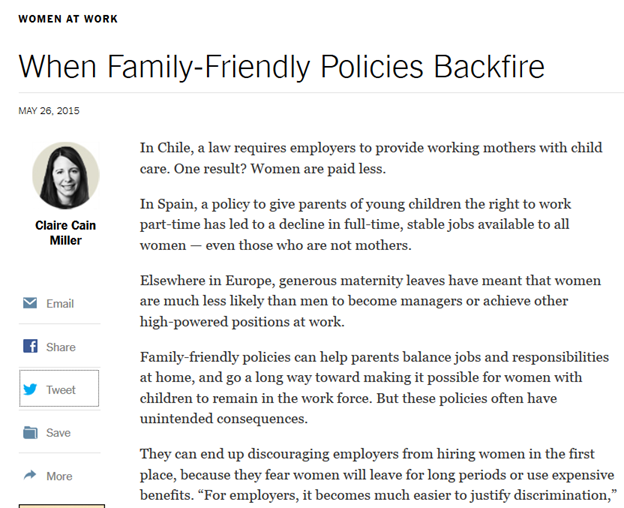
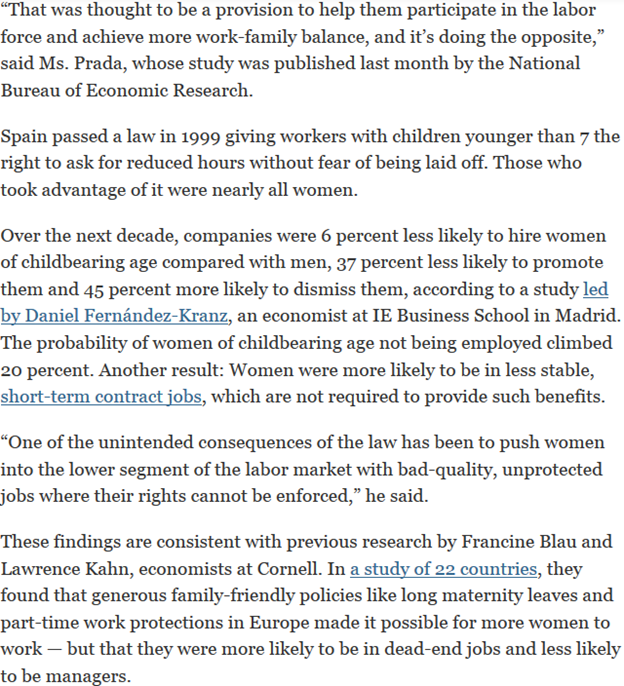
The best part of the article is its frank admission about how bare the cupboard is in dealing with the impact of generous maternity leave on the gender gap. Maternity leave should not be too generous, should not be paid by employers but by taxpayers, and should extend to both men and women.

Urban planners are confident souls
15 May 2015 Leave a comment
in development economics, economics of regulation, environmental economics, growth miracles, politics - Australia, politics - New Zealand, politics - USA, urban economics Tags: green rent seeking, housing affordability The fatal conceit, land use regulation, offsetting behaviour, RMA, The pretence to knowledge, unintended consequences, urban planning, zoning

The crusade to ban e-cigarette had the predictable effect among teens
12 May 2015 Leave a comment
in environmental economics, health economics Tags: do gooders, economics of smoking, meddlesome preferences, nanny state, offsetting behaviour, The fatal conceit, The pretence to knowledge, unintended consequences
Teen e-cigarette consumption has surpassed conventional smoking in 2014 #vaping via @CDCgov
statista.com/chart/3417/eci… http://t.co/RnZz1nbj5X—
Statista (@StatistaCharts) April 22, 2015
FA Hayek on piecemeal analysis such as cost benefit analysis and evidence-based policy
09 May 2015 Leave a comment
in applied price theory, applied welfare economics, Austrian economics, comparative institutional analysis, constitutional political economy, economics of regulation, F.A. Hayek Tags: Constitution of Liberty, cost benefit analysis, evidence-based policy, offsetting behaviour, The fatal conceit, The pretence to knowledge, unintended consequences
Happy Birthday, F.A. Hayek!
(8 May 1899 – 23 March 1992) http://t.co/K431Kj9nok—
Screwed by State (@ScrewedbyState) May 09, 2015
The pretence to knowledge has a supply and a demand
01 May 2015 Leave a comment
in applied price theory, Austrian economics, F.A. Hayek, labour supply, occupational choice, Public Choice, rentseeking Tags: consultants, rent seeking, The pretence to knowledge
The life of an economist. http://t.co/gvBLa9Tk3h—
Justin Wolfers (@JustinWolfers) March 02, 2015
Milton Friedman on evidence-based policy
27 Apr 2015 Leave a comment
in applied price theory, applied welfare economics, comparative institutional analysis, Milton Friedman Tags: evidence-based policy, offsetting behaviour, The fatal conceit, The pretence to knowledge, unintended consequences
Zero hour contracts may be outlawed in New Zealand–updated
13 Apr 2015 1 Comment
in entrepreneurship, industrial organisation, labour economics, labour supply, managerial economics, occupational choice, organisational economics, personnel economics, politics - New Zealand, survivor principle, unions Tags: Aaron Director, creative production, David Friedman, inherent inequality of bargaining power between workers and employers, Richard Epstein, Ronald Coase, The fatal conceit, The pretence to knowledge, zero hours contracts

In another triumph of the Socialist Left of the National Party, the supposedly centre-right New Zealand government is considering outlawing zero hours contracts:
ONE News can exclusively reveal the Workplace Relations Minister is leaning towards outlawing the contracts and other employment provisions that he sees as unfair…
The Minister of Workplace Relations said the most punitive aspects of zero-hour contracts will be banned:
Mr Woodhouse has previously said a ban of zero-hour contracts would be an overreaction, but signalled the outlawing of aspects including:
•Restraint of trade clauses that stop someone working for a competing business if an employer does not provide the desired hours of work.
•The cancellation of shifts at short or no notice.
One reason for this is to neutralise a wedge issue with the Labour Party. The labour parties in both New Zealand and United Kingdom plan to outlaw zero hours contracts.
The NZ Labour Party’s Certainty at Work private member’s bill would require employment agreements to include an indication of the hours an employee will have to work to complete tasks expected of them.

Aaron Director pointed out that there are many real world business practices that behave differently from the caricatures in textbooks and arouse suspicious responses from economists (as well as from lay observers including lay observers with no ideological agenda).
Director said that visions of market power dance their heads and some of these suspect practices have been regulated for reasons he attributed in a large part to intellectual laziness. Ronald Coase made the same observation about knee-jerk responses to perplexing new business practices:
One important result of this preoccupation with the monopoly problem is that if an economist finds something—a business practice of one sort or other—that he does not understand, he looks for a monopoly explanation.
And as in this field we are very ignorant, the number of ununderstandable practices tends to be rather large, and the reliance on a monopoly explanation, frequent.
Much of the lasting influence of Aaron Director and of Ronald Coase came from their ability to show that simple judgements about business practices often cannot withstand rigorous scrutiny.
The organisation of and the contracting practices in the labour market is not a complicated despite the best efforts of the Left over Left and unions to pretend that it is so, as Richard Epstein explains:
Labour markets are not characterized by tricky externalities. They do not pollute streams or require the creation of public goods.
They are not characterized by genuine breakdowns in information, as workers are in a position to observe the conditions of their employment on a day-to-day basis.
Left to their own devices, without explicit support from union activities, they will be highly competitive, and thus work hard to allocate scarce human capital to its most productive use.
Workers have the option to quit for higher wages, and employers can always seek out low cost techniques to reduce their labour costs. Any short-term dislocation for firms or individuals is more than offset by the overall increase in the system productivity, spurred in part by clear signals that should increase investments in human capital.
In the UK, the Work Foundation found that 80% of those on zero hours contracts are not looking for another job; only 26% wanted longer hours. This implies that 74% were content with their current work times arrangements.
Labour's zero hours myth breitbart.com/london/2015/04… http://t.co/M8JsW6NWSF—
Alex Wickham (@WikiGuido) April 07, 2015
The inherent inequality of bargaining power between employers and workers and the reserve army of the unemployed must not be all that they are cracked up to be these days if low paid workers have to sign legally enforceable restraint of trade agreements, which is a common complaint about zero hours contracts. The worker does not have guaranteed hours but must promise not to work for someone else in the same line of business.
Obviously, the few members of the reserve army of the unemployed lucky enough to have a low pay, insecure job that offers no regular hours have so many other job options that their employers must get them to agree not to quit and job-hop at will. Jobs must be readily available to low paid workers for otherwise why do employers insist on this restraint of trade in employment agreements?
If there is an inherent inequality of bargaining power between the bosses and the workers, why do employers seek restraint of trade agreements against these downtrodden workers who are supposed to have few options but to accept the miserable zero hours job offer before them?
The question that must always be asked is why do people deemed competent to vote and drive cars sign zero hours contract? What is in it for them – for the worker who signs these contracts – especially for workers who already have a job and are switching to a zero hours contract? David Friedman asked this question about the economics of restraint of trade agreements for employees:
…the employer who insists on an employee signing a non- competition agreement will find that he must pay, in additional wages or other terms of employment, the cost that the agreement imposes upon the employee, as measured by the employee and revealed in his actions.
It follows that the employer will insist on such an agreement only if he believes that its value to him is greater than its cost to the employee… The contract is designed, after all, with the objective of getting the other party to sign it.
If I am designing the contract and offering it to many other parties, that may put me in a position to commit myself to insisting on terms that give me a large fraction of the benefit that the contract produces. But it is still in my interest to maximize the size of that net benefit-which I do by only insisting on terms that are worth at least as much to me as they cost the other party.
If zero hours contracts are as bad as the Left over Left claim, the job quit rates for these contracts should be high, and people moving from existing jobs should be under-represented in this section of the labour force. If a worker already has a job, they have few reasons to sign up to such a purportedly poor job offer. Show me the evidence.
Unless we have a good idea about why firms are moving to zero hours contracts, which we don’t, and why employees sign these contracts rather than work for other employers who offer more regular hours of work, meddling in these still novel to the officious observer arrangements is risky.

No one says this about economists
27 Mar 2015 Leave a comment
in applied price theory, applied welfare economics, Austrian economics, comparative institutional analysis, constitutional political economy, F.A. Hayek, liberalism, Public Choice, rentseeking Tags: evidence-based policy, offsetting behaviour, science and public policy, The fatal conceit, The pretence to knowledge, unintended consequences
Scientists dream about what could be.
Economists remind you of price tags and unintended consequences
France, here the New Zealand labour market comes – part 2! How the Employment Court is re-regulating
04 Mar 2015 7 Comments
in applied price theory, Austrian economics, entrepreneurship, F.A. Hayek, George Stigler, human capital, industrial organisation, job search and matching, labour economics, law and economics, Ludwig von Mises, politics - New Zealand, survivor principle Tags: Armen Alchian, employment law, employment protection laws, entrepreneurial alertness, France, Israel Kirzner, The fatal conceit, The pretence to knowledge
As discussed yesterday, if the Employment Court had its way, New Zealand case law under the Employment Relations Act regarding redundancies and layoffs would be as job destroying as those in France.
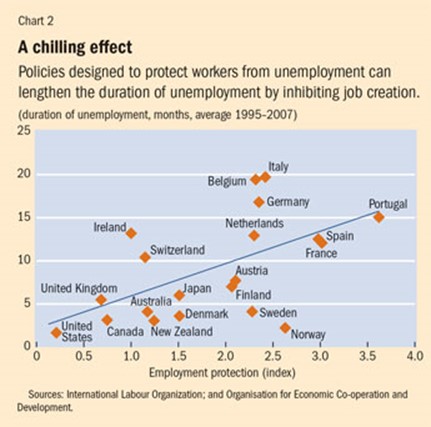
The Employment Court’s war against jobs goes back more than 20 years. To 1991 and G N Hale & Son Ltd v Wellington etc Caretakers etc IUW where the Court held that a redundancy to be justifiable under law it must be ‘unavoidable’, as in redundancies could only arise where the employer’s capacity for business survival was threatened.
The Court of Appeal slapped that down and affirm the right of the employer to manage his business in no uncertain terms:
…this Court must now make it clear that an employer is entitled to make his business more efficient, as for example by automation, abandonment of unprofitable activities, re-organisation or other cost-saving steps, no matter whether or not the business would otherwise go to the wall…
The personal grievance provisions … should not be treated as derogating from the rights of employers to make management decisions genuinely on such grounds. Nor could it be right for the Labour Court to substitute its own opinion as to the wisdom or the expediency of the employer’s decision.
When a dismissal is based on redundancy, it is the good faith of that basis and the fairness of the procedure followed that may fall to be examined on a complaint of unjustifiable dismissal
… the Court and the grievance committees cannot properly be concerned with an examination of the employer’s accounts except in so far as it bears on the true reason for dismissal.
The Employment Court could only inquire as to the genuineness of the employer’s decision and the procedures adopted. The Court could not substitute their views on management decisions. No second-guessing.
In Brake v Grace Team Accounting Ltd, the Employment Court found its way back into second-guessing employer’s decisions about how to manage their business. The figures used by the employer to decide that a redundancy was required were in error. The employer miscalculated.
The Employment Court had previously held in Rittson-Thomas T/A Totara Hills Farm v Hamish Davidson that the statutory test of what a fair and reasonable employer could have done in all the circumstances applies to the substantive reasoning for redundancies. Some enquiry into the employer’s substantive decision is required to establish that a hypothetical fair and reasonable employer could also make the same decision in all of the circumstances.
Subsequently in Brake v Grace Team Accounting Ltd, the Employment Court found that the actions by the employer were “not what a fair and reasonable employer would have done in all the circumstances” and “failed to discharge the burden of showing that the plaintiff’s dismissal for redundancy was justified”.
The Court found that the redundancy was “a genuine, but mistaken, dismissal”, but it still found that the dismissal was substantively unjustified. That is a major new development. Mistaken dismissals that are genuine are unlawful and grounds for compensation under the employment law.
The case was appealed where the issues were whether the correct test had been applied. The Court of Appeal, in a sad day for employers, job creation and the unemployed, found that the Employment Court was within its rights to do what it did and applied the statutory tests correctly:
GTA acted precipitously and did not exercise proper care in its evaluation of its business situation and it made its decision about Ms Brake’s redundancy on a false premise.
So it never turned its mind to what its proper business needs were but rather proceeded to evaluate its options based on incorrect information. We can see no error in the finding by the Employment Court that a fair and reasonable employer would not do this.
The test is now that fair and reasonable employers in New Zealand do not make mistakes. A much greater burden is now laid upon employers to show that not only that redundancies are justified, but they have made careful calculations and no mistakes.
No more seat of your pants entrepreneurship in New Zealand. No more entrepreneurial hunches – the essence of entrepreneurship is acting on hunches and other judgements that are incapable of being articulated to others and about which there is mighty disagreement in many cases. As Lavoie (1991) states:
…most acts of entrepreneurship are not like an isolated individual finding things on beaches; they require efforts of the creative imagination, skillful judgments of future costs and revenue possibilities, and an ability to read the significance of complex social situations.
The essence of entrepreneurship is your hunches are better than the next guy’s and you survive in competition by backing that hunch often to the consternation of the crowd. As Mises explains:
[Economics] also calls entrepreneurs those who are especially eager to profit from adjusting production to the expected changes in conditions, those who have more initiative, more venturesomeness, and a quicker eye than the crowd, the pushing and promoting pioneers of economic improvement…
The entrepreneurial idea that carries on and brings profits is precisely that idea which did not occur to the majority… The prize goes only to those dissenters who do not let themselves be misled by the errors accepted by the multitude
In many cases, those entrepreneurial hunches are sorted, sifted and selected on the basis of trial and error in the marketplace. Central to Hayek’s conception of the meaning of competition is it is a process of trial and error with many errors:
Although the result would, of course, within fairly wide margins be indeterminate, the market would still bring about a set of prices at which each commodity sold just cheap enough to outbid its potential close substitutes — and this in itself is no small thing when we consider the insurmountable difficulties of discovering even such a system of prices by any other method except that of trial and error in the market, with the individual participants gradually learning the relevant circumstances.
Remember Hayek’s conception of competition as a discovery procedure where prices and production emerge through the clash of entrepreneurial judgements and competitive rivalry:
…competition is important only because and insofar as its outcomes are unpredictable and on the whole different from those that anyone would have been able to consciously strive for; and that its salutary effects must manifest themselves by frustrating certain intentions and disappointing certain expectations
Errors are no longer permitted in the New Zealand labour market by the Employment Court. The Court has outlawed error in redundancy decisions.
This is despite the fact that the conception by Kirzner of the market process is that it is an error correction procedure without rival and a central role of entrepreneurial alertness is to correct errors in pricing and production:
It is important to notice the role played in this process of market discovery by pure entrepreneurial profit. Pure profit opportunities emerge continually as errors are made by market participants in a changing world. The inevitably fleeting character of these opportunities arises from the powerful market tendency for entrepreneurs to notice, exploit, and then eliminate these pure price differentials.
The paradox of pure profit opportunities is precisely that they are at the same time both continually emerging and yet continually disappearing. It is this incessant process of the creation and the destruction of opportunities for pure profit that makes up the discovery procedure of the market. It is this process that keeps entrepreneurs reasonably abreast of changes in consumer preferences, in available technologies, and in resource availabilities.
Rothbard made similar arguments about the centrality of discrepancies and error in entrepreneurship:
The capitalist-entrepreneur buys factors or factor services in the present; his product must be sold in the future. He is always on the alert, then, for discrepancies, for areas where he can earn more than the going rate of interest.
In Frank Knight’s conception of profit, there were temporary profits that arise from the correction of error:
In the theory of competition, all adjustments “tend” to be made correctly, through the correction of errors on the basis of experience, and pure profit accordingly tends to be temporary.
The Employment Court misunderstands the market process as a process of error correction. Those errors are identified through entrepreneurial alertness and trial and error. These errors are both of over-optimism and over-pessimism as Kirzner explains:
Errors of over-pessimism are those in which superior opportunities have been overlooked. They manifest themselves in the emergence of more than one price for a product which these resources can create. They generate pure profit opportunities which attract entrepreneurs who, by grasping them, correct these over-pessimistic errors.
The other kind of error, error due to over-optimism, has a different source and plays a different role in the entrepreneurial discovery process. Over-optimistic error occurs when a market participant expects to be able to complete a plan which cannot, in fact, be completed.
A considerable part of entrepreneurial alertness arises from the business opportunities created by sheer ignorance and pure error as Kirzner explains:
What distinguishes discovery (relevant to hitherto unknown profit opportunities) from successful search (relevant to the deliberate production of information which one knew one had lacked) is that the former (unlike the latter) involves that surprise which accompanies the realization that one had overlooked something in fact readily available. (“It was under my very nose!”)
The market process is a selection procedure where the more efficient survive for reasons that may be unknown to the entrepreneurs directly concerned as well as to observers and officious judges. Alchian pointed out the evolutionary struggle for survival in the face of market competition ensured that only the profit maximising firms survived:
- Realised profits, not maximum profits, are the marks of success and viability in any market. It does not matter through what process of reasoning or motivation that business success is achieved.
- Realised profit is the criterion by which the market process selects survivors.
- Positive profits accrue to those who are better than their competitors, even if the participants are ignorant, intelligent, skilful, etc. These lesser rivals will exhaust their retained earnings and fail to attract further investor support.
- As in a race, the prize goes to the relatively fastest ‘even if all the competitors loaf.’
- The firms which quickly imitate more successful firms increase their chances of survival. The firms that fail to adapt, or do so slowly, risk a greater likelihood of failure.
- The relatively fastest in this evolutionary process of learning, adaptation and imitation will, in fact, be the profit maximisers and market selection will lead to the survival only of these profit maximising firms.
The surviving firms may not know why they are successful, but they have survived and will keep surviving until overtaken by a better rival. All business needs to know is a practice is successful.
One method of organising production and supplying to the market will supplant another when it can supply at a lower price (Marshall 1920, Stigler 1958). Gary Becker (1962) argued that firms cannot survive for long in the market with inferior product and production methods regardless of what their motives are. They will not cover their costs.
The more efficient sized firms are the firm sizes that are currently expanding their market shares in the face of competition; the less efficient sized are those firms that are currently losing market share (Stigler 1958; Alchian 1950; Demsetz 1973, 1976). Business vitality and capacity for growth and innovation are only weakly related to cost conditions and often depends on many factors that are subtle and difficult to observe (Stigler 1958, 1987). The Employment Court pretends to know better than the outcome of the competitive struggle in the market for survival.
The Employment Court also believes employers have something akin to academic tenure. In 2010, the Court found that an employee’s redundancy was unjustified because the employer did not offer redeployment and there is no requirement that the right of the redeployment be written into the employment agreement (Wang v Hamilton Multicultural Services Trust). The particulars of this case were quite interesting:
- A new management role was created with significantly more responsibility for training, supervision and decision making than the redundant finance administrator role, with a 50% salary increase to recognise the increased responsibilities and duties.
- The vacancy was advertised externally but the existing finance administrator was encouraged to apply.
- His experience and qualifications meant that he could fulfil the new role, albeit with some up-skilling.
- He decided not to apply for it to avoid jeopardising a personal grievance claim that his redundancy was not genuine and therefore unjustified.
In the case at hand, the Employment Court held that the employer was obliged to look for alternatives to making the employee redundant. Given that he would be able to perform the new finance manager position with some up-skilling, the employer should have offered him the position rather than simply inviting him to apply for it.
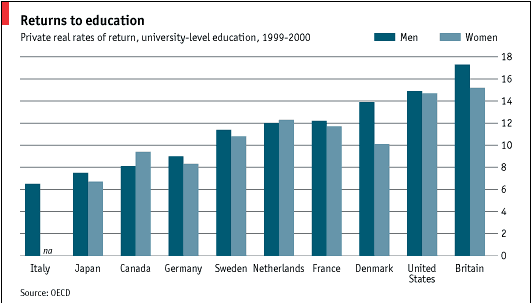
The notion that an employee through training can quickly increase their marginal productivity by 50% to fill a more senior role contradicts the modern labour economics of human capital. A 50% salary increase through a bit of training would imply extraordinary annual returns on other forms of on-the-job training and formal education as well as the training at hand in the Employment Court case.
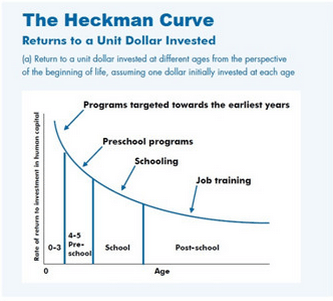
I would very much like to be in the position where I can get a 50% salary increase after a bit of training. As I recall, I required about 5-10 years of on-the-job human capital acquisition before my starting salary as a graduate was 50% higher through promotion and transfers.
In summary, the Employment Court stands apart from the modern labour economics of human capital and job search and matching as well as the modern theory of entrepreneurial alertness, and the market as a discovery procedure and an error correction mechanism. The Employment Court has fallen for both the pretence to knowledge and the fatal conceit.
 Utopia, you are standing in it!
Recent Comments