
Murray Rothbard on the pretence to knowledge of environmentalists and conservationists
24 Dec 2014 Leave a comment

M.A. Adelman on the use of knowledge and resource exploration and conservation
08 Dec 2014 Leave a comment


Some economics of zero-hours contracts – part 3: the fixed costs of working
02 Dec 2014 Leave a comment
in applied price theory, labour economics, labour supply, managerial economics, Marxist economics, organisational economics, personnel economics, politics - New Zealand, unions Tags: fixed cost of employment, fixed costs of working, inherent inequality of bargaining power between workers and employers, reserve army of the unemployed, The pretence to knowledge, zero hours contracts
The Unite Union, which represents about 7000 workers across New Zealand, has announced a campaign against zero-hours contracts. Zero-hours contracts have no specified hours or times of work so a worker could end up working 40 hours one week and none the next.
Unite national director Mike Treen did not know of the specific numbers of such contracts, but said these contracts were particularly common in the fast food industry, although they also appeared in some other industries.
Unite Union’s national director said that zero hours contracts made workers vulnerable to abuse as they became too nervous to speak out, for fear of having their hours reduced.
There’s no security and it puts enormous power in the hands of managers. People are extremely reluctant to assert their rights for simple things like breaks…
Treen admitted that zero-hours contracts gave employers flexibility, but pretended to know that the amount of flexibility employers actually needed was often exaggerated.
It’s not like they have huge swings or anything. They know how much they are going to sell on any particular day of the week during the year… We don’t expect everybody to have guaranteed hours but 80 per cent of the crew should be able to have it.
Treen said the union was not planning to push for a law change at this stage and would focus on addressing the issue during negotiations with fast food companies early next year.
The new leader of the opposition has promised to outlaw these zero our contracts when he gets into government. I wish him well in drafting a law that outlaws zero-hours contracts without outlawing some part-time and casual jobs as well.
Zero-hours contracts and the class war
As is to be expected, the Guardian is rather hot and bothered about zero hours contracts. One of its columnists referred to those on zero-hours contracts as the new reserve army of the unemployed:
It is a pity Karl Marx was not around last week to comment on the news that 90% of the workers at Sports Direct are on zero-hours contracts.
The author of the Communist Manifesto would also have had plenty to say about the news that the official estimates of those working in this form of casualised labour had shot up by 25%…
It is safe to say Marx would have cavilled with those who see zero-hour contracts as an expression of Britain’s economic strength, a demonstration of flexible labour markets in action.
He would have thought "reserve army of labour" a better description of conditions in which workers were expected to be permanently on call for an employer.
The Guardian went on to admit that the reserve army of unemployed are not as discontented as they should be:
It’s only fair to say that some employees are content to be on zero-hours contracts.
Some students, for example, want to combine work with study and are willing to turn up when summoned. That’s also true of older workers topping up their pensions with a bit of irregular, part-time work.
Despite this, the class war continues as does the immiseration of the proletariat and the long-term decline in profits that will lead to the crisis in capitalism and, with a bit of luck, the inevitable proletarian revolution:
Marx would have seen zero-hours contracts as the continuation of a long historical trend, stretching back to the mid-1960s when the profitability of western manufacturing firms started to fall.
From that moment, he would say, the search was on for measures to boost profits, and this has manifested itself in a number of ways: by direct attacks on organised labour; by the increased financialisation of the economy; by the search for cheap raw materials whatever the environmental cost; and by asset bubbles.
Accordingly, zero-hours contracts are the response to tougher conditions facing firms as a result of the financial crisis.
Reversing that trend will require more than legislation: it will mean tackling one of the root causes of that crisis: the imbalance of power in the labour market.
A more mellow writer in the Guardian brought up the imagery of the interwar depression:
Of course it is difficult for employers to match the demand to work nine to five and yet also to be served on a 24-hour basis, cheaply and effectively by someone, not them.
But there are other ways to solve this conundrum than indenturing workers or making them wait at the metaphorical factory gate for a tap on the shoulder.
The fixed costs of working
I will start my third blog on the economics of zero-hours by reviewing the economic literature on the fixed costs of working. Helpfully, this literature predicts that zero hours contracts really shouldn’t exist much at all.
The literature on the economics of the fixed costs of work arose out of the economics of retirement and the economics of the labour supply of married women, and in particular of young mothers. This literature was attempting to explain why older workers, or young mothers either worked a minimum number of hours, or not at all.
Fixed costs of working constrain the choices that older employees make about how many hours and days that are worthwhile working part-time. For employees, the fixed costs of going to work limit the numbers of days and number of hours per day that a worker is willing to work part-time. The timing costs of working at scheduled times and a fixed number of days per week can make working fewer full-time days, rather than fewer hours per day less disruptive to the leisure and other uses of personal time.
The fixed costs of working induced older workers to retire completely, and young mothers to withdraw from the workforce for extended periods of time, unless these workers worked either full-time or enough hours part-time each day and through the week to justify the costs of commuting and otherwise disrupting their day and week.
In the case of older workers, there were the fixed costs of commuting and other disruptions to their day. In the case of mothers, there are additional fixed costs of working arising from child care and the commuting and other rather rigid time commitments of picking up and dropping off younger children at school and to day care centres.
The fixed costs of going to work
There is a minimum number of hours of work that will be supplied by different workers that is set by the fixed costs of working. These fixed costs of work arise from commuting time and from dressing and other tasks involved in preparing for the trip to work. These costs are fixed because they do not vary with the number of hours to be worked per day and the amount of effort to be exerted while working (Cogan 1981; Hamermesh and Donald 2007).
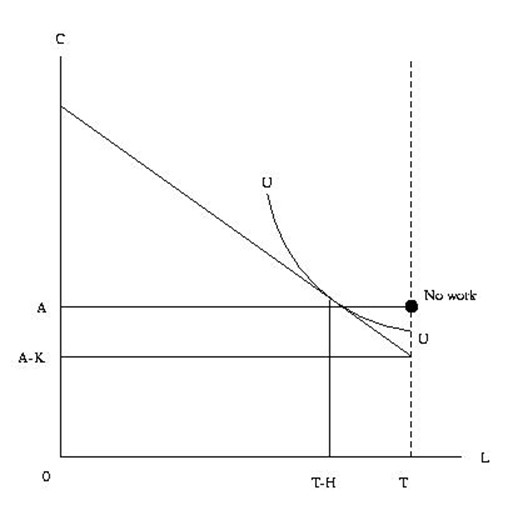
A worker will not accept a job offer or continue in a particular job unless they work sufficient hours so that these fixed costs of going to work are recovered along with receiving sufficient reward for giving up pursuing other job openings open now and in the future and for forgoing leisure and the option of making other uses of their time (Cogan 1981; Hamermesh and Donald 2007).
Cogan (1981) estimated that the average fixed time and money costs of married women entering the workforce was 28 per cent of their earnings, and also estimated that the minimum number of hours a married woman was willing to supply in the labour market was 1,300 hours per year.
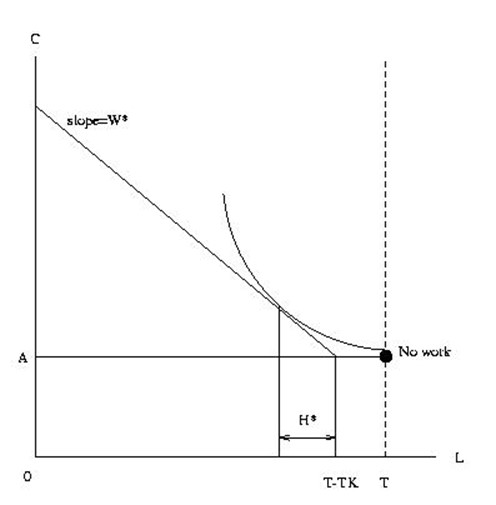
There may be a preference for fewer working days over fewer hours per day to reduce the time and money costs of going to work. Donald and Hamermesh (2009) estimated that fixed costs of going to work are equal to about 8 per cent of income. The fixed costs of working provide an incentive to workers to bunch activities.
The fixed timing costs of labour market entry
A surprisingly large part of the fixed costs of working comes from disruption in the ability to use spare time effectively (Donald and Hamermesh 2009, 2007). Entering or remaining in the workforce for any time at all significantly affects the effective allocation and enjoyment of time outside of working hours. This disruption to the effective use of the time that is left outside of working hours is the fixed timing cost of labour market entry.
One way to reduce this disruption from entering the labour force at all is to seek to reduce the number of days worked per week rather than the number of hours per day.
Leisure and other private uses of time are displaced if the individual takes or stays in even a small part-time job. Workers must use their reduced amount of remaining free time to catch-up on tasks, often at the weekend that they could have done if they were not working.
Leisure time may be the first to go because many personal tasks can be rescheduled but must be done eventually. These range from cooking, eating, and cleaning to personal upkeep, sleep and rest. Tasks must be hurried or done to a lower quality (Donald and Hamermesh 2009).
Routine – having the same schedule from day to day – saves time (Hamermesh 2005). Routine enables people to economise on the set-up costs of consumption, leisure and going to work.
Entering the work-force for any time at all to work even a small number of hours per day or per week calls for new daily and weekly routines and disrupts many existing routines that make better use of leisure, family and other uses of time (Hamermesh 2005).
Entering the workforce constrains the unfettered use of spare time. Working increases the fixed costs of coordinating family and leisure times. Workers must surround working times with buffers to ensure they are not late for work.
One reality of rising incomes is time become more valuable. A rise in wages raises the value of time because time is a finite and irreplaceable resource. Time cannot be stored or bought and sold but people can try and make better use of it.
With only 24 hours still in every day, the cost of time-intensive activities including working will rise as incomes increase. People shift away from time intensive activities and buy more of those products that are time saving or which are less time intensive to consume. Time is money and this maxim applies with greater resonance as incomes and wealth increase.
Another important fixed time costs of labour market entry is its impact on the efficiency of the remaining time devoted to leisure, household production and other activities when even a small amount of market work is undertaken. Spare time is of much less value if part of every day is to be spent at work.
Fixed timing costs arise because of a need to hurry to get to work on time and forego other activities to be rested for work the next morning. The requirement to attend work blocks out certain days from major other uses of that day and reduces the time available in any day of part-day work for leisure, family time and household production.
Household production refers to the goods and services made at home which could be purchased in the market from a third-party. These include food preparation, cooking, carer obligations, and household cleaning. There are also various other household tasks that must perform for one-self which are essentially personal maintenance and leisure.
Working even a few hours can reduce the worker’s efficiency in household production and other non-market activities and may require the worker to buy goods and services that were previously produced at home. This reduces the net financial rewards of working. Fewer full days of work, rather than fewer hours per day is less disruptive to leisure and the other uses of personal time.
The fixed time costs of market work might induce workers to engage in different mixes of other activities. The additional hours of work during the week affect the allocation of time on a non-working weekend day. They reduce leisure time on weekends and increase weekend time devoted to household production by those who do market work on week days. Workers catch up at the weekend on the household production that the rigidities of their market work prevented them from doing during the week.
Stress is an important fixed cost of working. Workers spend non-market time worrying or thinking about work-problems. Even a few hours of market work will place a worker at risk of some stress.
Floors and ceilings on the structure of the working week
The fixed costs of going to work and the fixed time cost of labour market entry both place constraints on the willingness of workers to accept a job offer involving a zero-hours contract. These contracts must offer something extra over competing job options.
The employer must offer something extra to prospective recruits to induce them to sign a zero-hours contract. There must be something substantial to overcome both the fixed costs of work, such as commuting, and the less obvious but still substantial fixed costs of labour market entry.
Any commitment to work, such as working on a zero hours contract, carries with it significant costs in terms of disruption to the rest of the day, the rest of the working week and the amount of the weekend that is spent on leisure versus resting from work and catching up on tasks that otherwise could have been done during the week but for work commitments.
A zero-hours contract must pay enough over the expected life time of the job to make up for the costs of going to work as well as the disruption and loss of leisure time and also the pure disutility of working before the worker breaks even on working.
As the Unite Union official noted, zero hours contracts appear to be most prevalent in the fast food sector. Job turnover rates in the sector can be several hundred per cent per year.
Many of the workers in the fast food sector, as the Unite union official himself noted, are young. Teenagers and young workers changed jobs frequently, particularly those who are studying part-time or full-time work, injuring the summer.
As such, zero-hours contracts in any particular job will have a short expected life over which the teenager or young worker would have to recoup for the fixed cost of working and the fixed cost of any labour market entry. Employers would have to offer some sort of premium or other implicit guarantee of regular work to induce prospective young recruits to sign a zero hours contract.
The type of workers who will profit from signing a zero hours contracts of those workers with few other demands on their time and flexible days. The workers who might find zero hours contract appealing will be those who do have much routine in their day. Workers who have a considerable amount of routine in their day such as because of family commitments will not find the wage offers in zero hours contracts appealing.
There will be job sorting: workers who have low fixed costs of working and low fixed costs of labour market entry will be attracted to zero-hours contracts.
Employers profit from offering zero hours contracts to workers who don’t want to make a regular commitment to come into work every day. Teenagers and students fall into this category, which makes it less surprising that zero hours contracts appear to be most common in the fast food sector.
There are mutual gains in the fast food sector to both employers and workers from zero hours contracts when there are peaks and troughs in product demand, and some teenagers and young workers have a low cost of coming into work at short notice.
M.A. Adelman on the use of knowledge in resource exploration and conservation
29 Nov 2014 Leave a comment

Housing habitability laws
25 Nov 2014 1 Comment
in economics of regulation, urban economics Tags: consumer products standards, do gooders, economics of regulation, nanny state, offsetting behaviour, rent control, The fatal conceit, The pretence to knowledge, urban economics

Minimum standards for rental housing is back in the news in New Zealand. After some deaths in some rather nasty fires in rental houses without fire alarms, there are demands that landlords must put fire alarms in place and maintain those fire alarms. About a dozen people or so die in fires in New Zealand every year.
The fact that in the proposed regulation, landlords are also required to maintain those fire alarms – ensure they have batteries in them – is a microcosm of the economics of rental housing habitability laws.
Even when landlords put in fire alarms, low income tenants prefer to spend their money on something other than replacement batteries for those alarms. These tenants are presumed to be competent to vote and drive cars, but not manage the risk of fires in the houses in which they live.
Maybe the reason for the lack of interest of low income tenants in putting batteries and fire alarms is domestic household fires are relatively rare these days. Fire is buried in the green area of the diagram below and is similar to drowning and falls.

The American data below suggests that your chances of dying by fire are about the same as dying from choking and a little worse from dying from post surgery complications.

Rather than in need of nudging, your average low income tenants seems to have it pretty right regarding the risks of dying in a fire.
When I went looking for some economics of housing habitability laws, Google was a bit of a disappointment. There are some empirical work done in the 1970s and early 1980s and then it fell away.
My suspicion is there is not so much empirical work on the economics of housing habitability laws because proving the obvious is not a good investment in Ph.D. topics or tenure track economic research.

Walter Block wrote an excellent defence of slumlords in his 1971 book Defending the Undefendable:
The owner of ghetto housing differs little from any other purveyor of low-cost merchandise. In fact, he is no different from any purveyor of any kind of merchandise. They all charge as much as they can.
First consider the purveyors of cheap, inferior, and second-hand merchandise as a class. One thing above all else stands out about merchandise they buy and sell: it is cheaply built, inferior in quality, or second-hand.
A rational person would not expect high quality, exquisite workmanship, or superior new merchandise at bargain rate prices; he would not feel outraged and cheated if bargain rate merchandise proved to have only bargain rate qualities.
Our expectations from margarine are not those of butter. We are satisfied with lesser qualities from a used car than from a new car. However, when it comes to housing, especially in the urban setting, people expect, even insist upon, quality housing at bargain prices.
Richard Posner discussed housing habitability laws in his Economic Analysis of the Law. The subsection was titled wealth distribution through liability rules. Posner concluded that habitability laws will lead to abandonment of rental property by landlords and increased rents for poor tenants.

What do-gooder would want to know that a warranty of habitability for rental housing will lead to scarcer, more expensive housing for the poor! Surprisingly few interventions in the housing market work to the advantage of the poor.
Certainly, there will be less rental housing of a habitability standard below that demanded by do-gooders. In the Encyclopaedia of Law and Economics entry on renting, Werner Hirsch said:
It would be a mistake, however, to look upon a decline in substandard rental housing as an unmitigated gain. In fact, in the absence of substandard housing, options for indigent tenants are reduced. Some tenants are likely to end up in over-crowded standard units, or even homeless.
If you’re so smart, why aren’t you rich: Deirdre McCloskey on economists as forecasters
10 Nov 2014 1 Comment

How to argue against the minimum wage when genuinely trying to argue for it – OECD edition
08 Nov 2014 Leave a comment
in labour economics, minimum wage, Public Choice Tags: living wage, minimum wage, social cost of the minimum wage, The fatal conceit, The pretence to knowledge

The 2014 OECD employment outlook argued for modest minimum wage increases while at the same time setting out all the steps necessary to manage the unintended consequences of minimum wage regulation:
Mandatory minimum wages, which now exist – or are being implemented – in 26 OECD countries and a number of emerging economies, can help underpin the wages of low-paid workers.
Evidence suggests that, when set at an appropriate level, minimum wages tend to have only a small adverse effect on employment.
Sensible minimum-wage design includes: taking account of differences by region according to the average income level, as well as by age in experience and productivity; ensuring that the level and adjustments of the minimum wage involve independent commissions; and reducing social security contributions to lower non-wage labour costs at the minimum wage (Emphasis mine).
George Stigler made very similar criticisms of the impracticality of a single minimum wage in 1946:
If an employer has a significant degree of control over the wage rate he pays for a given quality of labour, a skilfully-set minimum wage may increase his employment and wage rate and, because the wage is brought closer to the value of the marginal product, at the same time increase aggregate output…
This arithmetic is quite valid but it is not very relevant to the question of a national minimum wage. The minimum wage which achieves these desirable ends has several requisites:
1. It must be chosen correctly… the optimum minimum wage can be set only if the demand and supply schedules are known over a considerable range…
2. The optimum wage varies with occupation (and, within an occupation, with the quality of worker).
3. The optimum wage varies among firms (and plants).
4. The optimum wage varies, often rapidly, through time.
A uniform national minimum wage, infrequently changed, is wholly unsuited to these diversities of conditions
Modest minimum wage increases must varying in their modesty by individual worker quality, occupation, region, firm and plant and the extent to which this modesty can be excessively immodest can change rapidly through time. Little wonder that the OECD refers to minimum wage regulation as a careful balancing act.

In sum, to avoid throwing a good number of low paid, low skilled workers onto the scrapheap of society for the sake of their more employable co-workers, the minimum wage pretty much be set separately for each individual worker. The labour market does that now.

The reversing gender gap: why women choose not to be scientists, engineers and IT professionals
05 Nov 2014 4 Comments
in discrimination, economics of education, gender, human capital, labour economics, labour supply, occupational choice Tags: do gooders, occupation choice, sex discrimination, The fatal conceit, The pretence to knowledge
Concerns about the lack of women undertaking careers in science and engineering are based on one simple false premise: that science and engineering are the most prestigious choices available to women with great ability in maths and science at high school.
We themed our roundup this week: 5 Plots on Gender You Have to See blog.plot.ly/post/976775676… @randal_olson @katy_milkman http://t.co/B5suLXIPkz—
plotly (@plotlygraphs) September 16, 2014
If relatively more prestigious career options are open to women who also happen to qualify for science and engineering, women will be underrepresented in science and engineering simply because they have better career options than the men who become scientists and engineers.
In New Zealand, just as many women as men qualify for science and engineering and the IT degrees. Not as many women who have qualified take up this option simply because they also qualify for medicine and law in greater numbers than the men who happen to qualify for science, engineering and IT degrees.
In the United States, the Association for Psychological Science found that:
Women may be less likely to pursue careers in science and math because they have more career choices, not because they have less ability, according to a new study published in Psychological Science.
Although the gender gap in mathematics has narrowed in recent decades, with more females enrolling and performing well in math classes, females are still less likely to pursue careers in science, technology, engineering, and mathematics (STEM) than their male peers.
Researchers tend to agree that differences in math ability can’t account for the underrepresentation of women in STEM fields. So what does?
Developmental psychologist Ming-Te Wang and his colleagues at the University of Pittsburgh and University of Michigan wondered whether differences in overall patterns of math and verbal ability might play a role.
The researchers examined data from 1490 college-bound US students drawn from a national longitudinal study. The students were surveyed in 12th grade and again when they were 33 years old. The survey included data on several factors, including participants’ SAT scores, various aspects of their motivational beliefs and values, and their occupations at age 33.
Looking at students who showed high math abilities, Wang and colleagues found that those students who also had high verbal abilities — a group that contained more women than men — were less likely to have chosen a STEM occupation than those who had moderate verbal abilities.
This outcome is no surprise for those familiar with the gap between men and women in verbal and reading abilities – a gap that is strongly in favour of women
The OECD PISA tests at the age of 15 find that teenage boys have a slight advantage in maths – a few percentage points – teenage girls have a serious advantage in reading.

The OECD PISA tests at the age of 15 find that this superior verbal and reading abilities of teenage girls the equivalent of six months extra schooling. One half year’s education goes a long way towards explaining many wage gaps by gender,ethnicity in race. This six-month edge in schooling is a serious advantage when qualifying for university.
Young women choose to not pursue science, engineering and IT careers because there are other career options that allow them to use their superior verbal and reading abilities – other careers is that allow them to be more successful in life than being a scientist, an engineer or an IT geek. As the Association for Psychological Science explains in the same press release cited above:
Our study shows that it’s not lack of ability or differences in ability that orients females to pursue non-STEM careers, it’s the greater likelihood that females with high math ability also have high verbal ability,” notes Wang. “Because they’re good at both, they can consider a wide range of occupations.
To put it bluntly, science, engineering and IT degrees are for young people who lack the verbal and reading abilities to get into medicine and law. Science, engineering and IT good degrees are for those who can’t get into medicine and law. They could have been contenders if they were more articulate and well-read.
There is a gender disparity in science, engineering and IT because teenage girls find these degrees to be inferior choices – inferior choices given the set of abilities they have when considering their career options.
HT: Mark J. Perry

The real reason why behavioural economics is so popular among politicians and bureaucrats
03 Nov 2014 Leave a comment
in applied price theory, applied welfare economics, behavioural economics, Public Choice, rentseeking Tags: behavioural economics, do gooders, The fatal conceit, The pretence to knowledge
 \
\
HT: David-k-Levine
 Utopia, you are standing in it!
Recent Comments