
.
Celebrating humanity's flourishing through the spread of capitalism and the rule of law
17 Nov 2015 Leave a comment
in applied price theory, applied welfare economics, comparative institutional analysis, constitutional political economy, development economics, economic history, economics of bureaucracy, growth disasters, growth miracles, Public Choice Tags: bourgeoisie deal, capitalism and freedom, Deirdre McCloskey, industrial revolution, The Great Enrichment, The Great Escape, The Great Fact, Thomas Piketty
.
22 Jun 2015 Leave a comment
in human capital, labour economics, labour supply, occupational choice, politics - Australia, politics - New Zealand, politics - USA, public economics, sports economics Tags: British economy, CEO pay, Denmark, economics of migration, endogenous growth theory, Spain, superstar wages, taxation and entrepreneurship, taxation and superstars, taxation and the labour supply, Thomas Piketty, top 1%
Emmanuel Saez is leading a literature showing how sensitive migration decisions of superstars are to top marginal tax rates. Specifically, he and his co-authors studied Spain’s Beckham’s law.
Cristiano Ronaldo moved from Manchester United to Real Madrid in 2009 partly to avoid the announced 50% top marginal income tax in the UK to benefit from “Beckham Law” in Spain. Beckham’s Law was a preferential tax scheme of 24% on foreign residents in Spain. When David Beckham transferred to Real Madrid, the manager of Arsenal football club commented that the supremacy of British soccer was at risk unless the U.K.’s top marginal tax rate changed.
A number of EU member states offer substantially lower tax rates to immigrant football players, including Denmark (1991), Belgium (2002) and Spain (2004). Beckham’s law had a big impact in Spain:
…when Spain introduced the Beckham Law in 2004, the fraction of foreigners in the Spanish league immediately and sharply started to diverge from the fraction of foreigners in the comparable Italian league.
Moreover, exploiting the specific eligibility rules in the Beckham Law, we show that the extra influx of foreigners in Spain is driven entirely by players eligible for the scheme with no effect on ineligible players.

Suez also found evidence from tax reforms in all 14 countries that the location decisions of players are very responsive to tax rates. Suez in another paper with Thomas Piketty wants the top tax rate to be 80%. However, their work on taxation and the labour supply supports a much lower rate:
First, higher top tax rates may discourage work effort and business creation among the most talented – the so-called supply-side effect. In this scenario, lower top tax rates would lead to more economic activity by the rich and hence more economic growth. If all the correlation of top income shares and top tax rates documented on Figure 1 were due to such supply-side effects, the revenue-maximising top tax rate would be 57%.
Suez and Piketty then go on to argue that the pay of chief executives of public companies, a subset of the top 1% and top 0.1%, may not reflect their productivity but that is a much more complicated argument about agency costs and the separation of ownership and control which they make rather weakly.
Much of their other work on top incomes is about the emergence of a working rich whose top incomes are wages earned by holding superstar jobs in a global economy. It would be peculiar and perhaps overzealous to organise the entire taxation of high incomes around the correction of agency costs arising from the separation of ownership and control of some of the companies listed on the stock exchange.
Figure 1: Percentage of national income (including capital gains) received by top 1%, and each primary taxpayer occupation in top 1%, USA
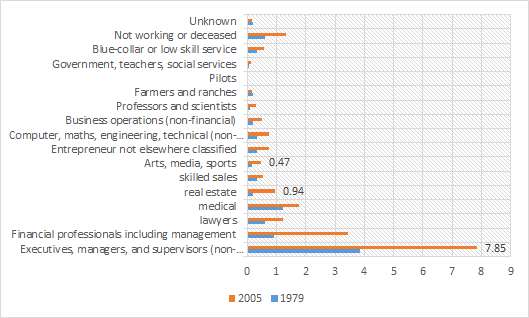
Source: Jon Bakija, Adam Cole and Bradley T. Heim “Jobs and Income Growth of Top Earners and the Causes of Changing Income Inequality: Evidence from U.S. Tax Return Data”.
There is a long history showing how the labour supply of sports stars is highly sensitive to top marginal income tax rates. For a very long time, boxing was the only really big-money sport for athletes:
The 1950s was the era of the 90 percent top marginal tax rate, and by the end of that decade live gate receipts for top championship fights were supplemented by the proceeds from closed circuit telecasts to movie theatres.
A second fight in one tax year would yield very little additional income, hardly worth the risk of losing the title. And so, the three fights between Floyd Patterson and Ingemar Johansson stretched over three years (1959-1961); the two between Patterson and Sonny Liston over two years (1962-1963), as was also true for the two bouts between Liston and Cassius Clay (Muhammad Ali) (1964-1965).
Then, the Tax Reform Act of 1964 cut the top marginal tax rate to 70 percent effective in 1965. The result: two heavyweight title fights in 1965, and five in 1966. You can look it up.
Ufuk Akcigit, Salome Baslandze, and Stefanie Stantcheva found that the migration of superstar inventors is highly responsive to top marginal tax rates.
#Braindrain is real, even quantifiable — as per NBER paper 21024. Geniuses don't tolerate extra taxes easily. http://t.co/HVP8uEFAfz—
Amity Shlaes (@AmityShlaes) June 07, 2015
Ufuk Akcigit, Salome Baslandze, and Stefanie Stantcheva studied the international migration responses of superstar inventors to top income tax rates for the period 1977-2003 using data from the European and US Patent offices.
our results suggest that, given a ten percentage point decrease in top tax rates, the average country would be able to retain 1% more domestic superstar inventors and attract 38% more foreign superstar inventors.

Emmanuel Saez and co-authors also found that a preferential top tax scheme for high earning migrants in their first three years in Denmark was highly successful in attracting highly skilled labour to that country:
…the number of foreigners in Denmark paid above the eligibility threshold (that is the group affected by the tax scheme) doubles relative to the number of foreigners paid slightly below the threshold (those are comparison groups not affected by the tax scheme) after the scheme is introduced.
This effect builds up in the first five years of the scheme and remains stable afterwards. As a result, the fraction of foreigners in the top 0.5% of the earnings distribution is 7.5% in recent years compared to a 4% counterfactual absent the scheme.
This very large behavioural response implies that the resulting revenue-maximising tax rate for a scheme targeting highly paid foreigners is relatively small (about 35%). This corresponds roughly to the current tax rate on foreigners in Denmark under the scheme once we account for other relevant taxes (VAT and excises).

This blog post was motivated by a courageous tweet about Tony Atkinson saying that increases in the top tax rate have little effect on the supply of labour! Not so.
30 May 2015 Leave a comment
in applied price theory, applied welfare economics, comparative institutional analysis, development economics, economic history, entrepreneurship, growth disasters, growth miracles, income redistribution, politics - Australia, politics - New Zealand, politics - USA, Public Choice, public economics, rentseeking Tags: entrepreneurial alertness, Leftover Left, taxes and the labour supply, The inequality and growth, Thomas Piketty, top 1%, Twitter left
Tim Taylor, the editor of the Journal of Economic Perspectives, has written a superb blog post on why we should be sceptical about a strong relationship between inequality and economic growth. Taylor was writing in response to the OECD’s recent report "In It Together: Why Less Inequality Benefits All,".
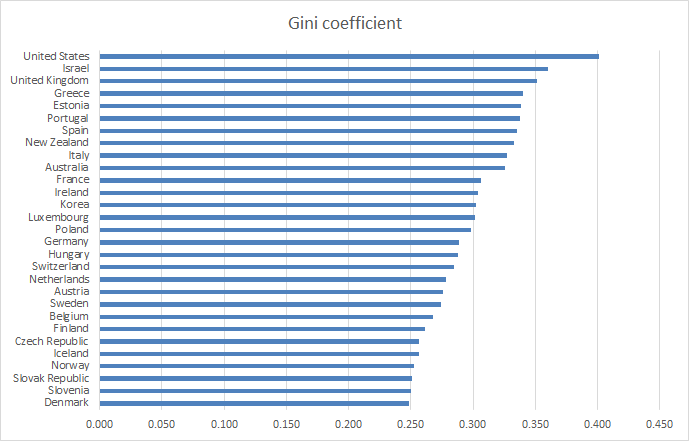
Taylor’s basic point is economists have enough trouble working out what causes economic growth so trawling within that subset of causes to quantify the effects of rising or falling inequality inequality seems to be torturing the data to confess. The empirical literature is simply inconclusive as Taylor says:
A variety of studies have undertaken to prove a connection from inequality to slower growth, but a full reading of the available evidence is that the evidence on this connection is inconclusive.
Most discussions of the link between inequality and growth are notoriously poor of theories connecting two. There are three credible theories in all listed in the OECD’s report:
The report first points out (pp. 60-61 that as a matter of theory, one can think up arguments why greater inequality might be associated with less growth, or might be associated with more growth. For example, inequality could result less growth if:
1) People become upset about rising inequality and react by demanding regulations and redistributions that slow down the ability of an economy to produce growth;
2) A high degree of persistent inequality will limit the ability and incentives of those in the lower part of the income distribution to obtain more education and job experience; or
3) It may be that development and widespread adoption of new technologies requires demand from a broad middle class, and greater inequality could limit the extent of the middle class.
About the best theoretical link between inequality and economic growth is what Taylor calls the "frustrated people killing the goose that lays the golden eggs." Excessive inequality within a society results in predatory government reactions at the behest of left-wing or right-wing populists.

Taylor refers to killing the goose that laid the golden egg as dysfunctional societal and government responses to inequality. He is right but that is not how responses to inequality based on higher taxes and more regulation are sold. Thomas Piketty is quite open about he wants a top tax rate of 83% and a global wealth tax to put an end to high incomes:
When a government taxes a certain level of income or inheritance at a rate of 70 or 80 percent, the primary goal is obviously not to raise additional revenue (because these very high brackets never yield much).
It is rather to put an end to such incomes and large estates, which lawmakers have for one reason or another come to regard as socially unacceptable and economically unproductive…
The left-wing parties don’t say let’s put up taxes and redistribute so that is not something worse and more destructive down the road. Their argument is redistribution will increase growth or at least not harm it. That assumes the Left is addressing this issue of not killing the goose that lays the golden egg at all.

Once you discuss the relationship between inequality and growth in any sensible way you must remember your John Rawls. Incentives encourage people to work, save and invest and channels them into the occupations where they make the most of their talents. Taylor explains:
In the other side, inequality could in theory be associated with faster economic growth if: 1) Higher inequality provides greater incentives for people to get educated, work harder, and take risks, which could lead to innovations that boost growth; 2) Those with high incomes tend to save more, and so an unequal distribution of income will tend to have more high savers, which in turn spurs capital accumulation in the economy.
Taylor also points out that the OECD’s report is seriously incomplete by any standards because it fails to mention that inequality initially increases in any poor country undergoing economic development:
The report doesn’t mention a third hypothesis that seems relevant in a number of developing economies, which is that fast growth may first emerge in certain regions or industries, leading to greater inequality for a time, before the gains from that growth diffuse more widely across the economy.
At a point in its report, the OECD owns up to the inconclusive connection between economic growth and rising inequality as Taylor notes:
The large empirical literature attempting to summarize the direction in which inequality affects growth is summarised in the literature review in Cingano (2014, Annex II).
That survey highlights that there is no consensus on the sign and strength of the relationship; furthermore, few works seek to identify which of the possible theoretical effects is at work. This is partly tradeable to the multiple empirical challenges facing this literature.
The OECD’s report responds to this inclusiveness by setting out an inventory of tools with which you can torture the data to confess to what you want as Taylor notes:
There’s an old saying that "absence of evidence is not evidence of absence," in other words, the fact that the existing evidence doesn’t firmly show a connection from greater inequality to slower growth is not proof that such a connection doesn’t exist.
But anyone who has looked at economic studies on the determinants of economic growth knows that the problem of finding out what influences growth is very difficult, and the solutions aren’t always obvious.
The chosen theory of the OECD about the connection between inequality and economic growth is inequality leads to less investment in human capital at the bottom part of the income distribution.
[Inequality] tends to drag down GDP growth, due to the rising distance of the lower 40% from the rest of society. Lower income people have been prevented from realising their human capital potential, which is bad for the economy as a whole
I found this choice of explanation curious. So did Taylor as the problem already seems to have been solved:
There are a few common patterns in economic growth. All high-income countries have near-universal K-12 public education to build up human capital, along with encouragement of higher education. All high-income countries have economies where most jobs are interrelated with private and public capital investment, thus leading to higher productivity and wages.
All high-income economies are relatively open to foreign trade. In addition, high-growth economies are societies that are willing to allow and even encourage a reasonable amount of disruption to existing patterns of jobs, consumption, and ownership. After all, economic growth means change.
In New Zealand, interest free student loans are available to invest in higher education as well as living allowances for those with parents on a low income. There are countries in Europe with low levels of investment in higher education but that’s because of high income taxes not because of inequality.
The OECD’s report is fundamentally flawed which is disappointing because most research from the OECD is to a good standard.
via CONVERSABLE ECONOMIST: Does Inequality Reduce Economic Growth: A Skeptical View.
25 Feb 2015 Leave a comment
in applied welfare economics, development economics, economic history, growth miracles, human capital, labour economics, politics - New Zealand, politics - USA, poverty and inequality Tags: Paul Krugman, Thomas Piketty
20 Jan 2015 Leave a comment
in applied welfare economics, politics - Australia, politics - New Zealand, politics - USA Tags: Leftover Left, Oxfam, Thomas Piketty
20 Jan 2015 Leave a comment
in applied price theory, applied welfare economics, economic growth, economic history, income redistribution, macroeconomics, Public Choice, public economics, rentseeking Tags: Leftover Left, Thomas Piketty
25 Sep 2014 Leave a comment
in economics of media and culture, Marxist economics Tags: Thomas Piketty
Professor Jordan Ellenberg looked at the five most popular book passages in a number of current best-sellers, according to data from Amazon Kindle readers. He determined the average page number readers highlighted and divided that by the total number of pages in the book.
A high number, according to Ellenberg, means that readers are reading until the end. Donna Tartt’s Pulitzer Prize-winning blockbuster, The Goldfinch, for example, earned a score of 98.5 percent on the index.
Piketty’s book scored a dismal 2.4 percent. The latest of the five most popular highlights in Piketty’s book is located on page 26, according to the Ellenberg.
26 May 2014 Leave a comment
in labour economics, politics - USA Tags: data mining, Thomas Piketty
29 Apr 2014 Leave a comment
in applied welfare economics, entrepreneurship, macroeconomics, market efficiency, politics, Rawls and Nozick, taxation, technological progress Tags: Greg Mankiw, Jon Elster, Mirrlees Review, Robert Lucas, Thomas Piketty, Tyler Cowen
It’s 700 pages long and goes on about Marx. Some people were watching the other channel when the Berlin Wall fell.

My 1 o’clock lecture at ANU in 1990 was next to a room rented out ironically from 12 to 1 to the Campus Trots and then to the Campus Christians for an hour of prayer to another saviour.
The Twitter summary of Piketty is this:
Karl Marx wasn’t wrong, just early. Pretty much. Sorry, capitalism. #inequalityforevah
The only Marxist I bother with is Jon Elster. He is a leading proponent of Analytical Marxism and one of the last polymaths. Brian Barry once wrote that to review one of Elster’s books one:
would either have to have taken off several years to master the many fields which fall within Elster’s purview or would be a consortium of at least twenty carefully-chosen experts.
All of Elster’s books and writings are worth reading, including
As Jon Elster noted:
Marxian economics is, with a few exceptions, intellectually dead
and Marx’s labour theory of value is:
useless at best, harmful and misleading at its not infrequent worst.
To go on with my non-review, I will quote Tyler Cowen:
The crude seven-word version of Piketty’s argument is “rates of return on capital won’t diminish.”
Piketty’s reasons why rates of return on capital won’t diminish are fairly specific and restricted to only a small share of capital.
.. In any case this is pure speculation and Piketty’s entire argument depends upon it.
… Piketty converts the entrepreneur into the rentier.
To the extent capital reaps high returns, it is by assuming risk…
Yet the concept of risk hardly plays a role in the major arguments of this book.
Once you introduce risk, the long-run fate of capital returns again becomes far from certain.
In fact the entire book ought to be about risk but instead we get the rentier…
Overall, the main argument is based on two (false) claims.
First, that capital returns will be high and non-diminishing, relative to other factors.
Second, that this can happen without significant increases in real wages.
Piketty’s advocacy of a top marginal income tax rate of 80% and a an international treaty for a wealth tax are wildly impractical and destructive of economic growth and entrepreneurship. His advocacy of 60% marginal tax rates on incomes above $200,000 strike at the heart of the professional and managerial occupations that are the backbone of day-to-day capitalism. Piketty’s wealth tax would tax the homes and the retirement savings of the ordinary middle class:
Piketty’s reason for these high top tax rates is not to bring in more revenue or to redistribute wealth to poor and the downtrodden but simply “to put an end to such incomes.” Harsanyi argues that:
Like many progressives, Piketty doesn’t really believe that most people deserve their wealth anyway, so confiscating it presents no real moral dilemma.
He also argues that we can measure a person’s productivity and the value of a worker (namely, low-skilled labourers) while arguing that other groups of workers (namely, the kind of people he doesn’t admire) are bequeathed undeserved, “arbitrary” salaries. What tangible benefit does a stockbroker or a kulak or an explanatory journalist offer society, after all?
This takes me back to Jon Elster who had this to say on socialism:
Optimism and wishful thinking have been features of socialist thought from its inception.
In Marx, for instance, two main premises appear to be that whatever is desirable is possible, and that whatever is desirable and possible is inevitable.
…It has become clear that classical socialism massively underestimated the importance of economic incentives
.
Greg Mankiw is less harsh, but still to the point:
Like President Obama and others on the left, Piketty wants to spread the wealth around.
Another philosophical viewpoint is that it is the government’s job to enforce rules such as contracts and property rights and promote opportunity rather than to achieve a particular distribution of economic outcomes.
No amount of economic history will tell you that John Rawls (and Thomas Piketty) offers a better political philosophy than Robert Nozick (and Milton Friedman).
John Rawls was actually very much alive to the importance of incentives in a just and prosperous society.
Unequal incomes might turn out to be to the advantage of everyone. Work effort and entrepreneurial alertness respond to incentives; incentives channel people into the occupations and jobs where they produce more.
Rawls lent qualified support to the idea of a flat-rate consumption tax because these taxes:
impose a levy according to how much a person takes out of the common store of goods and not according to how much he contributes.
A simple way to have a progressive consumption tax is to exempt all savings from taxation.
With his emphasis on fair distributions of income, Rawls’ initial appeal was to the Left. Left-wing thinkers then started to dislike his acceptance of capitalism and his tolerance of large discrepancies in income and wealth.
It’s impossible to make the workers better off by taxing capital. The optimal rate of tax on income from capital is zero. This is why the Mirrlees Review of the UK taxation system argued for zero taxation of the returns to capital.
Robert Lucas estimated in 1990 that eliminating all taxes on income from capital would increase the U.S. capital stock by about 35% and consumption by 7%.
Hans Fehr, Sabine Jokisch, Ashwin Kambhampati, and Laurence J. Kotlikoff (2014) found that eliminating the corporate income tax completely would raise the U.S. capital stock (machines and buildings) by 23%, output by 8% and the real wages of unskilled and skilled workers each by 12%.
Book reviews serve the same purpose as film reviews. They are filters for our time. Do you agree?
I made a time management decision to not read a long book plenty of others reviewed and some even understood.
As for the growing income inequality, there is a long literature dating back 25-years arguing that skill-biased technological change is increasing the returns to investing in education as Gary Becker blogged in 2011:
Earnings inequality in the United States and many other countries has increased greatly since the late 1970s, due in large measure to globalization and technological progress that raised the productivity of more educated and more skilled individuals.
While the average American college graduate earned about a 40% premium over the average high school graduate in 1980, this premium increased to over 70% in 2000.
The good side of this higher education-based earnings inequality is that it induced more young men, and especially more young women, to go to and finish college.
The bad side is that many sufficiently able children could not take advantage of the greater returns from a college education because their parents did not prepare them to perform well in school, or they went to bad schools, or they lacked the financing to attend college.
As a result, the incomes of high school dropouts and of many high school graduates stagnated while incomes boomed for many persons who graduated college, and even more so for those with post graduate education.
There is nothing new under the sun.
Celebrating humanity's flourishing through the spread of capitalism and the rule of law
Scholarly commentary on law, economics, and more
Beatrice Cherrier's blog
Celebrating humanity's flourishing through the spread of capitalism and the rule of law
Celebrating humanity's flourishing through the spread of capitalism and the rule of law
Celebrating humanity's flourishing through the spread of capitalism and the rule of law
Why Evolution is True is a blog written by Jerry Coyne, centered on evolution and biology but also dealing with diverse topics like politics, culture, and cats.
Celebrating humanity's flourishing through the spread of capitalism and the rule of law
Celebrating humanity's flourishing through the spread of capitalism and the rule of law
A rural perspective with a blue tint by Ele Ludemann
DPF's Kiwiblog - Fomenting Happy Mischief since 2003
Celebrating humanity's flourishing through the spread of capitalism and the rule of law
The world's most viewed site on global warming and climate change
Tim Harding's writings on rationality, informal logic and skepticism
A window into Doc Freiberger's library
Let's examine hard decisions!
Commentary on monetary policy in the spirit of R. G. Hawtrey
Thoughts on public policy and the media
Celebrating humanity's flourishing through the spread of capitalism and the rule of law
Politics and the economy
A blog (primarily) on Canadian and Commonwealth political history and institutions
Reading between the lines, and underneath the hype.
Economics, and such stuff as dreams are made on
"The British constitution has always been puzzling, and always will be." --Queen Elizabeth II
Celebrating humanity's flourishing through the spread of capitalism and the rule of law
Celebrating humanity's flourishing through the spread of capitalism and the rule of law
WORLD WAR II, MUSIC, HISTORY, HOLOCAUST
Undisciplined scholar, recovering academic
Celebrating humanity's flourishing through the spread of capitalism and the rule of law
Res ipsa loquitur - The thing itself speaks
Celebrating humanity's flourishing through the spread of capitalism and the rule of law
Researching the House of Commons, 1832-1868
Articles and research from the History of Parliament Trust
Reflections on books and art
Posts on the History of Law, Crime, and Justice
Celebrating humanity's flourishing through the spread of capitalism and the rule of law
Exploring the Monarchs of Europe
Cutting edge science you can dice with
Small Steps Toward A Much Better World
“We do not believe any group of men adequate enough or wise enough to operate without scrutiny or without criticism. We know that the only way to avoid error is to detect it, that the only way to detect it is to be free to inquire. We know that in secrecy error undetected will flourish and subvert”. - J Robert Oppenheimer.
The truth about the great wind power fraud - we're not here to debate the wind industry, we're here to destroy it.
Celebrating humanity's flourishing through the spread of capitalism and the rule of law
Celebrating humanity's flourishing through the spread of capitalism and the rule of law
Economics, public policy, monetary policy, financial regulation, with a New Zealand perspective
Celebrating humanity's flourishing through the spread of capitalism and the rule of law
Restraining Government in America and Around the World


 Utopia, you are standing in it!
Recent Comments