17 Mar 2016
by Jim Rose
in applied welfare economics, economic history, economics of education, entrepreneurship, human capital, labour economics, politics - New Zealand, poverty and inequality, urban economics
Tags: household wealth, housing prices, pessimism bias, top 1%
Tring Le found that the human capital stock was consistently 2.6 times the value of the physical capital stock of New Zealand.
I decided to apply that ratio to the net capital stock of New Zealand estimates of Statistics New Zealand back to 1987 to see what we get. It is pretty standard for the value of human capital to be two to two and one-half times the value of physical capital.
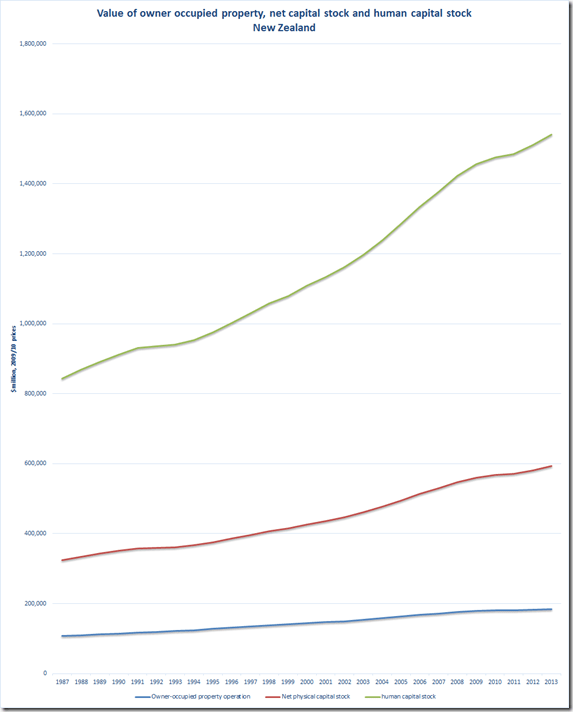
Source: National Accounts (Industry Benchmarks): Year ended March 2013 and Lˆe Thi. Vˆan Tr`ınh, Estimating the monetary value of the stock of human capital for New Zealand, University of Canterbury PhD thesis (September 2006), Table 4.8: Human and physical capital stocks.
All the above chart says it is most wealth in New Zealand is held by ordinary people either as their human capital or the value of their homes.
17 Feb 2016
by Jim Rose
in applied welfare economics, development economics, economic history, economics of regulation, entrepreneurship, growth disasters, growth miracles, industrial organisation
Tags: billionaires, entrepreneurial alertness, India, superstars, top 1%
16 Feb 2016
by Jim Rose
in applied welfare economics, economic history, economics of regulation, entrepreneurship, financial economics, human capital, industrial organisation, labour economics, poverty and inequality, survivor principle
Tags: billionaires, British economy, entrepreneurial alertness, superstars, top 1%

Inheriting wealth is not what it used to be in Britain. There are all these upstarts running businesses or working in the City.

Source: Caroline Freund and Sarah Oliver, The Origins of the Superrich: The Billionaire Characteristics Database (2016).
15 Feb 2016
by Jim Rose
in applied price theory, development economics, economic history, entrepreneurship, growth miracles, human capital, industrial organisation, labour economics
Tags: billionaires, China, entrepreneurial alertness, superstars, top 1%
20 Jan 2016
by Jim Rose
in applied welfare economics, economic history, labour economics, politics - New Zealand, poverty and inequality
Tags: Employment Contracts Act, employment law, Leftover Left, rational ignorance, rational irrationality, top 1%, union power, Withering away of the proletariat
The union movement posted two excellent charts during the last election showing how well things have gone since the 1980s economic reforms and their consolidation in the early 1990s.
The charts show that real wage growth returned in the early 1990s after the passage of the Employment Contracts Act and the consolidation of government finances. This was after two decades of wage stagnation in what the unions regards as the good old days.
Furthermore, as the union chart shows, the average incomes of the top 1% in New Zealand is a pretty stable for several decades. Whatever else is happening New Zealand, you cannot blame it on the top 1% because they are lazy. What increase there was in average top incomes in New Zealand was followed by the return of real wage growth in New Zealand and a long economic boom where the unemployment rate drop below 3.5%
The main bugbear is housing affordability which is a result of the Resource Management Act passed in 1993 as the union chart shows. The unions, the Labour Party and Greens all support the laws that result in this housing unaffordability.
15 Jan 2016
by Jim Rose
in economic history, labour economics, poverty and inequality, unions
Tags: collective bargaining coverage, top 1%, union membership, union power, union wage premium
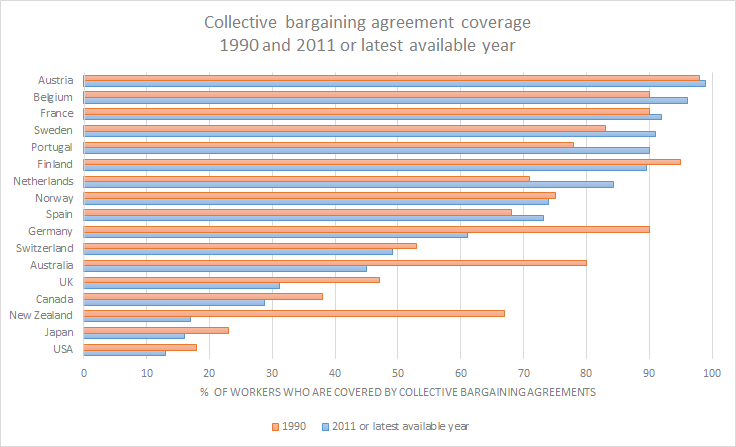
Despite all the hullabaloo, collective bargaining agreement coverage is not declined by that much outside of the English-speaking countries. Outside of the USA, the top 1% are very lazy so they have not benefited from this decline of union power. Within the USA, so few people are covered by collective bargaining agreements for so long that it would not figure in the rising top incomes over the last 30 or more years.

Source: Economic Policy Reforms 2015: Going for Growth – © OECD 2015 and OECD Employment Outlook 2002.
As for New Zealand, the main difference between 70% collective bargaining agreement coverage in 1990 and less than 20% collective bargaining coverage in 2011 is real wage growth returned to New Zealand in the early 1990s after 20 years of wage stagnation. The major economic event of the time was the passage of the Employment Contracts Act.
Previous Older Entries Next Newer Entries





 Utopia, you are standing in it!
Recent Comments