…
The Economist Crony Capitalism Index
08 Jul 2016 Leave a comment
in applied price theory, applied welfare economics, comparative institutional analysis, constitutional political economy, development economics, economics of bureaucracy, entrepreneurship, financial economics, growth disasters, growth miracles, industrial organisation, politics - USA, Public Choice, rentseeking, survivor principle Tags: crony capitalism, superstar wages, superstars, top 1%
Average top incomes in New Zealand
05 Jul 2016 Leave a comment
in human capital, labour economics, labour supply, occupational choice, poverty and inequality Tags: creative destruction, entrepreneurial alertness, top 1%
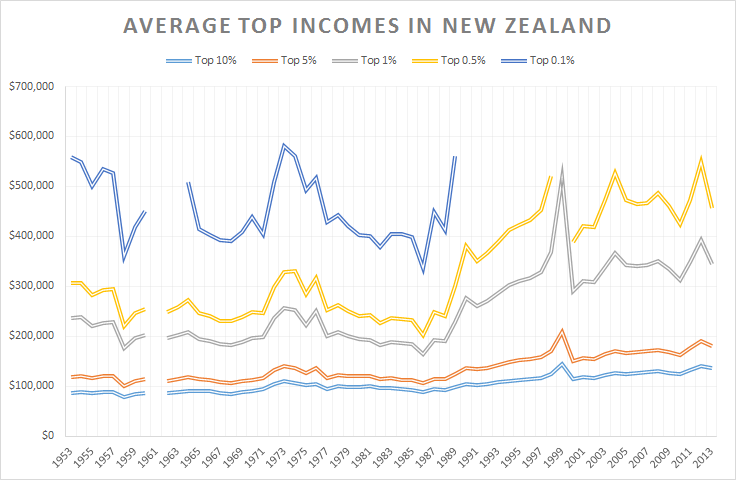
The average top income in New Zealand is that of a professional, executive or entrepreneur.
Source: The World Wealth and Income Database.
#FeeltheBern? There’s a Cure.
09 Jun 2016 Leave a comment
in applied price theory, applied welfare economics, comparative institutional analysis, economic history, economics of education, economics of regulation, health economics, income redistribution, industrial organisation, international economics, politics - USA, Public Choice, public economics, rentseeking Tags: 2016 presidential election, antimarket bias, crony capitalism, living wage, pessimism bias, top 1%
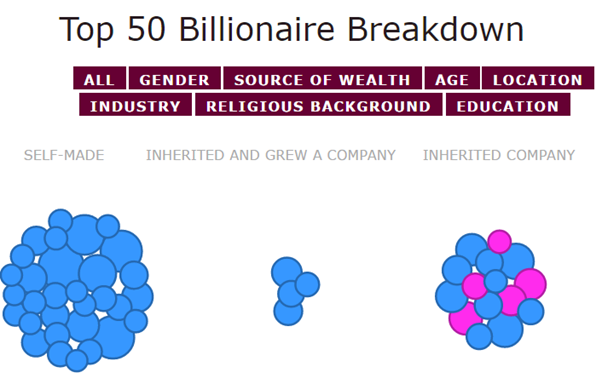
Few of the top 50 billionaires inherited their wealth
01 Jun 2016 Leave a comment
in applied price theory, applied welfare economics, economic history, entrepreneurship, financial economics, human capital, labour economics, poverty and inequality, unions Tags: entrepreneurial alertness, inherited wealth, superstar wages, superstars, top 0.1%, top 1%
Of the 15 inheritance based billionaires, three are from the Walton family, two are the Koch brothers and another three are from the Mars family.
Source: The world’s top 50 billionaires: A demographic breakdown.
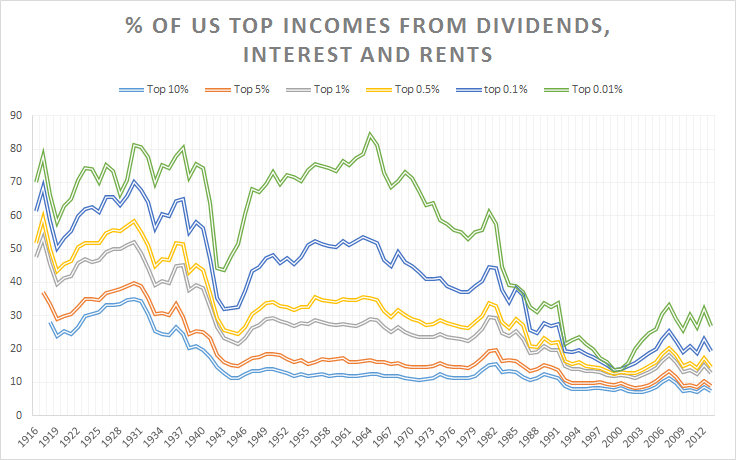
The decline and decline of the rentier class in the USA
24 May 2016 Leave a comment
in economic history, entrepreneurship, human capital, industrial organisation, labour economics, labour supply, occupational choice, politics - USA, poverty and inequality Tags: entrepreneurial alertness, superstar wages, superstars, top 1%, top incomes
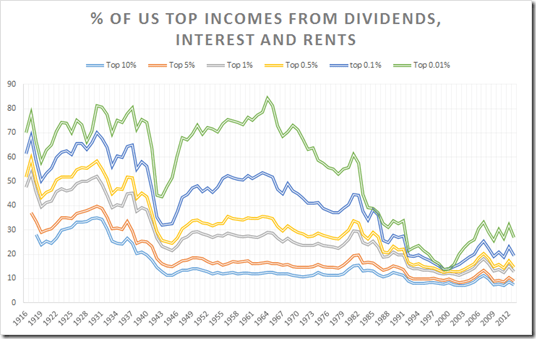
Looks like the Reagan Revolution coincided with the American rich going out to work for a living. They started earning most of their incomes from wages, salaries and pensions or from entrepreneurial income. The American rich are now working rich; top wage earners, not top income earners.
![]()
Source: The World Wealth and Income Database.
% of top incomes from wages, salaries and pensions
23 May 2016 Leave a comment
in applied price theory, applied welfare economics, economic history, entrepreneurship, human capital, industrial organisation, labour economics, labour supply, occupational choice, poverty and inequality, survivor principle Tags: entrepreneurial alertness, envy, superstar wages, superstars, top 1%, top incomes
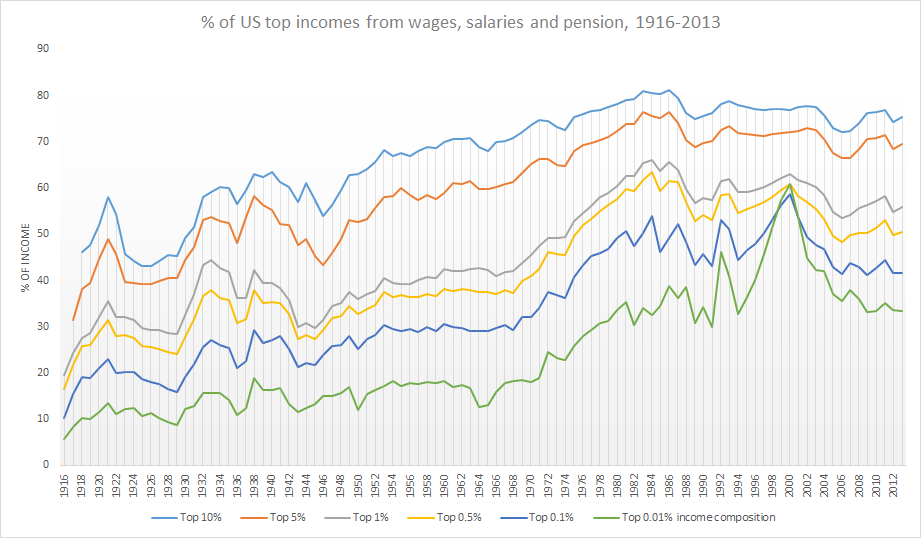
Everybody from the top 10% to the top 0.01% have to work for their living these days with much of their income coming from wages.
Source: The World Wealth and Income Database.
Bryan Bruce’s boy’s own memories of pre-neoliberal #NewZealand @Child_PovertyNZ
23 May 2016 Leave a comment
in applied welfare economics, comparative institutional analysis, economic history, economics of regulation, income redistribution, industrial organisation, politics - New Zealand, poverty and inequality, Public Choice, rentseeking Tags: child poverty, conspiracy theories, expressive voting, family poverty, Leftover Left, living standards, neoliberalism, Old Left, pessimism bias, rational irrationality, reactionary left, top 1%
New work by Chris Ball and John Creedy shows substantial *declines* in NZ inequality.
initiativeblog.com/2015/06/24/ine… http://t.co/f94fw4Bhae—
Eric Crampton (@EricCrampton) June 24, 2015
You really are still fighting the 1990 New Zealand general election if Max Rashbrooke makes more sense than you on the good old days before the virus of neoliberalism beset New Zealand from 1984 onwards.

Source: Mind the Gap: Why most of us are poor | Stuff.co.nz.
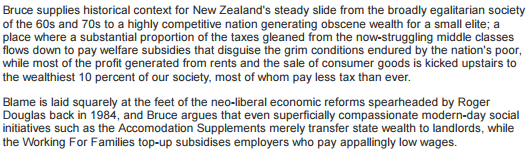
Bryan Bruce in the caption looks upon the New Zealand of the 1960s and 70s as “broadly egalitarian”. Even Max Rashbrooke had to admit that was not so if you were Maori or female.
The present rate of technology adoption is nearly a vertical line —@blackrock https://t.co/3oS3YAI4ld—
Vala Afshar (@ValaAfshar) January 22, 2016
Maybe 65% of the population of those good old days before the virus of neoliberalism. were missing out on that broadly egalitarian society championed by Bryan Bruce.
As is typical for the embittered left, the reactionary left, gender analysis and the sociology of race is not for their memories of their good old days. New Zealand has the smallest gender wage gap of any of the industrialised countries.
The 20 years of wage stagnation that proceeded the passage of the Employment Contracts Act and the wages boom also goes down the reactionary left memory hole.
That wage stagnation in New Zealand in the 1970s and early 80s coincided with a decline in the incomes of the top 10%. When their income share started growing again, so did the wages of everybody after 20 years of stagnation. The top 10% in New Zealand managed to restore their income share of the early 1970s and indeed the 1960s. That it is hardly the rich getting richer.
Did top income earners pay less income tax after @JohnKeyMP was elected?
08 May 2016 Leave a comment
in politics - New Zealand, public economics Tags: superstar wagers, superstars, top 1%, top incomes
#NewZealand’s top 1% is getting even lazier under neoliberal @johnkeyMP
07 May 2016 Leave a comment
in politics - New Zealand, public economics Tags: entrepreneurial alertness, Leftover Left, reactionary left, superstar wagers, superstars, top 1%
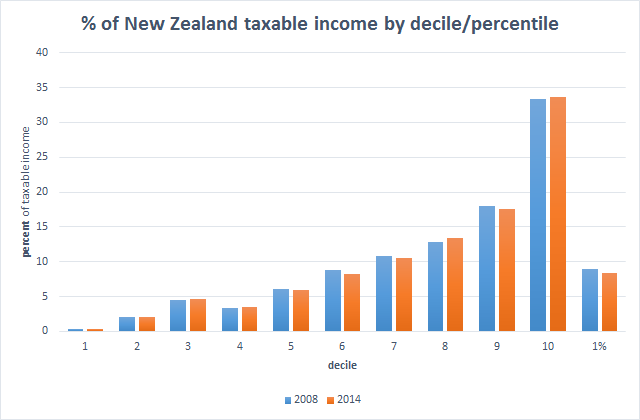
The share of incomes of the top 1% in New Zealand has not increased since the 1950s – they are just bone lazy at extracting labour surplus.
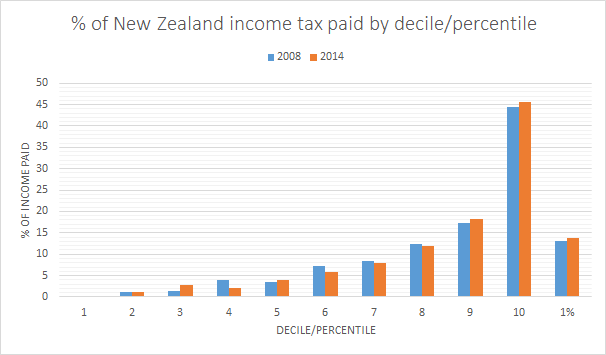
Veteran left-wing grumbler Max Rashbrooke was good enough to collect Inland Revenue Data data that show that getting even lazier under right-wing government elected in 2008. Their share of taxable income has dropped from 9% when labour lost power to 8.4% now. These figures exclude capital gains.
The top 1% gave Canadian women a pass on real wage stagnation too
07 May 2016 Leave a comment
in applied welfare economics, discrimination, economic history, gender, labour economics, labour supply Tags: Canada, gender wage gap, middle class stagnation, reversing gender gap, top 1%, wage stagnation
Creative destruction in top ICT company pay
05 May 2016 Leave a comment
in human capital, industrial organisation, labour economics, labour supply, occupational choice, survivor principle Tags: Apple, CEO pay, creative destruction, entrepreneurial alertness, Facebook, Google, Microsoft, superstar wages, superstars, top 1%, Twitter, Uber, Yahoo
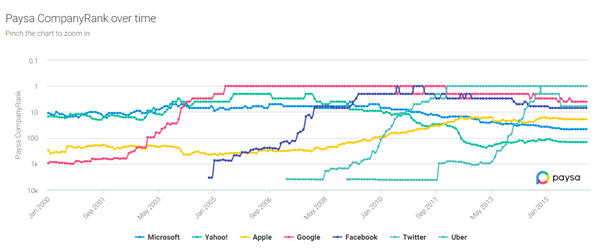
I am surprised to see that Yahoo is in business much less competing for top talent. Microsoft is in decline too. Apple does not pay people as much as everybody else.
Source: Paysa Company Rank | Paysa.
Some other colours seem to duplicate so you will have to work out which is which by when they exploded in hiring top talent.
@Economicpolicy shows that top CEO pay has been a miserable rollercoaster for 15 years
25 Apr 2016 Leave a comment
Was Occupy Wall Street based on a measurement error?
26 Mar 2016 Leave a comment
in applied welfare economics, economic history, entrepreneurship, human capital, labour economics, poverty and inequality Tags: entrepreneurial alertness, superstar wages, superstars, top 0.1%, top 1%
Piketty and Saez (2003, updated) estimated the share of income held by the top 1% from 13 percent in 1991 to 23 percent in 2012. The new Bricker et al. research shows only a 7 percentage point increase to 18 percent in 2012. The share held by the super-rich, the top 0.1% has increased much at all.
Source: Measuring income and wealth at the top using administrative and survey data via How super-rich Americans get that way is changing – AEI | Pethokoukis Blog » AEIdeas.

Recent Comments