10 Aug 2015
by Jim Rose
in business cycles, human capital, job search and matching, labour economics, labour supply, macroeconomics, politics - New Zealand, unemployment
Tags: equilibrium unemployment rate, hysteresis, long-term unemployment, natural unemployment rate, unemployment duration, unemployment rates
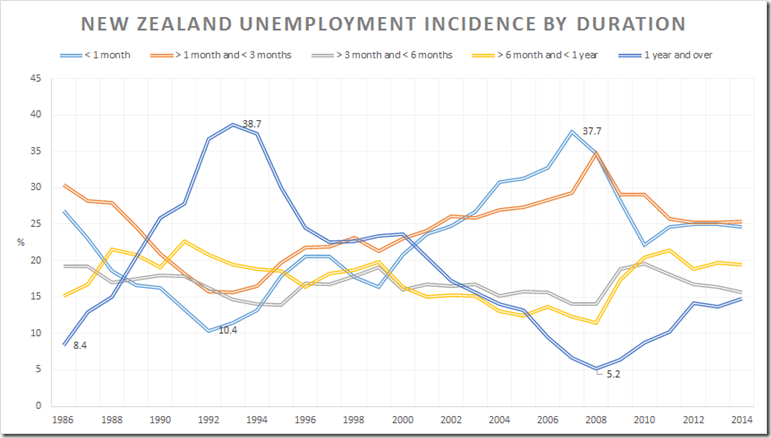
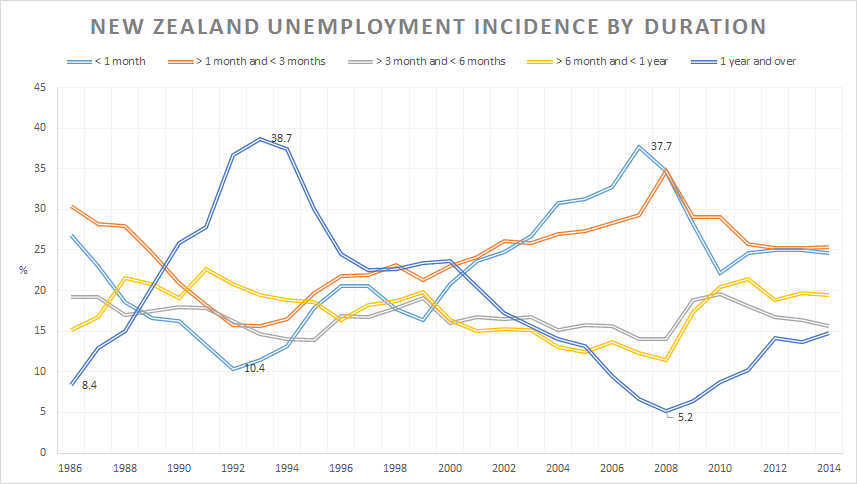
There has been bit of a wild ride in long-term unemployment in New Zealand. Long-term unemployment – longer than one year – ranging from just over 8% of unemployment in 1986 to nearly 40% in 1992 then down to 5% in 2008. Clearly the duration of unemployment in New Zealand is highly sensitive to the business cycle unlike the case in the USA or UK.
Source: OECD StatExtract.
This sensitivity of long-term unemployment to the business cycle does not bode well for the hypothesis of hysteresis where human capital depreciates the longer a jobseeker is out of employment. For this hypothesis to hold, there must be some enduring aspect of long-term unemployment rather than just going up and down with the business cycle rather noticeably.

The rival hypothesis to hysteresis is the long-term unemployed tend to be those who have a lot of trouble getting employment, which is why they end up been unemployed for a long time. Again in New Zealand, these less employable jobseekers appear to be able to find jobs quite easily when the labour market is good.
09 Aug 2015
by Jim Rose
in business cycles, economic history, global financial crisis (GFC), job search and matching, labour economics, labour supply, macroeconomics, unemployment
Tags: British disease, British economy, equilibrium unemployment rate, Margaret Thatcher, natural unemployment rate, unemployment duration, unemployment rates
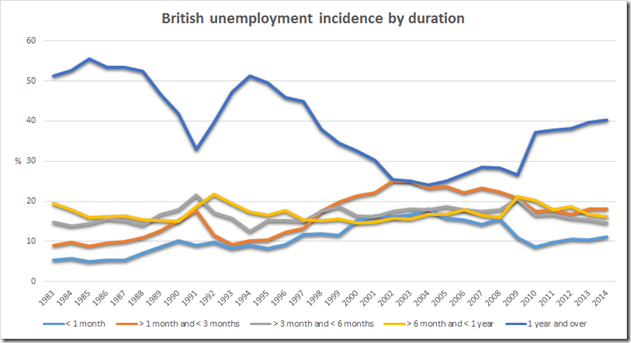
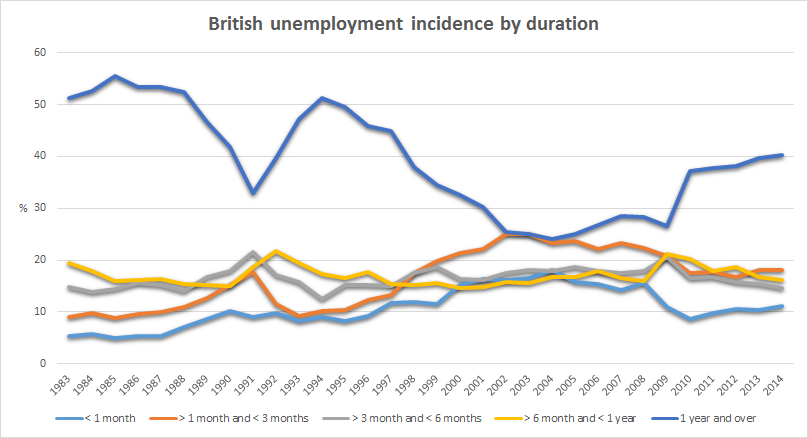
In contrast to the USA, there is been a long-term decline in long-term unemployment, that is unemployment of more than a year, in the British economy over the 1990s. The situation then stabilised and then increased after the global financial crisis. There is also a rather rapid fall in long-term unemployment in the mid-1980s as the British economy recovered under Thatchernomics
Source: OECD StatExtract.
08 Aug 2015
by Jim Rose
in budget deficits, great recession, job search and matching, labour economics, labour supply, macroeconomics, politics - USA, unemployment, welfare reform
Tags: natural unemployment rate, taxation and labour supply, unemployment duration, unemployment insurance, unemployment rates, welfare state
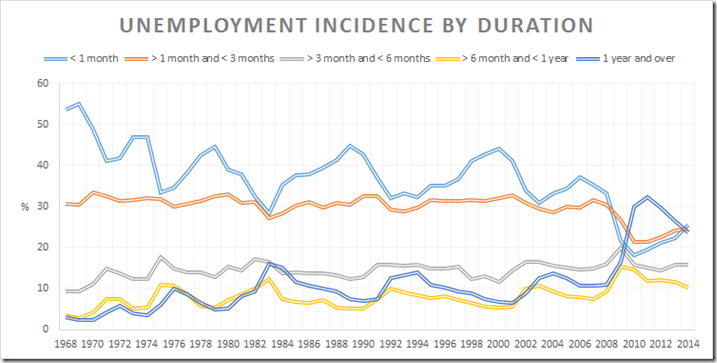
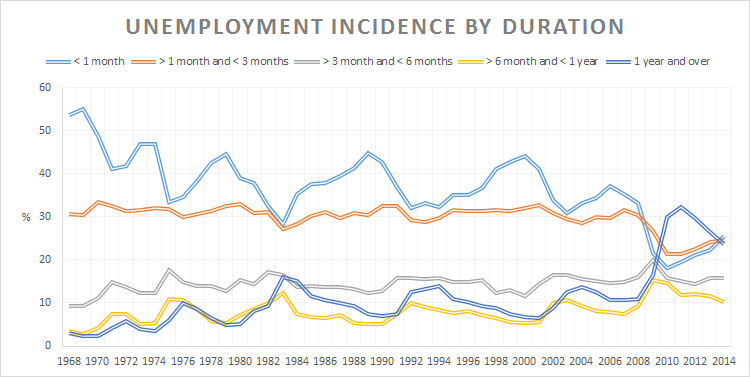
The Great Recession was the first recession in the USA in a good 40 to 50 years where the composition of employment changed by much. Even the big recession at the beginning of the 1980s did not do much to the composition of unemployment by duration in the USA.
Source: OECD StatExtract.
Those unemployed for more than a year moved from barely double digits even in a bad recession prior to 2008 to coming on one-third of all unemployed. Likewise, those unemployed for less than a month halved from 40% to 20%. Something changed in the US labour market with the Great Recession and the long extensions of unemployment insurance from 26 weeks to 52 weeks and then 99 weeks.
08 Aug 2015
by Jim Rose
in business cycles, economic history, global financial crisis (GFC), great recession, job search and matching, labour economics, labour supply, macroeconomics, unemployment
Tags: Australia, Canada, unemployment rates
Source: OECD StatExtract.
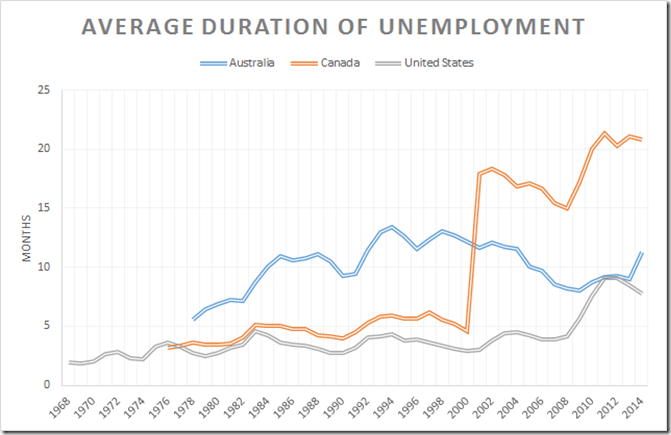
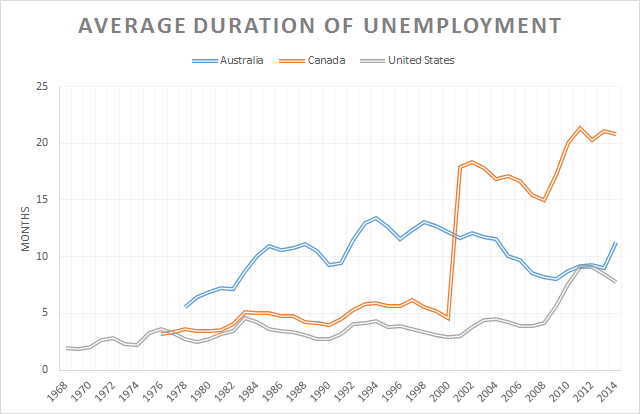
I have no information as to why there is a sudden surge in the Canadian unemployment duration rate in 2001.
10 May 2015
by Jim Rose
in business cycles, economic growth, job search and matching, labour economics, labour supply, macroeconomics, politics - USA, unemployment
Tags: Canada, unemployment rates
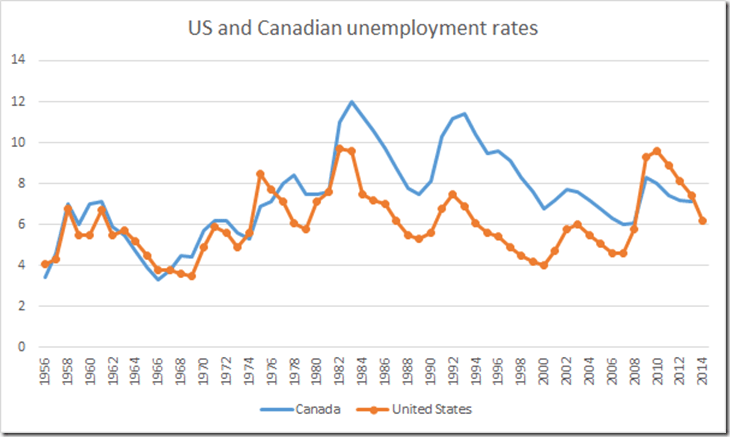
Source: OECD StatExtract
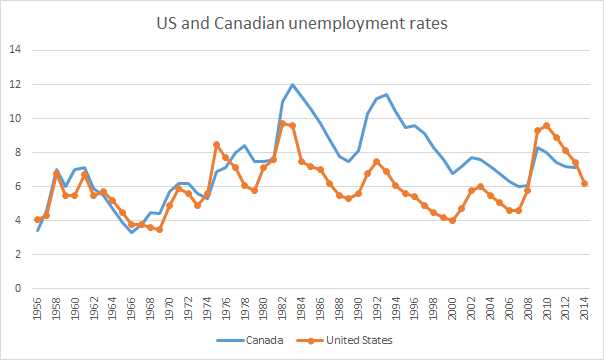
Unemployed people are defined as those who report that they are without work, that they are available for work and that they have taken active steps to find work in the last four weeks.
The ILO Guidelines specify what actions count as active steps to find work; these include answering vacancy notices, visiting factories, construction sites and other places of work, and placing advertisements in the press as well as registering with labour offices.
09 May 2015
by Jim Rose
in economic growth, economic history, great depression, job search and matching, labour economics, labour supply, macroeconomics, unemployment
Tags: British economy, Celtic Tiger, Ireland, prosperity and depression, sick man of Europe, unemployment rates
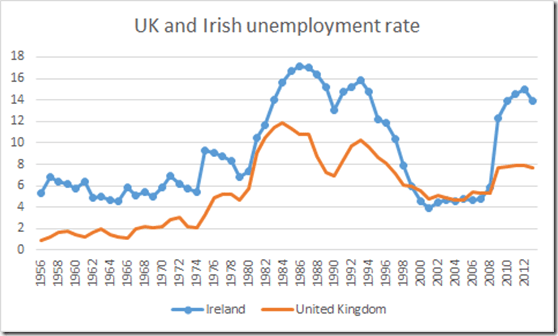
Source: OECD StatExtract
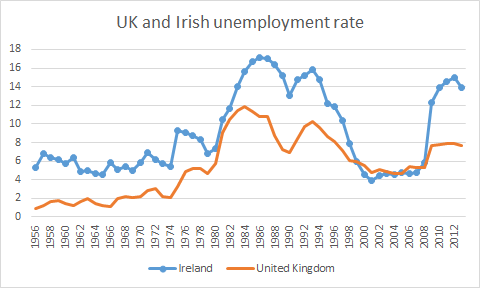
Ireland and Britain justly earned the name the sick man of Europe in the 1980s. Irish unemployment was in the mid teens much of the 1980s because the Irish economy was in a great depression from 1973 to 1992.
Unemployed people are defined as those who report that they are without work, that they are available for work and that they have taken active steps to find work in the last four weeks. The ILO Guidelines specify what actions count as active steps to find work; these include answering vacancy notices, visiting factories, construction sites and other places of work, and placing advertisements in the press as well as registering with labour offices.
 Utopia, you are standing in it!
Recent Comments