Susan Hornsby-Geluk writes: Among the most controversial aspects of the recently enacted Employment Relations Amendment Act 2026 is the introduction of a high-income threshold for personal grievance claims. Under the new provisions, employees earning $200,000 or more in annual remuneration will lose the right to bring a personal grievance for unjustified dismissal, or an unjustified…
A worthwhile trade off
A worthwhile trade off
25 Mar 2026 Leave a comment
in applied price theory, economics of regulation, human capital, labour economics, labour supply, law and economics, occupational choice, politics - New Zealand, property rights Tags: offsetting behavior, unintended consequences, employment law
Very Expensive Affordable Housing
10 Jun 2025 1 Comment
in applied price theory, economics of regulation, law and economics, politics - USA, property rights, urban economics Tags: housing affordability, offsetting behavior, The fatal conceit, unintended consequences
In my post Affordable Housing is Almost Pointless, I highlighted how point systems for awarding tax credits prioritize DEI, environmental features, energy efficiency, and other secondary goals far more than low cost. A near-comic example comes from D.C., where so-called affordable housing units now cost between $800,000 and $1.3 million dollars each! One such unit […]
Very Expensive Affordable Housing
Long-Run Effects of Trade Wars
24 Apr 2025 Leave a comment
in applied price theory, applied welfare economics, comparative institutional analysis, development economics, econometerics, history of economic thought, industrial organisation, labour economics, labour supply, politics - USA, unemployment Tags: 2024 presidential election, free trade, tariffs, unintended consequences
This short note shows that accounting for capital adjustment is critical when analyzing the long-run effects of trade wars on real wages and consumption. The reason is that trade wars increase the relative price between investment goods and labor by taxing imported investment goods and their inputs. This price shift depresses capital demand, shrinks the […]
Long-Run Effects of Trade Wars
Why Tariffs Don’t Cause and Won’t Fix Trade Deficits
12 Apr 2025 Leave a comment
in applied price theory, history of economic thought, industrial organisation, international economics, politics - USA Tags: free trade, tarrifs, unintended consequences

There’s a fundamental misconception at the root of President Trump’s tariff policies, which is the mistaken claim that the existence of a US trade deficit proves that trade is unfair. There are two related mistaken claims. One is a claim that if tariff and non-tariff barriers to trade were removed, then trade would be balanced.…
Why Tariffs Don’t Cause and Won’t Fix Trade Deficits
How employers respond to minimum wage increases
15 Feb 2025 Leave a comment
in applied price theory, labour economics, labour supply, minimum wage, unemployment Tags: offsetting behavior, unintended consequences
In yesterday’s post, I made reference to this 2021 article by Jeffrey Clemens (University of California at San Diego), published in the Journal of Economic Perspectives (open access). Clemens puts forward an interesting perspective on the debate about the observed employment impacts of the minimum wage (or lack thereof):…I contend that controversies over the economics of minimum wages…
How employers respond to minimum wage increases
Noah Smith on L.A: fire lessons
13 Jan 2025 Leave a comment
in applied price theory, economics of bureaucracy, economics of natural disasters, environmental economics, environmentalism, income redistribution, law and economics, politics - USA, property rights, Public Choice, rentseeking, urban economics Tags: unintended consequences
The best piece I have seen so far, here is one bit: Basically, the lessons I take away from the horrific L.A. fires are: The insurance industry as we know it is in big trouble. Climate change is making wildfires worse, but there’s not much we can do about that right now. Forest management needs […]
Noah Smith on L.A: fire lessons
Smart Growth Burns Thousands of Homes
11 Jan 2025 1 Comment
in economics of bureaucracy, economics of natural disasters, economics of regulation, environmental economics, law and economics, property rights, Public Choice, urban economics Tags: land use planning, unintended consequences, zoning
Los Angeles city and regional planners are just as responsible for the Palisades, Eaton, and other fires that have burned in the past few days as if they had poured gasoline on the homes and lit the matches. The destruction of these homes, including, for what it is worth, homes … Continue reading →
Smart Growth Burns Thousands of Homes
The high cost of free insurance
24 Sep 2024 Leave a comment
in applied price theory, economics of bureaucracy, economics of information, economics of regulation, environmental economics, politics - New Zealand, Public Choice, public economics, urban economics Tags: unintended consequences
Eric Crampton writes – Government sometimes cannot stop itself from providing bailouts when risk-taking goes wrong. This kind of ‘free’ insurance policy leads to no end of bad outcomes.
The high cost of free insurance
Petrol cars ‘rationed to meet eco targets’
04 Sep 2024 Leave a comment
in economics of regulation, energy economics, environmental economics, global warming, transport economics Tags: British politics, unintended consequences

By Paul Homewood h/t Doug Brodie I predicted this would happen: Car makers are rationing sales of petrol and hybrid vehicles in Britain to avoid hefty net zero fines, according to one of the country’s biggest dealership chains. Robert Forrester, chief executive of Vertu Motors, said manufacturers were delaying deliveries of cars […]
Petrol cars ‘rationed to meet eco targets’
Climate Policies Fail in Fact and in Theory
25 Aug 2024 Leave a comment
in energy economics, environmental economics, global warming Tags: climate alarmism, offsetting behavior, unintended consequences
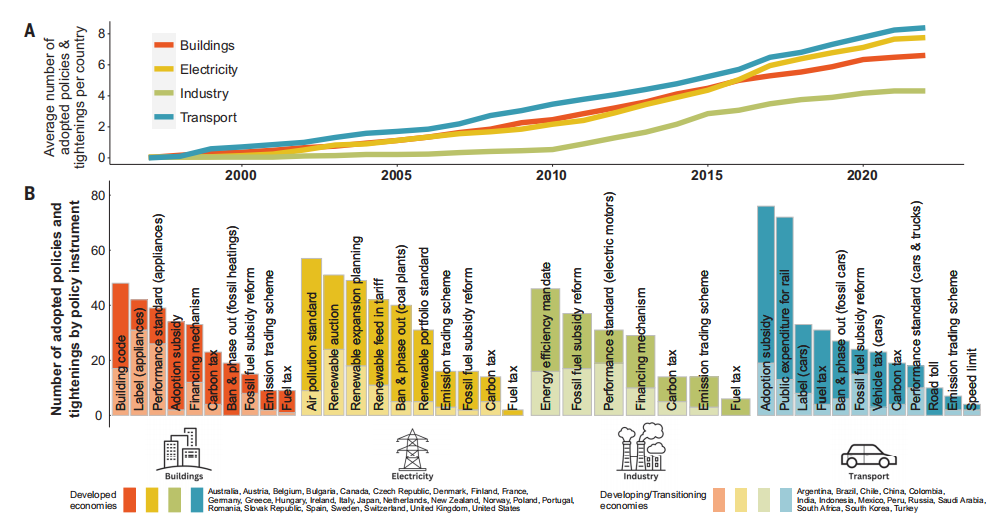
A recent international analysis of 1500 climate policies around the world concluded that 63 or 4% of them were successful in reducing emissions. The paper is Climate policies that achieved major emission reductions: Global evidence from two decades publishes at Science.org. Excerpts in italics with my bolds. Abstract Meeting the Paris Agreement’s climate targets necessitates […]
Climate Policies Fail in Fact and in Theory
Do not stifle supply and then subsidize demand
25 Jun 2024 Leave a comment
in applied price theory, applied welfare economics, comparative institutional analysis, income redistribution, law and economics, politics - USA, Public Choice, rentseeking Tags: offsetting behavior, unintended consequences
That phrasing comes from Arnold Kling, right? It is also the topic of my latest Bloomberg column. Here is one bit: Unfortunately, the US already was setting a bad example for the British. Recent plans from the Biden administration called for a broadly similar approach to housing policy, namely subsidizing demand. Earlier this year, Biden called for […]
Do not stifle supply and then subsidize demand
Fauci Didn’t Test
09 Jun 2024 Leave a comment
in applied welfare economics, economics of regulation, health economics, politics - USA Tags: economics of pandemics, The fatal conceit, unintended consequences
I am not a Fauci hater but I think this criticism of Facui from epidemiologist and oncologist Vinay Prasad hits the mark: Lockdown was specifically advocated for by Anthony Fauci (‘15 days to stop the spread’/ ‘hunker down’/ ‘shelter in place’), and Fauci would go on to make hundreds of other specific policy recommendations. Although he initially […]
Fauci Didn’t Test
The Peltzman Effect at Sea
04 May 2024 Leave a comment
in applied price theory, economics of bureaucracy, Economics of international refugee law, labour economics, labour supply, law and economics, Public Choice, public economics Tags: economics of migration, offsetting behavior, unintended consequences
Deiana, Maheshr,and Mastrobuoniand have recently published an analysis of the effects of Search and Rescue operations on migration from Africa to Europe.Nearly half a century ago, Sam Peltzman showed that, because mandatory seat-belts made driving safer, drivers tended to drive more recklessly, partially offsetting the increased safety. Similar effects occurred in the search and rescue…
The Peltzman Effect at Sea
Life is full of tradeoffs: if we want more nickel to make EV batteries we might have to use more coal
28 Feb 2024 Leave a comment
in development economics, energy economics, environmental economics, global warming Tags: unintended consequences
See One Country’s Dream of EV-Driven Prosperity Helps Fuel a Coal Binge Instead: Indonesia pitches its plan to leverage natural resources as a model for other developing nations by Jon Emont of The WSJ. Excerpts:”A few years ago, Indonesia set out to turn its treasure trove of nickel into an electric-car manufacturing boom.It imposed a sweeping…
Life is full of tradeoffs: if we want more nickel to make EV batteries we might have to use more coal
On price control
25 Feb 2024 Leave a comment
in applied price theory, comparative institutional analysis, economic history, economics of bureaucracy, energy economics, environmental economics, global warming, income redistribution, industrial organisation, Public Choice, rentseeking Tags: price controls, The fatal conceit, unintended consequences, utility regulation

 Utopia, you are standing in it!
Recent Comments