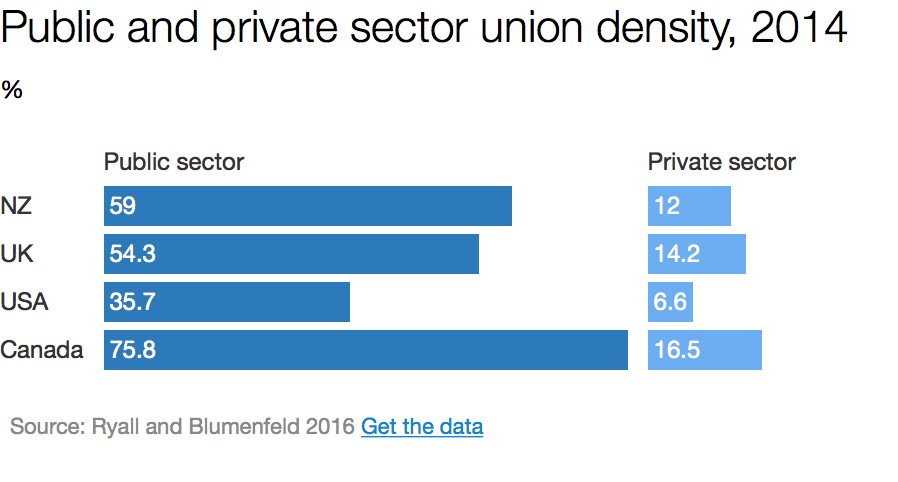
US union membership in public and private sectors and federal, state and local governments since 1983
15 Mar 2016 Leave a comment
in economic history, labour economics, unions Tags: public sector unions, union membership, union power
Unions are dead on their feet in the private sector in the USA but going strong as ever in the public sector, especially in local government.

Source: Bureau of Labour Statistics Table 3. Union affiliation of employed wage and salary workers by occupation and industry
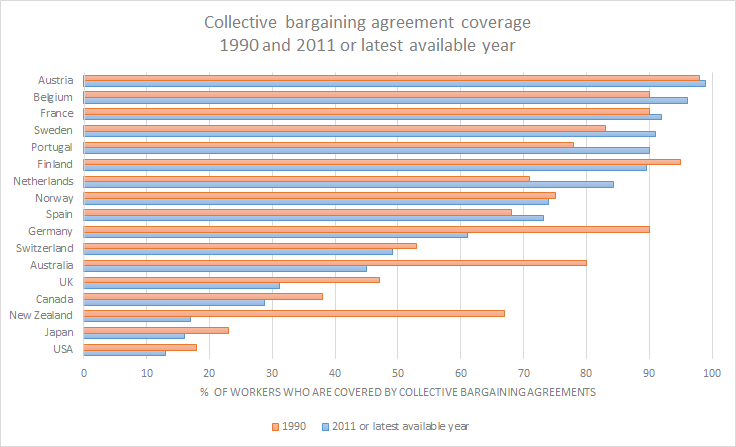
Collective bargaining coverage across the OECD, 1990 and 2011
15 Jan 2016 Leave a comment
in economic history, labour economics, poverty and inequality, unions Tags: collective bargaining coverage, top 1%, union membership, union power, union wage premium
Despite all the hullabaloo, collective bargaining agreement coverage is not declined by that much outside of the English-speaking countries. Outside of the USA, the top 1% are very lazy so they have not benefited from this decline of union power. Within the USA, so few people are covered by collective bargaining agreements for so long that it would not figure in the rising top incomes over the last 30 or more years.
Source: Economic Policy Reforms 2015: Going for Growth – © OECD 2015 and OECD Employment Outlook 2002.
As for New Zealand, the main difference between 70% collective bargaining agreement coverage in 1990 and less than 20% collective bargaining coverage in 2011 is real wage growth returned to New Zealand in the early 1990s after 20 years of wage stagnation. The major economic event of the time was the passage of the Employment Contracts Act.
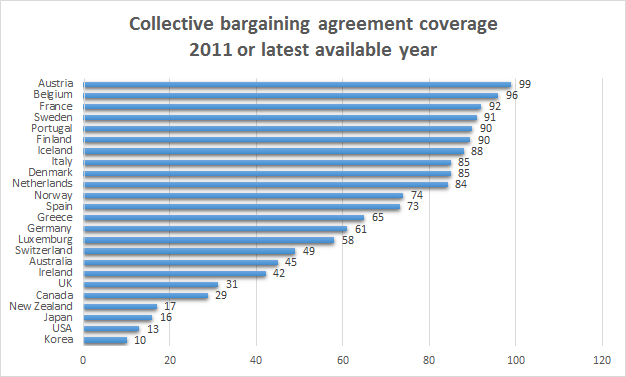
Collective bargaining agreement coverage across the OECD
14 Jan 2016 Leave a comment
in labour economics, unions Tags: collective bargaining, collective bargaining coverage, union membership, union power, union wage premium
Source: OECD Economic Policy Reforms (2015).
British union membership by public and private sector and gender since 1995
15 Dec 2015 Leave a comment
in economic history, labour economics, unions Tags: British economy, union membership, union power, union wage premium
British union membership is very much a public sector phenomena. Outside of the public sector, union membership is low but stable for 20 years now.

Source: Office of National Statistics, Trade Union Membership 2014
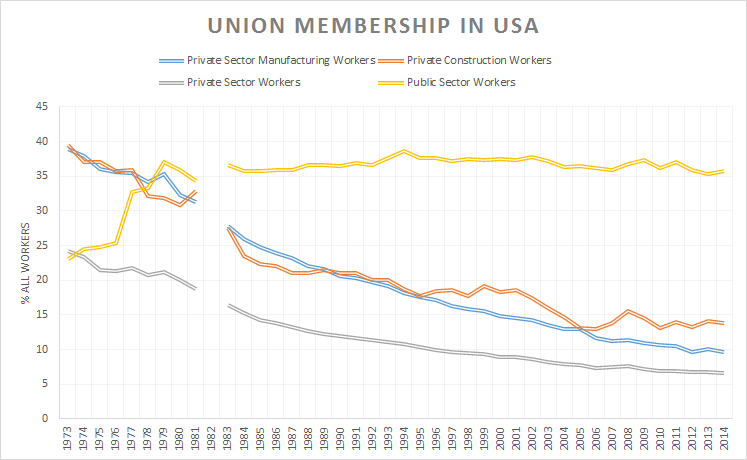
Public and private sector union membership in the USA since 1973
14 Dec 2015 Leave a comment
in economic history, economics of bureaucracy, labour economics, politics - USA, Public Choice, rentseeking, unions Tags: union membership, union power, union wage premium
Public and private sector union membership took completely different paths in the USA over the last 40 years. Public sector union memberships held its own. There is been a steady decline in union membership in the private sector. The exception is construction unions which held their own in membership for the last 10 years.
Source: unionstats.com.
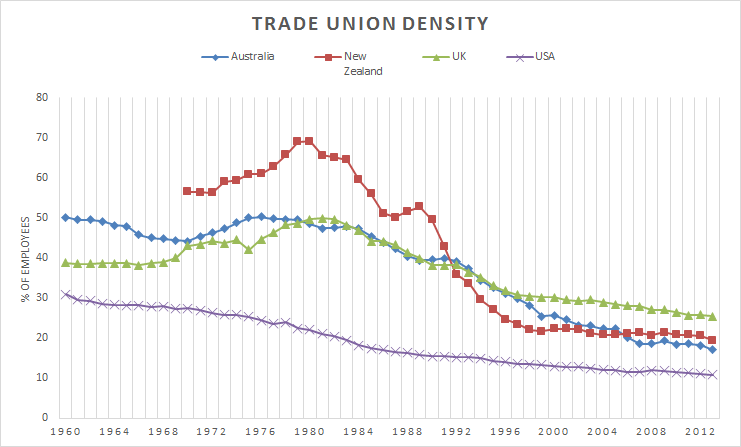
Trade union membership, USA, UK, Australia & New Zealand since 1960 @FairnessNZ
04 Dec 2015 2 Comments
in labour economics, politics - Australia, politics - New Zealand, politics - USA, unions Tags: union membership, union power
Union membership was in a long-term decline in New Zealand before the passage of the hated Employment Contracts Act in 1991. If anything, union membership stopped falling after the passage of that law.
Source: OECD Stat.
As for the other countries, steady decline in membership has been the trend since 1980. The already low level of union membership in the USA has been in a steady decline since at least 1960.
The Real World Effects Of Unions @FairnessNZ @PeetzDavid
09 Nov 2015 Leave a comment
in applied price theory, applied welfare economics, labour economics, labour supply, Milton Friedman, unemployment, unions Tags: union membership, union power, union wage premium
Collective-bargaining agreement coverage and union density rates, major economies, latest available data
16 Aug 2015 Leave a comment
in labour economics, unions Tags: collective bargaining, union membership, union power, union wage premium
In the USA, UK, Australia, New Zealand, and Canada, if you want to be covered by a union collective-bargaining agreement, join a union. Does not seem to matter if you are a union member in France, Germany, Portugal, Spain and the Netherlands and to a lesser extent Italy because you is covered by collective bargaining agreements in most jobs.

Source: OECD estimates and J. Visser, Amsterdam Institute for Advanced Labour Studies (2011), ICTWSS Database on Institutions, Coordination, Trade Unions, Wage Setting and Social Pacts (version 3.0) in OECD (2013) Economic Policy Reforms 2013: Going for Growth.
In the Nordic countries, it runs the other way with most workers covered by collective bargaining agreement but also are union members.
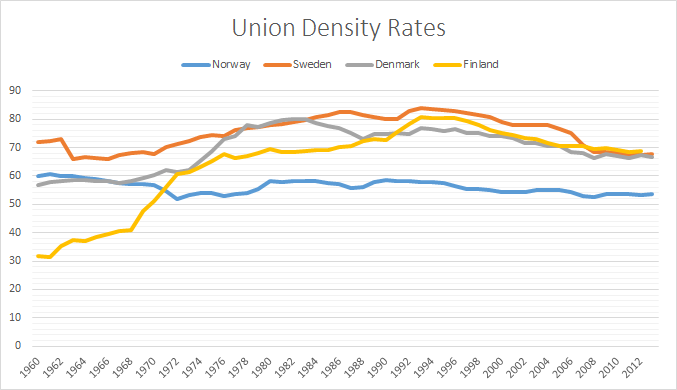
Union density rates in Scandinavia since 1960
15 Aug 2015 Leave a comment
in economic history, labour economics, unions Tags: Denmark, Finland, Norway, Sweden, union membership, union power, union wage premium
Union membership has been very high all the time in Norway, Sweden, Denmark and Finland.
Source: OECD Stat Extract.
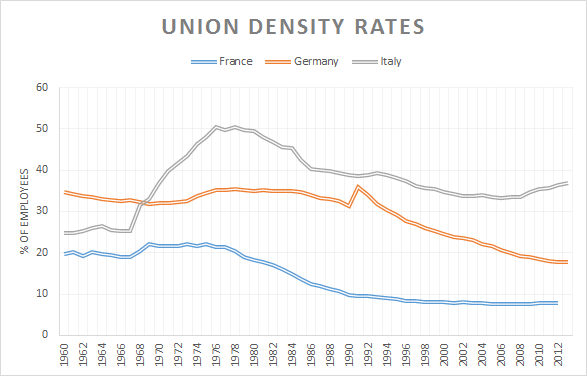
Union density rates in Germany, France and Italy
14 Aug 2015 Leave a comment
in economic history, Euro crisis, labour economics, unions, urban economics Tags: Eurosclerosis, France, German unification, Germany, Italy, union membership, union power, union wage premium
There are large differences in unionisation rates between the three countries. France has always had low levels of unionisation which halved since the 1970s. Italy had a sharp boost in union membership in the number of unions in the 1960s and 70s. This may have been associated with increased urbanisation. Union membership rate stayed pretty high in Italy ever since with a small taper downwards. Germany had stable unionisation rates prior to German unification after which the numbers about halved up in a slow taper.
Source: OECD Stat Extract.
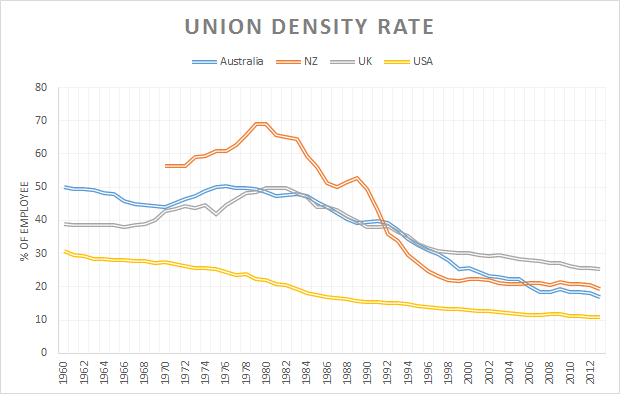
Union density rates in USA, UK, Australia and New Zealand since 1960
13 Aug 2015 Leave a comment
in labour economics, politics - Australia, politics - New Zealand, politics - USA, unions Tags: Australia, British economy, union membership, union power, union wage premium
Unions have been in a long-term decline in Australia, New Zealand, the UK and the USA for as far back as survey and administrative data can be collected. There is a bit of a hump in union membership in the mid-1970s in New Zealand, Australia and the UK but that was about it.
Source: Source: OECD and J.Visser, ICTWSS database (Institutional Characteristics of Trade Unions, Wage Setting, State Intervention and Social Pacts, 1960-2010), version 3.0 (http://www.uva-aias.net/).
The Problem With Unions
26 May 2015 Leave a comment
in labour economics, unions Tags: union membership, union power, union wage premium, voter demographics
As wages go nowhere, labor unions are increasingly making sense to American workers read.bi/1WzeXX4 http://t.co/sbxQzcuUkC—
BI Markets (@themoneygame) August 17, 2015

From a macro-level by Richard Posner:
Current union hostility to immigrant workers is consistent with the unions’ former hostility to blacks and women–which is to say, to workers willing to work for a wage below the union wage. And by raising labor costs, unions accelerate the substitution of capital for labor, further depressing the demand for labor and hence average wages. Union workers, in effect, exploit nonunion workers, as well as reducing the overall efficiency of the economy. The United Auto Workers has done its part to place the Detroit auto industry on the road to ruin.
From a micro-level by Pajamas Media:
One afternoon I was helping oversee the plant while upper management was off site. The workers brought an RV into the loading yard with a female “entertainer” who danced for them and then “entertained” them in the RV. With no other management around, I went…
View original post 4,036 more words

 Utopia, you are standing in it!
Recent Comments