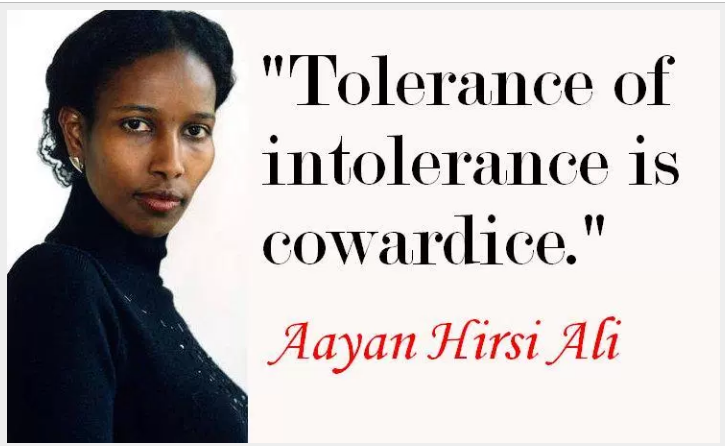
Source: A Conversation With Ayaan Hirsi Ali | The Counter Jihad Report
Celebrating humanity's flourishing through the spread of capitalism and the rule of law
23 Jun 2016 Leave a comment
in defence economics, liberalism, libertarianism Tags: Age of Enlightenment, free speech, Middle-East politics, political correctness, religious tolerance, war against terror
04 Jun 2016 Leave a comment
in defence economics, laws of war, war and peace Tags: Egypt, Gaza blockade, Gaza Strip, Israel, Middle-East politics, war against terror
Oxfam inadvertently left the neighbour on the western border of Gaza off the map in its YouTube clip but not on its eastern border. An honest mistake despite the Arab Spring drawing the attention of Egypt and its politics to everyone’s ears including ODA activists.

The Gaza Strip has two borders: both Egypt and Israel restrict trade with the Gaza. Through this honest mistake in map reading, Oxfam blames Gaza’s problems on the Israeli blockade. I am sure it will correct its position once it reads a map such as the one adjacent which is identical to that in its YouTube clip in all but one detail. It has all of the Gaza’s neighbours on it.
We're currently helping ~700k people in #Gaza affected by Israeli blockade: oxf.am/gaza-crisis #EndGazaBlockade https://t.co/4BWdGDqo2F—
Oxfam International (@Oxfam) June 04, 2016
Any blockade of Israel of the Gaza Strip is not grounds to attack Israel because it can always trade across its border with Egypt but Hamas backed the wrong side in the recent Egyptian presidential election.
After the military coup, the military leaders closed 95% of the tunnels that connected Egypt to Gaza. In 2013-2014, Egypt’s military has destroyed most of the 1,200 tunnels which were used to smuggle food, weapons and other goods into Gaza, including flooding them with sewage. Egypt is setting-up a 13-mile buffer zone with the Gaza Strip. The includes clearing 10,000 residents from 800 houses.
Hamas derived 40% of its tax revenue from tariffs on goods that flow through those tunnels with Egypt. One estimate puts the economic losses at nearly a fifth of Gazan GDP.
The Israeli blockade of the Gaza may have something to do with Gaza firing missiles randomly at civilian targets in Israel. Hamas now murders Israeli citizens in the street in knife attacks.
The Gaza strip may have political differences with the Egyptian military dictators but it is not actually committing acts of war against them.
There is no good reason why Oxfam is not protesting against Egypt’s blockade of the Gaza in the same way they protest against breaches of international law involved in the Israeli blockade!Passing references to the Egyptian blockade in press releases is not enough.
No peace convoys attempt to break the Egyptian blockade. Plenty were launched against Israel. One reason is the Egyptians are rough customers. There is rule of law in Israel, none in Egypt.
24 Mar 2016 Leave a comment
in defence economics, war and peace Tags: Gitmo, war against terror
14 Feb 2016 Leave a comment
in defence economics, war and peace Tags: Middle-East politics, Syrian Civil War, war against terror
16 Jan 2016 Leave a comment
in economic history, war and peace Tags: terrorism, war against terror
28 Nov 2015 1 Comment
in applied price theory, applied welfare economics, economics of crime, law and economics, transport economics, war and peace Tags: offsetting the, risk risk trade-offs, unintended consequences, war against terror
16 Nov 2015 1 Comment
in economic history, economics of religion, occupational choice, politics - Australia, politics - New Zealand, politics - USA, war and peace Tags: British politics, counter-signalling, economics of oppositional identities, game theory, ISIS, New Zealand Greens, war against terror, World War II
Japanese Americans interned during World War II jumped at the chance to volunteer to fight. They saw it as their last chance to prove their undivided loyalty to their country.
One Japanese father, when saying goodbye to his son, stressed that showing his loyalty to his country, if necessary through the last full measure of devotion was far more important that his returning safely to his family.
The 442nd Combat Regiment Team was the most decorated unit in World War II. Its motto was “Go for Broke”. The 4,000 Nisei soldiers in April 1943 had to be replaced nearly 2.5 times. In total, about 14,000 men served, earning 9,486 Purple Hearts.
Migrants are a cut above regarding initiative and judgement. They pass many of these traits on to their children. These Japanese Americans, both migrants and native born knew that counter-signalling was required. They had to go out of their way to show their loyalty no matter how unfair any suspicions of disloyalty among Japanese Americans might have been at the time.
I am reminded of that counter-signalling by Japanese Americans during the darkest days of World War II when I read the remarks of Julie Anne Genter and Jeremy Corbyn. Both focused their pleas on the need to be inclusive and understanding why people join violent, radical groups. They and the rest of the Twitter Left had nothing to contribute regarding strategies to deter the next attack and disrupt those that are in the planning stage, but that is not new.
The notion that bad behaviour towards minority communities leads to more recruitment to the terrorists is overrated. There will be a few wind-bags who say harsh things after each terrorist attack, but if they cross the line, they will be dealt with by the police and courts in a democracy governed by the rule of law.
Acrimony towards your community following the latest terrorist attacks has little to do with the level of recruitment to these terrorist groups either now or in the past. As Alan Krueger explains:
One of the conclusions from the work of Laurence Iannaccone—whose paper, “The Market for Martyrs,” is supported by my own research—is that it is very difficult to effect change on the supply side. People who are willing to sacrifice themselves for a cause have diverse motivations. Some are motivated by nationalism, some by religious fanaticism, some by historical grievances, and so on. If we address one motivation and thus reduce one source on the supply side, there remain other motivations that will incite other people to terror.
Malcontents join the jihadists today for the same reasons they joined the Red Brigade, the Japanese Red Army Faction and Baader-Meinhof gang in the 1970s and 1980s.
Plenty of young people were attracted to communism in previous generations as a way of sticking it to the man. Now as then economic conditions were good as were political freedoms. Italy, Japan and Germany were all at the peak of recoveries from war. Japanese incomes are doubled in the previous decade. Germany and Italy were rich countries. As Alan Krueger explains:
Despite these pronouncements, however, the available evidence is nearly unanimous in rejecting either material deprivation or inadequate education as important causes of support for terrorism or participation in terrorist activities. Such explanations have been embraced almost entirely on faith, not scientific evidence.
Each generation has its defining oppositional identity. Radical Islam is the oppositional identity of choice for today’s angry young men and women. Mind you, they have to buy Islam for dummies to understand what they’re signing up for.
In previous generations, it was communism, weird Christian sects, eco-terrorism, animal liberationist terrorism and a variety of domestic terrorists of the left and right with conspiratorial motivations. Look at the level of diversity of the angry young men and women on the domestic terrorists list of the FBI. One jihadists when interviewed said that 30 years ago he would probably have become a Communist as his vehicle for venting his frustrations.
There is always an ample supply of troubled and angry people so trying to redress their grievances is overrated as Alan Krueger explains:
…it makes sense to focus on the demand side, such as by degrading terrorist organizations’ financial and technical capabilities, and by vigorously protecting and promoting peaceful means of protest, so there is less demand for pursuing grievances through violent means. Policies intended to dampen the flow of people willing to join terrorist organizations, by contrast, strike me as less likely to succeed.
The current appeal of radical Islam rests on what psychologists call personal significance. The quest for personal significance by these angry young men and women is the desire to matter, to be respected, to be somebody in one’s own eyes and in the eyes of others.
A person’s sense of significance may be lost for many reasons, including economic conditions. The anger can grow out of a sense of disparagement and discrimination; it can come from a sense that one’s brethren in faith are being humiliated and disgraced around the world.
Extremist ideologies, be they communism, fascism or extreme religions are effective in such circumstances because it offers a quick-fix to a perceived loss of significance and an assured way to regain it. It accomplishes this by exploiting primordial instincts for aggression, sex and revenge. MI5’s behavioural science unit found that
“far from being religious zealots, a large number of those involved in terrorism do not practise their faith regularly. Many lack religious literacy and could… be regarded as religious novices.” The analysts concluded that “a well-established religious identity actually protects against violent radicalisation”
Most evidence point to moral outrage, disaffection, peer pressure, the search for a new identity, for a sense of belonging and purpose as drivers of radicalisation. Anthropologist Scott Atran pointed out in testimony to the US Senate in March 2010:
“. . . what inspires the most lethal terrorists in the world today is not so much the Quran or religious teachings as a thrilling cause and call to action that promises glory and esteem in the eyes of friends, and through friends, eternal respect and remembrance in the wider world”. He described wannabe jihadists as “bored, underemployed, overqualified and underwhelmed” young men for whom “jihad is an egalitarian, equal-opportunity employer . . . thrilling, glorious and cool”.
Chris Morris, the writer and director of the 2010 black comedy Four Lions – which satirised the ignorance, incompetence and sheer banality of British Muslim jihadists – said “Terrorism is about ideology, but it’s also about berks”.
23 Oct 2015 Leave a comment
in politics - USA, war and peace Tags: Afghanistan, unintended consequences, war against terror
https://twitter.com/ianbremmer/status/653888723034222592/photo/1
Rethinking Afghanistan (and then rethinking some more) http://t.co/uY7T6mUIUV—
ian bremmer (@ianbremmer) October 17, 2015
11 Oct 2015 Leave a comment
in war and peace Tags: Afghanistan, economics of identity, Taliban, war against terror
How the Taliban overlaps with ethnicity in Afghanistan: bit.ly/VoxMidEastMaps https://t.co/I8HBhCooJQ—
Vox Maps (@VoxMaps) October 01, 2015
28 Sep 2015 Leave a comment
in war and peace Tags: Iran, Iraq, ISIS, Middle-East politics, Saudi Arabia, Syria, war against terror
Where do ISIL fighters come from? http://t.co/Euh7eySwoX—
Amazing Maps (@Amazing_Maps) June 09, 2015
02 Aug 2015 Leave a comment
in defence economics, war and peace Tags: Iran, ISIS, Kurds, Middle-East politics, Syria, Turkey, war against terror
https://twitter.com/ianbremmer/status/625742628450115587/photo/1
The worrying spread of terrorism in Africa http://t.co/C16YJy3szT—
ian bremmer (@ianbremmer) July 20, 2015
30 Jul 2015 Leave a comment
in defence economics, economics of crime, law and economics, war and peace Tags: ISIS, Middle-East politics, war against terror
https://twitter.com/nytgraphics/status/625780164610379777/photo/1
ISIS has inspired or directed attacks in at least 14 countries outside of Iraq and Syria nyti.ms/1Lfwbof http://t.co/ptDFG3EXRU—
NYT Graphics (@nytgraphics) July 27, 2015
Celebrating humanity's flourishing through the spread of capitalism and the rule of law
Scholarly commentary on law, economics, and more
Beatrice Cherrier's blog
Celebrating humanity's flourishing through the spread of capitalism and the rule of law
Celebrating humanity's flourishing through the spread of capitalism and the rule of law
Celebrating humanity's flourishing through the spread of capitalism and the rule of law
Why Evolution is True is a blog written by Jerry Coyne, centered on evolution and biology but also dealing with diverse topics like politics, culture, and cats.
Celebrating humanity's flourishing through the spread of capitalism and the rule of law
Celebrating humanity's flourishing through the spread of capitalism and the rule of law
A rural perspective with a blue tint by Ele Ludemann
DPF's Kiwiblog - Fomenting Happy Mischief since 2003
Celebrating humanity's flourishing through the spread of capitalism and the rule of law
The world's most viewed site on global warming and climate change
Tim Harding's writings on rationality, informal logic and skepticism
A window into Doc Freiberger's library
Let's examine hard decisions!
Commentary on monetary policy in the spirit of R. G. Hawtrey
Thoughts on public policy and the media
Celebrating humanity's flourishing through the spread of capitalism and the rule of law
Politics and the economy
A blog (primarily) on Canadian and Commonwealth political history and institutions
Reading between the lines, and underneath the hype.
Economics, and such stuff as dreams are made on
"The British constitution has always been puzzling, and always will be." --Queen Elizabeth II
Celebrating humanity's flourishing through the spread of capitalism and the rule of law
Celebrating humanity's flourishing through the spread of capitalism and the rule of law
WORLD WAR II, MUSIC, HISTORY, HOLOCAUST
Undisciplined scholar, recovering academic
Celebrating humanity's flourishing through the spread of capitalism and the rule of law
Res ipsa loquitur - The thing itself speaks
In Hume’s spirit, I will attempt to serve as an ambassador from my world of economics, and help in “finding topics of conversation fit for the entertainment of rational creatures.”
Researching the House of Commons, 1832-1868
Articles and research from the History of Parliament Trust
Reflections on books and art
Posts on the History of Law, Crime, and Justice
Celebrating humanity's flourishing through the spread of capitalism and the rule of law
Exploring the Monarchs of Europe
Cutting edge science you can dice with
Small Steps Toward A Much Better World
“We do not believe any group of men adequate enough or wise enough to operate without scrutiny or without criticism. We know that the only way to avoid error is to detect it, that the only way to detect it is to be free to inquire. We know that in secrecy error undetected will flourish and subvert”. - J Robert Oppenheimer.
The truth about the great wind power fraud - we're not here to debate the wind industry, we're here to destroy it.
Celebrating humanity's flourishing through the spread of capitalism and the rule of law
Celebrating humanity's flourishing through the spread of capitalism and the rule of law
Economics, public policy, monetary policy, financial regulation, with a New Zealand perspective
Celebrating humanity's flourishing through the spread of capitalism and the rule of law
Restraining Government in America and Around the World
![image_thumb[1]](https://utopiayouarestandinginit.com/wp-content/uploads/2016/04/image_thumb110.png "image_thumb[1]")

 Utopia, you are standing in it!
Recent Comments