"Some of our enemies are fighting our other enemies, whom we want to lose." http://t.co/JDP1UbyZWr—
William Easterly (@bill_easterly) September 25, 2014
Some of our enemies are fighting our other enemies, whom we want to lose
26 Jul 2015 1 Comment
in war and peace Tags: Gaza Strip, Iran, Iraq, ISIS, Israel, Middle-East politics, Syria, war against terror
For the first time in 14 years, USA not engaged in a major ground war
08 Jul 2015 Leave a comment
in defence economics, politics - USA, war and peace Tags: war against terror
#Dailychart: For the first time in 14 years, America is not engaged in a major ground war econ.st/1TeK8oR http://t.co/qUmjCIDQaQ—
The Economist (@ECONdailycharts) June 11, 2015
The current state of play in Syria
08 Jul 2015 Leave a comment
in defence economics, politics - USA, war and peace Tags: Middle-East politics, Syria, war against terror
A weak ISIS and a weak U.S. strategy: wapo.st/1H5LE4i http://t.co/3IpQclcSvg—
Post Graphics (@PostGraphics) July 07, 2015
Droll critique of ISIS training video
06 Jul 2015 Leave a comment
in defence economics, economics of media and culture Tags: ISIS, Middle-East politics, war against terror
Why Do People Become Islamic Extremists?
19 Jun 2015 Leave a comment
in labour economics, occupational choice Tags: economics of identity, war against terror
Fatal terrorist attacks in Europe since 2001
15 May 2015 Leave a comment
in economics of crime, law and economics Tags: European politics, terrorist attacks, war against terror
#Dailychart: Fatal terrorist attacks in Western Europe since 2001 econ.st/1CnBN87 http://t.co/pu2LBS7Qb7—
The Economist (@ECONdailycharts) January 18, 2015
The war situation in Iraq and Syria
10 May 2015 Leave a comment
ISW Iraq SITREP. Baiji-Repeat of Tikrit w/ roles of Iranian militias vs. Coalition airstrikes?
iswiraq.blogspot.com/2015/05/iraq-s… http://t.co/QLwhV0lkhS—
ISW (@TheStudyofWar) May 09, 2015
ISW Syria SITREP is out. Did Hezbollah decide to not engage JN or is "Qalamoun battle coming"? bit.ly/1JOMZ4R http://t.co/eb3zIQuhwU—
ISW (@TheStudyofWar) May 05, 2015
HT: Lorenzo M Warby
Hypocritical Greens betray NZ sovereignty to US court decision but oppose investor state dispute settlement on sovereignty grounds
10 May 2015 Leave a comment
in defence economics, economics of crime, international economic law, international economics, International law, law and economics, politics - New Zealand, politics - USA Tags: foreign policy, free trade agreements, green hypocrisy, green party, investor state disputes settlement, national security, preferential trading agreements, war against terror
The Greens are happy to betray New Zealand’s sovereignty to a US court where New Zealand’s side of the story was not heard, New Zealand was not a litigant, New Zealand was not named in the proceedings and New Zealand had not agreed to waive its sovereign immunity under US law.
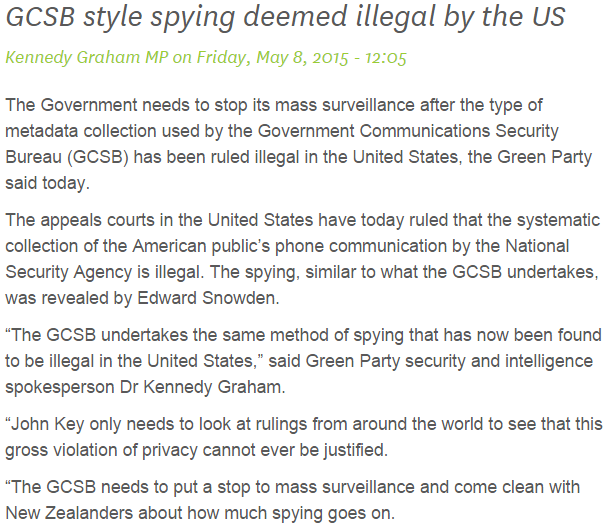
The Greens on the other hand are hysterical about the prospect of New Zealand voluntarily submitting to investor state disputes settlement through an international treaty. International treaties normally are about trading in sovereignty: you give up some form of sovereignty return for something you value more.
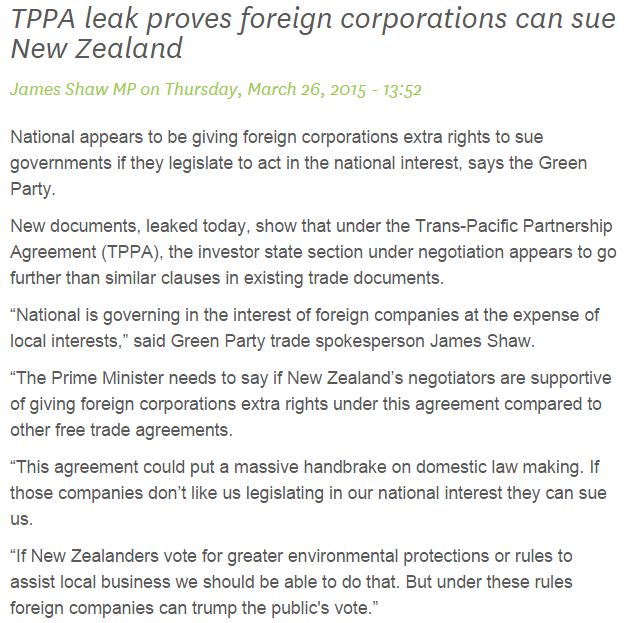
It is thoroughly hypocritical of the Greens to argue the New Zealand should bow down to a foreign court when that court rules in a way that it favours its ideological agenda but refuse to support the principle of international arbitration in circumstances where that may advance New Zealand’s national interests.
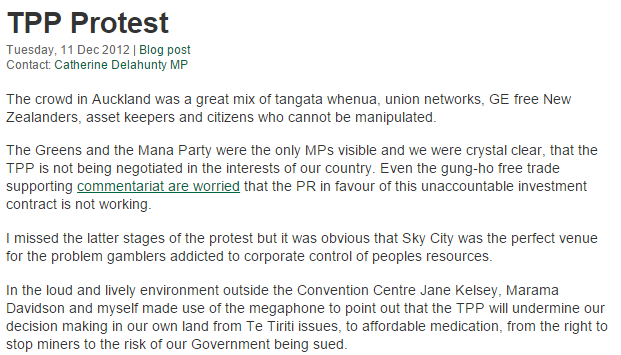
At a minimum, New Zealand itself chose to give up its sovereignty if it agrees to investor state dispute settlement in a trade agreement. The decision was not imposed by a foreign court where it was not heard nor was a party.


Of particular concern to the Greens is international arbitration could "trump the public’s vote vote". New Zealand has repeatedly elected parties that support the alliance with America, and support a robust security and intelligence policy, including electronic surveillance as part of the war on terror.
The last week of the 2014 general election campaign was dominated by the Government Security Communications Bureau and its cooperation with the National Security Agency and the extent to which New Zealand security services engaged in electronic surveillance in New Zealand and abroad.
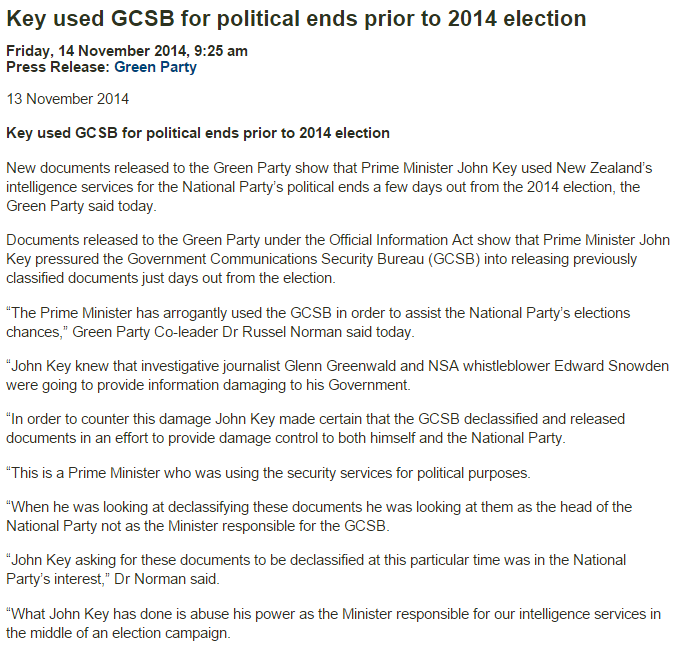
The Greens want to subvert that democratic decision that has been repeated over many New Zealand elections about national security and foreign relations to defer to an American court when New Zealand didn’t even appear as a party.

The US Court of appeal was deciding an issue of statutory interpretation of the Patriot Act. There was no constitutional issues at hand.
The Patriot Act expires in a month unless it is extended. Congress has ample opportunity to amend the renewed law to overturn the appeal court’s decision for the future operation of its security and intelligence laws.
The Greens want a Court of Appeal interpretation of the American Patriot Act to extend to New Zealand without a vote of the New Zealand people or the parliament having any say on whether to give up New Zealand’s sovereignty or waive sovereign immunity in American courts.
.
Jihad, Texas style
05 May 2015 Leave a comment
in politics - USA, war and peace Tags: gun control, Jihad, taxes, war against terror
How Libya’s 2011 War changed Africa
20 Apr 2015 Leave a comment
in war and peace Tags: Arab Spring, Libya, Middle-East politics, war against terror

Obama’s Plans For Pulling Out Of Afghanistan vs. What Really Happened
26 Mar 2015 Leave a comment
in politics - USA, war and peace Tags: Afghanistan, war against terror

There Is No Global Jihadist ‘Movement’ — Atlantic Mobile
13 Mar 2015 Leave a comment
Some nice charts about how ISIS is more a rabble that happens to survive because of the lack of unity among its many enemies which include the Iraqi government government and its army that runaway.


 Utopia, you are standing in it!
Recent Comments