Is welfare dependence optimal for whom – part 1? The labour-leisure trade-off and the rewards for working

The higher is the welfare benefit, the greater the probability that an individual will choose to go on welfare rather than work. Welfare dependency is the most rewarding leisure-labour trade-off for them.

The higher the wage on offer to a given worker in the labour market, the greater is the probability that they will choose to work rather than go on welfare. Working is the most rewarding leisure-labour trade-off for them.

Both the income and substitution effects of welfare benefits provide a disincentive to work. Higher income levels from generous welfare benefits induce higher consumption of all normal goods, including leisure. Income taxes and a high benefit abatement rate provides little incentive to work (the substitution effect) for lower paid workers and some second earners.

When confronted with the choice of a low-paying job and a generous welfare benefit, some will choose welfare over work. These workers are responding rationally to the (dis)incentives embedded in the labour market and welfare system. For them, welfare dependency is optimal.

This is particularly true for single parents with low labour market skills. One or more children may generate more net income (from increased welfare benefits) than working in the labour market and paying child care. If there is no expiry date for these welfare benefits, some individuals who go on welfare will stay on welfare for a long period of time.

Of course, the economics of crime comes up. A condition of receipt of welfare benefits in just about every welfare state is healthy adults must make themselves available for work and actively look for work.

Most of the essentials of the impact of welfare reform on labour-leisure trade-offs are captured, and most policy dilemmas are clearly defined within the framework in Figure 1. Figure 1 illustrates the position of two workers regarding whether to work (the participation decision) and how many hours to work.

Figure 1: The basic leisure-labour trade-off

The hourly wage rate represented by the symbol W in Figure 1 is traded-off against working fewer or no hours. This additional of leisure time includes: pure leisure; household production such as child care, cooking and cleaning; education and other human capital investments; and personal time such as self-care and sleep.

  • Worker 1 in Figure 1 works 40 hours while worker 2 with different circumstances works part-time in Figure 1.
  • Worker 1 could be a male with no dependents so not working full-time has a relatively high opportunity cost even if low paid.
  • Women who higher qualifications are also more likely to be persistent workers alternating between full-time career and part-time work when there are child care responsibilities.
  • Worker 2 in Figure 1 could be a sole parent or a second earner in a married couple with young children. For these workers, working can have a high opportunity cost because of the cost of child care, especially if the sole parent or second earner is low paid.
  • For workers with a high opportunity cost of work and low wages from working, for them, welfare dependents can be quite optimal.
  • Not so for society because the welfare benefits conditional on people making themselves available for work and taking steps to find it and stay in work.

The next few blogs will explain how various welfare reforms change the labour leisure trade-off for welfare recipients. There are three main parameters in any welfare system:

  1. the amount of the welfare benefit,
  2. the threshold for the benefit abatement on earned income, and
  3. the benefit reduction rate for income exceeding the abetement-free threshold.

This is not to ignore work testing and work requirements, these complications are postponed to later blogs. All of these parameters and the implications of changing them on labour supply will be discussed in future blogs.

The blogs so far

is-welfare-dependants-optimal-for-whom-part-one-the-labour-leisure-trade-off-and-the-rewards-for-working

is-welfare-dependence-optimal-for-whom-part-two-the-labour-supply-effects-of-welfare-benefit-abatement-rate-changes

is-welfare-dependency-optimal-for-whom-part-3-abatement-free-income-thresholds-and-labour-supply

is-welfare-dependents-optimal-for-the-whom-part-4-in-work-tax-credits-and-labour-supply

is-welfare-dependence-optimal-for-whom-part-5-higher-abatement-rates-and-labour-supply

is-welfare-dependence-optimal-for-whom-part-6-mandatory-work-requirements-and-labour-supply

is-welfare-dependence-optimal-for-whom-part-7-the-role-of-tagging-in-welfare-benefits-system

Lindsay Mitchell – Labour’s Carmel Sepuloni: be careful what you ask for

The Truly Disadvantaged

Lindsay Mitchell has a nice blog today on the views of the new Labour Party spokesman on social development – the New Zealand ministerial portfolio covering social security and social welfare

Carmen Sepuloni disagrees with National Party’s policy of requiring solo mothers to look for work. She believed there should be support for sole parents to return to work, but not a strict compulsion:

It is a case by case basis. I don’t think it should be so stringent because it’s not necessarily to the benefit of their children.

The American sociologist James Julius Wilson in The Truly Disadvantaged (1987) and When Work Disappears (1996) wrote about how more children are growing-up without a working father living in the home and thereby gleaning the awareness that work is a central expectation of adult life:

. . . where jobs are scarce, where people rarely, if ever, have the opportunity to help their friends and neighbors find jobs. . . many people eventually lose their feeling of connectedness to work in the formal economy; they no longer expect work to be a regular, and regulating, force in their lives.

In the case of young people, they may grow up in an environment that lacks the idea of work as a central experience of adult life — they have little or no labor force attachment.

Carmel Sepuloni appears to believe that work is not a central expectation of adult life. Hard work used to be a core value of the Labour Party.

The toughest week of door knocking for the Labour Party in the 2011 general elections was after the Party promised that the in-work family tax credit should also be paid to welfare beneficiaries.

Voters in strong Labour Party areas were repulsed by the idea. These working-class Labour voters thought that the in-work family tax credit was for those that worked because they had earnt it through working on a regular basis. The party vote of the Labour Party in the 2011 New Zealand general election fell to its lowest level since its foundation in 1919 which was the year where it first contested an election.

When Sepuloni was on the Backbenchers TV show prior to the recent NZ general election, she was asked by the host whether she would support a $40 per hour minimum wage if that would mean equality. She did not hesitate to say yes.

Sepuloni does not seem to have noticed that wages must have something to do with the value of what you produce and the ability of your employer to sell it at a price that covers costs. 

Front Cover

The economic literatures (Heckman 2011; Fryer 201o) and sociological literatures (Wilson 1978, 1987, 2009, 2011), particularly in the U.S. is suggesting that skill disparities resulting from a lower quality education and less access to good parenting, peer and neighbourhood environments produce most of the income gaps of racial and ethnic minorities rather than factors such as labour market discrimination.

Front Cover

Grounds for optimism about the effectiveness of welfare reform in overcoming barriers to employment lie in the success of the 1996 federal welfare reforms in the USA.

The subsequent declines in welfare participation rates and gains in employment were largest among the single mothers previously thought to be most disadvantaged: young (ages 18-29), mothers with children aged under seven, high school drop-outs, and black and Hispanic mothers. These low-skilled single mothers who were thought to face the greatest barriers to employment. Blank (2002) found that:

At the same time as major changes in program structure occurred during the 1990s, there were also stunning changes in behavior. Strong adjectives are appropriate to describe these behavioral changes.

Nobody of any political persuasion-predicted or would have believed possible the magnitude
of change that occurred in the behavior of low-income single-parent families over this decade.

People have repeatedly shown great ability to adapt and find jobs when the rewards of working increase and eligibility for welfare benefits tighten.

via Lindsay Mitchell: Carmel Sepuloni: be careful what you ask for.

Milton Friedman on Welfare

How Not to Be Poor | NCPA

ba428 Figure1ba428 Figure2

via How Not to Be Poor | NCPA.

The long-term solution to child poverty in New Zealand

Image

The UK’s welfare benefits cap of £26,000 per year – the income of the average working family

In case you'd forgotten - the families milking the system

Since the cap was introduced a year ago, more than 38,600 households have had the amount they are paid in benefits limited to £26,000 a year – the income of the average working family.

Despite predictions by critics that the new rule would cause misery, the poll – conducted by Ipsos Mori – found that 45 per cent of those affected say they have been spurred to return to work.

Benefits for couples and lone parents have been capped at £500 per week, or £350 for a single. childless person.

The £26,000-a-year cap is equivalent to an income of £34,000 before tax, which is similar to the salaries of many nurses and teachers.

heryl Prudham her husband Robert and their nine children

Cheryl Prudham, her husband Robert and their nine children are going on a trip to Menorca, just weeks after the mum said she should be given a bigger house at the expense of the taxpayer.

HT: Daily Mail – their photos above are a little bit too focused on ethnic minorities. The Daily Mail’s audience is the working class Tory and the lower middle class.

James Tobin on limiting the domain of inequality


The slums of Jebson Pl – down and out in New Zealand includes Sky TV

10716447 copy

via Whale Oil Beef Hooked  and waikato-times

The New Zealand social welfare system is the second most targeted towards the poor in the OECD

HT: twitter.com/SACOSS

Managerial Econ: Why are wages decreasing and employment increasing in Great Britain?

The simplest explanation is that supply is increasing:  as supply increases output increases real prices fall and output increases.

The Financial Times shows the data and puts forward several explanations:

(1) welfare reforms are pushing people off the dole and into the labor force;

(2) older workers are choosing to retire at a later age.

Both explanations would imply an increase in supply.

via Managerial Econ: Why are wages decreasing and employment increasing in Great Britain?.

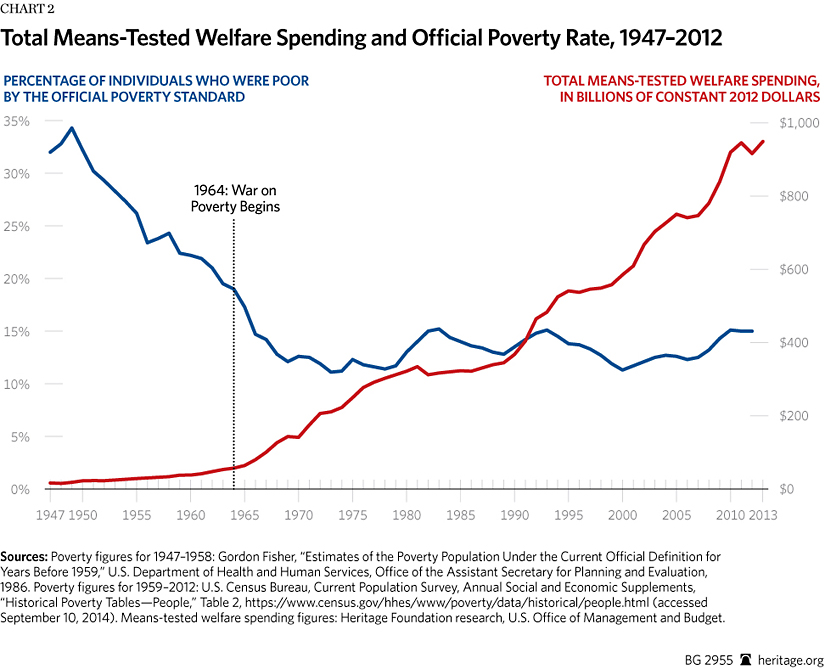
The demand and supply of poverty 1947 – 2012

image

Image

Milton Friedman on poverty alleviation

Image

Job finding rates under work for the dole when there is involuntary unemployment

Jeff Borland is a critic of work for the dole. He points out that they do not improve the job finding rates of participants and in fact reduce the amount of job search because work for the Dole participants are busy undertaking work for the dole requirements:

The main reason is that participation in the program diverts participants from job seeking activity towards Work for the Dole activity. Research on similar programs internationally has come up with comparable findings.

This made me wonder. If unemployment is caused by deficient aggregate demand, and otherwise is involuntary, how can work for the dole increase unemployment or reduce the rate at which people exit unemployment?

‘Involuntary’ unemployment occurs when all those willing and able to work at the given real wage but no job is available, i.e. the economy is below full employment. A worker is ‘involuntary’ unemployment if he or she would accept a job at the given real wage. Keynesians believe money wages are slow to adjust (e.g. due to money illusion, fixed contracts or because employers and employees want long run money wage stability), and so the real wage may no adjust to clear the labour market: there can be ‘involuntary’ unemployment.

Under the deficient aggregate demand theory of unemployment, people have no control over why they are unemployed – that’s why their unemployment is involuntary.

Sticky wages are no less sticky when work for the dole is introduced and people search more intensively for jobs. Deficient demand unemployment is no less deficient when there is an increase in job search intensity.

Work for the dole must be carefully defined, of course, to differentiate it from the failed active labour market programs of the past that attempted to improve the employability of the unemployed. By work for the dole, I simply mean mandatory work requirements simply make it more of an ordeal to be on unemployment and thereby encourage people to find a job.

Mandatory work requirements simply tax leisure. By taxing leisure,  mandatory work requirements  change the work leisure trade-off between unemployment and seeking a job with greater zeal and a lower asking wage more attractive option. More applicants asking for lower wages will mean employers can fill jobs faster and at lower wages, which means our create more jobs in the first place.

The probability of finding a job for an unemployed worker depends on how hard this individual searches and how many jobs are available: Chance of Finding Job = Search Effort x Job Availability

Both the search effort of the unemployed and job creation decisions by employers are potentially affected by unemployment benefit generosity and mandatory work for welfare benefits requirements.

Modern theory of the labour market, based on Mortensen and Pissarides provides that more generous unemployment benefits put upward pressure on wages the unemployed seek. If wages go up, holding worker productivity constant, the amount left to cover the cost of job creation by firms declines, leading to a decline in job creation.

Everything else equal under the labour macroeconomics workhorse search and matching model of the labour market, reducing the rewards of being unemployed exerts downward pressure on the equilibrium wage. This fall in asking wages increases the profits employers receive from filled jobs, leading to more vacancy creation. More vacancies imply a higher finding rate for workers, which leads to less unemployment.  The vacancy creation decision is based on comparing the cost of creating a job to the profits the firm expects to obtain from hiring the worker.

When unemployment benefits are less generous or more onerous work requirements are attached, some of the unemployed will become less choosey about the jobs they seek in the wages they will accept.  a number of people at the margin between working or not. An example is commuting distance  to jobs. A number of people turn down a job  because is just that little too far to commute. A small change in the cost of  accepting that job would have resulted in them moving from being unemployed to fully employed.

Unemployment is easy to explain in modern labour macroeconomics: it takes time for a job seeker to find a suitable job with a firm that wishes to hire him or her; it takes time for a firm to fill a vacancy. Search is required on both sides of the labour market  –  there are always would-be workers searching for jobs, and firms searching for workers to fill vacancies.

In a recession, a large number of jobs are destroyed at the same time. It takes time for these unemployed workers to be reallocated new jobs.  It takes time for firms to find where it is profitable to create new jobs and find workers suitable to fill these new jobs.

Recessions are reorganisations. Unemployed workers look for jobs, and firms open vacancies to maximize their profits. Matching  unemployed workers with  new firms firms is a time-consuming and costly process.

Down and out in the USA isn’t what it used to be

Image

Calmfor’s Iron Law of Active Labour Market Policy.

Lars Calmfors is a Swedish economist whose main interest is labour makets.

His iron law of Active Labour Market Policy (ALMP) refers to a characteristic of make work schemes, like the WPA that operated in the United States in the 1930s.

The characteristic or problem with these schemes is that if people are attracted to these schemes by generous pay or conditions, their motive to search for regular work is necessarily reduced.

Assuming unemployment is anywhere near NAIRU, the effect of this reduced aggregate labour supply will be inflationary, which means that demand will have to be reduced, which in turn means that the jobs created by the make work scheme will be, at least to some extent, at the expense of regular jobs.

Alternatively, if people are coerced into joining make work schemes because of what might be called a “workfare” sanction, their job search efforts are not reduced, thus the jobs created by the make work scheme have a better chance of not being at the expense of normal jobs.

via RALPHONOMICS: Calmfor’s Iron Law of Active Labour Market Policy..

Previous Older Entries Next Newer Entries

Bassett, Brash & Hide

Celebrating humanity's flourishing through the spread of capitalism and the rule of law

Truth on the Market

Scholarly commentary on law, economics, and more

The Undercover Historian

Beatrice Cherrier's blog

Matua Kahurangi

Celebrating humanity's flourishing through the spread of capitalism and the rule of law

Temple of Sociology

Celebrating humanity's flourishing through the spread of capitalism and the rule of law

Velvet Glove, Iron Fist

Celebrating humanity's flourishing through the spread of capitalism and the rule of law

Why Evolution Is True

Why Evolution is True is a blog written by Jerry Coyne, centered on evolution and biology but also dealing with diverse topics like politics, culture, and cats.

Down to Earth Kiwi

Celebrating humanity's flourishing through the spread of capitalism and the rule of law

NoTricksZone

Celebrating humanity's flourishing through the spread of capitalism and the rule of law

Homepaddock

A rural perspective with a blue tint by Ele Ludemann

Kiwiblog

DPF's Kiwiblog - Fomenting Happy Mischief since 2003

The Dangerous Economist

Celebrating humanity's flourishing through the spread of capitalism and the rule of law

Watts Up With That?

The world's most viewed site on global warming and climate change

The Logical Place

Tim Harding's writings on rationality, informal logic and skepticism

Doc's Books

A window into Doc Freiberger's library

The Risk-Monger

Let's examine hard decisions!

Uneasy Money

Commentary on monetary policy in the spirit of R. G. Hawtrey

Barrie Saunders

Thoughts on public policy and the media

Liberty Scott

Celebrating humanity's flourishing through the spread of capitalism and the rule of law

Point of Order

Politics and the economy

James Bowden's Blog

A blog (primarily) on Canadian and Commonwealth political history and institutions

Science Matters

Reading between the lines, and underneath the hype.

Peter Winsley

Economics, and such stuff as dreams are made on

A Venerable Puzzle

"The British constitution has always been puzzling, and always will be." --Queen Elizabeth II

The Antiplanner

Celebrating humanity's flourishing through the spread of capitalism and the rule of law

Bet On It

Celebrating humanity's flourishing through the spread of capitalism and the rule of law

History of Sorts

WORLD WAR II, MUSIC, HISTORY, HOLOCAUST

Roger Pielke Jr.

Undisciplined scholar, recovering academic

Offsetting Behaviour

Celebrating humanity's flourishing through the spread of capitalism and the rule of law

JONATHAN TURLEY

Res ipsa loquitur - The thing itself speaks

Conversable Economist

Celebrating humanity's flourishing through the spread of capitalism and the rule of law

The Victorian Commons

Researching the House of Commons, 1832-1868

The History of Parliament

Articles and research from the History of Parliament Trust

Books & Boots

Reflections on books and art

Legal History Miscellany

Posts on the History of Law, Crime, and Justice

Sex, Drugs and Economics

Celebrating humanity's flourishing through the spread of capitalism and the rule of law

European Royal History

Exploring the Monarchs of Europe

Tallbloke's Talkshop

Cutting edge science you can dice with

Marginal REVOLUTION

Small Steps Toward A Much Better World

NOT A LOT OF PEOPLE KNOW THAT

“We do not believe any group of men adequate enough or wise enough to operate without scrutiny or without criticism. We know that the only way to avoid error is to detect it, that the only way to detect it is to be free to inquire. We know that in secrecy error undetected will flourish and subvert”. - J Robert Oppenheimer.

STOP THESE THINGS

The truth about the great wind power fraud - we're not here to debate the wind industry, we're here to destroy it.

Lindsay Mitchell

Celebrating humanity's flourishing through the spread of capitalism and the rule of law

Alt-M

Celebrating humanity's flourishing through the spread of capitalism and the rule of law

croaking cassandra

Economics, public policy, monetary policy, financial regulation, with a New Zealand perspective

The Grumpy Economist

Celebrating humanity's flourishing through the spread of capitalism and the rule of law

International Liberty

Restraining Government in America and Around the World