Can New Zealand blame its small size for its economic woes?

The median national population size is not much more than New Zealand’s current population.

  • Controlling for location, Easterly and Kraay (2002) found that smaller states were richer than other states in per capita real GDP.
  • Rose (2006) reviewed the impact of size on the level of income, inflation, material well-being, health, education, and the quality of a country’s institutions and found that small countries are more open to trade than large countries, but are not systematically different otherwise.

As I argued in my previous post on distance, New Zealand were prosperous from the time of European settlement despite a small population and their great distance from the main markets of the world on each side of the Atlantic.

Of the ten richest countries in terms of GDP per capita, only four have populations above one million people (Alesina 2003). These countries are the USA (290 million people), Switzerland (7 million people), Norway (4 million people) and Singapore (3 million people). Of these four nations, two are below the global national population median of six million (Alesina 2003).

New Zealand’s population is similar and often larger in size than most of the richest countries in the world. Singapore and Hong Kong were initially far from the global Trans-Atlantic economic hubs before their respective development miracles unfolded in the mid and late 20th century.

Something must have happened recently for either small population size or distance to have become important when it was not important for most of the history of New Zealand. New Zealand has been on the same place on the map for all its history.

Transport costs on exports to England and the rest of Europe did not hold back New Zealand’s economic development in the 19th century and for most of the 20th century despite far more primitive and more expensive forms of transport.

New Zealand specialised in commodities that could be produced at a low cost because land and water was plentiful and exported them in bulk to large markets on the other side of the world because of falling transport costs. The invention of refrigeration in 1881 was a major boost to meat exports to England.

The main economic difference between smaller and larger nation-states around the globe is smaller nations are more open to international trade and foreign investment (Alesina et al. 2005).

In a world of freer overseas trade, small countries can extend the size of their markets by trade and sidestep many of the costs of small internal markets. As long as political borders do not greatly limit international trade, economic success is increasingly independent of national size (Alesina 2003; Alesina et al. 2000).

A leading economic advantage of large national size in more isolationist times was a large marketplace free of trade and investment barriers and fewer national borders and different legal systems to parry. As more nations open up to the world, the single market benefits of large size for a country start to melt away quickly (Alesina 2003; Alesina and Spolaore 2003; Alesina et al. 2000).

As countries become larger, administration costs and the growing heterogeneity in the political preferences of larger and more diverse populations counterbalance the benefits of size and scale (Alesina et al. 2003, 2004, 2006; Spolaore 2006). More nation-states and freer trade increase the degree that governments must compete for citizens and investment. Inter-jurisdictional competition increases the incentives for governments to adopt institutions and policies that promote efficiency and productivity and serve their peoples better (Friedman 2005).

David Friedman – Legal Systems Very Different From Ours

Video

Paul Ehrlich–still going after 40-years of wrong, wrong, and wrong again

We will soon be asking is it perfectly okay to eat the bodies of your dead because we’re all so hungry?

…In other words between now and 45 years from now, 2.5 billion people will be added to the planet. …We are moving towards resource wars

“Will overpopulation drive us to eat our own DEAD?” The Daily Mail, 23 May 2014

Paul Ehrlich is widely known for his 1968 book ‘The Population Bomb’ which he called for population control to prevent global crises from overpopulation. In his 1968 book, he predicted.

Plainly, he got that wrong. In 1970, Ehrlich predicted that Americans would be subjected to water rationing by 1974 and food rationing by the end of the 1970s. He got that wrong too.

Julian L. Simon and Ehrlich entered in a widely followed scientific wager in 1980.

Simon had Ehrlich choose five commodity metals. Simon bet that their prices would decrease, while Ehrlich bet they would increase. Between 1980 and 1990, the world’s population grew by more than 800 million, the largest increase in one decade in all of history.

Ehrlich lost the bet with Simon. All five commodities bet on declined in price from 1980 through to 1990.

Ehrlich was more than a sore loser. In 1995, he told the Wall Street Journal that

If Simon disappeared from the face of the Earth, that would be great for humanity.

Ehrlich calls those who disagree with him “idiots,” “fools,” “morons,” “clowns” and worse. His righteous zeal is matched by viciousness in disagreement and utter imperviousness to contrary evidence

Olympic Happiness: Better to win Bronze than Silver Medals?

Olympic Happiness: Better to win Bronze than Silver Medals? | Psychology Today.

The bronze winner is happy as Larry looking at all those losers that won nothing.

medals

The silver medal winners came second. At least they know that their mum will remember their great day when they almost made it. A 1924 silver medal winner was still brooding about it in his 80s.

ICT is changing our lives

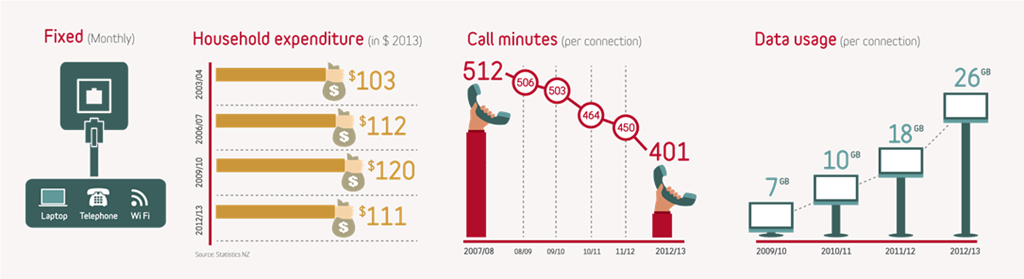
image


image

Source: Commerce Commission

Ronald Coase and the preoccupation with monopoly

Ronald Coase

One important result of this preoccupation with the monopoly problem is that if an economist finds something—a business practice of one sort or other—that he does not understand, he looks for a monopoly explanation. And as in this field we are very ignorant, the number of ununderstandable practices tends to be rather large, and the reliance on a monopoly explanation, frequent.

After this foray written in 1971, Coase went further in an appreciation written for George Stigler’s Nobel Prize in 1982:

…for reasons which are not altogether clear to me, it is a field [of industrial organisation] which has come to concentrate on The Monopoly Problem and, more specifically in the United States, on the problems thrown up by the administration of the antitrust laws.

The result has not been a happy one for economics.

By concentrating on the problem of monopoly in dealing with an economic system which is, broadly speaking, competitive, economists have had their attention misdirected and as a consequence they have left unexplained many of the salient features of our economic system or have been content with very defective explanations.

Foreigners Are Our Friends | Bryan Caplan | Learn Liberty – YouTube

The share market as a spy, investigator and muckraker: using share price movements to uncover secrets and solve mysteries

Armen Alchian successfully identifying lithium as the fissile fuel in the Bikini Atoll atomic bomb using only publicly available financial data. The early 1954 RAND corporation memo by Alchian was classified a few days later.

The Stock Market Speaks: How Dr. Alchian Learned to Build the Bomb by Joseph Michael Newhard, August 27, 2013 at for a replication study of Alchian’s event study of share market reactions to the Bikini Atoll nuclear detonations in 1954 updated with declassified information and modern finance theory.

An extra challenge for Alchian was not only was the component of the bomb classified, whether the explosion was atomic or hydrogen was classified too.

The share price of the supplier of lithium surged within a few days.

The replication study by Newhard found a significant upward movement in the price of Lithium Corporation relative to the other corporations. Within three weeks of the explosion, its shares were up 48% before settling down to a monthly return of 28% despite secrecy, scientific uncertainty, and public confusion surrounding the test; the company saw a return of 461% for the year.

The share market is a surprising efficient tool for discerning new knowledge.

After the Challenger space shuttle disaster in 1986, the share market identified within the hour which component supplier made the faulty part and marked it down accurately as to damages and loss of business. The blue ribbon commission of inquiry took 6-months to find the culprit.

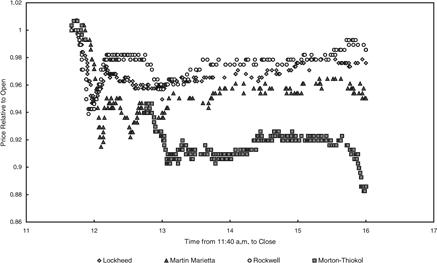
In the period immediately following the crash, securities trading in the four main shuttle contractors singled out Morton Thiokol as having manufactured the faulty component.

Intraday stock price movements following the challenger disaster


At market close, Thiokol’s shares were down nearly 12 per cent. By contrast, the share prices of the three other firms started to creep back up, and by the end of the day their value had fallen only around 3 per cent.

Morton Thiokol shed some $200 million in market value on the day. Over the next several months, the other contractors recovered and outperformed the market while Morton Thiokol lagged.

As a result of the investigation, Morton Thiokol had to pay legal settlements and perform repair work of $409 million at no profit. It also dropped out of bidding for future business.

The $200 million equity decline for Morton Thiokol in hindsight is a reasonable prediction of lost cash flows that came as a result of the judgment of culpability in the crash.

William Brown found that a group of firms that had significant ties to Lyndon Johnson increased in the market value after President Kennedy’s assassination. The share prices of General Dynamics, whose main aircraft plant was located in Fort Worth, Texas, climbed from $23.75 on November 22 to $25.13 on November 26, and by February 1964 was up over $30, a jump of around 30 per cent in three months.

Over the ten trading days following the announcement of Timothy Geithner’s nomination as U.S. Treasury Secretary, financial firms with a connection to Geithner experienced a cumulative abnormal return of about 12% relative to other financial sector firms. This reversed when his nomination ran into trouble due to unexpected tax return issues.

Pat Akey (2013) looked at the abnormal returns in share prices around close U.S. congressional elections. Firms gain on the election of a politician with whom they are connected – and they lost when he or she is defeated. The cumulative abnormal return to be between 1.7% and 6%.


Warren Buffett: I Build Wind Turbines To Lower My Taxes

“I will do anything that is basically covered by the law to reduce Berkshire’s tax rate,” Buffett told an audience in Omaha, Nebraska this weekend. “For example, on wind energy, we get a tax credit if we build a lot of wind farms. That’s the only reason to build them. They don’t make sense without the tax credit.”

Warren Buffett, co-chair of the 10,000 Small Businesses Advisory Council, takes part in a panel discussion following a news conference announcing a $20 million partnership to bring Goldman Sachs

Buffett has invested billions into wind power to get federal subsidies.

via Warren Buffett: I Build Wind Turbines To Lower My Taxes | The Daily Caller.

What exact did David Card say about the minimum wage?

Our findings suggest that the efficiency aspects of a modest rise in the minimum wage are overstated….

[W]e find no evidence for a large negative employment effect of higher minimum wages. Even in the earlier literature, however, the magnitude of the predicted employment losses from a much higher minimum wage would be small: the evidence at hand is relevant only for a moderate range of minimum wages, such as those that prevailed in the U.S. labour market during the past few decades.

Within this range, however, there is little reason to believe that increases in the minimum wage will generate large employment losses.

David Card and Alan B. Krueger, Myth and Measurement: The New Economics of the Minimum Wage, (Princeton: Princeton University Press, 1995, p. 393).

Can New Zealand blame distance for its economic woes?

Distance is common in many discussions of the relative growth performance of New Zealand. New Zealand is said to be small and remote and poorer for it. The figure below from a Productivity Commission report is an example.
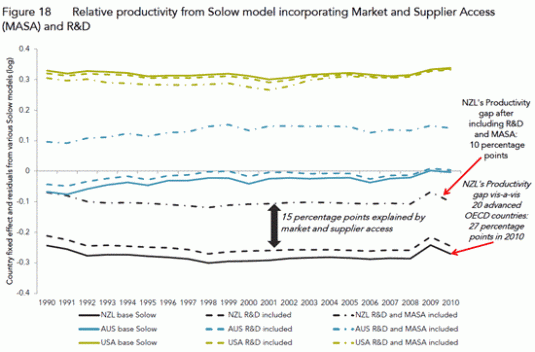
The Productivity Commission put it this way:

New Zealand firms face reduced access to large markets and limited participation in global value chains, where the transfer of advanced technologies now often occurs.

Indeed, global value chains – which can require intensive interaction and just-in-time delivery across borders – may have worsened the impact of New Zealand’s geographic isolation on trade in goods.

The Commission continues on to say that:

These limits on trade and the diffusion of new ideas into New Zealand may explain as much as 15 percentage points of the 27% productivity gap between New Zealand and the average of 20 OECD countries.

This 15 per cent claim is a daring claim. Physical location does not change over time.

New Zealand, Australia and the other European offshoots such as Canada and the USA all prospered for most to all their histories despite their distances from their mother country. Canada cannot blame distance for its weak productivity performance because it is next door to the USA.

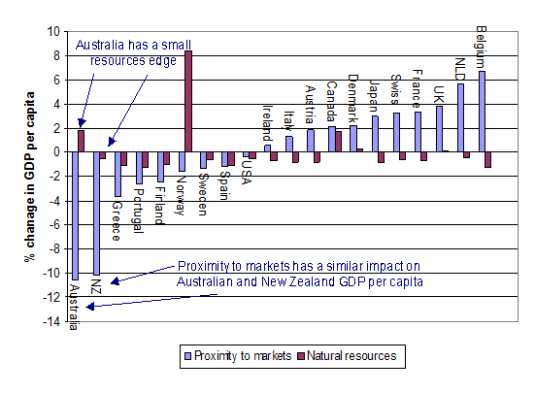
Figure 1 below using OECD data suggests that New Zealand and Australian real GDP per capita are both about 10 percentage points lower than they otherwise would be because of distance. A bounty of natural resources gives a less than a two per cent boost to Australia’s real GDP per capita, see Figure 1.

Figure 1: Estimated impact of proximity to markets and natural resources on real GDP per capita, OECD members, average for 2000-2004
Source: OECD.

The burden of geography is about distance from large agglomerations of production, consumption and supply. There is from the extra cost of exporting to distant markets and the cost penalty from ordering from major suppliers who are far way. Geography can also affect the international flow of ideas and the diffusion of new technologies.

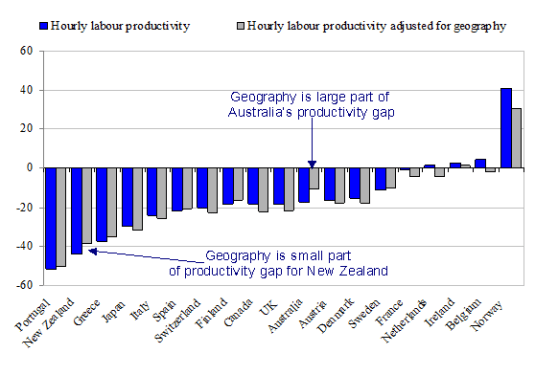
Figure 2 shows that most of the labour productivity gap of New Zealand and many others with the USA is not explained by geography – by access to major markets and any natural resource bounty.

Figure 2: Apparent and geography adjusted hourly labour productivity relative to the USA, 2006

Source: OECD (2008).

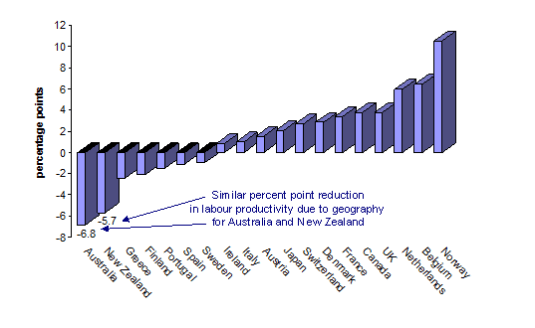
New Zealand’s apparent and geography adjusted productivity gaps with the USA are not far apart. In contrast, the OECD (2009c), geography cuts in half the gap in hourly labour productivity between the USA and Australia – see Figure 3.

Figure 3: Percentage point change in hourly labour productivity relative to the USA due to geography, 2006
Source: OECD.

The labour productivity gap of New Zealand with the USA is over four times larger than what could be reasonably attributed to geographic burdens. Other factors must account for the bulk of New Zealand’s productivity gap.

More to the point, distance and remoteness explain none of the productivity and income gaps across the Tasman and why this gap suddenly appeared in the 1970s and 1980s to NZ’s disadvantage.

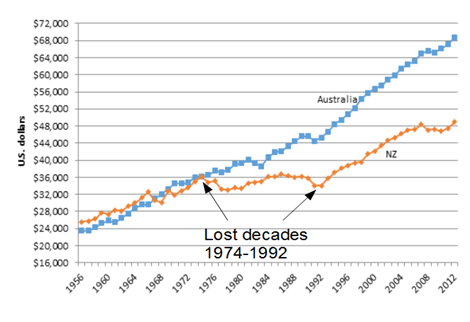
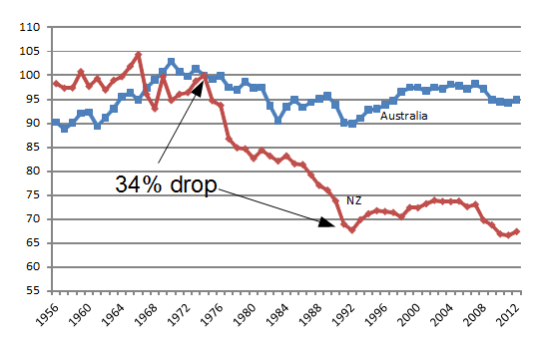
New Zealand lost almost two decades of growth between 1974 and 1992 as shown in Figure 4.

Figure 4: Real GDP per New Zealander and Australian aged 15-64, converted to 2013 price levels with updated 2005 EKS purchasing power parities, 1956-2012
Source: Computed from OECD StatExtract and The Conference Board, Total Database, January 2014.

The Trans-Tasman gap is the income and productivity gap that concerns Kiwis and is the relevant policy yardstick everyone uses or should use.

The emergence of the Trans-Tasman income gap from initial income parity in 1974 – see Figure 4 – cannot be because of distance because both NZ and Australia suffer equally from a 10% productivity burden because of distance.

This common 10% productivity burden due to distance does not explain real GDP per working age person in Australia and NZ dropping from parity in 1974 to a 35% gap inside 20 years and then suddenly stabilising.

Figure 4 showed that NZ started growing again in 1992 after the Ruth Richardson horror budget stabilised economic policy sentiments. There was to be no going back on the economic reforms.

Figure 5 below shows that NZ’s labour productivity growth dropped like a stone between 1974 and 1992 then stabilised at 1.85% growth per year from 1992 to 2005. GDP per working age person in Figure 5 is based to 100 in 1974 and then detrended by 1.85% per year – the trend growth rate of the USA in the 20th century. A flat line in Figure 5 is annual growth in real GDP per working age person of 1.85%. Australia’s growth rate is pretty flat since 1970 bar the odd recession and recovery from the same.

Figure 5: Real GDP per New Zealander and Australian aged 15-64, converted to 2013 price levels with updated 2005 EKS purchasing power parities, base 100 in 1974, 1.85 per cent detrending, 1956-2012
Source: Computed from OECD StatExtract and The Conference Board, Total Database, January 2014.

This 34% productivity drop in NZ from 1974 to the mid-1980s was too rapid to be explained by distance and global value chains suddenly becoming more important than was the case for most of NZ’s history. Australian GDP growth rates was not affected in the slightest by these trends in the geography of trade and input markets.

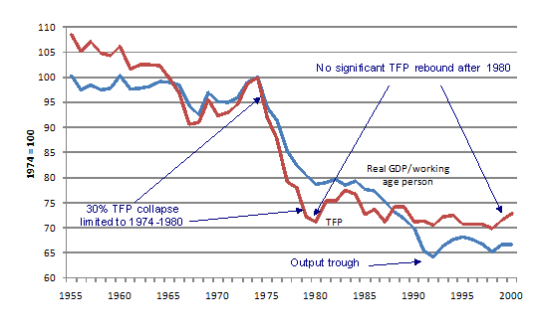
The Productivity Commission looked at the wrong data to ask the wrong questions. The data analysis undertaken on behalf of the Productivity Commission started in 1980. Figure 6 below shows at all the action and excitement regarding total factor productivity in New Zealand occurred before 1980.

Figure 6: New Zealand total factor productivity and real GDP per New Zealander aged 15-64, 2 per cent detrended, 1955-2000
Source: Kehoe and Ruhl (2003).

Kehoe and Ruhl (2003) attributed the decline in the growth of GDP per working age New Zealander after 1974 to 1992 to a sharp decline in total factor productivity from 1974 to 1980.

Figure 6 plots detrended data constructed by Kehoe and Ruhl (2003) to show that total factor productivity fell rapidly in New Zealand between 1974 and 1980, by 30 per cent in all, and then levelled out to grow again at the trend rate of two per cent.

There was no subsequent total factor productivity recovery to make up the lost ground. If this were so, Figure 4 would have had to include a strongly rising line for total factor productivity over many years after 1980 to recover the 30 per cent fall in the level of total factor productivity between 1974 and 1980.

Kehoe and Ruhl (2003) suggested that the identification of the factors that permanently reduced total factor productivity levels in New Zealand between 1974 and 1980 may have great contemporary policy relevance.

The total factor productivity drop identified by Kehoe and Ruhl (2003) occurred before the 1978 start of the Statistics New Zealand productivity data series.

The great value of the Kehoe and Ruhl (2003) data is the drawing out of the major decline in total factor productivity on the eve of the Statistics New Zealand data series.

Kehoe and Ruhl (2003) attributed the 1970s total factor productivity collapse to a massive change in trade patterns after the entry of the UK into the then European Economic Community in 1973.

All discussions of income gaps should be against Australia and any additional burden of distance that New Zealand faces in addition to Australia since 1974 when the Trans-Tasman income gap emerged.

When New Zealand catches-up with Australia in labour productivity that will be the time to start worrying about the burden of geography – a burden that holds back relative productivity equally in both countries. You cannot explain the difference between Australia’s and NZ’s relative productivity by geographic factors they have in common.

James Taylor – You’ve Got A Friend

Everything’s Amazing and Nobody’s Happy | Bryan Caplan

Who gains from anti-imperialism and opposition to foreign investment?

Much more commonly, [economic imperialism] is used by Marxists to describe–and attack–foreign investment in “developing” (i.e., poor) nations.

The implication of the term is that such investment is only a subtler equivalent of military imperialism–a way by which capitalists in rich and powerful countries control and exploit the inhabitants of poor and weak countries.

There is one interesting feature of such “economic imperialism” that seems to have escaped the notice of most of those who use the term.

Developing countries are generally labour rich and capital poor; developed countries are, relatively, capital rich and labour poor. One result is that in developing countries, the return on labour is low and the return on capital is high–wages are low and profits high. That is why they are attractive to foreign investors.

To the extent that foreign investment occurs, it raises the amount of capital in the country, driving wages up and profits down.

The effect is exactly analogous to the effect of free migration. If people move from labour-rich countries to labour-poor ones, they drive wages down and rents and profits up in the countries they go to, while having the opposite effect in the countries they come from.

If capital moves from capital-rich countries to capital-poor ones, it drives profits down and wages up in the countries it goes to and has the opposite effect in the countries it comes from.

The people who attack “economic imperialism” generally regard themselves as champions of the poor and oppressed.

To the extent that they succeed in preventing foreign investment in poor countries, they are benefiting the capitalists of those countries by holding up profits and injuring the workers by holding down wages.

It would be interesting to know how much of the clamour against foreign investment in such countries is due to Marxist ideologues who do not understand this and how much is financed by local capitalists who do.

David D. Friedman

Opposition to immigration might protect the wages of local workers. Opposition to foreign investment might increase the profits of local capitalists.

clip_image002

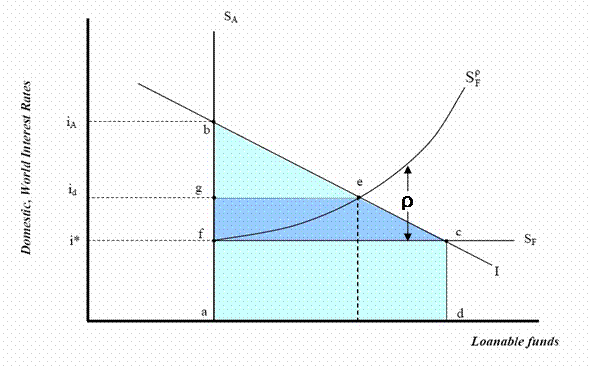
How does more competition help the local capitalists?  The foreign investment is in response to the high returns in the local market and that inflow of foreign capital will continue until local rates of return match those in other countries.

Equalisation of risk-adjusted rate of returns is central to the operation of capital markets.

Stopping this process of equalisation through regulation only benefits the capitalists inside the country. It reduces the wages of workers because they have less capital and fewer modern technologies to work with.

Ronald Coase on applied welfare economics versus comparative institutional analysis

All solutions have costs, and there is no reason to suppose that governmental regulation is called for simply because the problem is not well handled by the market or the firm.

Satisfactory views on policy can only come from a patient study of how, in practice, the market, firms and governments handle the problem of harmful effects….

It is my belief that economists, and policy-makers generally, have tended to over-estimate the advantages which come from governmental regulation.

But this belief, even if justified, does not do more than suggest that government regulation should be curtailed. It does not tell us where the boundary line should be drawn.

This, it seems to me, has to come from a detailed investigation of the actual results of handling the problem in different ways.

Previous Older Entries Next Newer Entries

Bassett, Brash & Hide

Celebrating humanity's flourishing through the spread of capitalism and the rule of law

Truth on the Market

Scholarly commentary on law, economics, and more

The Undercover Historian

Beatrice Cherrier's blog

Matua Kahurangi

Celebrating humanity's flourishing through the spread of capitalism and the rule of law

Temple of Sociology

Celebrating humanity's flourishing through the spread of capitalism and the rule of law

Velvet Glove, Iron Fist

Celebrating humanity's flourishing through the spread of capitalism and the rule of law

Why Evolution Is True

Why Evolution is True is a blog written by Jerry Coyne, centered on evolution and biology but also dealing with diverse topics like politics, culture, and cats.

Down to Earth Kiwi

Celebrating humanity's flourishing through the spread of capitalism and the rule of law

NoTricksZone

Celebrating humanity's flourishing through the spread of capitalism and the rule of law

Homepaddock

A rural perspective with a blue tint by Ele Ludemann

Kiwiblog

DPF's Kiwiblog - Fomenting Happy Mischief since 2003

The Dangerous Economist

Celebrating humanity's flourishing through the spread of capitalism and the rule of law

Watts Up With That?

The world's most viewed site on global warming and climate change

The Logical Place

Tim Harding's writings on rationality, informal logic and skepticism

Doc's Books

A window into Doc Freiberger's library

The Risk-Monger

Let's examine hard decisions!

Uneasy Money

Commentary on monetary policy in the spirit of R. G. Hawtrey

Barrie Saunders

Thoughts on public policy and the media

Liberty Scott

Celebrating humanity's flourishing through the spread of capitalism and the rule of law

Point of Order

Politics and the economy

James Bowden's Blog

A blog (primarily) on Canadian and Commonwealth political history and institutions

Science Matters

Reading between the lines, and underneath the hype.

Peter Winsley

Economics, and such stuff as dreams are made on

A Venerable Puzzle

"The British constitution has always been puzzling, and always will be." --Queen Elizabeth II

The Antiplanner

Celebrating humanity's flourishing through the spread of capitalism and the rule of law

Bet On It

Celebrating humanity's flourishing through the spread of capitalism and the rule of law

History of Sorts

WORLD WAR II, MUSIC, HISTORY, HOLOCAUST

Roger Pielke Jr.

Undisciplined scholar, recovering academic

Offsetting Behaviour

Celebrating humanity's flourishing through the spread of capitalism and the rule of law

JONATHAN TURLEY

Res ipsa loquitur - The thing itself speaks

Conversable Economist

Celebrating humanity's flourishing through the spread of capitalism and the rule of law

The Victorian Commons

Researching the House of Commons, 1832-1868

The History of Parliament

Articles and research from the History of Parliament Trust

Books & Boots

Reflections on books and art

Legal History Miscellany

Posts on the History of Law, Crime, and Justice

Sex, Drugs and Economics

Celebrating humanity's flourishing through the spread of capitalism and the rule of law

European Royal History

Exploring the Monarchs of Europe

Tallbloke's Talkshop

Cutting edge science you can dice with

Marginal REVOLUTION

Small Steps Toward A Much Better World

NOT A LOT OF PEOPLE KNOW THAT

“We do not believe any group of men adequate enough or wise enough to operate without scrutiny or without criticism. We know that the only way to avoid error is to detect it, that the only way to detect it is to be free to inquire. We know that in secrecy error undetected will flourish and subvert”. - J Robert Oppenheimer.

STOP THESE THINGS

The truth about the great wind power fraud - we're not here to debate the wind industry, we're here to destroy it.

Lindsay Mitchell

Celebrating humanity's flourishing through the spread of capitalism and the rule of law

Alt-M

Celebrating humanity's flourishing through the spread of capitalism and the rule of law

croaking cassandra

Economics, public policy, monetary policy, financial regulation, with a New Zealand perspective

The Grumpy Economist

Celebrating humanity's flourishing through the spread of capitalism and the rule of law

International Liberty

Restraining Government in America and Around the World