 |
By means of glasses, hotbeds, and hotwalls, very good grapes can be raised in Scotland, and very good wine too can be made of them at about thirty times the expense for which at least equally good can be brought from foreign countries. Would it be a reasonable law to prohibit the importation of all foreign wines, merely to encourage the making of claret and burgundy in Scotland? …As long as the one country has those advantages, and the other wants [lacks] them, it will always be more advantageous for the latter, rather to buy of the former than to make. |
Adam Smith on growing grapes in Scotland
27 May 2014 Leave a comment
in applied price theory, industrial organisation Tags: Adam Smith, free trade, industry policy, protectionism
Edward C Prescott – Restoring U.S. Prosperity – Brazil, 10 May 2014
27 May 2014 Leave a comment
in Edward Prescott, great recession, macroeconomics Tags: Edward Prescott, great recession
Fraudulent use of Dada | Catallaxy Files
26 May 2014 Leave a comment
in labour economics, politics - USA Tags: data mining, Thomas Piketty

Rethinking urban growth boundaries
26 May 2014 Leave a comment
in applied price theory, Public Choice, urban economics Tags: supply of land, town planning, urban limits

Land just inside the Auckland urban limit is worth 10 times the value of land just outside the limit.
35 sci-fi predictions that came true
26 May 2014 Leave a comment
in technological progress Tags: sci-fi, The Great Fact

The relative contributions of Thomas Schelling and the peace movement to the risks of war
26 May 2014 1 Comment
in Thomas Schelling, war and peace Tags: arms races, deterrence, disarmament, mutually assured destruction, peace movements, Robert Aumann
Thomas Schelling (and Robert Aumann) did terrible things such as work out how not to blunder into wars and how to deter wars rather than have to actually fight them.

Schelling’s unique contribution at the Rand Corporation involved viewing strategic situations as bargaining processes.
Focusing on the stand-off between the United States and the Soviet Union, Schelling observed that the two superpowers had both shared and opposing interests.
Their shared interests involved avoiding a nuclear war, while their opposing interests concerned dominating the other. Conflict and cooperation became inseparable.
Iran and Israel are moving down that same path if both have nuclear weapons.
Schelling focused in particular on how the United States and Soviet Union could arrive at and stick to bargains by means of deterrence and compellence.
Deterrence involves dissuading the other from doing something, while compellence referred to persuading the other to do something.
- Deterrence and compellence are supported by threats and promises.
- Threats are costly when they fail and successful when they are not carried out.
- Promises are costly when they succeed and successful when they are carried out. A threat is cheaper than a promise because you do not have to carry it out if your threats work in intimidating others to do what you want.
Since the exploitation of potential force is better than the application of force, it is key to use threats and promises while avoiding having to act upon these.
The challenge is to communicate threats and promises in a credible manner.
The ability to hurt people is conducive to peace, while the ability to destroy weapons increases the risk of war. This is the paradox of deterrence. A country needs a credible second-strike capacity to deter a pre-emptive first strike. A country needs its missiles to survive such an attack.
Populations are better protected by protecting the missiles. By protecting the missiles rather than their cities, each side was offering their populations as a hostage to the other.
With each side holding the other’s cities as hostage, neither has an incentive to strike first. This is much safer than having each side worried about their weapons been destroyed and they therefore use them before they are destroyed in some minor crisis.
That is one of Schelling’s many contributions to peace.
What were the contributions of the peace movements?
Robert Aumann argued well that the way to peace is like bargaining in a medieval bazaar. Never look too keen, and bargain long and hard. Aumann argues that:
If you are ready for war, you will not need to fight. If you cry ‘peace, peace,’ you will end up fighting…
What brings war is that you signal weakness and concessions.
Countries are more likely to cooperate if they have frequent interactions and have a long time horizon. The chances of cooperation increase when it is backed by the threat of punishment.
Disarmament, Aumann argues, “would do exactly the opposite” and increase the chances of war. He gave the example of the Cold War as an example of how their stockpiles of nuclear weapons and fleets of bombers prevented a hot war from starting:
In the long years of the cold war between the US and the Soviet Union, what prevented “hot” war was that bombers carrying nuclear weapons were in the air 24 hours a day, 365 days a year? Disarming would have led to war.
Aumann has quoted the passage from the biblical Book of Isaiah:
Isaiah is saying that the nations can beat their swords into ploughshares when there is a central government – a Lord, recognized by all.
In the absence of that, one can perhaps have peace – no nation lifting up its sword against another.
But the swords must continue to be there – they cannot be beaten into ploughshares – and the nations must continue to learn war, in order not to fight!
Picketing puppies
26 May 2014 Leave a comment
in environmental economics, environmentalism, health economics Tags: animal rights
Stirling University in the UK cancelled plans for a petting zoo after protests from PETA.

A petting zoo is set up outside the university library where stress-out students can have time out with puppies, kittens and other cute animals.
Hayek on the growth of knowledge and the growing acknowledgement of ignorance
25 May 2014 Leave a comment


The Anti-War Left and the purpose of the International Humanitarian Laws of War
25 May 2014 Leave a comment
in economics, laws of war, war and peace Tags: international humanitarian law
When it comes to the raison d’être of international humanitarian law, a stout ignorance infects the Renegade Left.
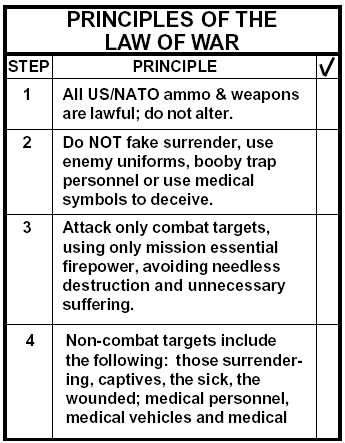

The purpose of international humanitarian law is to ensure a strict differentiation between civilians and combatants and provide for the detention and treatment of captured combatants.
The prospect of humane detention until the end of the conflict increases both the incentive to give quarter and to surrender when a military position is hopeless.
The purpose of this wartime detention of combatants is not to punish them, but to prevent return to the battlefield. Some of the detainees who have been released from Gitmo have returned to the battlefield.
The strict requirement under the Geneva conventions for combatants to carry their weapons openly and to dress in a uniform recognisable at a distance is to ensure that combatants are easy to distinguish from afar so that troops do not get trigger happy around civilians and refugee columns.
This is the fundamental purpose of international humanitarian law: saving civilians from the fighting.
In return for many legal protections from being harmed by the hostilities, civilians are strictly forbidden from engaging in hostilities.
If civilians directly engage in hostilities, they are considered unlawful or unprivileged combatants or belligerents. They may be prosecuted under the law of the detaining state. Both lawful and unlawful combatants may be interned for the duration in wartime, and they may be interrogated and also prosecuted for war crimes.
The severest of punishments are allowed for spies, saboteurs, infiltrators, francs-tireurs and guerrillas. Not carrying weapons openly and not dressing in a military uniform that is recognisable from a distance is a self-inflicted death sentence.
In the Battle of the Bulge, the English-speaking Nazi infiltrators dressed in American uniforms lost all interest in their missions once the first few who were captured were court-martialled in the field and immediately shot. This was the standard practice of every army at the time.
The Hostages Trial at Nuremburg dismissed some murder charges against some German commanders because partisan fighters in Europe could not be considered lawful belligerents under Article 1 of the 1907 Hague convention. The Tribunal stated:
We are obliged to hold that such guerrillas were francs tireurs who, upon capture, could be subjected to the death penalty. Consequently, no criminal responsibility attaches to the defendant List because of the execution of captured partisans…
The term combatant denotes the right to participate directly in hostilities. Lawful combatants cannot be prosecuted for lawful acts of war in the course of military operations even if their behaviour would constitute a serious crime in peacetime.
The term unlawful combatant was first used in US law in a 1942 United States Supreme Court decision in the case Ex parte Quirin.
The Supreme Court upheld the jurisdiction of a U.S. military tribunal over the trial of several German saboteurs in the US. This judgment states:
By universal agreement and practice, the law of war draws a distinction between the armed forces and the peaceful populations of belligerent nations and also between those who are lawful and unlawful combatants.
Lawful combatants are subject to capture and detention as prisoners of war by opposing military forces. Unlawful combatants are likewise subject to capture and detention, but in addition they are subject to trial and punishment by military tribunals for acts which render their belligerency unlawful.
The criteria from a just war include "serious prospects of success" and "the use of arms must not produce evils and disorders graver than the evil to be eliminated.
Neither applies to the firing of missiles from the Gaza into Israel after the 2005 disengagement.
When was the last time the Progressive Left denounced Hamas as war criminals for targeting civilians in Israel and intermingling with their own civilians for cover. Both are war crimes
This Google map shows much of the Gaza Strip is rural. There is plenty of rural land that is ideal for Hamas military bases this away from civilian centres as required by the laws of war.
The laws of war do not make it safer to be a combatant.
The laws of war are designed to reduce the chances that civilians are attacked because they are near military targets and of soldiers unlawfully intermingle among them for cover.
Why Life Expectancy Is Misleading
25 May 2014 Leave a comment
in technological progress Tags: life expectancy, The Great Escape, The Great Fact
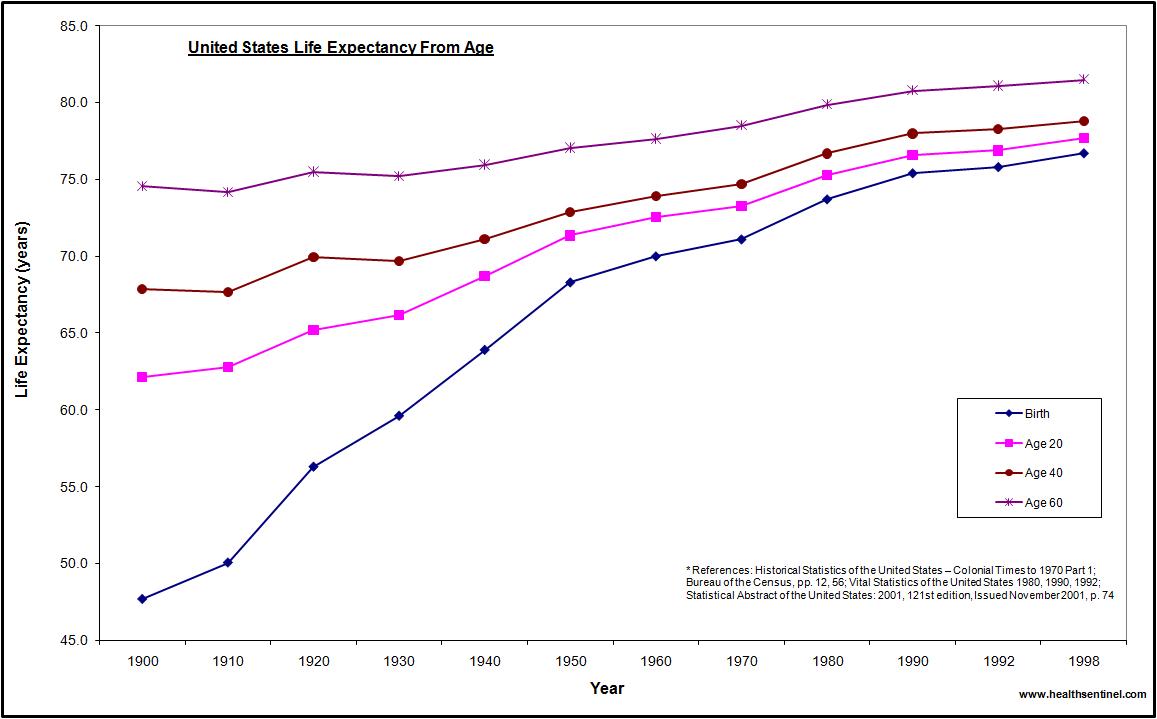
From 1900 to 1998, life expectancy from birth for Americans rose from 47 to 75, an increase of 28 years.
A good deal of that increase in life span had to do with increases in the chances of surviving birth and childhood.
via priceonomics
The Devil’s Dictionary – definition of a cynic
24 May 2014 Leave a comment
in applied price theory, liberalism Tags: Devil's dictionary

A blackguard whose faulty vision sees things as they are, not as they ought to be. Hence the custom among the Scythians of plucking out a cynic’s eyes to improve his vision.

 Utopia, you are standing in it!
Recent Comments