An astroid the size of a mountain will pass by tomorrow
26 Jan 2015 Leave a comment
in economics of media and culture Tags: space
Evidence that the Left over Left are narrow-minded and personally nasty to people who disagree with them
26 Jan 2015 Leave a comment
in politics - Australia, politics - New Zealand, politics - USA Tags: activists, expressive voting, Greens, Leftover Left, political psychology, progressive left


1960 : Scientists Blamed Growth Of Antarctic Ice Sheet On Global Warming
26 Jan 2015 Leave a comment
in economics

In 1960, scientists explained how global warming made the Antarctic ice sheet grow.

Now scientists explain that global warming makes the Antarctic ice sheet shrink.
Satellites measure Antarctica is … losing land ice at an accelerating rate which has implications for sea level rise.
the ice sheets are sensitive to warming temperatures and are going to cause significant sea level rise over this century (and beyond).
Global warming is truly amazing, in that it can simultaneously produce all possible outcomes.

The UK Green’s election signs are not in any way fluffy like those in New Zealand
26 Jan 2015 Leave a comment
in economics of media and culture, politics - New Zealand Tags: expressive voting, Greens, Leftover Left, Uk Greens

Obviously, the UK Greens are not as fluffy as their down-under compatriots if you have a look at this somewhat confrontational sign of theirs.

The New Zealand Greens have election campaign signs from which I can neither discern their message, nor easily work out that it is a Green sign because their logo is so small in the bottom right hand corner when driving by a car.

Maybe the Greens are not after car-owner votes, only bicyclists and public transport users – the middle-class on the way to their jobs in the city.
The sign of the UK Greens borders on hate speech. The UK Greens also do not have female and male co-leaders, as is the case for the New Zealand Greens, from what I can see – where is their gender balance?
Darwin awards: Abandoned lion cub who became best friends with man
26 Jan 2015 Leave a comment
in economics of media and culture Tags: Darwin awards

Currency union and asymmetrical supply shocks – the case of Finland
26 Jan 2015 Leave a comment
in economics
A nice discussion of the granular economy and real business cycle theory where the fortunes of one company can affect the entire economy.
New Zealand is in the same position with Fonterra – the dairy exporter that accounts for 7% of GDP.

This morning I am flying to Finland to speak about the outlook the Polish economy at a seminar in Helsinki. That is the inspiration for what I will talk about in this post – or rather I will tell the story of how an asymmetrical negative supply shock – combined with euro membership – has sent the Finnish economy into recession. It is (partly) a story of the demise of Finland’s best known company Nokia.
A cornerstone in Optimal Currency Area theory is that two countries should only join in a currency union if the shocks that hit the economies tend to be symmetrical. Hence, economic shocks should tend to hit both economies at the same time and by more or less the same magnitude.
A shock the oil price is a good example of a symmetrical supply shock to the euro zone countries as all the euro area countries…
View original post 1,427 more words
Failed monetary policy – the one graph version
26 Jan 2015 Leave a comment
in economics
This is the ECB’s monetary policy objective: “Inflation rates of below, but close to, 2%”
Have a look at the graph below and tell me if the ECB is fullfilling it’s objective…
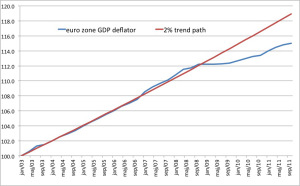
Oops I forgot – the ECB is not targeting a 2% inflation measured by the GDP deflator, but instead is targeting euro zone CPI (HICP) inflation, which of course includes non-monetary factors such as import prices and indirect taxes. You all of course know that it would make much more sense to target the GDP deflator than CPI (if not see here), but then again then the ECB would have to ease monetary policy aggressively…
PS if you wonder why German 10-year bond yields are inching closer and closer to 1% you might want to have a look at the GDP deflator graph once again…
Update: Scott Sumner has a related post.
The competing visions of stabilisation policy have been defined by Franco Modigliani and Milton Friedman
26 Jan 2015 Leave a comment
in business cycles, economics of information, history of economic thought, macroeconomics, Milton Friedman, monetarism, monetary economics Tags: Franco Modigliani, Keynes in macroeconomics, monetary policy, stabilisation policy, The fatal conceit, The pretence to knowledge


Grexit, Germany and Googlenomics
26 Jan 2015 Leave a comment
in economics
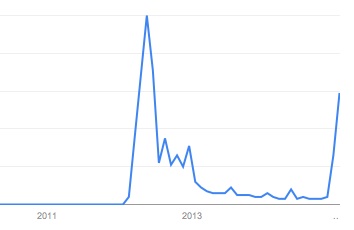
The talk of Greece leaving the euro area – Grexit – is back. Will Grexit actually happen? I don’t know, but I do know that more and more people worry that it will in fact happen.
This is what Google Trends is telling us about Google searches for “Grexit“:
And guess what? While this is happening euro zone inflation expectations have collapsed. In fact this week 5-year German inflation expectations turned negative! This mean that the fixed income markets now expect German inflation to be negative for the next five years!
It is hard to find any better arguments for massive quantitative easing within a rule-based framework in the euro zone (with or without Greece). And this is how it should be done.
PS it has been argued recently that euro zone bond yields have declined because the markets are pricing in QE from the ECB. Well, if…
View original post 69 more words
American public concern about global warming is recovering with the economy
26 Jan 2015 Leave a comment
in environmental economics, global warming, politics - USA Tags: climate alarmism, expressive voting

It was the Democrats and and independents who lost interest in global warning as the economy weakened.

Global warming is second bottom is a major political priority in the USA at this time

Victorian era exercise machine
26 Jan 2015 Leave a comment
Has the USA moved to lower trend GDP growth path?
26 Jan 2015 Leave a comment
in business cycles, economic growth, great recession, macroeconomics, politics - USA Tags: great recession, Jagadeesh Gokhale, prosperity and depression

Proof at last, that the moon landing was real
26 Jan 2015 Leave a comment
in economics of bureaucracy, politics - USA, technological progress Tags: conspiracy theorists, immigration, moon landing
Fortune 500 firms in 1955 vs. 2014; 89% are gone
26 Jan 2015 Leave a comment
in economics


HT: http://www.slideshare.net/amandagordon5439087/nimble-a-proposal-for-speed-agility-39060159 and http://blog.softwareinsider.org/2014/02/18/research-summary-sneak-peaks-from-constellations-futurist-framework-and-2014-outlook-on-digital-disruption/
 Utopia, you are standing in it!
Recent Comments