Skydiver becomes first to land without parachute
31 Jul 2016 Leave a comment
in economics of media and culture
Dowry in Rural India
31 Jul 2016 Leave a comment
in economics

Marriage is almost universal in India, and so is dowry. Despite being illegal since 1961, most Indian brides’ families pay a substantial amount of cash and gifts to the grooms’ families at the time of marriage, often amounting to several years of household income. Traditionally, dowry was considered stridhan, i.e., woman’s wealth, and it was indeed a type of premortem bequest as daughters typically did not inherit property from their fathers. Over time, however, dowry has become more of a groom-price that equates the supply and demand of brides and grooms in the marriage market.
Despite its wide prevalence, accurate data on dowry is hard to come by. In fact, even simple things such as the definition of dowry and its trend have been hotly debated in the economics literature. In a new paper, my co-authors, Nishith Prakash and Sungoh Kwon from the University of Connecticut, and I use data…
View original post 424 more words
Celebrating Friedman and Hetzel
31 Jul 2016 Leave a comment
in economics

Today Milton Friedman would have turned 102 years. Happy birthday Uncle Milty!
I have over the last couple of years done numerous posts celebrating Milton Friedman so this post will not be long. Instead I will leave the job to Robert Hetzel who I am also celebrating this year as Bob turned 70 years on July 3.
So I find it suiting that my readers should read Bob’s paper The Contributions of Milton Friedman to Economics. Here is the abstract:
Milton Friedman began his teaching career at the University of Chicago isolated intellectually. He defended the ideas that competitive markets work efficiently to allocate resources and that central banks are responsible for inflation. By the 1980s, these ideas had become commonplace. Friedman was one of the great intellectuals of the 20th century because of his major influence on how a broad public understood the Depression, the Fed’s stop-go monetary…
View original post 365 more words

The Solow model and catch-up growth
31 Jul 2016 Leave a comment
in development economics, economic growth, economics, growth miracles Tags: Solow convergence
Bill Maher on the Superiority of Western Values
31 Jul 2016 Leave a comment
in constitutional political economy, economics of religion, liberalism Tags: The Age of Enlightenment
Notes towards a Red Queen hypothesis of New Zealand politics
31 Jul 2016 Leave a comment
in economics
#feelthe bernie debunked by #MiltonFriedman
31 Jul 2016 Leave a comment
in applied price theory, applied welfare economics, economics, politics - USA Tags: 2016 presidential elections

College and post-graduate wage premium in the English speaking countries, France, S. Korea, Finland, Denmark, Norway and Sweden
31 Jul 2016 Leave a comment
in economics of education, human capital, labour economics, occupational choice Tags: Australia, British economy, Canada, College premium, Denmark, education premium, Finland, France, graduate premium, Ireland, Korea, Norway, post-graduate premium, Sweden
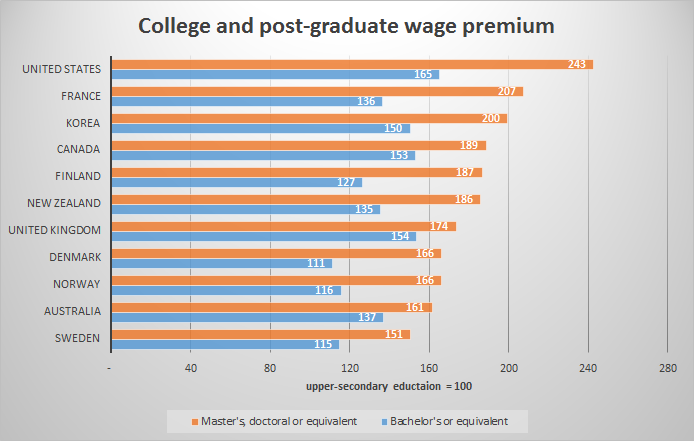
Source: Education at a Glance 2015, section 6.
 Utopia, you are standing in it!
Recent Comments