
Nick Stern is back with another report on climate change – colloquially known as Stern 2.0. It’s another offering from the Global Commission on the Economy and Climate. Since his 2006 review, Stern has been regularly in the news, claiming climate change is worse than we thought. The new report fits the mould.
The summary was released before the main report and we are invited to believe its findings without inspecting the evidence. It seems, though, that Stern has produced another far-fetched piece of work.
The new report makes three claims, none of which stand up: that climate policy stimulates economic growth; that climate change is a threat to economic growth; and an international treaty is the way forward.
Climate policy and economic growth
“Well-designed policies … can make growth and climate objectives mutually reinforcing,” the report claims.
The original Stern Review argued that it would cost about 1% of global GDP to stabilise the atmospheric concentrations of greenhouse gases around 525ppm CO2e. In its report last year the Intergovernmental Panel on Climate Change (IPCC) put the costs twice as high. The latest Stern report advocates a more stringent target of 450 ppm and finds that achieving this target would accelerate economic growth.
This is implausible. Renewable energy is more expensive than fossil fuels, and their rapid expansion is because they are heavily subsidised rather than because they are commercially attractive. The renewables industry collapsed in countries where subsidies were withdrawn, as in Spain and Portugal. Raising the price of energy does not make people better off and higher taxes, to pay for subsidies, are a drag on the economy.
Climate policy need not be expensive. Study after study has shown that it is possible to decarbonise at a modest cost and Stern has missed an opportunity to point this out.
But low-cost climate policy is far from guaranteed – it can also be very, very expensive. Europe has adopted a jumble of regulations that pose real costs for companies and households without doing much to reduce emissions. What is the point of the UK carbon price floor, for instance? Emissions are not affected because they are capped by the EU Emissions Trading Systems, but the price of electricity has gone up.
The subsidies and market distortions that typify climate policy do, of course, create opportunities for the well-connected to enrich themselves at the expense of the rest of society. Perhaps Stern 2.0 mistook rent seeking for wealth creation.
Climate change and economic growth
The report says that if, in the long run, “climate change is not tackled, growth itself will be at risk.”
The new report claims climate change would be a threat to economic growth. The original Stern Review argued that the damage would be 5-20% of global income. In the worst case, we would not be four times as rich by the end of the century, but only 3.8 times. The IPCC reckons Stern 1.0 exaggerated the impacts by a factor 10 or more, while the new Stern report agrees that the old Stern was off by an order of magnitude, but in the opposite direction.
Over the past two decades, economists have re-investigated the relationship between economic development and geography. This has not led to a revival of the climate determinism of Ellsworth Huntington – the Yale professor who argued that a nation’s prosperity could be predicted by its location and climate. On the contrary, most research finds that climate plays at most a minor role in economic growth, and that the impact of climate is moderated by technology and institutions. Just consider Iceland and Singapore. Stern 2.0 goes against the grain of a large body of literature.
International treaties
“A strong … international agreement is essential,” the Stern report says, calling for an international treaty with legally binding targets. Albert Einstein defined insanity as doing the same thing over and over again and expecting a different result. Since 1995, the parties to the UN Framework Convention on Climate Change have met year-after-year to try and agree on legally binding targets – and they have failed every time.
The reasons are simple. It is better if others reduce their emissions but you do not. No country likes to be bound by UN rules for its industrial, agricultural and transport policies. The international climate negotiations have been successful in creating new bureaucracies, but not in cutting emissions.
Stern also argues that “[d]eveloped countries will need to show leadership.” The EU has led international climate policy for two decades, but without winning any followers. The broken record that is Stern 2.0 is unlikely to inspire enthusiasm for more expensive energy.
A way forward
The Stone Age did not end because we ran out of stones, but because we found something better: bronze. The fossil fuel age will end when we find an alternative. The current renewables are simply not good enough – except for the happy few who profit from government largesse.
The environmental movement’s aversion to nuclear power and shale gas increases emissions and creates an impression of Luddism, whereas climate policy should focus on accelerating technological change in energy.
The unfounded claims in Stern’s new report do not build the confidence that investors and inventors need to take a punt on a carbon-free future. Exaggeration is great for headlines, but sober analysis is more convincing in the long run.
via theconversation.com under Creative Commons Licence


/assets.sbnation.com/uploads/chorus_asset/file/1374708/failing_at_two-degree_goal.0.png)
/assets.sbnation.com/uploads/chorus_asset/file/1374424/cumulative_historical_emissions.0.png)
/assets.sbnation.com/uploads/chorus_asset/file/1374568/China_s_per_capita_emissions.0.png)
/assets.sbnation.com/uploads/chorus_asset/file/1395414/outsourcing_emissions_2.0.png)
/assets.sbnation.com/uploads/chorus_asset/file/1374984/divvying_up_to_meet_the_budget.0.png)
/assets.sbnation.com/uploads/chorus_asset/file/1374504/Annex_B_vs_non_Annex_B.0.png)
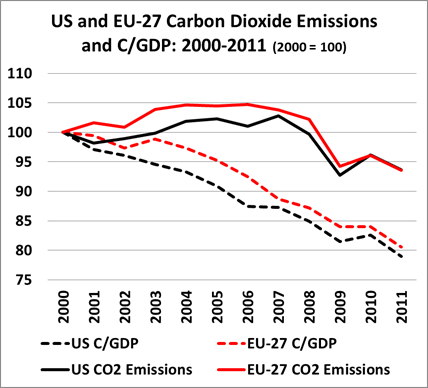 Whatever impact the EU ETS has had, the US achieved similar results with no carbon market (and some might argue, with no climate policy at all. Both the US and EU reduced aggregate emissions by 6.4 percent from 2000.









Recent Comments