Addressing Global Environmental Externalities: Transaction Costs Considerations

Gary D. Libecap, “Addressing Global Environmental Externalities: Transaction Costs Considerations.” Journal of Economic Literature (2014).

libecap

Abstract

Is there a way to understand why some global environmental externalities are addressed effectively, whereas others are not?

The transaction costs of defining the property rights to mitigation benefits and costs is a useful framework for such analysis. This approach views international cooperation as a contractual process among country leaders to assign those property rights.

Leaders cooperate when it serves domestic interests to do so. The demand for property rights comes from those who value and stand to gain from multilateral action.

Property rights are supplied by international agreements that specify resource access and use, assign costs and benefits including outlining the size and duration of compensating transfer payments, and determining who will pay and who will receive them.

Four factors raise the transaction costs of assigning property rights:

(i) scientific uncertainty regarding mitigation benefits and costs;

(ii) varying preferences and perceptions across heterogeneous populations;

(iii) asymmetric information; and

(iv) the extent of compliance and new entry.

These factors are used to examine the role of transaction costs in the establishment and allocation of property rights to provide globally valued national parks, implement the Convention on the International Trade in Endangered Species of Wild Fauna and Flora, execute the Montreal Protocol to manage emissions that damage the stratospheric ozone layer, set limits on harvest of highly-migratory ocean fish stocks, and control greenhouse gas emissions.

via Environmental Economics: JEL (52,2) p. 424 – Addressing Global Environmental Externalities: Transaction Costs Considerations.

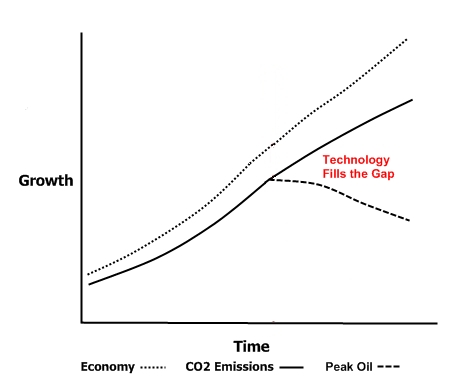
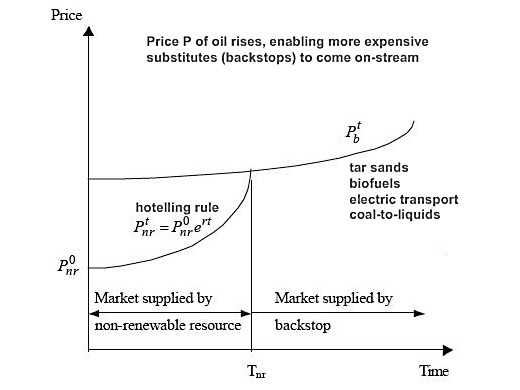
Peak oil versus global warming

The environmental movement manages to believe in both peak oil – oil will run out in the next two decades or so – and global warming based on runaway carbon emissions for the rest of the century burning the increasingly expensive and increasingly scarce crude oil that had ran out a long time ago previously.

Global warming will solve itself as long as we are willing to accept that the environmental movement is genuine in its predictions about peak oil.

The ideal green share market portfolio would be made up of shares in green energy companies and futures contracts in the natural resources sector to take advantage of peak oil.

Alternative energy sources are no substitute for low-cost, zero emissions nuclear power | AEIdeas

nuclear

via Alternative energy sources like wind and solar are no substitute for low-cost, zero emissions nuclear power | AEIdeas.

How Free Markets Will Beat Climate Change: Q&A with Matthew Kahn

David Friedman “Global Warming, Population, and the Problem with Externality Arguments”

Video

IEA Graphic Shows How to Radically Reduce CO2


Climate policy targets revisited | Richard Tol

The IPCC’s Fifth Assessment Report estimates lower costs of climate change and higher costs of abatement than the Stern Review. However, current UN negotiations focus on stabilising atmospheric concentrations of greenhouse gases at even lower levels than recommended by Stern.

This column argues that, given realistic estimates of the rate at which people discount the future, the UN’s target is probably too stringent.

Moreover, since real-world climate policy is far from the ideal of a uniform carbon price, the costs of emission reduction are likely to be much higher than the IPCC’s estimates.

PRTP is the preferred rate of time preference used in net present value calculations.

via Climate policy targets revisited | vox.

What global warming will cost us if we do nothing

David Friedman at Ideas delved into the best estimate of the global cost of global warming – by William Nordhaus – $4.1 trillion this century. This is $48 billion a year – 1/20th of one per cent of world income! Friedman then asked this:

Friedman’s even better argument on the social costs of global warming is that the costs of unlikely but catastrophic risks are included in the social cost arithmetic to make the problem serious. Without including them, global warming up to about a 2-degree warming provides a net benefit.

My Photo

Friedman shows great insight when he goes on to say that there is “no similar attempt to take account of low probability, high cost consequences of preventing global warming”.

That low probability, high cost consequence, which will occur sooner or later, is the next ice age. The next ice age could include a drop in sea levels of three hundred feet and half a mile of ice over the top of London and Chicago. That would bring a new meaning to climate change refugees. We are in a relatively warm period – an interglacial – in an ice age that started two million years ago.

Friedman asked whether “It is at least possible that global warming is all that is preventing the interglacial from ending”.

The great tactical victory of environmentalists is keeping the debate on the science going because even if the science is right, the economic costs are small.

How much will global warming cost is the correct question for policy debate. Let the science be settled!

Economists have no more expertise to judge the science of global warming than they do in judging the science behind the inevitability of super volcanoes going off again such as the one just north of me. The Yellow stone national park super volcano is 50,000 years overdue, by the way.

Economists can comment on the likely consequences, intended and unintended, of different choices and the constraints that different national and international institutional frameworks place on what policy choices might be made.

The chances of India, China and the rest of the Third World agreeing to forego or even slow their economic development to fight global warming is zero even before you consider the international collective action, verification and free rider problems. Adaptation and ‘richer is safer’ are the only game in town whichever way the climate goes!

Next Newer Entries

David Andolfatto

Celebrating humanity's flourishing through the spread of capitalism and the rule of law

Monetary Non-Neutrality

Celebrating humanity's flourishing through the spread of capitalism and the rule of law

Reason Magazine

Celebrating humanity's flourishing through the spread of capitalism and the rule of law

Coyote Blog

Celebrating humanity's flourishing through the spread of capitalism and the rule of law

Thoughts from the North

Celebrating humanity's flourishing through the spread of capitalism and the rule of law

Fardels Bear

A History of the Alt-Right

Vincent Geloso

Econ Prof at George Mason University, Economic Historian, Québécois

Bassett, Brash & Hide

Celebrating humanity's flourishing through the spread of capitalism and the rule of law

Truth on the Market

Scholarly commentary on law, economics, and more

The Undercover Historian

Beatrice Cherrier's blog

Matua Kahurangi

Celebrating humanity's flourishing through the spread of capitalism and the rule of law

Temple of Sociology

Celebrating humanity's flourishing through the spread of capitalism and the rule of law

Velvet Glove, Iron Fist

Celebrating humanity's flourishing through the spread of capitalism and the rule of law

Why Evolution Is True

Why Evolution is True is a blog written by Jerry Coyne, centered on evolution and biology but also dealing with diverse topics like politics, culture, and cats.

NoTricksZone

Celebrating humanity's flourishing through the spread of capitalism and the rule of law

Homepaddock

A rural perspective with a blue tint by Ele Ludemann

Kiwiblog

DPF's Kiwiblog - Fomenting Happy Mischief since 2003

The Dangerous Economist

Celebrating humanity's flourishing through the spread of capitalism and the rule of law

Watts Up With That?

The world's most viewed site on global warming and climate change

The Logical Place

Tim Harding's writings on rationality, informal logic and skepticism

Doc's Books

A window into Doc Freiberger's library

The Risk-Monger

Let's examine hard decisions!

Uneasy Money

Commentary on monetary policy in the spirit of R. G. Hawtrey

Barrie Saunders

Thoughts on public policy and the media

Liberty Scott

Celebrating humanity's flourishing through the spread of capitalism and the rule of law

Point of Order

Politics and the economy

James Bowden's Blog

A blog (primarily) on Canadian and Commonwealth political history and institutions

Science Matters

Reading between the lines, and underneath the hype.

Peter Winsley

Economics, and such stuff as dreams are made on

A Venerable Puzzle

"The British constitution has always been puzzling, and always will be." --Queen Elizabeth II

The Antiplanner

Celebrating humanity's flourishing through the spread of capitalism and the rule of law

Bet On It

Celebrating humanity's flourishing through the spread of capitalism and the rule of law

History of Sorts

WORLD WAR II, MUSIC, HISTORY, HOLOCAUST

Roger Pielke Jr.

Undisciplined scholar, recovering academic

Offsetting Behaviour

Celebrating humanity's flourishing through the spread of capitalism and the rule of law

JONATHAN TURLEY

Res ipsa loquitur - The thing itself speaks

Conversable Economist

In Hume’s spirit, I will attempt to serve as an ambassador from my world of economics, and help in “finding topics of conversation fit for the entertainment of rational creatures.”

The Victorian Commons

Researching the House of Commons, 1832-1868

The History of Parliament

Articles and research from the History of Parliament Trust

Books & Boots

Reflections on books and art

Legal History Miscellany

Posts on the History of Law, Crime, and Justice

Sex, Drugs and Economics

Celebrating humanity's flourishing through the spread of capitalism and the rule of law

European Royal History

Exploring the Monarchs of Europe

Tallbloke's Talkshop

Cutting edge science you can dice with

Marginal REVOLUTION

Small Steps Toward A Much Better World

NOT A LOT OF PEOPLE KNOW THAT

“We do not believe any group of men adequate enough or wise enough to operate without scrutiny or without criticism. We know that the only way to avoid error is to detect it, that the only way to detect it is to be free to inquire. We know that in secrecy error undetected will flourish and subvert”. - J Robert Oppenheimer.