The IMF puts the hidden cost of trading goods inside the EU at the equivalent of a 45% tariff. For services the figure climbs to 110%, higher than Trump’s “Liberation day” tariffs on Chinese imports—measures many saw as a near-embargo. These barriers are not direct taxes. Instead, a construction company might find its building materials or plans, […]
Trade sentences to ponder
Trade sentences to ponder
25 May 2025 1 Comment
in applied price theory, economics of regulation, industrial organisation, international economics Tags: European Union
Prepping for the Next Pandemic
24 May 2025 Leave a comment
in applied price theory, economics of bureaucracy, economics of natural disasters, health economics, Public Choice Tags: economics of pandemics
If you are like me, you spend a certain amount of time trying not to remember the pandemic experience. But COVID-19 pandemic did cause more than one million American deaths. In a world of sane and sensible prioritizing and policy-making, spending some time and effort focused on how to reduce the risks and costs of…
Prepping for the Next Pandemic
The (deeply underwhelming) Budget
23 May 2025 Leave a comment
in applied price theory, budget deficits, economic growth, economics of regulation, entrepreneurship, fiscal policy, macroeconomics, politics - New Zealand, Public Choice, public economics

Michael Reddell writes – There were good things in the Budget. There may be few/no votes in better macroeconomic statistics and, specifically, a monthly CPI but – years late (for which the current government can’t really be blamed) – it is finally going to happen.
The (deeply underwhelming) Budget
US State-Level Abortion Regulations: Causes and Effects
23 May 2025 Leave a comment
in applied price theory, discrimination, econometerics, economic history, gender, health economics, labour economics, politics - USA, population economics Tags: abortion law reform

Regulations about abortion are often wildly controversial. But what effects to they actually have? Caitlin Myers addresses these issues in “From Roe to Dobbs: 50 Years of Cause and Effect of US State Abortion Regulations” (Annual Review of Public Health 2025, pp. 433-446). As a starting point, consider the years before and after the 1973 US Supreme Court…
US State-Level Abortion Regulations: Causes and Effects
Excusing the Government
22 May 2025 Leave a comment
in applied price theory, applied welfare economics, comparative institutional analysis, constitutional political economy, economics of bureaucracy, economics of regulation, history of economic thought, income redistribution, international economics, labour economics, law and economics, property rights, Public Choice, public economics, rentseeking, urban economics
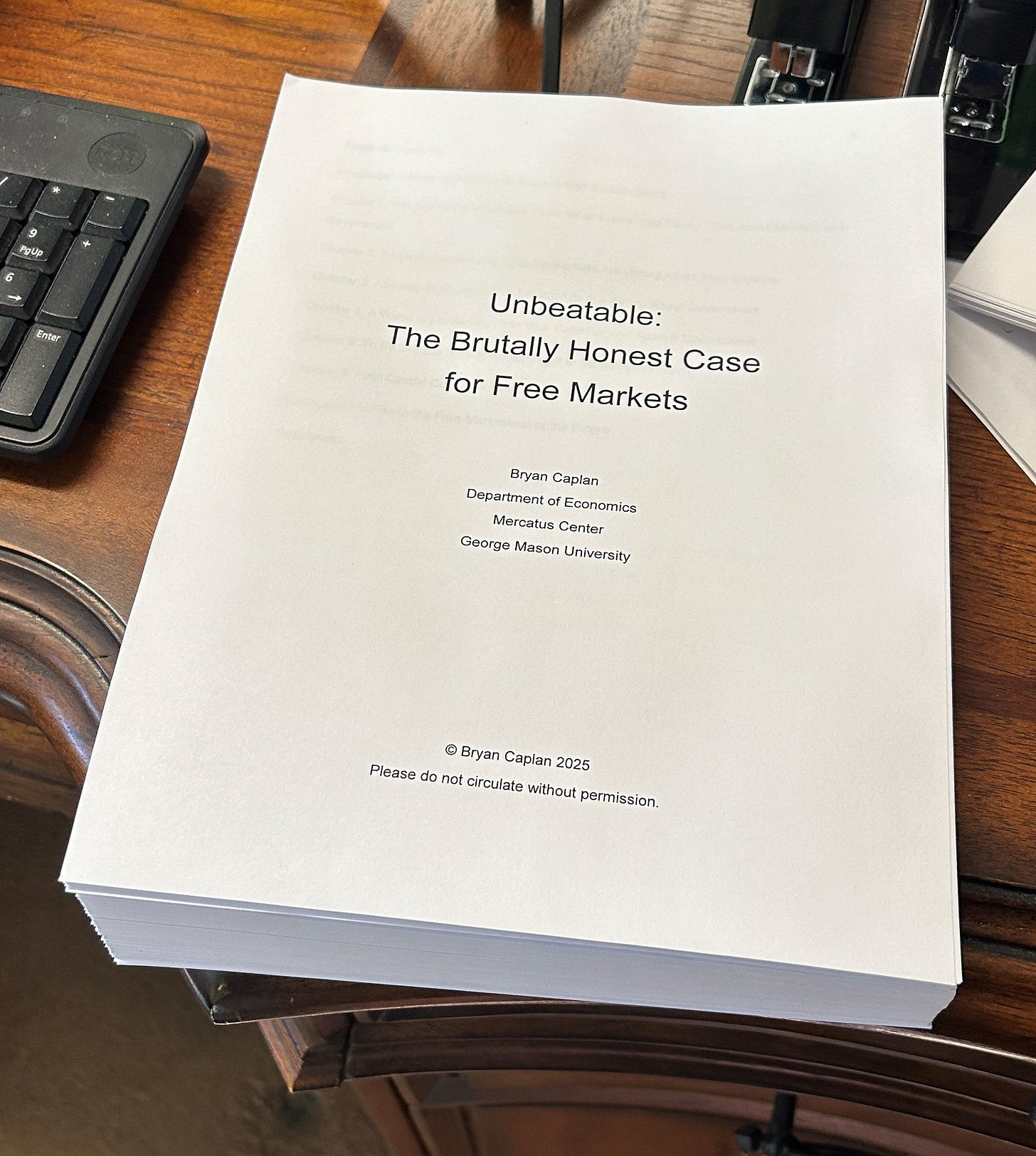
An excerpt from Chapter 3 of *Unbeatable*
Excusing the Government
Pro-Market & Pro-Business: Firms Strive to Satisfy the Customer
22 May 2025 Leave a comment
in applied price theory, comparative institutional analysis, economics of information, economics of regulation, entrepreneurship, history of economic thought, industrial organisation, labour economics, law and economics, property rights
Econ 101 is Underrated: Pharma Price Controls
22 May 2025 Leave a comment
in applied price theory, development economics, economics of regulation, entrepreneurship, health economics, law and economics, politics - USA, property rights Tags: 2024 presidential election, patents and copyrights, price controls, price discrimination
Econ 101 is often dismissed as too simplistic. Yet recent events suggest that Econ 101 is underrated. Take the tariff debate: understanding that a tariff is a tax, that prices represent opportunity costs, that a bilateral trade deficit is largely meaningless, that a so-called trade “deficit” is equally a goods surplus or an investment surplus—these […]
Econ 101 is Underrated: Pharma Price Controls
David Friedman Explains Why Trump’s Tariffs Will Fail | IEA Live
21 May 2025 Leave a comment
in applied price theory, David Friedman, history of economic thought, industrial organisation, international economics
Kevin Gentry Talks With Me About Trade and Phil Gramm’s and My New Book
20 May 2025 Leave a comment
in applied price theory, applied welfare economics, Austrian economics, comparative institutional analysis, development economics, economic history, economics of regulation, entrepreneurship, history of economic thought
TweetThanks for the honor, Kevin! The post Kevin Gentry Talks With Me About Trade and Phil Gramm’s and My New Book appeared first on Cafe Hayek.
Kevin Gentry Talks With Me About Trade and Phil Gramm’s and My New Book
David Friedman on markets, governments and whether we need either?
19 May 2025 Leave a comment
in applied price theory, comparative institutional analysis, constitutional political economy, David Friedman, defence economics, economics of crime, economics of regulation, environmental economics, history of economic thought, industrial organisation, law and economics, property rights
Trump, Putin, and the Game of Doing Nothing: This Week in Dumb Diplomacy
18 May 2025 Leave a comment
in applied price theory, defence economics, war and peace Tags: game theory, Russia, Ukraine
Calculating America’s Lead over Europe
16 May 2025 Leave a comment
in applied price theory, economic growth, economic history, macroeconomics Tags: European Union

There’s an enormous amount of data showing that people in the United States enjoy much higher livings standards than Europeans. That’s not too surprising since most European governments have adopted large-sized welfare states while Americans are (comparatively!) lucky in that we have a medium-sized welfare state. That’s all very straightforward and uncontroversial. What’s not completely […]
Calculating America’s Lead over Europe
The Merciful Maximization of the Market
15 May 2025 Leave a comment
in applied price theory, economic history
An excerpt from Chapter 2 of *Unbeatable*
The Merciful Maximization of the Market
Should gdp include defense spending?
15 May 2025 Leave a comment
in applied price theory, defence economics, economic growth, economic history, macroeconomics
Maybe not, isn’t that a form of double counting? After all, defense spending is there to enable the production of other goods and services, it is not useful per se. Chandler S. Reilly and Vincent Geloso recalculate the history of U.S. economic growth using this new method: In fact, our corrections applied to the entire […]
Should gdp include defense spending?
Supply is elastic, installment #6437
14 May 2025 Leave a comment
in applied price theory, entrepreneurship, health economics, industrial organisation, politics - USA, Public Choice, rentseeking Tags: price controls
Numerous empirical studies show a relationship between a drug’s expected market size and the magnitude of research and development investments. Early studies focused on changes to market size resulting from the demographics of disease burden (Acemoglu and Linn 2004) and policy changes influencing market demand (Finkelstein 2004). These findings have largely been confirmed by more […]
Supply is elastic, installment #6437
 Utopia, you are standing in it!
Recent Comments