Deming, Ong and Summers have a good overview of long-run and very recent changes in the US labor market. Using a measure of occupational titles the authors find: The years spanning 1990-2017 were the most stable period in the history of the US labor market, going back nearly 150 years. It’s a bit too early […]
Technological Disruption in the US Labor Market
Technological Disruption in the US Labor Market
27 Dec 2024 Leave a comment
in applied price theory, economic history, human capital, labour economics, labour supply, occupational choice, poverty and inequality Tags: creative destruction
Bye and Bye: Washington State Moves To Toward a “Wealth Tax” As the Wealthy Move to Leave the State
26 Dec 2024 Leave a comment
in applied price theory, entrepreneurship, financial economics, fiscal policy, income redistribution, macroeconomics, Marxist economics, politics - USA, Public Choice, public economics Tags: regressive left, taxation and entrepreneurship, taxation and investment, taxation and savings, wealth tax

Washington State’s unofficial state motto has long been “Al-ki” which means either “bye and bye” or “by and by” in Chinook. The former meaning now seems official as Gov. Jay Inslee pushed for a “wealth tax.” Wealthy citizens are already saying bye to the state in anticipation of what one Democratic billionaire recently called a […]
Bye and Bye: Washington State Moves To Toward a “Wealth Tax” As the Wealthy Move to Leave the State
Marginal Revolution Podcast–The New Monetary Economics!
25 Dec 2024 Leave a comment
in applied price theory, history of economic thought, macroeconomics, monetarism, monetary economics Tags: monetary policy
Today on the MR Podcast Tyler and I discuss the “New Monetary Economics”. Here’s the opening TABARROK: Today we’re going to be talking about the new monetary economics. Now, perhaps the first thing to say is that it’s not new anymore. The new monetary economics refers to a set of claims and ideas about monetary economics […]
Marginal Revolution Podcast–The New Monetary Economics!
Palagashvili and Stossel on How Vile Labor Unions Can Be
20 Dec 2024 Leave a comment
in applied price theory, industrial organisation, labour economics, labour supply, survivor principle, unions
TweetIn this video, GMU Econ alum – and my Mercatus Center colleague – Liya Palagashvili talks with John Stossel about the economic destructiveness of labor unions. The post Palagashvili and Stossel on How Vile Labor Unions Can Be appeared first on Cafe Hayek.
Palagashvili and Stossel on How Vile Labor Unions Can Be
Some Links
20 Dec 2024 Leave a comment
TweetGeorge Will is rightly appalled by the Luddism of Trump and American longshoremen. Two slices: Longshoremen won a tentative 61.5 percent pay increase over six years. The Wall Street Journal editorial page notes “the astounding fact” that there are only about 25,000 port jobs, so about half of ILA members do not have to show…
Some Links
Some Simple Economics of the Google Antitrust Case
17 Dec 2024 1 Comment
in applied price theory, economics of information, entrepreneurship, industrial organisation, law and economics, politics - USA, Public Choice, survivor principle, theory of the firm Tags: competition law
The case is straightforward: Google pays firms like Apple billions of dollars to make its search engine the default. (N.B. I would rephrase this as Apple charges Google billions of dollars to make its search engine the default–a phrasing which matters if you want to understand what is really going on. But set that aside […]
Some Simple Economics of the Google Antitrust Case
Call in the Bailiffs: How the NZ Government’s Green Investment Fund Turned Itself Into an Unpleasant Predatory Lender and Debt Collection Agency.
16 Dec 2024 1 Comment
in applied price theory, comparative institutional analysis, energy economics, entrepreneurship, environmental economics, law and economics, politics - New Zealand, property rights Tags: solar power
The just resigned Chair of the NZ Green Investment Fund (NZGIF) and Chancellor of Auckland University, Cecilia Tarrant, previously worked at Morgan Stanley Bank in New York, starting in 1997 and finishing in 2009. She’s a very nice person, a lawyer by training, and Structured Products expert, in particular on Mortgage Backed Securities. The collapse of…
Call in the Bailiffs: How the NZ Government’s Green Investment Fund Turned Itself Into an Unpleasant Predatory Lender and Debt Collection Agency.
Health insurance companies are not the main villain
16 Dec 2024 1 Comment
in applied price theory, health economics, industrial organisation, survivor principle Tags: health insurance
First of all, insurance companies just don’t make that much profit. UnitedHealth Group, the company of which Brian Thompson’s UnitedHealthcare is a subsidiary, is the most valuable private health insurer in the country in terms of market capitalization, and the one with the largest market share. Its net profit margin is just 6.11%… That’s only about half of […]
Health insurance companies are not the main villain
New Study: Achieving A ‘Net Zero’ Emissions Policy Would Have A ‘Negligible’ 0.28°C Climate Effect
14 Dec 2024 1 Comment
in applied price theory, applied welfare economics, development economics, economics of climate change, energy economics, environmental economics, environmentalism, global warming, growth miracles, politics - Australia, politics - New Zealand, politics - USA

Cost-benefit analyses affirm it would be better to abandon Net Zero policy initiatives and instead “do nothing” about greenhouse gas emissions. New research finds CO2’s largest possible climate impact is “negligible.” The cumulative expected temperature change in doubling CO2 from 400 to 800 ppm is only 0.81°C at most, and this is “certainly not cause…
New Study: Achieving A ‘Net Zero’ Emissions Policy Would Have A ‘Negligible’ 0.28°C Climate Effect
The Nobel Prize lectures in economics
12 Dec 2024 Leave a comment
in applied price theory, comparative institutional analysis, constitutional political economy, development economics, economics of crime, economics of regulation, growth disasters, growth miracles, history of economic thought, law and economics, property rights, Public Choice
More on Business Dynamism
11 Dec 2024 Leave a comment
in applied price theory, economic history, economics of bureaucracy, economics of regulation, entrepreneurship, financial economics, income redistribution, industrial organisation, labour economics, labour supply, managerial economics, organisational economics, personnel economics, Public Choice, rentseeking, survivor principle, theory of the firm Tags: creative destruction, employment law
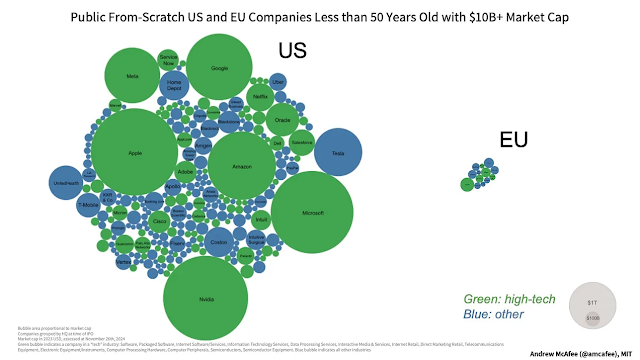
Over at the Geek Way, Andrew McAfee has created a startling visualization related to entrepreneurship in the US and EU. The Draghi Report on EU competitiveness is generating a small buzz among economists. One startling claim is thatthere is no EU company with a market capitalisation over EUR 100 billion that has been set up…
More on Business Dynamism
o1 explains why you should not dismiss Fischer Black on money and prices
08 Dec 2024 Leave a comment
in applied price theory, business cycles, economic growth, financial economics, fiscal policy, history of economic thought, macroeconomics, monetarism, monetary economics Tags: monetary policy
The prediction of inflation dynamics—how prices change over time—has increasingly confounded modern macroeconomists. Throughout much of the twentieth century, there seemed to be clear relationships linking the money supply, economic slack, and price levels. Monetarism, the school of thought that posits a stable connection between the growth rate of a money aggregate and the subsequent […]
o1 explains why you should not dismiss Fischer Black on money and prices
How is the Russian war economy doing?
08 Dec 2024 1 Comment
in applied price theory, defence economics, development economics, economic growth, economics of regulation, entrepreneurship, fiscal policy, growth disasters, income redistribution, industrial organisation, international economics, law and economics, macroeconomics, monetary economics, property rights, Public Choice, war and peace Tags: Russia, Ukraine
Here is a gloomy account from Vladimir Mirov: Ruble depreciation will contribute to inflation even further, as Russia is continued to be heavily reliant on imports – this is a kind of self-sustaining spiral. I also strongly disagree with those who say that cheaper ruble is “good” for exporters and the budget. Exporters have yet […]
How is the Russian war economy doing?
Why are no trillion dollar companies being created in Europe?
07 Dec 2024 1 Comment
in applied price theory, comparative institutional analysis, economics of regulation, entrepreneurship, human capital, industrial organisation, labour economics, labour supply, law and economics, occupational choice, poverty and inequality Tags: employment law
That is the theme of a new Substack by Pieter Garicano, here is one excerpt: These answers, according to a recent paper by Olivier Coste and Yann Coatanlem, two French investors, miss the point: the reason more capital doesn’t flow towards high-leverage ideas in Europe is because the price of failure is too high. Coste estimates that, […]
Why are no trillion dollar companies being created in Europe?
Why are no trillion dollar companies being created in Europe?
07 Dec 2024 Leave a comment
in applied price theory, economics of regulation, entrepreneurship, industrial organisation, labour economics, law and economics, property rights
That is the theme of a new Substack by Pieter Garicano, here is one excerpt: These answers, according to a recent paper by Olivier Coste and Yann Coatanlem, two French investors, miss the point: the reason more capital doesn’t flow towards high-leverage ideas in Europe is because the price of failure is too high. Coste estimates that, […]
Why are no trillion dollar companies being created in Europe?
 Utopia, you are standing in it!
Recent Comments