After the story of how Southwest Airlines broke an attempt at predatory pricing with booze, I learned of the Dow vs. Die Deutsche Bromkonvention episode. See here for an interesting narrative of events. To summarize, at the turn of the twentieth century, the German chemical industry was dominant and the various producers there had a comfortable cartel selling bromine…
A Pac-Man Defense Against Predatory Pricing?
A Pac-Man Defense Against Predatory Pricing?
08 Aug 2026 Leave a comment
in applied price theory, economic history, history of economic thought, industrial organisation Tags: competition law
New Zealand shows how to solve the equal pay crisis
07 Aug 2026 Leave a comment
in applied price theory, discrimination, economic history, economics of regulation, gender, human capital, labour economics, labour supply, occupational choice, poverty and inequality Tags: gender wage gap
Outgoing governments often try to craft a legacy for themselves by introducing policy traps that incoming governments find hard to undo, such as Rishi Sunak’s National Insurance cuts in 2024 or Gordon Brown’s introduction of the 50p top rate of income tax in 2010. Keir Starmer just did something similar by initiating a huge expansion in the […]
New Zealand shows how to solve the equal pay crisis
Farmers can’t avoid high synthetic nitrogen fertiliser prices by switching to organic fertiliser
04 Aug 2026 Leave a comment
in applied price theory, energy economics, industrial organisation
The New Zealand Herald reported yesterday:New Zealand farmers face hefty increases in the price of fertiliser this spring as a result of the escalating US-Iran conflict and the war in Ukraine.The Middle East plays a big role in the global fertiliser market because of its supply of natural gas and mineral resources.Russia is also a…
Farmers can’t avoid high synthetic nitrogen fertiliser prices by switching to organic fertiliser
Nobel Prize 2016 Part II: Oliver Hart
02 Aug 2026 Leave a comment
in applied price theory, history of economic thought
The Nobel Prize in Economics was given yesterday to two wonderful theorists, Bengt Holmstrom and Oliver Hart. I wrote a day ago about Holmstrom’s contributions, many of which are simply foundational to modern mechanism design and its applications. Oliver Hart’s contribution is more subtle and hence more of a challenge to describe to a nonspecialist; […]
Nobel Prize 2016 Part II: Oliver Hart
‘Market Power in Antitrust: Economic Analysis after Kodak,’ by Benjamin Klein
01 Aug 2026 Leave a comment
in applied price theory, economics of regulation, entrepreneurship, industrial organisation Tags: competition law
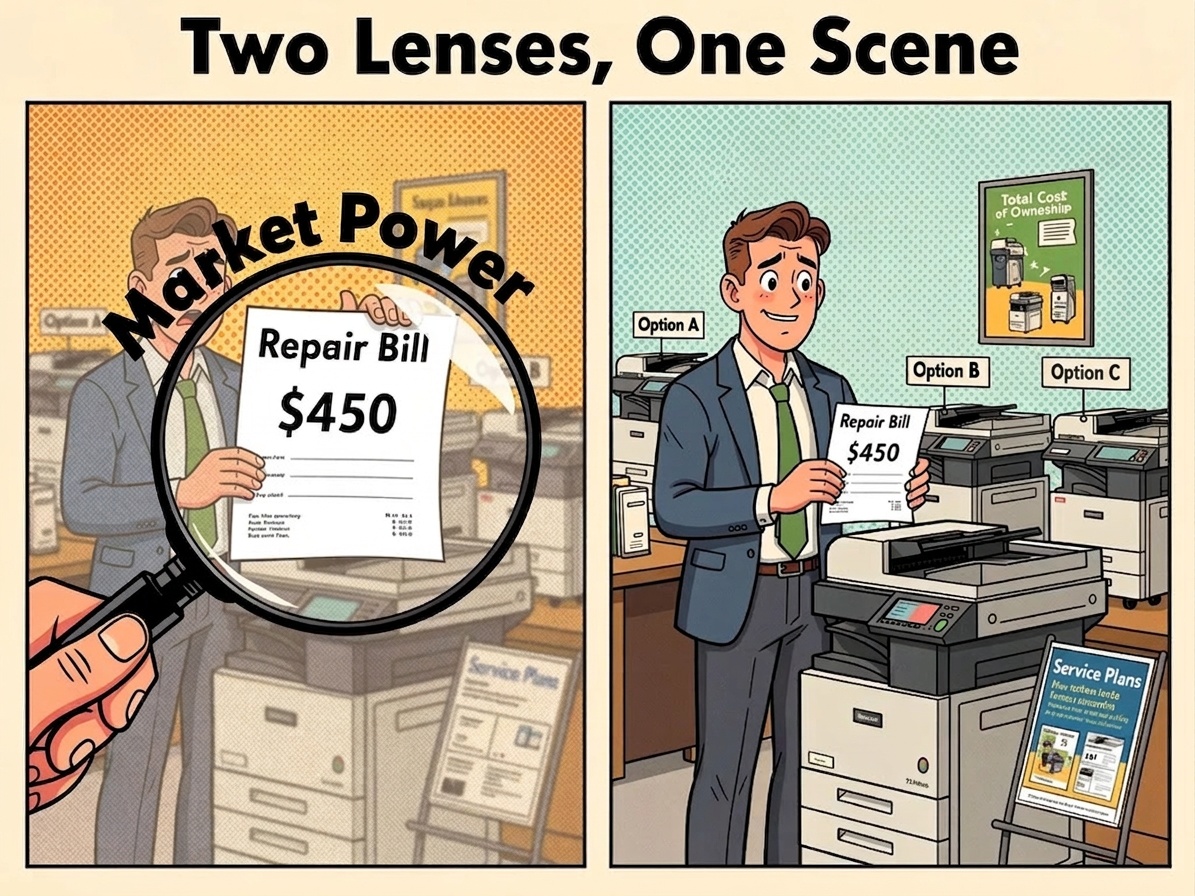
In 1992, the U.S. Supreme Court held in Eastman Kodak Co. v. Image Technical Services that a firm without market power in photocopiers might still possess market power in photocopier parts and service. The Court’s logic turned on opportunistic hold-up: Kodak could profit by trading short-run exploitation of locked-in customers for long-run losses in equipment…
‘Market Power in Antitrust: Economic Analysis after Kodak,’ by Benjamin Klein
The Most Depressing Chart about Germany
31 Jul 2026 Leave a comment
in applied price theory, fiscal policy, human capital, labour economics, labour supply, macroeconomics, poverty and inequality, welfare reform Tags: Germany

I’ve used the “most depressing chart” approach when writing about the United States, about Europe, about Japan, and about the western world. Today, let’s focus on Germany. And I’ll start with a caveat. I wrote about Germany earlier this month and that column included several charts that might qualify. Especially the last visual which showed […]
The Most Depressing Chart about Germany
The Endangered Species Act Reduces Housing
31 Jul 2026 Leave a comment
in applied price theory, econometerics, economics of regulation, environmental economics, environmentalism, law and economics, politics - USA, property rights, Public Choice, urban economics

Max Tabarrok’s paper on the Endangered Species Act and housing (WP) has just been published in the Journal of Public Economics! It’s a clever paper: Max observed that the moment an animal is put on the endangered species list, developers face enhanced compliance costs and liability risk. But what’s important for an empirical economist is…
The Endangered Species Act Reduces Housing
New Research Further Confirms Anti-Growth Impact of Wealth Taxation
30 Jul 2026 1 Comment
in applied price theory, economic growth, entrepreneurship, fiscal policy, human capital, income redistribution, labour economics, liberalism, macroeconomics, Marxist economics, poverty and inequality, Public Choice, public economics Tags: taxation and entrepreneurship, taxation and investment, taxation and labour supply

I’ve shared multiple studies about the harmful impact of wealth taxes (see here, here, here, here, and here). Today, let’s add to the body of evidence. I’ll start by calling attention to a column I wrote in 2019 that warned how wealth taxes mean very high – even confiscatory – taxes on saving and investment. […]
New Research Further Confirms Anti-Growth Impact of Wealth Taxation
The economic effects of GLP-1s
30 Jul 2026 Leave a comment
in applied price theory, entrepreneurship, industrial organisation, labour economics, labour supply, survivor principle
We estimate the causal impacts of GLP-1 treatment on labor market outcomes using linked Danish administrative data and a matched stacked difference-in-differences design. We compare patients who initiate GLP-1 treatment during the first two years of Semaglutide availability to observably similar patients who initiate four years later. We find that GLP-1 treatment reduces long-term sickness…
The economic effects of GLP-1s
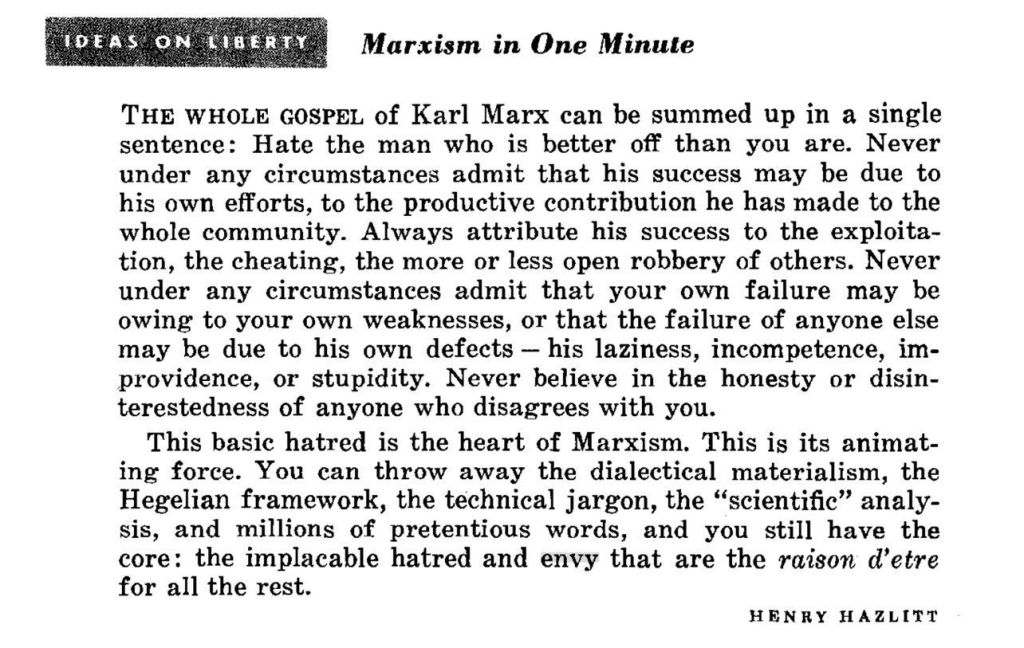
Hazlitt on Marx
29 Jul 2026 Leave a comment
in applied price theory, liberalism, libertarianism, Marxist economics
The Apples and Oranges Tribunal
28 Jul 2026 Leave a comment
in applied price theory, discrimination, economics of education, economics of regulation, gender, labour economics, labour supply, law and economics, liberalism, Marxist economics, poverty and inequality, property rights Tags: gender wage gap, sex discrimination
Suppose that apples sell for more than oranges and Parliament in it’s wisdom decides that, at last, apples and oranges must be compared. Not by shoppers — shoppers are biased, they merely reveal what they are willing to pay — but by a tribunal, which will determine whether apples and oranges are of truly equal…
The Apples and Oranges Tribunal
Occupational Licensing: US and International
25 Jul 2026 Leave a comment
in applied price theory, economics of information, economics of regulation, human capital, income redistribution, labour economics, labour supply, occupational choice, occupational regulation, politics - USA, Public Choice, rentseeking

The potential benefit of having the government require that certain jobs require an official license is quality control and protection. Personally, I rather like knowing that my nurse or doctor or dentist has gone through courses and training. The potential cost is that requirement to have a government license can become a way for those…
Occupational Licensing: US and International
Cataloging Growth: A Re-Evaluation of 1900–1990
25 Jul 2026 Leave a comment
in applied price theory, economic growth, economic history, entrepreneurship, macroeconomics
From Verónica Bäcker-Peral and Benjamin Wittenbrink of MIT: Measuring real GDP growth requires distinguishing changes in prices from changes in product quality and composition, yet systematic quality adjustment of price indexes is unavailable for much of the twentieth century. We construct a new quality-adjusted price index for U.S. consumer goods using 5.1 million product listings…
Cataloging Growth: A Re-Evaluation of 1900–1990
The Case Against a Universal Basic Income
23 Jul 2026 1 Comment
in applied price theory, fiscal policy, income redistribution, labour economics, labour supply, macroeconomics, politics - New Zealand, poverty and inequality, Public Choice, welfare reform
A Universal Basic Income, or UBI, is a superficially attractive idea. Under such a scheme, every adult would receive a regular payment from the government, regardless of income, employment or need. Supporters argue that it would reduce poverty, simplify welfare, provide security in an uncertain labour market and give people greater freedom to choose how […]
The Case Against a Universal Basic Income
“Start Spreadin’ the News”: New York Losing Billions as Millionaires Flee the Big Apple
23 Jul 2026 Leave a comment
in applied price theory, economic growth, fiscal policy, macroeconomics
Below is my column in the New York Post on the sharp decline in millionaires in New York, costing the…
“Start Spreadin’ the News”: New York Losing Billions as Millionaires Flee the Big Apple
 Utopia, you are standing in it!
Recent Comments