Watch “Professor Deirdre McCloskey: How Ideas can Change the World
29 Aug 2019 Leave a comment
in applied price theory, applied welfare economics, Austrian economics, comparative institutional analysis, constitutional political economy, development economics, economic history, growth disasters, growth miracles, industrial organisation, law and economics, liberalism, Marxist economics, property rights, Public Choice
EU destroys 700,000 hectares of rainforest for biofuels
28 Aug 2019 Leave a comment
All those trees would have absorbed large amounts of the carbon dioxide they claim to be so scared of. Somehow all this is deemed to be ‘sustainable’, using the climate excuse.
The EU wants to save our climate with supposedly green biofuels and has deemed palm oil “sustainable”. Yet on the other side of the globe, rainforests are being clear-cut to produce the 1.9 million tons of palm oil that end up in European fuel tanks every year, says Rainforest Rescue.
The European Union wants to protect the climate and reduce carbon emissions from motor vehicles by blending fuels with increasing shares of supposedly eco-friendly “biofuels”.
Last year, 1.9 million tons of palm oil were added to diesel fuel in the EU – in addition to millions of tons of equally harmful rapeseed and soybean oils.
The plantations needed to satisfy Europes’s demand for palm oil cover…
View original post 273 more words
Falling Behind and Catching up: India’s Transition from a Colonial Economy
28 Aug 2019 Leave a comment
by Bishnupriya Gupta (University of Warwick and CAGE)
The full paper of this blog post was published by The Economic History Review and it is available here
Official of the East India Company riding in an Indian procession, watercolour on paper, c. 1825–30; in the Victoria and Albert Museum, London. Available at <https://www.britannica.com/topic/East-India-Company/media/1/176643/162308>
There has been much discussion in recent years about India’s growth failure in the first 30 years after independence in 1947. India became a highly-regulated economy and withdrew from the global market. This led to inefficiency and low growth. The architect of Indian planning –Jawaharlal Nehru, the first prime minister, did not put India on an East Asian path. As a contrast, the last decade of the 20th century has seen a reintegration into the global economy and today India is one of the fastest growing economies.
Any analysis of Indian growth and development that…
View original post 692 more words
Collision Course: Offshore Wind Turbines Present New (Unnecessary) Mortal Danger for Trawlermen
28 Aug 2019 Leave a comment
The fishermen who work off America’s Atlantic coast, are furious over plans to spear thousands of industrial wind turbines into their fishing grounds, destroying not only the seabed (the source of their income and prosperity), but wrecking their fishing grounds, forever.
Trawlermen off the New Jersey coast have already told developers what they can do with their projects: Deepwater in Deep Trouble: Fishermen Tell Off-Shore Wind Farm Developers to F@*#K Off
Trawlermen everywhere face plenty of mortal peril dished up by Poseidon and mother nature. However, for those fishermen braving the elements off the coast of Rhode Island and Massachusetts the prospect of hundreds of these things providing a deadly obstacle course is simply too much.
Fishing For A Living Is Dangerous. Will Offshore Wind Farms Make It Worse?
WSHU
Nadine Sebai
1 August 2019
New England commercial fishermen have one of the most dangerous jobs in the country. Now…
View original post 971 more words
Why do we ignore women’s sports?
28 Aug 2019 2 Comments
Many more men than women watch sports. Women prefer to watch men’s sports. Oddly enough, the only sport that more women than men watch is boxing. Why would women want 2 athletic men in tight shorts beat themselves up?
Another Honest Liberal Pours Cold Water on Gun Control
28 Aug 2019 1 Comment
My collection of liberals who are honest on the issue of gun control is expanding.
- In 2012, I shared some important observations from Jeffrey Goldberg, a left-leaning writer for The Atlantic. In his column, he basically admitted his side was wrong about gun control.
- Then, in 2013, I wrote about a column by Justin Cronin in the New York Times.
He self-identified as a liberal, but explained how real-world events have led him to become a supporter of private gun ownership. - In 2015, I shared a column by Jamelle Bouie in Slate, who addressed the left’s fixation on trying to ban so-called assault weapons and explains that such policies are meaningless.
- Most recently, in 2017, Leah Libresco wrote in the Washington Post that advocates of gun control are driven by emotion rather empirical research and evidence.
Now we have another addition to the list.
Alex Kingsbury of…
View original post 904 more words
Australian: New Report: Electric Cars Have ‘Higher CO2 Emissions’
28 Aug 2019 Leave a comment
Iowa Climate Science Education
From The GWPF Original story at The Australian
Electric vehicles in Australia?s eastern states are responsible for more carbon dioxide emissions than regular petrol vehicles, according to an expert report that warns Labor?s green cars policy would require up to $7 billion in upgrades and installation of recharging infrastructure across the nation.


A pre-election briefing obtained by The Australian, which was prepared by engineering firm ABMARC, concedes the immediate benefit of electric vehicles in Australia ?is not guaranteed?. It also states Bill Shorten?s electric vehicle target of 50 per cent of new car sales by 2030 would need between $5bn and $7bn in recharging infrastructure and additional investment in ?switchboards, transformers and poles and wires?.
?Installing this level of charging infrastructure would require a significant increase in the rate of investment in recharging infrastructure,? the report says.

Bill Shorten?s pre-election green cars pledge would have required up to $7…
View original post 188 more words
Pay transparency strengthens the bargaining hands of employers @NZHumanRights
28 Aug 2019 Leave a comment
in applied price theory, discrimination, gender, job search and matching, labour economics, labour supply, managerial economics, personnel economics, politics - New Zealand
Harold Demsetz on the risks of merging to enhance market power. Corporate reorganizations often fail.
28 Aug 2019 Leave a comment
in applied price theory, financial economics, industrial organisation, law and economics, managerial economics, organisational economics, politics - USA, survivor principle Tags: competition law

A Prosperity Contest: America’s Poor Vs. the Middle Class in other Nations
28 Aug 2019 Leave a comment
My primary job is dealing with misguided public policy in the United States.
I spend much of my time either trying to undo bad policies with good reform (flat tax, spending restraint, regulatory easing, trade liberalization) or fighting off additional bad interventions (Green New Deal, protectionism, Medicare for All, class warfare taxes).
Seems like there is a lot to criticize, right?
Yes, but sometimes the key to success is being “less worse” than your competitors. So while I’m critical of many bad policies in the United States,
it’s worth noting that America nonetheless ranks #6 for overall economic liberty according to the Fraser Institute.
As such, it’s not surprising that America has higher living standards than most other developed nations according to the “actual individual consumption” data from the Organization for Economic Cooperation and Development.
And America’s advantage…
View original post 394 more words
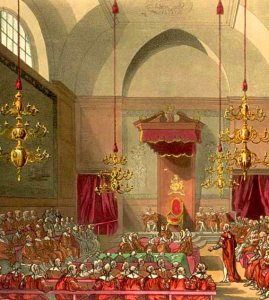
Parliament & World War I
27 Aug 2019 Leave a comment
In partnership with the Parliamentary Archives alongside their current exhibition on Parliament and the First World War, we recently held events in Parliament exploring the institution during the war years…
Parliament and the First World War exhibition, Westminster Hall
The Parliamentary Archives exhibition on Parliament and the First World War, still open in Westminster Hall, proved an excellent opportunity for us to gather together historians and discuss the impact of the First World War on Parliament.
Firstly, Dr Mari Takayanagi (Vote 100) spoke on ‘The Girl Porters and the Court Twins: Women Staff in Parliament in the First World War.’ Dr Takayanagi’s research had uncovered several women who had, because of the shortage of labour, had the opportunity to work in occupations within Parliament that had previously been closed to them because of their gender. She spoke of two examples: firstly the ‘girl porters’ who took messages…
View original post 676 more words


Recent Comments