https://www.facebook.com/share/sBU4jrUEAUnL2CYs/?mibextid=xfxF2i
Celebrating humanity's flourishing through the spread of capitalism and the rule of law
28 Sep 2024 Leave a comment
in applied price theory, industrial organisation, labour economics, labour supply, managerial economics, occupational choice, organisational economics, personnel economics Tags: creative destruction, economics of pandemics
28 Sep 2024 Leave a comment
in applied price theory, budget deficits, business cycles, economic growth, fiscal policy, history of economic thought, labour economics, macroeconomics, monetary economics, public economics, unemployment Tags: New Keynesian macroeconomics
Popular New Keynesian macroeconomic models predict that cuts in various types of distortionary taxes are contractionary when monetary policy is constrained at the zero lower bound. We turn to a long span of history in the United Kingdom to test this hypothesis. Using a new long-run dataset of narrative-identified tax changes from 1918to 2020, we […]
Another zero lower bound prediction bites the dust
27 Sep 2024 Leave a comment
in applied price theory, economic growth, economic history, entrepreneurship, financial economics, fiscal policy, health and safety, income redistribution, labour economics, labour supply, law and economics, macroeconomics, occupational choice, politics - USA, poverty and inequality, property rights, Public Choice, public economics Tags: envy, regressive left, taxation and entrepreneurship, taxation and investment
On tax policy, our friends on the left are motivated by envy and hatred. As shown in this Stossel video, Robert Reich is a sad example of this mindset. John Stossel understates his argument. It’s not that Reich is wrong. He’s wildly wrong. There are four points in the video that deserve attention. It is […]
Debunking Hate-and-Envy Tax Policy
27 Sep 2024 Leave a comment
in applied price theory, economics of bureaucracy, economics of regulation, environmental economics, environmentalism, income redistribution, law and economics, politics - New Zealand, property rights, Public Choice, rentseeking, transport economics, urban economics Tags: housing affordability, land supply, zoning
Chris Bishop and Simon Court announced: Two new laws will be developed to replace the Resource Management Act (RMA), with the enjoyment of property rights as their guiding principle, RMA Reform Minister Chris Bishop and Parliamentary Under-Secretary Simon Court say. “The RMA was passed with good intentions in 1991 but has proved a failure in […]
After 30 years, there is hope
27 Sep 2024 Leave a comment
in applied price theory, economic history, entrepreneurship, history of economic thought, human capital, income redistribution, industrial organisation, labour economics, labour supply, liberalism, Marxist economics, occupational choice, poverty and inequality, Public Choice Tags: top 1%
Byrne Hobart writes to me: One of the purposes of inheritance taxes is to avoid compounding intergenerational wealth. But The Missing Billionaires points out that if all of America’s millionaires had put their money in broad market indices in 1900, their heirs would number 16,000 billionaires, even accounting for taxes, splitting estates among multiple children, etc. So […]
Should we keep the wealthy non-diversified? (from my email)
24 Sep 2024 Leave a comment
in applied price theory, economics of bureaucracy, economics of information, economics of regulation, environmental economics, politics - New Zealand, Public Choice, public economics, urban economics Tags: unintended consequences
Eric Crampton writes – Government sometimes cannot stop itself from providing bailouts when risk-taking goes wrong. This kind of ‘free’ insurance policy leads to no end of bad outcomes.
The high cost of free insurance
23 Sep 2024 Leave a comment
in applied price theory, entrepreneurship, financial economics, macroeconomics, monetary economics Tags: monetary policy
When rates go low, future profits go high. Everyone wants a cutBy Richard B. McKenzie. Excerpt:”Profits in the future, dollar for dollar, are worth less than current dollars. This is because current profits can earn interest between now and the future, which means that future profits must be discounted by some percentage to make them…
Why the Fed Cut Sent Stocks Soaring
23 Sep 2024 Leave a comment
in applied price theory, development economics, history of economic thought, international economics Tags: economics of colonialism, free trade, tariffs
See When Leftists Were Free Traders: In Pax Economica, historian Marc-William Palen chronicles the left-wing history of free trade. From Reason magazine.Dr. Marc-William Palen is a historian at the University of Exeter. His Ph. D. is from The University of Texas.The review is very good. Here is the Amazon link for the book: Pax Economica:…
Historian Anthony Comegna reviews Marc-William Palen’s book Pax Economica: Left-Wing Visions of a Free Trade World
22 Sep 2024 Leave a comment
in applied price theory, economic growth, economics of bureaucracy, economics of regulation, energy economics, environmental economics, industrial organisation, labour economics, law and economics, macroeconomics, Public Choice, resource economics, transport economics, urban economics Tags: British politics
Between 2004 and 2021, before Russia’s invasion of Ukraine, the industrial price of energy tripled in nominal terms, or doubled relative to consumer prices. With almost identical population sizes, the UK has under 30 million homes, while France has around 37 million. 800,000 British families have second homes compared to 3.4 million French families. Per capita electricity generation in the UK […]
Facts about Britain
22 Sep 2024 Leave a comment
in applied price theory, economics of regulation, income redistribution, law and economics, property rights, Public Choice, rentseeking, urban economics Tags: rent control
Bloomberg: Moraal is among the growing number of Dutch people struggling to find a rental property after a new law designed to make homes more affordable ended up aggravating a housing shortage. Aiming to protect low-income tenants, the government in July imposed rent controls on thousands of homes, introducing a system of rating properties based on […]
The Affordable Rent Act
21 Sep 2024 Leave a comment
in applied price theory, economic history, health economics, industrial organisation Tags: drug lags
The US has high prices for branded drugs but it has some of the lowest prices for generic drugs in the world and generic drugs are 90% of prescriptions. I’ve been saying this for years but here is the latest study: U.S. prices for brand-name originator drugs were 422 percent of prices in comparison countries, […]
The US Has Low Prices for Most Prescription Drugs
18 Sep 2024 Leave a comment
in applied price theory, entrepreneurship, labour economics, labour supply, poverty and inequality, public economics Tags: taxation and entrepreneurship, taxation and investment, taxation and labour supply
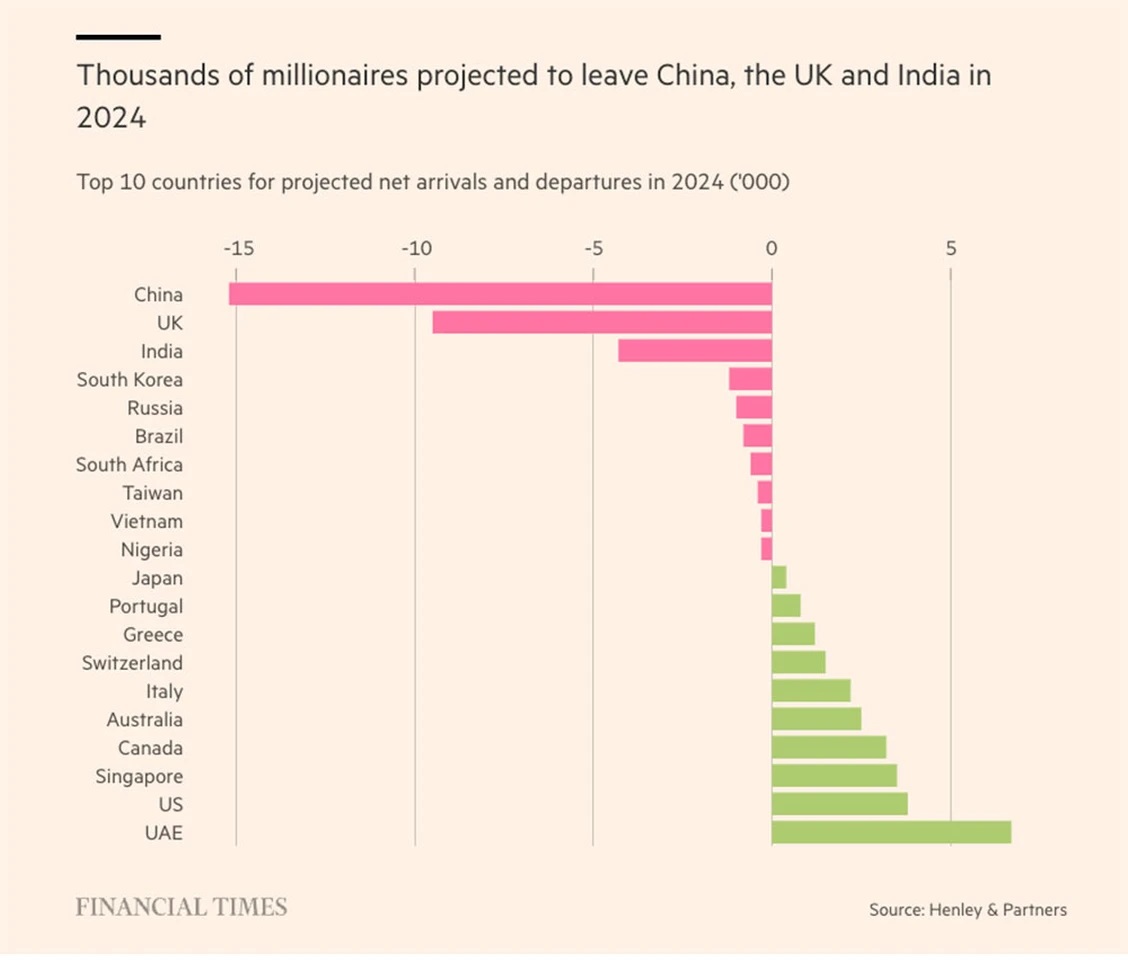
I wrote a few days ago about how Americans are moving from high-tax states to lower-tax states (mostly to states with no income taxes or flat taxes). Today, let’s look at international tax migration. I’ve addressed this issue before, but generally in the context of individual countries that are attracting or repelling entrepreneurs, investors, business […]
Tax-Motivated International Migration
18 Sep 2024 Leave a comment
in applied price theory, comparative institutional analysis, economic history, history of economic thought, human capital, job search and matching, labour economics, labour supply, law and economics, occupational choice, poverty and inequality Tags: British politics, compensating differences, pay equity

The UK’s Orwellian sounding Equality Act 2010 is strikingly Marxist. It demands equal pay for work of equal value where these are defined as follows: A’s work is equal to that of B if it is like B’s work, rated as equivalent to B’s work, or of equal value to B’s work. A’s work is […]
Equality Act 2010
17 Sep 2024 Leave a comment
in applied price theory, econometerics, economic history, entrepreneurship, fiscal policy, human capital, income redistribution, labour economics, labour supply, macroeconomics, occupational choice, poverty and inequality, Public Choice, public economics Tags: taxation and entrepreneurship, taxation and investment, taxation and labour supply
By Eric Pichet, here is the abstract: Despite attempts to ‘unwind’ the Impôt de Solidarité sur la Fortune (‘Solidarity Wealth Tax,’ the French wealth tax) during the last legislature (2002-2007), ISF yields had soared by 2006, jumping from €2.5 billion in 2002 to €3.6 billion. Analysis of the economic consequences of this ISF wealth tax […]
The Economic Consequences of the French Wealth Tax
Celebrating humanity's flourishing through the spread of capitalism and the rule of law
Celebrating humanity's flourishing through the spread of capitalism and the rule of law
Celebrating humanity's flourishing through the spread of capitalism and the rule of law
Celebrating humanity's flourishing through the spread of capitalism and the rule of law
Celebrating humanity's flourishing through the spread of capitalism and the rule of law
Celebrating humanity's flourishing through the spread of capitalism and the rule of law
Celebrating humanity's flourishing through the spread of capitalism and the rule of law
Celebrating humanity's flourishing through the spread of capitalism and the rule of law
Celebrating humanity's flourishing through the spread of capitalism and the rule of law
Celebrating humanity's flourishing through the spread of capitalism and the rule of law
Celebrating humanity's flourishing through the spread of capitalism and the rule of law
Celebrating humanity's flourishing through the spread of capitalism and the rule of law
A History of the Alt-Right
Econ Prof at George Mason University, Economic Historian, Québécois
Celebrating humanity's flourishing through the spread of capitalism and the rule of law
Scholarly commentary on law, economics, and more
Beatrice Cherrier's blog
Celebrating humanity's flourishing through the spread of capitalism and the rule of law
Celebrating humanity's flourishing through the spread of capitalism and the rule of law
Celebrating humanity's flourishing through the spread of capitalism and the rule of law
Why Evolution is True is a blog written by Jerry Coyne, centered on evolution and biology but also dealing with diverse topics like politics, culture, and cats.
Celebrating humanity's flourishing through the spread of capitalism and the rule of law
A rural perspective with a blue tint by Ele Ludemann
DPF's Kiwiblog - Fomenting Happy Mischief since 2003
Celebrating humanity's flourishing through the spread of capitalism and the rule of law
The world's most viewed site on global warming and climate change
Tim Harding's writings on rationality, informal logic and skepticism
A window into Doc Freiberger's library
Let's examine hard decisions!
Commentary on monetary policy in the spirit of R. G. Hawtrey
Thoughts on public policy and the media
Celebrating humanity's flourishing through the spread of capitalism and the rule of law
Politics and the economy
A blog (primarily) on Canadian and Commonwealth political history and institutions
Reading between the lines, and underneath the hype.
Economics, and such stuff as dreams are made on
"The British constitution has always been puzzling, and always will be." --Queen Elizabeth II
Celebrating humanity's flourishing through the spread of capitalism and the rule of law
Celebrating humanity's flourishing through the spread of capitalism and the rule of law
WORLD WAR II, MUSIC, HISTORY, HOLOCAUST
Undisciplined scholar, recovering academic
Celebrating humanity's flourishing through the spread of capitalism and the rule of law
Res ipsa loquitur - The thing itself speaks
In Hume’s spirit, I will attempt to serve as an ambassador from my world of economics, and help in “finding topics of conversation fit for the entertainment of rational creatures.”
Researching the House of Commons, 1832-1868
Reflections on books and art


Recent Comments