29 May 2019
by Jim Rose
in applied price theory
New Zealand has always been small and remote so it is necessary to show the geographic factors are time varying for remoteness to be important to the productivity drop that started in 1973
 croaking cassandra
As regular readers know, I tend not to be particular upbeat about the New Zealand economic story. For anyone new, there should be a hint in the very title of the blog. If, by chance, you are still attracted to an upbeat take, only last week in a post here I critiqued a recent book chapter taking that sort of view.
And so I was a bit surprised when, more than a year ago now, I was asked to write a chapter for a forthcoming book on aspects of policymaking, and associated outcomes, in a small state (this one). In principle, the book sounded potentially interesting, and they were approaching a bunch of pretty serious and senior people to contribute. But it wasn’t clear there was much in it for me, and since the plan was for the introduction or foreword to have been written by the head of the…
View original post 2,422 more words
29 May 2019
by Jim Rose
in applied price theory, Austrian economics, economics of crime, economics of information, economics of regulation, entrepreneurship, financial economics, industrial organisation, law and economics, managerial economics, market efficiency, Murray Rothbard, organisational economics, politics - USA, Public Choice, rentseeking, survivor principle
Tags: insider trading
29 May 2019
by Jim Rose
in applied price theory, comparative institutional analysis, constitutional political economy, David Friedman, economic history, economics of crime, entrepreneurship, industrial organisation, law and economics, liberalism, libertarianism, macroeconomics, monetary economics, property rights, Public Choice
29 May 2019
by Jim Rose
in applied price theory, discrimination, economics of education, economics of love and marriage, gender, human capital, labour economics, labour supply, law and economics, occupational choice, poverty and inequality
Tags: gender wage gap
28 May 2019
by Jim Rose
in applied price theory, discrimination, economic history, economics of bureaucracy, economics of crime, economics of regulation, human capital, income redistribution, labour economics, labour supply, law and economics, minimum wage, politics - USA, poverty and inequality, Public Choice, rentseeking, Thomas Sowell, unemployment, welfare reform
28 May 2019
by Jim Rose
in applied price theory
 The Inquiring Mind
This article at The Atlantic by Heidi Tworek had as a sub-title – Regulators should think carefully about the fallout from well-intentioned new rules and avoid the mistakes of the past.
This is an excellent article and fully repays the time spent reading it.
I will only quote a few points, as this really needs to be read in it’s entirety.
The history of radio, and in particular how it was regulated in interwar Germany, is more relevant than ever: Five years ago, the question was whether we would regulate social media. Now the questions are how and when we will regulate them. As politicians and regulators in places as disparate as Berlin, Singapore, and Washington—even Facebook founder Mark Zuckerberg—consider how best to do so, we should think carefully about the fallout from well-intentioned new rules and avoid the mistakes of the past.
This article is dated 27 May…
View original post 555 more words
28 May 2019
by Jim Rose
in applied price theory
 Fruits and Votes
Today, the Knesset of Israel took the first step towards passing a bill to dissolve itself and set an early election, probably for 9 September. This came after Yisrael Beitenu leader Avigdor Liberman said he would not join an emerging government coalition that he claimed would be a halakha government. He was referring to the demands in such a coalition of the two Haredi Knesset factions, Shas and United Torah Judaism. (Halakha is Jewish law.)
It is still possible that this is all an elaborate ploy by PM Benjamin Netanyahu and his various allies to pressure Liberman into backing down. However, Liberman himself has said he welcomes new elections, and the preliminary reading of the elections bill passed with 65 votes, or exactly the number that the putative right/Haredi coalition would have if Yisrael Beitenu’s five seats are included.
In the 2019(a?) election in April, Netanyahu’s Likud won 35…
View original post 341 more words
28 May 2019
by Jim Rose
in applied price theory, comparative institutional analysis, constitutional political economy, development economics, economic growth, economic history, economics of bureaucracy, economics of crime, economics of education, economics of regulation, growth disasters, growth miracles, income redistribution, industrial organisation, international economics, law and economics, property rights, Public Choice, public economics, rentseeking, survivor principle, technological progress
Tags: competition law, The Great Enrichment
27 May 2019
by Jim Rose
in applied price theory, comparative institutional analysis, development economics, economic history, economics of regulation, entrepreneurship, industrial organisation, labour economics, law and economics, macroeconomics, Milton Friedman
26 May 2019
by Jim Rose
in applied price theory, discrimination, economic history, economics of crime, economics of education, health economics, human capital, labour economics, labour supply, occupational choice, poverty and inequality
Tags: racial discrimination
26 May 2019
by Jim Rose
in applied price theory
 Media Myth Alert
Few media-driven myths are as tenacious as the notion that Edward R. Murrow abruptly ended the communists-in-government witch-hunt of Senator Joseph R. McCarthy.
The myth dates to March 9, 1954, when Murrow’s 30-minuteSee It Now program on CBS television examined the campaign of innuendo, exaggeration, and half-truth that McCarthy had been waging for more than four years.
And the myth was invoked today at Minnesota Public Radio’s online site, in a commentary that declared:
“In the spring of 1954, McCarthy’s crusade of insinuation, innuendo and guilt by association was brought to an end by journalist Edward R. Murrow and Joseph Welsh, attorney for the U.S. Army.”
(The commentary mentioned Welsh because he dramatically confronted McCarthy at a congressional hearing in June 1954, pointedly asking the senator: “Have you no sense of decency, sir? At long last, have you left no sense of decency?”)
As for Murrow, though, his
View original post 318 more words
25 May 2019
by Jim Rose
in applied price theory
 მატიანე
At the age of four, my daughter earned her second diploma. When she was two, she graduated with the highest possible honors from theToddler Room at her nursery school in Colorado. Two years later she graduated from the preschool of the Jewish Community Center, where she matriculated on our return to New York State.
At the graduation ceremony, titled Friends of the Earth, I was lectured by four- and five-year-olds on the importance of safe energy sources, mass transportation, and recycling. The recurring mantra was “With privilege comes responsibility” as in “With the privilege of living on this planet comes the responsibility to care for it.” Of course, Thomas Jefferson thought that life on this planet was more an inalienable right than a privilege, but then he had never been to preschool.
I’d heard some of this from my daughter before and had gotten used to the idea that she…
View original post 3,129 more words
25 May 2019
by Jim Rose
in applied price theory
 Science Matters
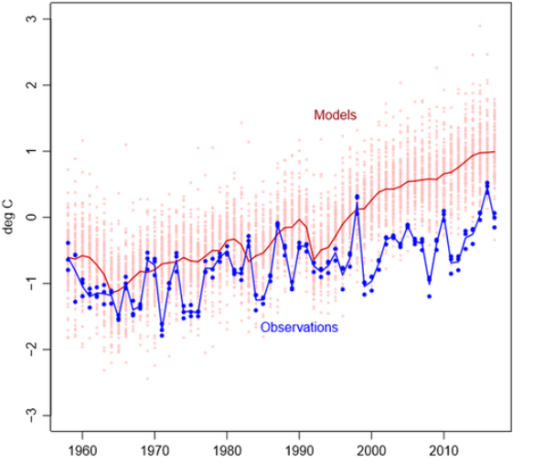 Models vs. Observations. Christy and McKitrick (2018) Figure 3
The title of this post is the theme driven home by Patrick J. Michaels in his critique of the most recent US National Climate Assessment (NA4). The failure of General Circulation Models (GCMs) is the focal point of his presentation February 14, 2018. Comments on the Fourth National Climate Assessment. Excerpts in italics with my bolds.
NA4 uses a flawed ensemble of models that dramatically overforecast warming of the lower troposphere, with even larger errors in the upper tropical troposphere. The model ensemble also could not accommodate the “pause” or “slowdown” in warming between the two large El Niños of 1997-8 and 2015-6. The distribution of warming rates within the CMIP5 ensemble is not a true indication of a statistical range of prospective warming, as it is a collection of systematic errors. Despite a glib statement about this Assessment fulfilling…
View original post 1,135 more words
Previous Older Entries Next Newer Entries



Recent Comments