As expected, I really enjoyed the Institute for Liberal Studies’ UBI debate between myself and Chris Freiman. Chris was definitely the least enthusiastic UBI supporter I’ve debated. All the way to the point of, “Given all the truly promising ideas we have, and the downside risks of the UBI, perhaps I shouldn’t even publicly defend…
Universal Basic Income: The Freiman-Caplan Debate
Universal Basic Income: The Freiman-Caplan Debate
27 Mar 2024 Leave a comment
in applied price theory, applied welfare economics, fiscal policy, human capital, income redistribution, labour economics, labour supply, macroeconomics, politics - USA, poverty and inequality, Public Choice Tags: child poverty, family poverty, negative income tax
How credible is the Milei plan?
24 Mar 2024 Leave a comment
in applied price theory, budget deficits, business cycles, development economics, economic growth, financial economics, fiscal policy, growth disasters, income redistribution, international economics, macroeconomics, monetary economics, Public Choice, public economics Tags: Argentina
Here is a good Substack essay by Nicolas Cachanosky, excerpt: Inflation expectations depend on what is expected to happen to the budget in the months to come. It is natural, then, to ask whether the observed surpluses are sustainable in the months ahead. Answering this question requires looking at two things. First, how was the fiscal […]
How credible is the Milei plan?
Eat the Rich: Warren Plan Would Impose Wealth Tax, Captivity Tax, and $100 Billion for Increasing Tax Audits
23 Mar 2024 Leave a comment
in applied price theory, applied welfare economics, economic growth, fiscal policy, income redistribution, labour economics, labour supply, macroeconomics, poverty and inequality, Public Choice, public economics Tags: taxation and entrepreneurship, taxation and investment, taxation and labour supply

The wealth tax is back. We have previously discussed the constitutional and policy concerns surrounding the push by Democrats like Sen. Elizabeth Warren (D., Mass.) to introduce a wealth tax that would start with billionaires. It would not likely end there. The law would also apply the same type of California approach to wealthy families […]
Eat the Rich: Warren Plan Would Impose Wealth Tax, Captivity Tax, and $100 Billion for Increasing Tax Audits
Do Me a Personal Favor: Please Pre-Order *Build, Baby, Build* Now
22 Mar 2024 Leave a comment
in applied price theory, applied welfare economics, comparative institutional analysis, constitutional political economy, economics of bureaucracy, economics of regulation, income redistribution, law and economics, liberalism, Marxist economics, politics - USA, property rights, Public Choice, public economics, rentseeking Tags: land supply, zoning

I started writing Build, Baby, Build: The Science and Ethics of Housing Regulation, in the early weeks of Covid. Now, with the kind cooperation of the Cato Institute, my second non-fiction graphic novel releases on May 1, 2024. That’s less than six weeks away.The official coverPlease forgive my laughable arrogance, but I assure you that…
Do Me a Personal Favor: Please Pre-Order *Build, Baby, Build* Now
The cost of net zero
21 Mar 2024 Leave a comment
in applied price theory, applied welfare economics, energy economics, environmental economics, global warming, politics - New Zealand Tags: climate alarmism
Emeritus Professor of Engineering Mike Kelly has published a paper estimating the costs to New Zealand to achieve net zero emissions. He says three major projects would need to be completed: And this has to be done within the next 26 years. The electricity sector would need to grow from 155 PJ to 425 PJ. […]
The cost of net zero
Claude 3 Opus does Austrian economics
20 Mar 2024 Leave a comment
in applied price theory, Austrian economics, comparative institutional analysis, entrepreneurship, history of economic thought Tags: entrepreneurial alertness
TC: Let’s say you were Peter Boettke, and looking to pen a critique of Kirzner’s theory of entrepreneurship. You come from a slightly different branch of the Austrian school. How would you use that differential background to express your differences with the Kirznerian theory, which emphasizes alertness above all else as an entrepreneurial characteristic? “If […]
Claude 3 Opus does Austrian economics
100 Years of Rent Control in Sweden
17 Mar 2024 Leave a comment
in applied price theory, economic history, economics of bureaucracy, economics of regulation, history of economic thought, income redistribution, law and economics, property rights, Public Choice, public economics, rentseeking, urban economics Tags: rent control, Sweden
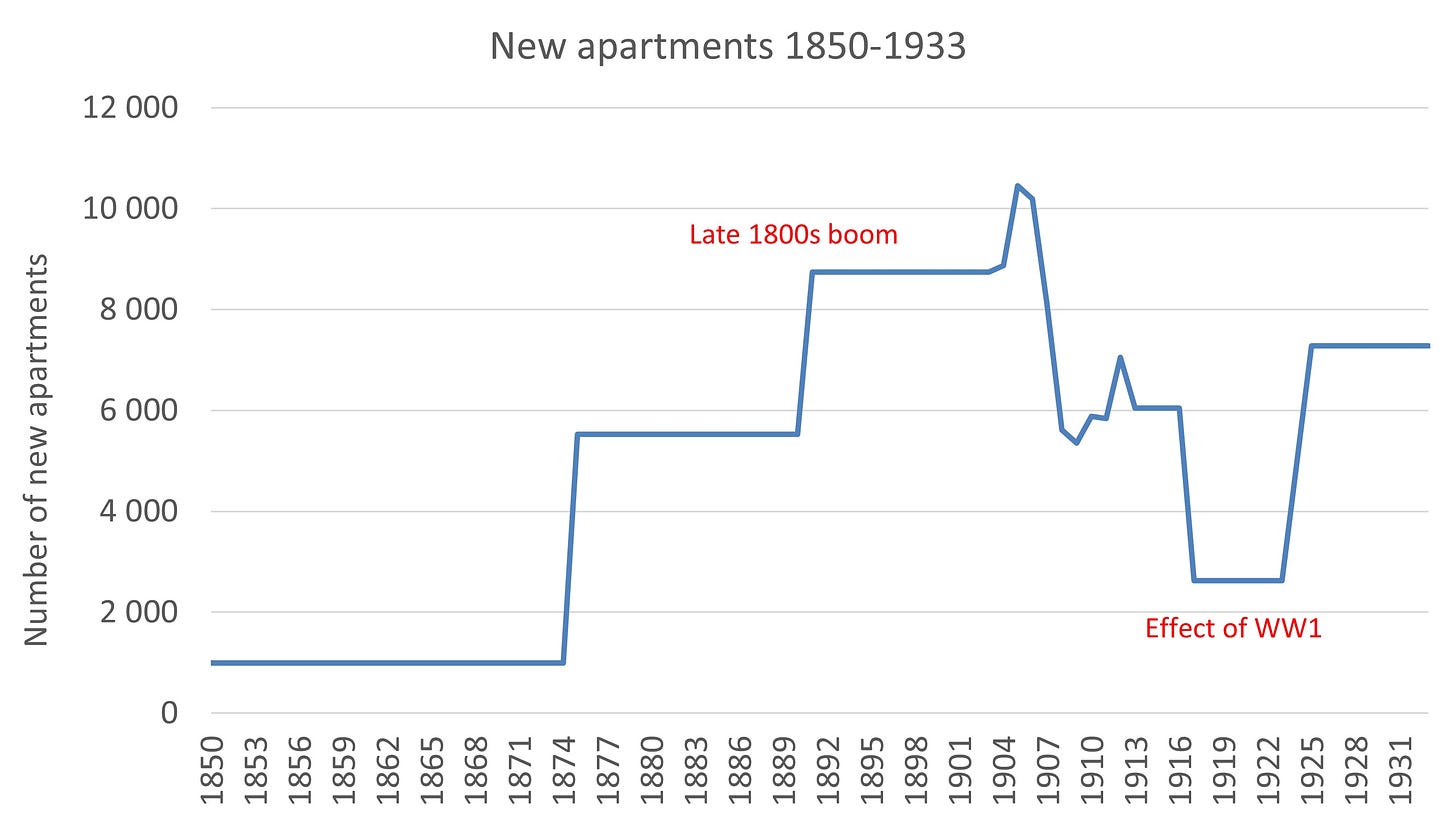
Bet On It reader Vanja Månborg knows a lot about rent control in Sweden. If you think Sweden is a country of thoughtful technocrats where government intervention works well, reading his guest post may make you think again. Here’s Vanja:Sweden has had rent control regulations since 1917 with less than two decades of pause between…
100 Years of Rent Control in Sweden
Bonus Quotation of the Day…
15 Mar 2024 Leave a comment
in applied price theory, applied welfare economics, Austrian economics, comparative institutional analysis, liberalism, Marxist economics
Tweet… is from page 434 of the final (2016) volume – Bourgeois Equality – of Deirdre McCloskey’s soaring trilogy on the essence of bourgeois values, on their transmission, and on their essential role in modern life: Zero-sum is the default in thinking about my gain and thine. It is the chief error in economic thinking…
Bonus Quotation of the Day…
One Year Since the Meltdown at Silicon Valley Bank: Commercial Real Estate and Ongoing Threats
13 Mar 2024 Leave a comment
in applied price theory, economics of information, economics of regulation, financial economics, macroeconomics, monetary economics, politics - USA Tags: banking panics

One year ago in March 2023, Silicon Valley Bank melted down, quickly followed by similar meltdowns at Signature Bank and First Republic Bank. Measured by the nominal size of bank assets, these were three of the biggest four US bank failures in history. (The failure of Washington Mutual Bank in 2008 remains the largest.) Was…
One Year Since the Meltdown at Silicon Valley Bank: Commercial Real Estate and Ongoing Threats
An Open Letter to Nobel-laureate Economist Angus Deaton
13 Mar 2024 Leave a comment
in applied price theory, applied welfare economics, Austrian economics, comparative institutional analysis, economic history, entrepreneurship, history of economic thought, income redistribution, international economics, labour economics, labour supply, poverty and inequality, Public Choice, rentseeking, survivor principle, unemployment Tags: creative destruction, free trade, tariffs
TweetProf. Angus Deaton Princeton University Prof. Deaton: Over the years I’ve learned much from your writings, and I regard your 2013 The Great Escape as one of the most important books published in the past 15 years. So I was quite surprised and disappointed to read that you, as you say, are now “much more…
An Open Letter to Nobel-laureate Economist Angus Deaton
Claude 3 Opus Also Fails Steve Landsburg’s Economics Exam
13 Mar 2024 Leave a comment
in applied price theory, history of economic thought, industrial organisation
Almost one year ago, Steve Landsburg tried GPT-4 on one of his exams. It failed, badly. I tried out some of the same questions on Claude 3 Opus, by many accounts now the leading AI. It failed, badly. Steve’s exams are very clever. They aren’t technically difficult but they are tricky in the sense that […]
Claude 3 Opus Also Fails Steve Landsburg’s Economics Exam
The RCT Agenda
12 Mar 2024 Leave a comment
in applied price theory, applied welfare economics, comparative institutional analysis, development economics, econometerics, economic history, economics of bureaucracy, economics of education, economics of information, economics of regulation, experimental economics, growth disasters, growth miracles, history of economic thought, human capital, labour economics, labour supply, law and economics, managerial economics, market efficiency, Marxist economics, occupational choice, organisational economics, property rights, Public Choice, public economics Tags: The fatal conceit

Randomized Controlled Trials: Could you be any more scientific? The book I’m now writing, Unbeatable: The Brutally Honest Case for Free Markets, insists that the randomistas of the economics profession actually have a thinly-veiled political agenda. Namely: To get economists to humbly serve the demagogues that rule the world instead of bluntly challenging their unabated…
The RCT Agenda
‘Swiftonomics’ and the optimal number of Taylor Swift examples
11 Mar 2024 Leave a comment
in applied price theory, economics of information, economics of media and culture, history of economic thought, industrial organisation
I was interested to read this recent article on Inside Higher Education, about ‘Swiftonomics’:Paul Krugman, a New York Times columnist, Nobel Prize winner and Distinguished Professor of economics at the CUNY Graduate Center, began working on the curriculum for the course last summer. Swift’s massive Eras Tour had just kicked off, creating such a frenzy…
‘Swiftonomics’ and the optimal number of Taylor Swift examples
Reading deal – rare media bouquet
11 Mar 2024 1 Comment
in applied price theory, economic history, economics of bureaucracy, economics of media and culture, income redistribution, industrial organisation, law and economics, market efficiency, movies, politics - New Zealand, property rights, Public Choice, public economics, rentseeking, survivor principle, theory of the firm, urban economics Tags: Wellington
Both Matt Nippert of the NZ Herald and Tom Hunt of The Post deserve a bouquet for their analyses of the truly remarkable deal between the Wellington City Council (WCC) and the troubled American Cinema company Reading. For this who don’t know, Reading owns a large (more than 14, 000 square metres or 1.4 hectares) […]
Reading deal – rare media bouquet


Recent Comments