
Kenneth Armstrong: The Advent of Brexit – Can It Be Paused?
13 Dec 2018 Leave a comment

 As each day passes, a new window seems to be thrown open exposing fresh legal issues to be solved as the UK continues its journey towards its withdrawal from the European Union. It’s like opening an advent calendar for lawyers.
On Monday 10 December, the Court of Justice of the European Union in its Wightman ruling resolved the legal question of whether an EU Member State can revoke its Article 50 TEU notification of its intention to withdraw from the EU and do so unilaterally. The Court ruled that unilateral revocation is a permissible action of a sovereign EU state provided it occurs before a withdrawal agreement enters into force or before the expiry of the two-year period for negotiations (or an extended period).
On Tuesday 11 December, the former UK Prime Minister Sir John Major suggested that the right to revoke be invoked with immediate effect in order to…
View original post 1,341 more words

Free To Choose 1990 – The Power of the Market – Market of Hong Kong
12 Dec 2018 Leave a comment
in applied price theory, development economics, economic history, growth miracles, industrial organisation, Milton Friedman, survivor principle Tags: Hong Kong
The reports are coming in – and they bring fresh challenges for the Ardern Govt
11 Dec 2018 Leave a comment
19,000 school trustees, now 19 000 political enemies

Finance Minister Grant Robertson has had a good run this year, with the economy performing well and the government’s books in excellent shape.
Despite ministers splashing out cash in every direction, the half-year economic and fiscal update (out this week) may even offer the Finance Minister scope for a bit more spending in the years ahead, without endangering his self-imposed goal of sustainable surpluses .
But a shadow may be beginning to emerge from this apparently cloudless sky. It lies in the reports from all those reviews the government called for in its first months of office.
View original post 645 more words
Gavin Phillipson and Alison L. Young: Wightman: What Would Be the UK’s Constitutional Requirements to Revoke Article 50?
10 Dec 2018 Leave a comment
 Today the Court of Justice of the European Union delivered its judgment in Wightman. This followed the opinion of Advocate General Campos Sánchez-Bordona, concluding that the UK may unilaterally revoke its notification of its intention to leave the EU. In a similar manner to the AG, the CJEU placed conditions on this unilateral revocation. A formal process would be needed to notify the European Council of the UK’s intention to revoke article 50. Such notice of revocation would have to be unequivocal and unconditional (para 74), and, importantly, ‘in accordance with the constitutional requirements of the Member State’, in this case, the UK, and following a ‘democratic process’ (para 66). It would also have to take place before the end of the Article 50 negotiation period, or any agreed extension, and before a Withdrawal Agreement between the exiting state and the EU had been ‘concluded’ – i.e. entered…
View original post 3,295 more words
Andrew Sullivan: the bad (atheism-bashing and religion-osculation) and the good (seeing American ideologies as religions)
10 Dec 2018 Leave a comment

Several people sent me links to Andrew Sullivan’s latest column in New York magazine (click on screenshot below). The curious thing is that half the senders thought the article was great while the other half despised it. After reading it (it’s long, but read it anyway), I can see why. His opening attacks on atheism as a dysfunctional religion are deeply misguided, but his criticism of both Right and Left extremist ideologies as religions is trenchant and on the mark. And the last bit, where Sullivan talks about the new Churchill movie Darkest Hour, shows Sullivan at his best, a thoughtful person and a writer who can be moving.
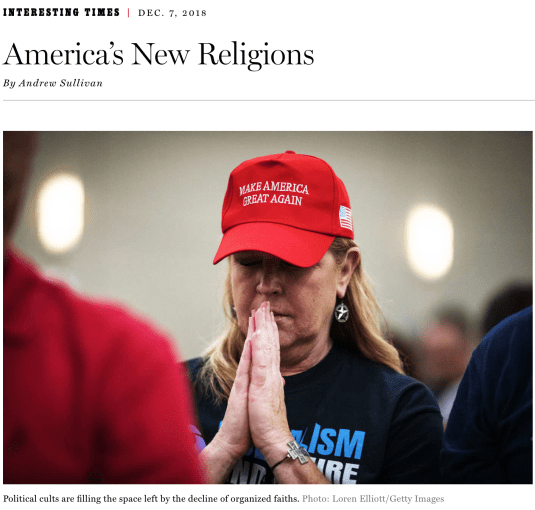
I used to get into fracases with Sullivan, and it was always over religion. Now that he writes less about it and more about politics—in which he’s moving left towards becoming a centrist—I like him better and read him more…
View original post 2,589 more words
Where have real house prices risen and fallen?
10 Dec 2018 Leave a comment

The QV house prices indices for November for each of the territorial local authority areas were released last week. Much of the headline coverage is around the fact that in the last year Auckland prices have barely changed, while those in places like Dunedin, Invercargill, Palmerston North and Whanganui have shown double-digit rates of increase. Even Wellington prices rose 7.4 per cent – something brought home to me when a house across our driveway went for $2 million recently (a very big house).
Cycles are often not in synch from place to place and I’ve sometimes found it an interesting reference point to look back and see how (real) house prices have changed since the peak of the previous surge upwards in house prices, in mid 2007. That, of course, was just before the onset of the last recession in New Zealand.
Here is a chart showing (mostly) the cities
View original post 516 more words
Pirates & the Theory of the Firm – Intro to Political Economy, Lecture17 Mike Munger
10 Dec 2018 Leave a comment
in applied price theory, comparative institutional analysis, economic history, economics of crime, entrepreneurship, human capital, industrial organisation, labour economics, law and economics, managerial economics, occupational choice, organisational economics, personnel economics, property rights, survivor principle, theory of the firm Tags: asymmetric information, moral hazard, transaction costs
Season 4: have we reached ‘peak Columbo’?
09 Dec 2018 Leave a comment


We all agree that Columbo is one of the greatest shows of all time. But what’s most impressive is that the calibre of episodes was so high for so long. From its stunning debut in 1968’s Prescription: Murder, the show hit the ground galloping at full pace and barely let up throughout its 70s’ run.
But when, I wonder, can we say the show was at its absolute zenith? When it was still fresh enough to make for joyful viewing, while boasting performances, writing and story lines that were hitting all the right marks time and again?
Regular readers may have noticed that in my review of A Deadly State of Mind, the final episode of Season 4, that I queried whether we had reached ‘peak Columbo‘ in terms of consistent quality. And that’s really the genesis of this article.
“There’s a genuine argument that Season 4…
View original post 1,200 more words
YouTube Censors John Stossel’s Video On Socialism
09 Dec 2018 Leave a comment

In a column published at Townhall on Thursday, journalist and former Fox Business host John Stossel announced that YouTubeattempted to prevent a video he produced on socialism from being viewed by young people.
Ironically enough, Stossel revealed this detail as part of his review of the documentary movie The Creepy Line. The film is about how tech giants (specifically YouTube owner Google and social media giant Facebook) can intentionally manipulate search engine results in order to influence certain political outcomes.
Below is John Stossel’s video in question and there is a Spanish version you can view here. Socialism is the achievement of Communism by political, as opposed to violent, means. Environmentalism hails from the Marxist tradition and the groups based on it use both politics and violence to achieve their ends. It does not do well for individual freedom when technology companies (like Google) further Leftist ends.
Paul M. Romer: Lecture in Economic Sciences 2018
09 Dec 2018 Leave a comment
in applied price theory, development economics, economic growth, economic history, human capital, macroeconomics Tags: endogenous growth theory
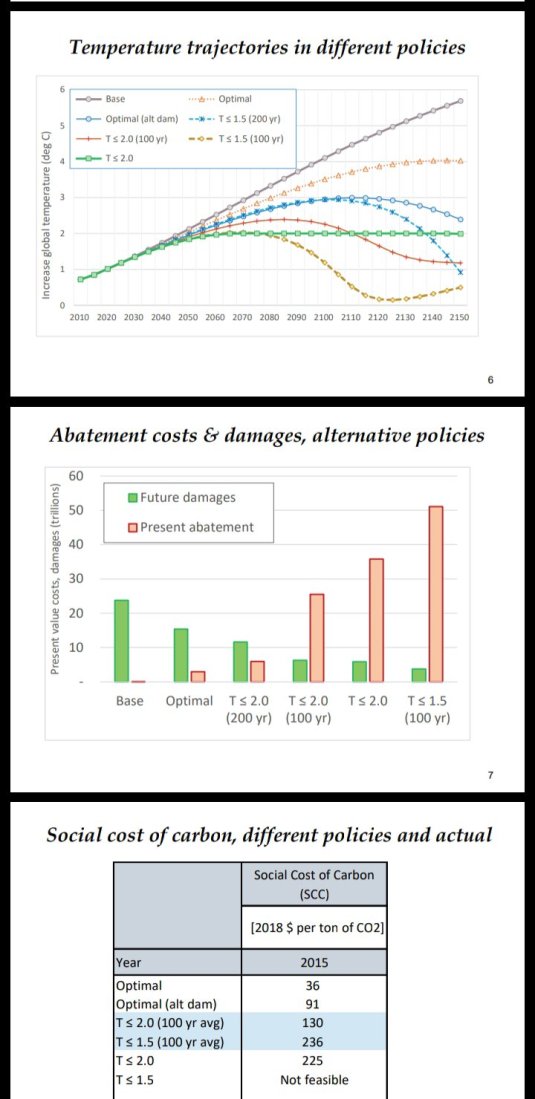
From William Nordhous Nobel lecture #OTD FYI @jamespeshaw @mfe_news
09 Dec 2018 Leave a comment
in applied price theory, applied welfare economics, development economics, energy economics, environmental economics, global warming Tags: climate alarmism


Recent Comments