The European Commission’s Google Android decision takes a mistaken, ahistorical view of the smartphone market
24 Jul 2018 Leave a comment
We’re All Gonna Starve!
24 Jul 2018 Leave a comment
in applied price theory, development economics, economics of natural disasters, energy economics, environmental economics, growth disasters, growth miracles, international economics Tags: pessimism bias, The Great Enrichment
What can you do when policymakers ignore your evidence? Tips from the ‘how to’ literature from the science community
23 Jul 2018 Leave a comment

Put down that huge blue pen. Step away from the flipchart.
There is now a large literature on the strategies that people might use to promote the use of evidence in policy, so you no longer have to start from first principles in your workshop.
Thanks to Dr Kathryn Oliver and colleagues, we now have systematic reviews of the peer reviewed academic evidence on the ‘barriers’ between evidence and policy (click here) and the ‘grey literature’, which includes newspaper editorials, blogs, and practitioner reports (click here later – this article is still in review).
The advice from the peer reviewed literature can be summed up as follows:
- Produce better quality evidence on policy problems and solutions.
- Improve dissemination strategies to increase policymaker access to research: write more concise and less jargon-filled reports, boost resources for dissemination, and remove paywall obstacles to accessing research.
- Develop relationships with policymakers, to…
View original post 756 more words
The New Yorker goes after Pinker and his progressivism
23 Jul 2018 Leave a comment

UPDATE: forgot to add this picture of the plaque adorning the building where the New Yorker was founded. Check out the last sentence!

__________
Not long ago the New Yorker had an article about free speech whose message, at least to me, was that we have to ratchet back on the First Amendment protections traditionally (and now consistently) construed by American courts. A few readers disagreed, but rereading the article I decided that while the magazine played lip service to free speech, the article had a weaselly way of pretending to be evenhanded while conveying its real message that it’s time to reassess the legal protections of speech in America. In the interest of social justice, it said, we should have a hard look at how the First Amendment is applied, and think about making changes. (See a similar sentiment in an earlier piece in the magazine.)
This same pretense…
View original post 2,417 more words
Indian Drivers and corruption
22 Jul 2018 Leave a comment
in applied price theory, development economics, economics of bureaucracy, economics of crime, economics of regulation, growth disasters, growth miracles, law and economics, Public Choice, rentseeking, transport economics Tags: economics of corruption
On Contempt: The FBI Has Congress’ Number
22 Jul 2018 Leave a comment

 Below is my column in The Hill newspaper on the lingering questions left from the Strzok testimony. While it may seem like a thousand years after Helsinki and the Cohen tape, the testimony of Strzok was shaped by highly dubious instructions from the FBI not to answer core questions. It is highly doubtful that a majority of these refusals would be upheld under judicial review — starting with the first question asked of Strzok.
Here is the column:
View original post 1,112 more words
Manchester University students deface mural containing Kipling poem on grounds that he was a colonialist and racist
22 Jul 2018 Leave a comment
Karl Marx favored the British empire. Therefore anyone who says they are a communist are as bad as Kipling.
According to several sources, including the BBC, theManchester Evening News and The National, students at Manchester University, which is where Matthew Cobb teaches (he IS NOT TO BLAME) decided to paint over a mural that displayed a poem by Rudyard Kipling, replacing it with a poem by Maya Angelou.
The defacing was done by leaders of the student union, who apparently didn’t consult either the University or their own constituents. The BBC reports:
The protest was an attempt to reclaim history by those who have been “oppressed by the likes of Kipling for so many centuries, and continue to be to this day,” according to Sara Khan, the liberation and access officer at the student union.
In a Facebook post, the student official said Kipling’s works “sought to legitimate the British Empire’s presence in India and dehumanise people of colour”.
And here’s a statement by one of…
View original post 994 more words
Forthcoming: James M. Buchanan and the Political Economy of Desegregation
22 Jul 2018 Leave a comment

My article, co-authored with Phil Magness and Art Carden, on James Buchanan and the political economy desegregation is now forthcoming at the Southern Economic Journal. In this article, we do two things: 1) we respond to the claims made by Nancy MacLean (Duke University) in Democracy in Chains that nobel laureate James Buchanan was a closeted racist and segregationist and show that the opposite was true; 2) we situate public choice within debates over racism and desegregation. The article can be downloaded here on SSRN and the abstract is below:
Recent historical works, most notably 2017’s Democracy in Chains, claim that 1986 Nobel Laureate James M. Buchanan’s formative contributions to political economy were inspired in significant part by hostility to Brown v. Board of Education. This argument suggests that the research agenda of public choice economics emerged from an opportunistic alliance with Virginia’s “Massive Resistance” to school integration and should…
View original post 131 more words
The Andrew Leigh-Sinclair Davidson company tax debate
21 Jul 2018 Leave a comment

In March, there was extensive media coverage (e.g. in the Guardian Australia) of shadow assistant treasurer Andrew Leigh’s company tax research which found companies paying lower effective company tax rates (i.e. actual tax paid/profits) did not create more jobs than those paying higher effective tax rates, and may actually create fewer jobs. The research paper was published in Economic Analysis and Policy (EAP), the online journal of the Economic Society of Australia (QLD) of which I’m Vice President, although this is a personal comment on my part, and I am not on the editorial committee of EAP.
I am very pleased that RMIT’s Sinclair Davidson has converted his critique of Andrew Leigh’s paper, originally published at Catallaxy Files, into a submission to EAP. Davidson’s paper has been published along with a reply by Andrew Leigh, which in my view doesn’t effectively counter the major criticism Davidson makes, that…
View original post 515 more words
The “Overheated” Costs of Climate Change
21 Jul 2018 Leave a comment
in applied price theory, applied welfare economics, energy economics, environmental economics, global warming, politics - Australia, politics - New Zealand, politics - USA Tags: climate alarmism
The EU would have sued MySpace, given time
21 Jul 2018 Leave a comment
in applied price theory, entrepreneurship, industrial organisation, law and economics, survivor principle Tags: competition law

Replacing science-based cancer treatments with “alternative treatments” increases your risk of dying from cancer (new study)
21 Jul 2018 Leave a comment

Cancer is a truly terrible disease, and although our ability to treat and even cure many types of cancer has greatly improved, our current methods for dealing with it are admittedly imperfect and often have serious side-effects. It is, therefore, hardly surprising that many people who are diagnosed with cancer would forgo science-based treatments for “alternative” or “complimentary” treatments (aka CAM). After all, who wouldn’t be tempted by the promise of a miracle cure? The problem is that these “natural” treatments are unproven and unregulated, and choosing them over science-based medicine actually increases your risk of dying from cancer. This was demonstrated by a paper published earlier this year (Johnson et al. 2018a) that compared people who took only alternative cancer treatments to those who took conventional treatments. It found that those who relied on alternative treatments had a significantly lower survivorship. A second study (by some of…
View original post 1,096 more words
On Energy Transitions
21 Jul 2018 Leave a comment


These days the media are full of stories about people setting targets to “decarbonize” the energy sources fueling their societies. Some are claiming (and some have failed notoriously) to achieve zero carbon electrification. We should take a deep breath, step back and rationally consider what is being discussed and proposed.
The History of Energy Transitions
Thanks to Bill Gates we have this helpful graph showing the progress of human civilization resulting from shifts in the mix of energy sources.
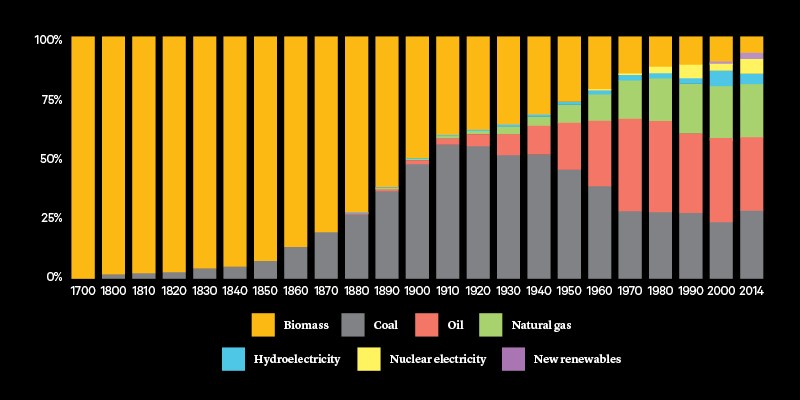
Before the 19th century, it is all biomass, especially wood. Some historians think that the Roman Empire collapsed partly because the cost of importing firewood from the far territories exceeded the benefits. More recently, the 1800’s saw the rise of coal and the industrial revolution and a remarkable social transformation, along of course with issues of mining and urban pollution. The 20th century is marked first by the discovery and use…
View original post 4,478 more words
Climate lawfare suffers another defeat
20 Jul 2018 1 Comment


Is it any wonder that US judges are reluctant to put themselves in the position of climate experts, when the evidence for man changing the global climate is so nebulous and strongly disputed?
Today a U.S. District Judge threw out New York City’s lawsuit against five major energy companies alleging damages relating to climate change, reports The GWPF.
Judge John Keenan wrote in his opinion that, “Global warming and solutions thereto must be addressed by the two other branches of government,” not the judiciary, according to Bloomberg.
View original post 266 more words


Recent Comments