@AmyAdamsMP 3 strikes deters many crimes but with a twist @dbseymour @greencatherine

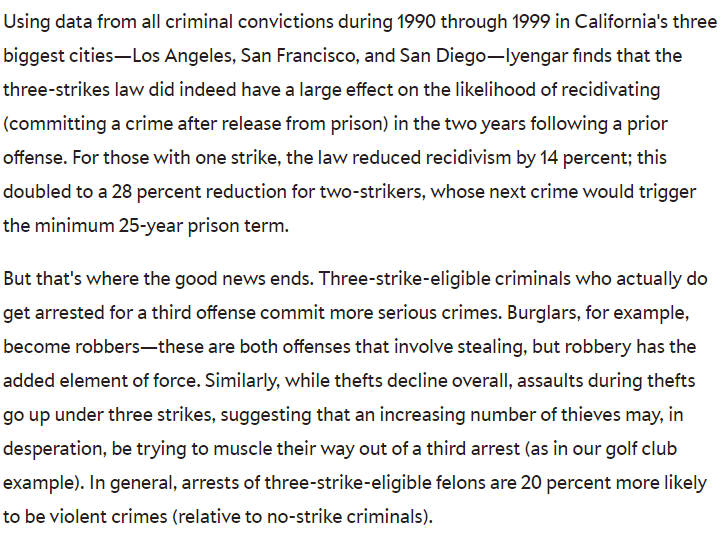
A card-carrying Leftist would not know what to do with this study by Radha Iyengar. In their life mission of excusing criminals, they could bait and switch. Quickly acknowledged the results of the study, a massive reduction in serious crime, then go on as fast as possible to the unintended consequences on marginal deterrence. 3rd strike offenders tend to commit more violent crimes because they have less to lose. That is basic applied price theory.

image

Source: Do three-strikes laws make criminals more violent?

Sadly, card-carrying leftists denied themselves this argument when arguing against 3 strikes when the laws before Parliament. You have to admit the deterrence works in order to argue that 3 strikes and you are out screws up marginal deterrence.

To be fair, the Left did not do that fully. The standard argument against life without parole is that these prisoners will have nothing to lose and will be difficult for the prison guards to manage. That is, life without parole screws up marginal deterrence even among hardened criminals.

@TBillTheProf unintentionally destroys the case for a #livingwage @Mark_J_Perry @arindube

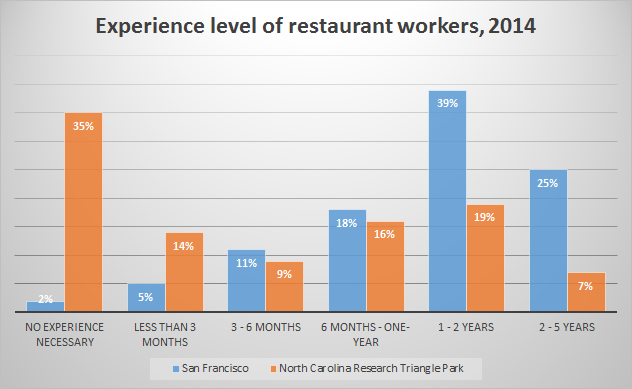
Living wage advocate William Lester published a briefing for the Washington Centre for Equitable Growth that destroys the case for a living wage. He did not intend this but he documented in detail the exclusion of inexperienced workers from the restaurant industry in San Francisco after a living wage was imposed. He compared San Francisco’s minimum wage of $12 per hour with North Carolina which only pays the federal minimum of $7.25 per hour.

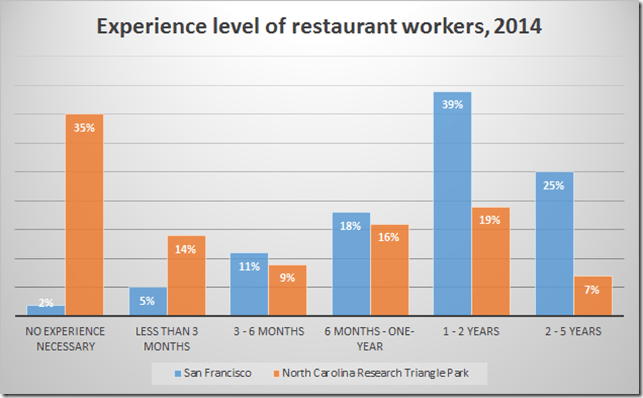
What Lester found was a systematic increase in hiring standards. The living wage in San Francisco of $12 all but ended the hiring of inexperienced workers as shown in the chart below. This is exactly what basic price theory predicts. I put the two pie charts in his paper into a single bar chart so this powerful effect of the living wage on hiring standards is not lost.
image

Source: The consequences of higher labor standards in full service restaurants – Equitable Growth.

The most fundamental criticism of living wage and minimum wage increases is they exclude workers who do not meet the new labour productivity level required to make it profitable for employers to hire them.  UK research found the same thing – an increase in hiring standards and tougher shortlisting. Lester welcomes this transition of the restaurant industry in San Francisco into a career for professionals. As he says in his briefing paper:

Concurrent with this wage compression was a rise in professional standards as employers sought to hire and keep already well-trained workers at higher wages and with expanded benefits. Both developments reduced turnover and attracted more professional employees who maintain a high level of customer service.

As with all minimum wage and living wage advocates, he is incurious as to what happens to those low skilled, inexperienced workers and new workforce entrants who no longer meet the hiring standards of San Francisco restaurants because of the large minimum wage increase.

As Lester concedes in his conclusions about what will happen if the San Francisco minimum wage of $12 an hour, the highest in the country, is extended to other cities and states:

Higher professional standards may limit entry-level opportunities within the industry, while lower standards may result in more employer-provided training for new workers.

Employer funded on-the-job training is often a major part of a job package. It is well-known in the labour economics literature since the time of Adam Smith that any job is a package of wages and other attributes including learning opportunities.

Workers sell their services and buy learning opportunities; firms buy labour services and sell jobs with varying learning possibilities (Rosen 1972, 1975, 1976). The rational allocation of time results in most careers starting with large investments in full-time schooling and then mostly investments in on-the-job training (Becker 1975; Ben-Porath 1967, 1970; Weiss 1987).

As the training provided by restaurant employers is useful to other employers, the trainee must fund it through trading off wages for this training. Once trained, the employee can command a higher pay because other employers are willing to pay them more now that they are trained. Again, this is a standard result in the human capital literature.

Where the human capital is more specialised to one firm or job, the employer and the trainee share the cost. A classic example of this is an apprenticeship.

Source: IZA World of Labor – Do firms benefit from apprenticeship investments?

In San Francisco, employers expect recruits to be fully trained and experienced. They provide little in the way of on-the-job training. Their recruits must have been able to afford to fund this in their previous jobs by trading off wages for training as Lester notes in his working paper:

…San Francisco employers were less likely to report lengthy formal training periods for either front-of-house or back-of-house workers. Instead, there is an overall higher level of skill expectation and—as is the case for many professions—workers are expected to acquire and exhibit industry specific knowledge on their own. 

In North Carolina, as Lester notes, the restaurant industry hires younger workers with less formal education and offers them intensive on-the-job training:

The restaurant industry in the Research Triangle region tends to hire younger workers with a lower level of formal education. Specifically, 49.5 percent of workers in there are under age 24 or have less than a high school education, compared to  38.9 percent in San Francisco. Conversely, 40.6 percent of workers in San Francisco have some college or a bachelor’s degree or higher, compared to 29.7 percent in the Research Triangle Region.

North Carolina restaurants sought to hire unskilled workers who were friendly and reliable as Lester notes:

One manager of a neighbourhood bistro in Raleigh explained what he looks for in a new front-of-house worker: “Basically, we require [that a server] can work a four-shift minimum per week and go an entire shift, an entire eight-hour shift without smoking a cigarette and [without] any facial piercings or anything. Beyond that, just come in with a smile on your face.”

The restaurant industry in North Carolina is willing to give people low skilled,  poorly educated and inexperienced a chance to work if they are willing to work. Lester reports this when quoting an upscale bar-and-grill manager on his hiring standards:

We look for at least one year’s experience, but the biggest thing we look for is we look for the person. We don’t look for the skill. I could teach anybody how [to] wait tables [and] pour drinks. I can teach anybody how to cook steaks. What I can’t teach is how to be a good person.

Lester then discusses with some degree of approval the hiring standards in the San Francisco where restaurants are professional careers:

Rather than viewing servers as essentially interchangeable labourers who can be trained quickly and easily if they possess a modicum of personal hygiene and a friendly personality, employers in San Francisco exhibited a clear description of what a “professional server” was.

One mid-scale restaurant employer said of her front-of-house staff: “We have a lot of people who have made it a career and they’re investing in the knowledge of the product and learning their trade or already know their trade because they’ve done it for years.”

Much to the surprise of believers in the inherent inequality of bargaining power between employers and workers, employers invest heavily in low-skilled employees despite the fact this makes them employable elsewhere. Lester again:

“Training is a huge investment for us and it is constant,” [a manager] said. “Training days depend on the position. Bartending training is ten days and servers require eight days. In the kitchen it’s probably about ten days. Every day they write note cards on all their recipes. But they’ll take a final. When they take their final, their test in the kitchen, they have to know every ingredient, every ounce, and every item, for the entire station. That’s why we require them to write note cards.

Even at higher-end restaurants, employers in the region have built a human resource system that accepts a high rate of turnover. “We try to stay ahead of the game so that we’re always hiring, we’re always interviewing, but hopefully it’s not desperation hires,” says another manager. “And we try to have a mix of needs like people who need fulltime, who can work lunches and brunches and all of that, to servers who really want very part time so that you can kind of over staff on busy shifts and then there’s always someone that wants to go home. There’s always a student that would like a Saturday night off.”

Lester paints a picture of a San Francisco restaurant industry that expects workers to fund their own industry specific human capital. In North Carolina, employers provide those training opportunities to minimum wage workers despite this making these up-skilled employees an attractive proposition for rivals to poach. By depriving low skilled workers of this opportunity of both wages and employer-funded training, a living wage would make them worse off.

I am at a loss here. How can the progressive left regard the exclusion of low paid, low skilled workers as a good thing? How do they put food on the table in San Francisco other than through a welfare check? How do they get their first job?
Downsizing, morale & productivity @SueMoroney @GreenCatherine #livingwage

It comes as a surprise to living wage advocates that entrepreneurs are so alert to the impact of downsizing and firm closures on employee morale that they keep these a secret to the last possible minute.

Entrepreneurs are not fools. They profit from alertness to the effects of changes in the fortunes of the firm on labour productivity. There is a vast literature on how to motivate workers towards more effort and diligence and honesty.

I worked at a Japanese private university whose financial survival was always in question. We spent a lot of time gossiping about the security of our jobs.

I refer to one year at one employer as the year of doing nothing because management was so consumed with restructuring and downsizing. They were too busy to sign out the output of their staff.

I have come across an estimate the effect of downsizing announcement on productivity at a German bakery chain of 193 shops.

Source: The Effect of Announced Downsizing on Workplace Performance: Evidence from a Retail Chain by Guido Friebel, Matthias Heinz, Nikolay Zubanov :: SSRN.

The study found that announcements of a sale to a new owner and closure reduced sales by six and 21 percent, respectively. This negative effect increased with the share of workers on a permanent contract, even though these workers faced a much lower unemployment risk. Fewer customers were served per unit of time because of less employee effort at the bakery chain.

Going back to my year of doing nothing, which dragged out through worker consultations sought by the unions under the collective agreement, I remember chatting to a mate whose father was in the downsizing consulting business. He told me that private businesses get downsizing over as quickly as possible because of the impact on morale and productivity. Entrepreneurs are perfectly aware that uncertainty promotes office gossip and valuable staff moving on.

An Economic Approach to School Integration: Public Choice with Tie-ins

Thomas Borcherding “An Economic Approach to School Integration: Public Choice with Tie-ins.” Public Choice, 1977, argues that a reason for racial or ethnic discrimination in the public sector is politics encourages the coercive transfer of income from the racial, religious or ethnic group to those with more political influence.

Race can be used as a means of organizing coalitions to lobby for fiscal and economic discrimination in favour of even a previously unprejudiced group.

Preferences of each group to locate in a common geography and the severe control over entry or exit from the group that such things as skin colour, language, caste, and religious dogma impose make the organization of racial or ethnic coalitions by political entrepreneurs fairly cheap and minimises free riding and defection.

Prejudice may reinforce the solidarity of each group and help to monitor via custom, mores, and folkways the behavior of those that would attempt to bring persons of other groups into the former coalition. Further, prejudice may also serve as a device to rationalize exploitation of another group by fiscal or other means.

Borcherding argues that integration, racial balancing, quotas, and busing of school children take on a new logic when income transfers can be tied to fairly immutable characteristics such as race.

Mixing of children by race reduces the ability of a white dominated school board to differentially favour its own partisans’ children and to discriminate against those of blacks.

This paper anticipated Becker’s point that the competition among pressure groups for political influence for looks for lower cost ways of redistributing wealth so as to as much as possible limits the largess as much as possible to the pressure groups that lobby for it and their allies.

Solution aversion and the anti-science Left

image

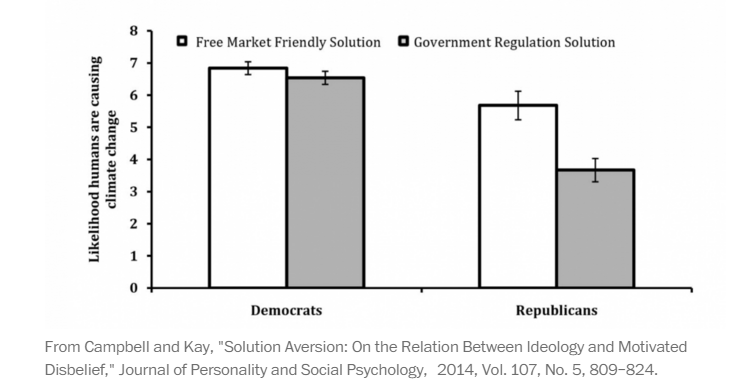
Climate science is the latest manifestation of solution aversion: denying a problem because it has a costly solution. The Right does this on climate science, the Left does it on gun control, GMOs, and plenty more. Cass Sunstein explains:

It is often said that people who don’t want to solve the problem of climate change reject the underlying science, and hence don’t think there’s any problem to solve.

But consider a different possibility: Because they reject the proposed solution, they dismiss the science. If this is right, our whole picture of the politics of climate change is off.

Some psychologists wasted grant money on lab experiments to show that people that think the solution to a problem is costly tend to rubbish every aspect of the argument. Any politician will tell you you do not concede anything. Sunstein again:

Campbell and Kay asked the participants whether they agreed with the IPCC. And in both, about 80 percent of Democrats did agree; the policy solutions made no difference.

Republicans, in contrast, were far more likely to agree with the IPCC when the proposed solution didn’t involve regulatory restrictions…

Here, then, is powerful evidence that many people (of course not all) who purport to be skeptical about climate science are motivated by their hostility to costly regulation.

The Left is equally prone to motivated readings. For example, it was found that those on the left are much more concerned about home invasions when gun control can reduce them rather than increase them.

image

The Left picks and chooses which scientific consensus as it accepts. The overwhelming consensus among researchers is biotech crops are safe for humans and the environment. This is a conclusion that is rejected by the very environmentalist organisations that loudly insist on the policy relevance of the scientific consensus on global warming.

Previously the precautionary principle was used to introduce doubt when there was no doubt. But when climate science turned in their favour, environmentalists wanted public policy to be based on the latest science.

The Right is welcoming of the science of nuclear energy or geo-engineering. The Left rejects it point-blank. Their refusal to consider nuclear energy as a solution to global warming is a classic example of solution aversion. Let he who is without sin cast the first stone.

Monopolies and patents can breed deadweight loss and market inefficiencies

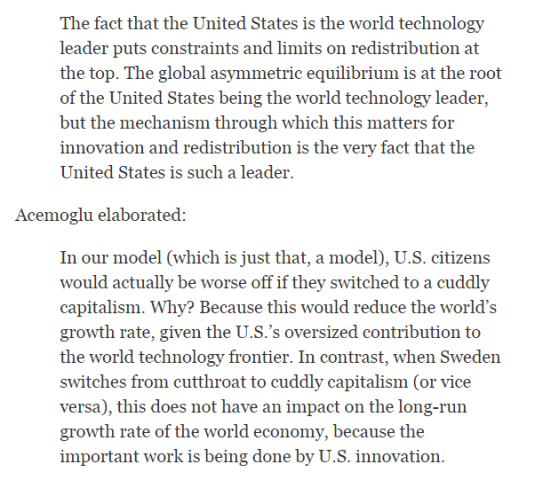
The Scandinavian welfare states are mooching off the USA

The welfare states in Scandinavia do not make their societies any less unequal than most other welfare states once you take into account taxes and transfers – after-tax redistributions.

Source: Why Can’t America Be Sweden? – The New York Times.

Big bills left on the #livingwage sidewalk?

Living wage activists believe that businesses can profitably pay their low-paid workers a lot more. The living wage pay increase will not jeopardise the survival of the business or jobs because their workers will be more productive because of the living wage increase. Morale will be higher and job turnover will be lower. Both of these will increase productivity perhaps enough to offset the increase in labour costs.

In a nutshell, living wage activists have discovered a hitherto untapped entrepreneurial opportunity for profit. These living wage activists are happy to disclose this secret to lower costs to the world at no fee.

What they are arguing is businesses do not notice a profit opportunity that these political activists have noticed and are now publicising widely. Entrepreneurs are leaving money on the table that could easily be snapped up simply by paying their low-paid employers higher wages.

Source: Mancur Olson (1996) “Distinguished Lecture on Economics in Government: Big Bills Left on the Sidewalk: Why Some Nations Are Rich, and Others Poor.” Journal of Economic Perspectives 3-24.

This money on the table metaphor is similar to the big bills left on the sidewalk metaphor. There is easy money to be had from paying low-paid workers more because these workers will quickly become more productive because of the higher wages.

Living wage activists do not address why entrepreneurs had not discovered this insight into cost saving themselves. After all, every entrepreneur, every employer knows that if they pay more, they will get a better class of job applicant.

Of course, if this insight by the living wage activists is true, all workers should be given a similar increase in their pay because their productivity will go through the roof as well.

Entrepreneurs profit directly from spotting every new opportunity for profit. They have no reason to turn money down particularly when it is obvious and straight under their nose.

The modern theories of the firm focus, in part or in full on reducing opportunistic behaviour, cheating and fraud in employment relationships. The cost of discovering prices and making and enforcing contracts and getting what you pay for are central to Coase’s theory of the firm put forward in 1937.

The profits of entrepreneurs for running a firm is directly linked from their successful policing of the efforts of employees and sub-contractors to ensure the team and each member perform as promised and individual rewards matched individual contributions (Alchian and Demsetz 1972; Barzel 1987). Alchian and Demsetz’s (1972) theory of the firm focused on moral hazard in team production. As they explain:

Two key demands are placed on an economic organization-metering input productivity and metering rewards.

The main rationale in personnel economics from everything ranging from employer funding of retirement pensions to the structure of promotions and executive pay including stock options is around better rewarding self-motivating employees who strive harder and reducing the costs of monitoring employee effort.

At bottom, the efficiency wage hypothesis is entrepreneurs are unaware of the higher quality and greater self-motivation of better paid recruits for vacancies but wise bureaucrats and farsighted politicians notice these gaps in the market. Bureaucrats and politicians notice these gaps in the market before those who gain from superior entrepreneur alertness to hitherto untapped opportunities for profit do so and instead leave that money on the table.

Is Education Signaling or Skill Building?

Negative Externalities and the Coase Theorem

Presidential candidate tax plans and economic growth

[/embed]https://www.facebook.com/UnbiasedAmerica/photos/pb.123061011213236.-2207520000.1457089554./449398021912865/?type=3&theater[/embed]

Rational irrationality and how the #livingwage works

Image

What animals are poached where?

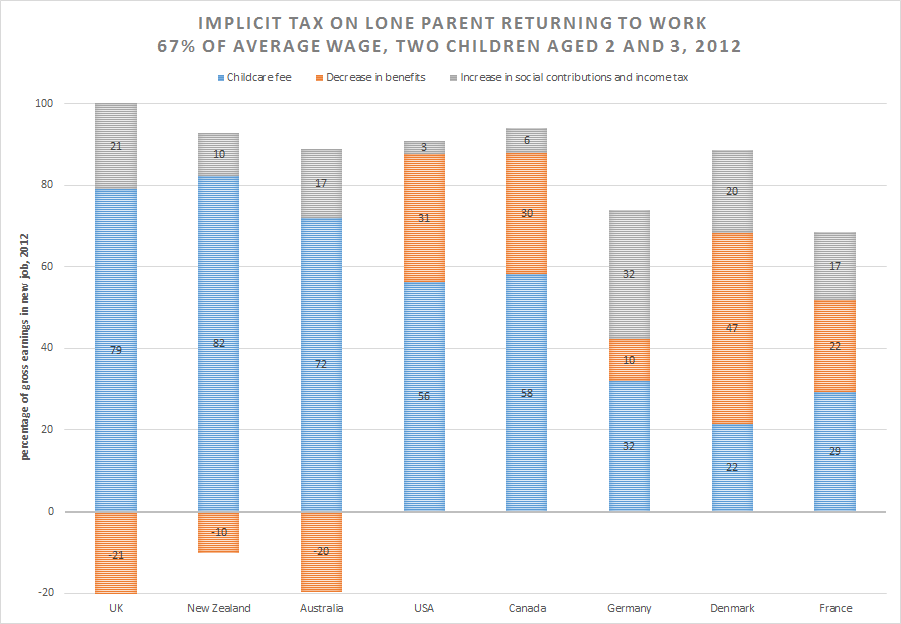
Implicit tax on a lone parent returning to a low-paid job in the USA, UK, Denmark, France, Germany, Canada, Australia and New Zealand

image

Source: Economic Policy Reforms: Going for Growth – OECD (2016).

Save Our Parks! How to Keep National Parks Open

Previous Older Entries Next Newer Entries

Coordination Problem

Celebrating humanity's flourishing through the spread of capitalism and the rule of law

Libertarian Land

Celebrating humanity's flourishing through the spread of capitalism and the rule of law

Arin’s Substack

Celebrating humanity's flourishing through the spread of capitalism and the rule of law

David Andolfatto

Celebrating humanity's flourishing through the spread of capitalism and the rule of law

Monetary Non-Neutrality

Celebrating humanity's flourishing through the spread of capitalism and the rule of law

Reason Magazine

Celebrating humanity's flourishing through the spread of capitalism and the rule of law

Coyote Blog

Celebrating humanity's flourishing through the spread of capitalism and the rule of law

Thoughts from the North

Celebrating humanity's flourishing through the spread of capitalism and the rule of law

Fardels Bear

A History of the Alt-Right

Vincent Geloso

Econ Prof at George Mason University, Economic Historian, Québécois

Bassett, Brash & Hide

Celebrating humanity's flourishing through the spread of capitalism and the rule of law

Truth on the Market

Scholarly commentary on law, economics, and more

The Undercover Historian

Beatrice Cherrier's blog

Matua Kahurangi

Celebrating humanity's flourishing through the spread of capitalism and the rule of law

Temple of Sociology

Celebrating humanity's flourishing through the spread of capitalism and the rule of law

Velvet Glove, Iron Fist

Celebrating humanity's flourishing through the spread of capitalism and the rule of law

Why Evolution Is True

Why Evolution is True is a blog written by Jerry Coyne, centered on evolution and biology but also dealing with diverse topics like politics, culture, and cats.

NoTricksZone

Celebrating humanity's flourishing through the spread of capitalism and the rule of law

Homepaddock

A rural perspective with a blue tint by Ele Ludemann

Kiwiblog

DPF's Kiwiblog - Fomenting Happy Mischief since 2003

The Dangerous Economist

Celebrating humanity's flourishing through the spread of capitalism and the rule of law

Watts Up With That?

The world's most viewed site on global warming and climate change

The Logical Place

Tim Harding's writings on rationality, informal logic and skepticism

Doc's Books

A window into Doc Freiberger's library

The Risk-Monger

Let's examine hard decisions!

Uneasy Money

Commentary on monetary policy in the spirit of R. G. Hawtrey

Barrie Saunders

Thoughts on public policy and the media

Liberty Scott

Celebrating humanity's flourishing through the spread of capitalism and the rule of law

Point of Order

Politics and the economy

James Bowden's Blog

A blog (primarily) on Canadian and Commonwealth political history and institutions

Science Matters

Reading between the lines, and underneath the hype.

Peter Winsley

Economics, and such stuff as dreams are made on

A Venerable Puzzle

"The British constitution has always been puzzling, and always will be." --Queen Elizabeth II

The Antiplanner

Celebrating humanity's flourishing through the spread of capitalism and the rule of law

Bet On It

Celebrating humanity's flourishing through the spread of capitalism and the rule of law

History of Sorts

WORLD WAR II, MUSIC, HISTORY, HOLOCAUST

Roger Pielke Jr.

Undisciplined scholar, recovering academic

Offsetting Behaviour

Celebrating humanity's flourishing through the spread of capitalism and the rule of law

JONATHAN TURLEY

Res ipsa loquitur - The thing itself speaks

Conversable Economist

In Hume’s spirit, I will attempt to serve as an ambassador from my world of economics, and help in “finding topics of conversation fit for the entertainment of rational creatures.”

The Victorian Commons

Researching the House of Commons, 1832-1868

Books & Boots

Reflections on books and art

Legal History Miscellany

Posts on the History of Law, Crime, and Justice

Sex, Drugs and Economics

Celebrating humanity's flourishing through the spread of capitalism and the rule of law

European Royal History

Exploring the Monarchs of Europe

Tallbloke's Talkshop

Cutting edge science you can dice with