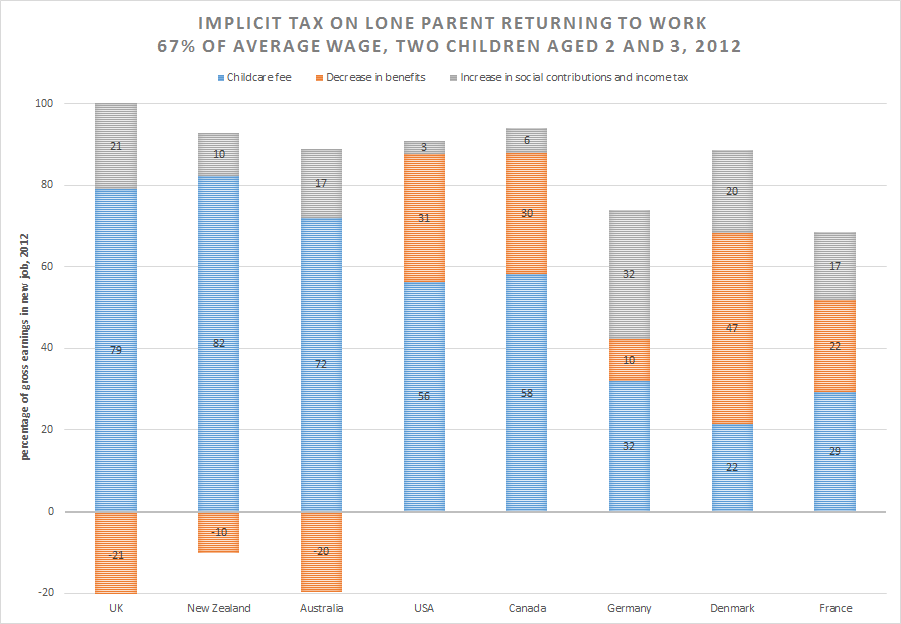
Source: Economic Policy Reforms: Going for Growth – OECD (2016).
Celebrating humanity's flourishing through the spread of capitalism and the rule of law
28 Feb 2016 Leave a comment
in applied price theory, fiscal policy, labour economics, labour supply, politics - Australia, politics - New Zealand, politics - USA, poverty and inequality, public economics, welfare reform Tags: poverty traps, single mothers, single parents, social insurance, taxation and labour supply, welfare state
25 Feb 2016 Leave a comment
in applied price theory, comparative institutional analysis, environmental economics, law and economics, property rights, resource economics Tags: contracting-out, free market environmentalism, national parks, privatisation
24 Feb 2016 Leave a comment
in applied price theory, comparative institutional analysis, economics of bureaucracy, industrial organisation, politics - New Zealand, Public Choice, public economics Tags: anti-market bias, New Zealand Greens, privatisation, rational irrationality, state owned enterprises

Green MP Gareth Hughes today nailed the case as to why governments should never run businesses. Too many MPs simply do not understand what dividends represent and what the profits from asset sales represent.
Hughes was reported today saying that taxpayers lost nearly $1 billion in dividends since the recent privatisations of power companies. He is the Green party spokesman on state owned enterprises.

Source: Asset sales cost hits $1 billion | Green Party of Aotearoa New Zealand.
Does the Green Party understand that an asset sells for a price equal to its risk-adjusted discounted net present value of the stream of dividends. When you sell a financial asset, you cash out the net present value of the stream of dividends that might have come from those assets.
The Greens, who are prissy about government transparency and dishonesty of their opponents, did not mention the $4.7 billion in revenue from the asset sale. Taxpayers now receiving more in dividends as a part owner of the privatised power companies than they did as a full owner.
Hughes had the cheek to complain about the politicisation of those privatisations such as favourable terms for small share buyers. That inability of governments to even sell an asset competently is a strong reason why governments should never run businesses in the first place.
If an asset cannot be sold in the full light of day – a major issue in an election campaign and a referendum – without the sale price that is politicised, what is the chance of good management of any state-owned enterprise when it is not the central focus of opposition scrutiny?
It is been many years since dividends from the state-owned enterprise portfolio has been a net positive cash flow for the taxpayer, as the chart below shows.
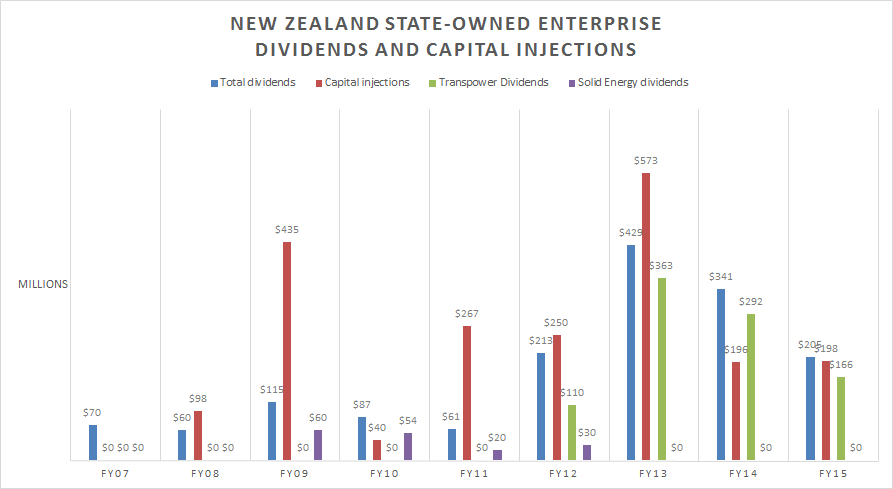
Source: New Zealand Treasury – data released under the Official Information Act.
KiwiRail and Solid Energy gobbled up whatever dividends came out of the power companies. Aside from power companies, state-owned enterprises not really offer much in the way of dividends to the taxpayer as the chart again shows.
23 Feb 2016 Leave a comment
in applied price theory, economic growth, fiscal policy, macroeconomics, politics - USA
https://twitter.com/TheNewDeal/status/696864555658539008
As a contrast against the Bernie Sanders tax-and-spend high-growth plan, the Edward Prescott plan is:
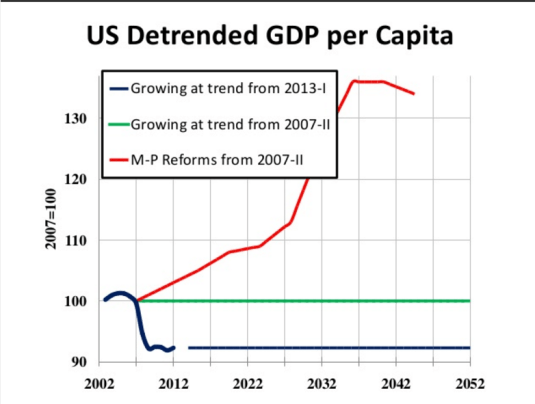
Source: Edward C. Prescott – Importance of Good Governance for Economic Prosperity.
The difference between the Prescott and Sanders plans is Prescott delivers high growth through massive supply-side reforms that include the abolition of taxes on income from capital, mandatory savings for retirement along with much lower marginal tax rates.
The Sanders plan argues that if you tax people a lot more, there is more growth, more investment, more innovation and entrepreneurship and greater labour supply. There is no historical precedent for that as an outcome from higher taxes.
In the case of Prescott, the disagreement is over how large are his growth dividends. In the case of the Sanders band, only one economist agrees that his plan will increase growth. Despite that, he is still voting for Hillary Clinton.
23 Feb 2016 Leave a comment
in applied price theory, economic history, economics of information, politics - New Zealand, Public Choice Tags: anti-foreign bias, anti-market bias, Bryan Caplan, Deirdre McCloskey, make-work bias, New Zealand Greens, New Zealand Labour, pessimism bias, rational ignorance, rational irrationality, votor demographics
Fascinating. Yawning chasm between why Labour members think they lost and why voters think they did. From @thetimes http://t.co/MvhZYI2CTr—
Joe Watts (@JoeWatts_) July 23, 2015
Left-wingers do whinge about voters not understanding; about how if only the voters understood better their arguments than they do now. The Left thinks voters just keep getting it wrong.
They do not know how lucky they are. Rational ignorance and rational irrationality are a rich harvest for the policies of Labour and the Greens.
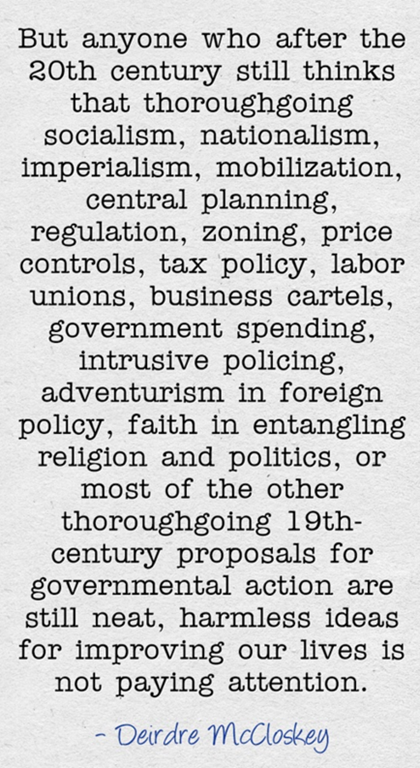
Most of the policies of Labour and the Greens are premised on cultivating the rational irrationalities of voters. These lead to Bryan Caplan’s pessimism bias, an anti-market bias, an anti-foreign bias and make-work bias:
The evidence—most notably, the results of the 1996 Survey of Americans and Economists on the Economy—shows that the general public’s views on economics not only are different from those of professional economists but are less accurate, and in predictable ways.
The public really does generally hold, for starters, that prices are not governed by supply and demand, that protectionism helps the economy, that saving labour is a bad idea, and that living standards are falling.
Politicians mindful of re-election must pander to these four biases.
Fortunately, for the New Zealand Labour Party and the Green Party of Aotearoa New Zealand, voters have no rational reason to correct these four biases. Voters are rationally irrational. As each individual counts so little, why spend any time correcting biased political beliefs?
Anti-market bias: The tendency to underestimate the benefits of the market mechanism. The typical voter equates market phenomena such as profitability and interest as examples of unbridled monetary confiscations by ‘greedy’ businesses. This biased against the market, despite all its successes, is a rich field to till for both Labour and the Greens
Anti-foreign bias: The tendency to underestimate the economic benefits of interaction with foreigners. This antagonism towards such trends as outsourcing employment overseas, or selling raw materials to faraway traders, is reminiscent of the mercantilism Adam Smith so brilliantly demolished but it still lives on today in the hearts of the voting citizenry. Labour and the Greens play to that bias shamelessly.
Make-work bias: The tendency to underestimate the economic benefits from conserving labour. Those who look to the visible face of job losses overlook the job gains (often by those who lost their jobs) to be made tomorrow in emerging industries. The Greens and Labour are sure-fire enemies of creative destruction.
Pessimistic bias: The tendency to overestimate the severity of economic problems, and to underestimate the recent past, present and future performance of the economy. In The Progress Paradox (2003), Gregg Easterbrook ridicules abundance denial:
Our forebears, who worked and sacrificed tirelessly in the hopes their descendants would someday be free, comfortable, healthy, and educated, might be dismayed to observe how acidly we deny we now are these things.
Many average voters seem to feel that Malthus was correct in diagnosing the allegedly poor prospects for the market economy.
Where would the voting base of the Greens be without a pessimism bias? They are professional pessimists and doomsday prophets from their earliest days. Labour assumes working class Tories are dupes of what is left of fading media barons such as Rupert Murdoch.

23 Feb 2016 Leave a comment
in applied price theory, fiscal policy, public economics
23 Feb 2016 Leave a comment
in applied price theory, comparative institutional analysis, constitutional political economy, economic history, economics of media and culture, economics of regulation, labour economics, macroeconomics, Marxist economics, politics - USA Tags: 2016 presidential election, antiforeign bias, antimarket bias, British politics, Leftover Left, make-work bias, rational ignorance, rational irrationality, renegade Left, Twitter left

22 Feb 2016 Leave a comment
in applied price theory, fiscal policy, labour economics, labour supply, macroeconomics, politics - USA Tags: 2016 presidential election, ageing society, cranks, demographic crisis, older workers, quackery, rational ignorance, rational irrationality
The economist costing the economic plan of a 74-year-old candidate forgot there is an ageing society in his labour force participation rate projections.
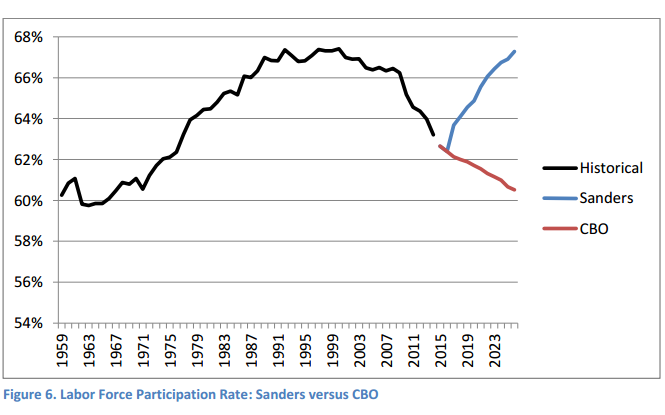
Source: Gerald Frieldman (2016).
18 Feb 2016 Leave a comment
in applied price theory, politics - New Zealand, public economics
The New Zealand Treasury understands neither who pays company taxes when capital is internationally mobile nor why Ireland was relentlessly bullied over its 12.5% company tax rate.
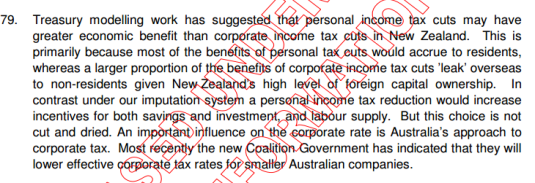
The Treasury makes the surprising claim that the benefits of company tax cuts will leak overseas to non-residents because of the high level of foreign capital ownership.
Now if New Zealand were to substantially cut its company tax rate, hell will freeze over before the Australian Treasurer rings up and say thanks mate. The Australian worry will be the loss of investment and corporate headquarters to New Zealand.
Who pays company tax when capital is internationally mobile is one of the easiest questions you can get in an economics quiz. Just trace out how investors will react to a lower company tax in New Zealand.
If company taxes are lower in New Zealand, more investment will flow into New Zealand, increasing the size of the capital stock in New Zealand and with it wages in New Zealand because New Zealand workers have more capital to work with.
When will these international capital inflows stop? It is obvious! When risk-adjusted after-tax returns equalise for internationally mobile investors. They will adjust their portfolios so that after-tax returns equalise across tax jurisdictions.
The after-tax returns are equalised by the competing tax jurisdictions having different before-tax rates of return on capital and therefore costs of capital.
Jurisdictions with high company taxes have to offer larger before-tax returns so that internationally mobile investors receive the same risk-adjusted after-tax return everywhere. High tax jurisdictions boost before tax return by wages being lower in the high tax jurisdiction.
High company taxes are paid for by the workers of the jurisdiction concerned through having to accept lower wages to work with the same amount of capital. They must compensate foreign investors by boosting before-tax returns so that their after-tax rates of return equalise across competing tax jurisdictions.
The New Zealand Treasury missed this most basic point about who pays a company tax in a globalised world. The Australian Treasury is right on top of this basic piece of economics:
The mobility of capital refers to how easily financial capital (debt and equity) flows into and out of a country. Greater capital mobility will shift more of the burden of taxation from capital to labour through larger changes in the domestic capital stock, and hence in domestic labour productivity and wages (Grubert and Mutti 1985; Gravelle 2010).
In this situation, a reduction in the company tax rate will result in large inflows of foreign capital to ensure that there is no material difference between the after tax (risk adjusted) rate of return on investment in Australia and the rate available abroad.
The many attempts at company tax harmonisation by the European Union and G20 are motivated by the fear of large capital flows into the lower tax jurisdictions.
No high-tax country views the low company taxes in Ireland, Singapore and Hong Kong as a windfall where they can raise more tax revenue on the additional dividends repatriated from lower tax jurisdictions.
Very large economies such the USA can get away with a slightly above average rates of company tax because the number of other places to go are fewer.
A small open economy such as New Zealand should safely assume that most to all of burden of the company tax is on New Zealand workers through lower wages.
Capital migrates from high-tax to low-tax locations, reducing capital-to-labour ratios in high-tax countries. The low-tax countries experience higher capital-to-labour ratios, a higher marginal product of labour, and higher wages.
I will be putting in an Official Information Act request seeking to find out whether the work of Arnold Harberger influences their company tax briefings to ministers. I will also add any work they are done on corporate inversions and the company tax rate in Ireland.
18 Feb 2016 Leave a comment
in applied price theory, fiscal policy, politics - USA
17 Feb 2016 Leave a comment
in applied price theory, labour economics, minimum wage, politics - USA, public economics

In a bizarre twist, the Economic Policy Institute is spinning one of the strongest arguments against minimum wage increases into an argument for them.
The Economic Policy Institute pointed out this week that raising the minimum wage saves billions because public assistance to low-paid workers is wound back as their wages rise.
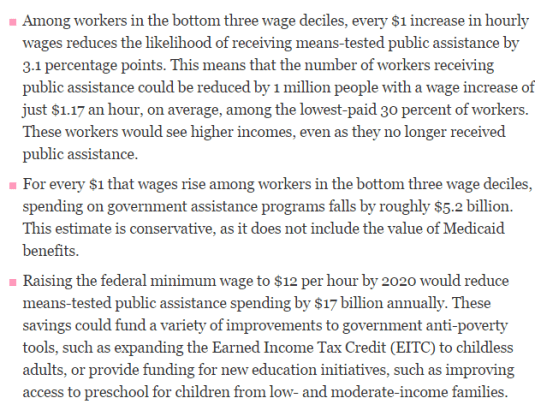
A bog standard argument against minimum wage rises is the take-home pay of low paid workers will rise by much less than the rise in labour costs to their employers.
The reason for that discrepancy between before and after-tax pay is cash and non-cash assistance from government reduces as their wages rise with the minimum wage increase.
It is pretty standard for effective marginal tax rates and low-paid workers to be high because of the many forms of assistance in cash and in-kind which they receive winds back as their wages rise.
Working Class American Families Face Marginal #Tax Rates up to 43.7% bit.ly/1IGqQqE @ScottElliotG https://t.co/zJwIfrp2pT—
Tax Foundation (@taxfoundation) January 04, 2016
There is a large literature on the labour supply effects of this winding back of family tax credits and other assistance to low-paid as their earnings increase.
The poverty trap facing welfare beneficiaries and the low-paid because of this winding back of family tax credits and other social assistance is so widely accepted that is the only time that the Left believes in supply-side economics. It is one of the reasons for their enthusiasm for a universal basic income.
Because of the interaction between wage rises and social assistance, the practical upshot is the job of the low-paid worker is put at risk by the minimum wage increase and yet their take-home pay increases by much less. Some will lose their jobs. Others will not be hired in the first place.
Jens Rushing's perfect response to #RaiseTheWage critics went viral this summer. Read it: attn.com/stories/2619/e… https://t.co/KBIM5XLKmz—
The Fairness Project (@ProjectFairness) November 06, 2015
Almost 20 years ago, Paul Krugman pondered on why supporters of the minimum wage was so adamant that their before-tax wage must increase rather than their incomes be supplemented by family tax credits and other social assistance. He asked:
…why take this route? Why increase the cost of labour to employers so sharply, which–Card/Krueger notwithstanding–must pose a significant risk of pricing some workers out of the market, in order to give those workers so little extra income? Why not give them the money directly, say, via an increase in the tax credit?
In his book review, Krugman nailed it when he concluded that the demands for a higher minimum wages about morality:
…I suspect there is another, deeper issue here-namely, that even without political constraints, advocates of a living wage would not be satisfied with any plan that relies on after-market redistribution. They don’t want people to “have” a decent income, they want them to “earn” it, not be dependent on demeaning handouts…
In short, what the living wage is really about is not living standards, or even economics, but morality. Its advocates are basically opposed to the idea that wages are a market price–determined by supply and demand, the same as the price of apples or coal.
And it is for that reason, rather than the practical details, that the broader political movement of which the demand for a living wage is the leading edge is ultimately doomed to failure: For the amorality of the market economy is part of its essence, and cannot be legislated away.
The advocates of the living wages simply offended by the notion of people earning so little. I am less kind than Krugman to this moralising.
These do-gooders are perfectly willing to put the jobs of the low-paid at risk so that they are not offended by how little they have paid.
In the finest traditions of rational irrationality and expressive voting, they simply deny they are putting jobs at risk and going into terribly convoluted arguments about how the employment effects of be small and everyone are we better off and more productive. Arguments that Paul Krugman laughed at back in 1998.
Living wage advocates are not using the low-paid for policy experiments, which would be pretty bad, they use them to make themselves feel better about the inequalities of the world. They just want to drive the sinners out of the temple come what may.
17 Feb 2016 3 Comments
in applied price theory, economics of education, human capital, income redistribution, politics - New Zealand, poverty and inequality, rentseeking
How conceited students are to complain about a $20,000 student loan when they got $1/2 million coming down the pipe. 
Source: A Degree is a smart investment | Universities New Zealand – Te Pōkai Tara.
Self-appointed social justice warriors in the New Zealand Labour Party and New Zealand Greens pander to this middle class greed. They should be ashamed of themselves.
26% of eligible students do not take out a student loan so they would really get a leg up from the abolition of tuition fees.
The median repayment time for those who left study in 2011 and remained in New Zealand was 5.8 years.
16 Feb 2016 Leave a comment
in applied price theory, discrimination, economics of media and culture, entrepreneurship, labour economics, law and economics, liberalism, politics - USA
David Henderson reminded me of the superb discussion by Milton Friedman in Capitalism and Freedom of the way in which the marketplace erodes prejudice.
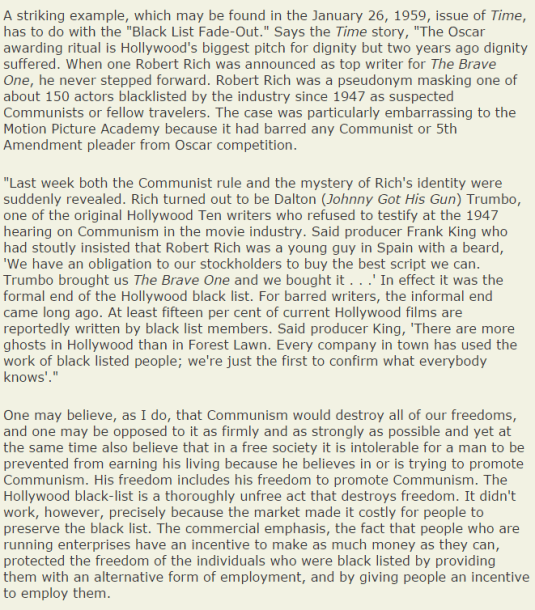
Source: Milton Friedman on Trumbo, David Henderson | EconLog | Library of Economics and Liberty.
15 Feb 2016 Leave a comment
in applied price theory, economics of regulation, entrepreneurship, labour economics, politics - USA
15 Feb 2016 Leave a comment
in applied price theory, development economics, economic history, entrepreneurship, growth miracles, human capital, industrial organisation, labour economics Tags: billionaires, China, entrepreneurial alertness, superstars, top 1%
Celebrating humanity's flourishing through the spread of capitalism and the rule of law
Celebrating humanity's flourishing through the spread of capitalism and the rule of law
Celebrating humanity's flourishing through the spread of capitalism and the rule of law
Celebrating humanity's flourishing through the spread of capitalism and the rule of law
Celebrating humanity's flourishing through the spread of capitalism and the rule of law
Celebrating humanity's flourishing through the spread of capitalism and the rule of law
Celebrating humanity's flourishing through the spread of capitalism and the rule of law
Celebrating humanity's flourishing through the spread of capitalism and the rule of law
A History of the Alt-Right
Econ Prof at George Mason University, Economic Historian, Québécois
Celebrating humanity's flourishing through the spread of capitalism and the rule of law
Scholarly commentary on law, economics, and more
Beatrice Cherrier's blog
Celebrating humanity's flourishing through the spread of capitalism and the rule of law
Celebrating humanity's flourishing through the spread of capitalism and the rule of law
Celebrating humanity's flourishing through the spread of capitalism and the rule of law
Why Evolution is True is a blog written by Jerry Coyne, centered on evolution and biology but also dealing with diverse topics like politics, culture, and cats.
Celebrating humanity's flourishing through the spread of capitalism and the rule of law
A rural perspective with a blue tint by Ele Ludemann
DPF's Kiwiblog - Fomenting Happy Mischief since 2003
Celebrating humanity's flourishing through the spread of capitalism and the rule of law
The world's most viewed site on global warming and climate change
Tim Harding's writings on rationality, informal logic and skepticism
A window into Doc Freiberger's library
Let's examine hard decisions!
Commentary on monetary policy in the spirit of R. G. Hawtrey
Thoughts on public policy and the media
Celebrating humanity's flourishing through the spread of capitalism and the rule of law
Politics and the economy
A blog (primarily) on Canadian and Commonwealth political history and institutions
Reading between the lines, and underneath the hype.
Economics, and such stuff as dreams are made on
"The British constitution has always been puzzling, and always will be." --Queen Elizabeth II
Celebrating humanity's flourishing through the spread of capitalism and the rule of law
Celebrating humanity's flourishing through the spread of capitalism and the rule of law
WORLD WAR II, MUSIC, HISTORY, HOLOCAUST
Undisciplined scholar, recovering academic
Celebrating humanity's flourishing through the spread of capitalism and the rule of law
Res ipsa loquitur - The thing itself speaks
In Hume’s spirit, I will attempt to serve as an ambassador from my world of economics, and help in “finding topics of conversation fit for the entertainment of rational creatures.”
Researching the House of Commons, 1832-1868
Reflections on books and art
Posts on the History of Law, Crime, and Justice
Celebrating humanity's flourishing through the spread of capitalism and the rule of law
Exploring the Monarchs of Europe
Cutting edge science you can dice with



Recent Comments