
@garethmorgannz dogma test: ban bikes, swimming & sugar – updated
14 Feb 2016 1 Comment
in applied price theory, applied welfare economics, economics of regulation, fiscal policy, health and safety, health economics, politics - New Zealand
Do-gooding curmudgeon Gareth Morgan takes great pride in his positions on public policy and health and safety such as a sugar tax are evidence-based.
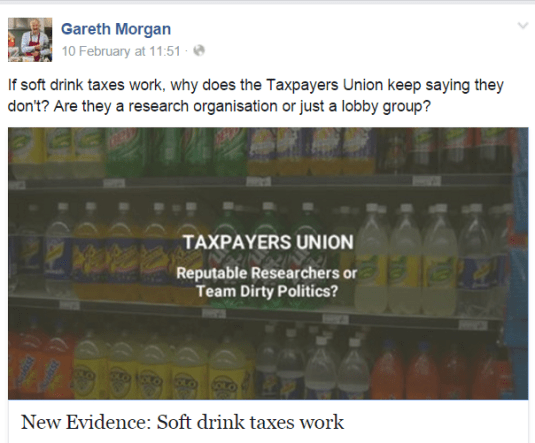
He is quick to suggest that those that disagree with them are ignorant or steeped in moral turpitude, preferably both. His offsider has even suggested that I am too dogmatic to bother arguing with. Me!
It will be a slow train coming before Gareth Morgan takes an evidence-based health and safety approach to bikes and swimming. They are dangerous activities that should be banned if he is to be consistent. Morgan is a keen motorcyclist and recently asked for exclusive access to a seaside batch.
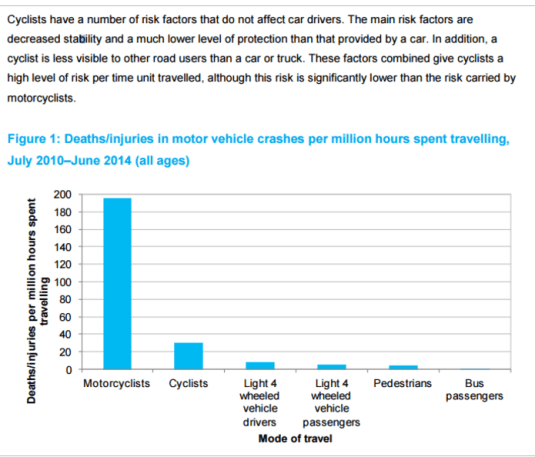
As I have previously argued, all the evidence suggests that riding a bike is dangerous. Both motorcycles and bicycles are way more dangerous than travelling by car.
Riding a motorbike and a bike should both be banned to protect motorcyclists and bicyclists from themselves. Like people who drink sugary drinks, they just do not understand the risks.
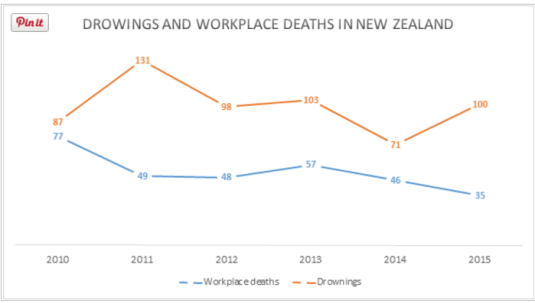
Swimming is an even more dangerous activity with multiple fatalities of a weekend common in summer. Again, people do not understand the risks of swimming both in the city and in rivers. They must be protected from themselves.
The argument that Gareth Morgan and his entourage will make in response to a demand for bans is the exact same one made against the food police.
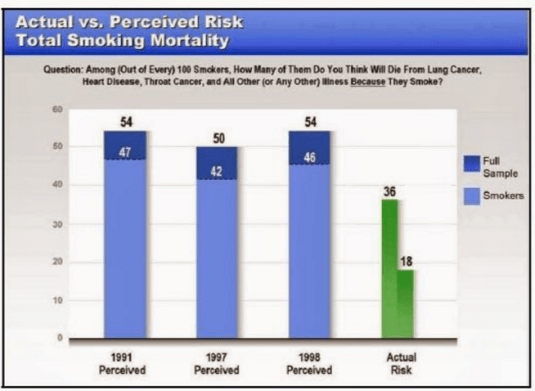
I am sure Morgan will point out that people know that riding a bike or swimming is dangerous. Even those living in a cave also know that drinking sugary drinks and having a smoke is also dangerous. Indeed, the evidence is people overestimate the risks of these socially disapproved activities rather than underestimate them.
 The argument that Morgan and his entourage would use against banning bikes, motorbikes and swimming is voluntary assumption of risk.
We live in a free society. If people want to lead a risky life, they are free to do so as long as they do not harm others.

Morgan is quick to point out the cost of the public health system of sugary drinks and other targets of the food police and the safety Nazis.

Last time I looked, bicycle and motorbike accidents resulting trips to emergency wards and other expenses to the taxpayer.
You cannot have it both ways. Arguing that the fiscal cost of sugary drinks and other roads is a rationale for regulating their consumption. That argument applies just as strongly to the case for – updated banning motorbikes, bicycles and swimming.
Until Gareth Morgan’s do-gooding extends to calling for the banning of a passion of his life, which is motorcycling, his evidence-based crusades do not have much standing.
You cannot reject voluntary assumption of risk on a selective basis especially when you engage in one of those risky activities yourself.
UPDATE: Morgan has in the past called for the insurance levy on motorbikes to reflect risk better than is the case now.
…research we’ve done at the Motorcycle Safety Advisory Council indicates that the risk of serious and expensive injury on a motorcycle is around 45 times higher per person-kilometre travelled as it is for occupants of other vehicles.
And we have a lot more bumps, scrapes and bruises per person-kilometre as well.
It gets worse. We also found that up to 31 per cent of our injuries arise from incidents involving no other vehicles. In other words we do this to ourselves because we can’t handle the road conditions.
Now of course we can blame the road as some of us are wont to do, but the reality is in most cases it’s pure incompetence or lack of self-management.
Any charging regime that gives riders an incentive to ride within their level of competence, to self-manage risk by wearing better protective clothing for example, or even lifting competency levels has to be a win-win doesn’t it?
This is not a call for a ban. Moreover, this is just a calm discussion of actuarial risk and the rampant cross-subsidies in the New Zealand universal, no fault accident compensation scheme.
Buried in at all these remarks by Morgan is people have the right to take risks and ride a bike if they want. No similar courtesy to people who like sugary drinks and those who support their right to drink and eat what they please. No similar courtesy to honest disagreement over whether a sugar tax is worth the trouble and strife.
What I must also add is the Morgan Foundation is a famous advocate of sugar taxes but a little-known advocate of actuarially fair insurance levies on motorbike. If the notoriety was the other way around, this debate would have more credibility. That is why I missed it in the first draft of this post.
 I am still waiting for Gareth Morgan to call for bans on advertising of motorbikes and bicycles to children and on children’s television because they are impressionable. Why are motorbike and bicycle ads safe for children but cigarette and junk food ads not?
Milton Friedman argued that people agree on most social objectives, but they differ often on the predicted outcomes of different policies and institutions. This leads us to Robert and Zeckhauser’s taxonomy of disagreement
Positive disagreements can be over questions of:
1. Scope: what elements of the world one is trying to understand?
2. Model: what mechanisms explain the behaviour of the world?
3. Estimate: what estimates of the model’s parameters are thought to obtain in particular contexts?
Values disagreements can be over questions of:
1. Standing: who counts?
2. Criteria: what counts?
3. Weights: how much different individuals and criteria count?
Any positive analysis tends to include elements of scope, model, and estimation, though often these elements intertwine; they frequently feature in debates in an implicit or undifferentiated manner. Likewise, normative analysis will also include elements of standing, criteria, and weights, whether or not these distinctions are recognised.
Obesity by Occupation: In US police, firefighters, & security lead the pack. #dataviz
Source: wsj.com/articles/memo-… http://t.co/fPyQGKIUMk—
Randy Olson (@randal_olson) December 18, 2014
The origin of political disagreement is a broad church in a liberal democracy. Those you disagree with are not evil, they just disagree with you. As Karl Popper observed:
There are many difficulties impeding the rapid spread of reasonableness. One of the main difficulties is that it always takes two to make a discussion reasonable. Each of the parties must be ready to learn from the other.
Feel-good policies attacking sugar in drinks will do nothing but provoke opposition and delay the day when people confront the fact that they are going to the fatter than their parents and their grandparents because they are richer.
https://twitter.com/DKThomp/status/599218426620485633
I lost 18kg after I was diagnosed with type II diabetes. Giving up sugary drinks and biscuits contributed maybe 2 kg to that weight reduction. Central to that weight production was I was well motivated.

A rise in the price of a sugary drink and the political fight over that turns friends into enemies and is a distraction from the larger cause.
https://twitter.com/DKThomp/status/698174875630989316
Greg Mankiw was on point when he said that do we really think that meddling at this micro level of sugary drinks serves any purpose and can government be trusted to micromanage our lives with pushes rather than nudges:
To what extent should we use the power of the state to protect us from ourselves? If we go down that route, where do we stop?
Taxing soda may encourage better nutrition and benefit our future selves. But so could taxing candy, ice cream and fried foods. Subsidizing broccoli, gym memberships and dental floss comes next. Taxing mindless television shows and subsidizing serious literature cannot be far behind.
Even as adults, we sometimes wish for parents to be looking over our shoulders and guiding us to the right decisions. The question is, do you trust the government enough to appoint it your guardian?
For Valentine’s Day, @ATabarrok presents I, Rose
14 Feb 2016 Leave a comment
in applied price theory, history of economic thought, industrial organisation, international economics Tags: division of labour, spontaneous order
Ten behavioural biases and effects in regulation
12 Feb 2016 Leave a comment
in applied price theory, behavioural economics, comparative institutional analysis

Source: Stephen Littlechild via Who’s Phooling Whom? – Clive Crook.
F A Hayek – Unemployment And The Free Market
12 Feb 2016 Leave a comment
in applied price theory, Austrian economics, business cycles, economic growth, F.A. Hayek, fiscal policy, job search and matching, labour economics, labour supply, macroeconomics, unemployment, unions Tags: job search, mismatch unemployment, search unemployment, union power, union wage premium, waiting unemployment
Sex differences in the minimum acceptable romantic partner
11 Feb 2016 Leave a comment
in applied price theory, economics of love and marriage, gender, labour economics
Richard McKenzie wrote a couple of papers over the last 10 years pointing out that the connection between the labour market and the marriage market will entrench the gender wage gap.
Across all cultures, good financial prospects influence female choices of a partner. Because income influences the prospects of men more than it does women in the dating and marriage market in all cultures, men have an extra incentive to work hard and an additional reward to that of women when they invest in human capital, riskier jobs and longer hours.

Seinfeld had a simpler explanation of this: men are shallow, it goes with the territory.
The only way that men will stop investing in better economic prospects as a way of winning better girlfriends and wives, is for women to lower their standards.
The response of less educated women to more and more of the better educated men and women pairing off together was to stop marrying what was left in the dating pool and have children on their own rather than drop their standards.
The only time that the left become supply-side economists
10 Feb 2016 Leave a comment
in applied price theory, Public Choice, public economics Tags: povertytraps, taxation and labour supply
Matthew Kahn on urban climate change adaptation @RusselNorman @JulieAnneGetner
10 Feb 2016 Leave a comment
in applied price theory, applied welfare economics, environmental economics, global warming, transport economics, urban economics Tags: climate adaptation
If you do not follow this guy’s blog, there is a serious gap in your education in urban and environmental economics especially with regard to climate change.
Ease of doing business in Europe, World Bank Doing Business 2016 rankings
10 Feb 2016 Leave a comment
in applied price theory, industrial organisation, law and economics, property rights Tags: doing business, EU, Europe
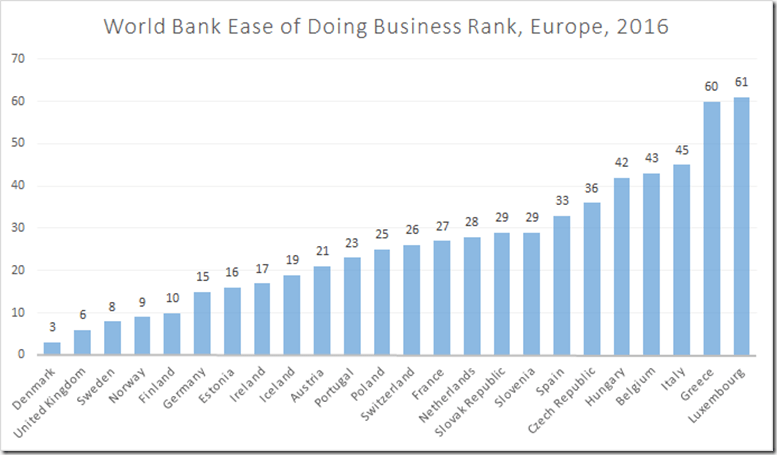
For a rich country, Luxembourg is a pretty crappy place to do business – worse than Greece. Mostly due to terrible rankings for the Luxembourg legal system. Italy is not much better.
Source: Ranking of economies – Doing Business – World Bank Group.
@NZGreens a bright future for this student in housing policy
10 Feb 2016 Leave a comment
in applied price theory, urban economics
@LivingWageUK documents the Achilles heel of the #livingwage
09 Feb 2016 1 Comment
in applied price theory, economics of bureaucracy, economics of regulation, entrepreneurship, managerial economics, minimum wage, organisational economics, personnel economics, politics - New Zealand, Ronald Coase, theory of the firm
Research publicised by a Living Wage UK highlighted the Achilles heel of any living wage proposal. This Achilles heel applies to the voluntary adoption of the living wage and a living wage mandated through minimum wage laws.
The critique to follow accepts pretty much everything claimed by the living wage movement about the benefits of the living wage but simply traces out the consequence of this one promised benefit.

Source: New evidence of business case for adopting Living Wage Living Wage Foundation.
The living wage is substantially above the minimum wage. Offering the living wage will change the composition of the recruitment pool of low-wage employers. This is the Achilles heel of the living wage which Living Wage UK documents in its study it tweeted about and from which I have taken the above snapshot.
Jobseekers would not have considered vacancies by these employers will now apply because of the living wage increase. These better calibre applicants will win those jobs ahead of the jobseekers whose current productivity levels are less than that to justify the cost of the living wage.
Central to the living wage rhetoric is that somehow employees will be more productive because of the adoption of the living wage.
The simplest way of doing that for an employer is to hire more qualified, more productive employers are no longer a hire the type of people you currently hire. They will be unemployed or pushed into the non-living wage sector of the low-wage market.
Best 2 Minimum Wage Cartoons Ever, from Henry Payne, Updated for Seattle's $15 "Economic Death Wish" @HenryEPayne http://t.co/vatUzkHMss—
Mark J. Perry (@Mark_J_Perry) August 18, 2015
A living wage is an exclusionary policy where ordinary workers, often with families who are not productive enough to produce $19.25 per hour living wage plus overheads will never be interviewed.
The workers with the type of skills that currently win those jobs covered by a living wage increase will not be shortlisted because the quality of the recruitment pool will increase because of the living wage.
There will be an influx of more skilled workers attracted by the higher wages for living wage jobs. They will go to the head of the queue and displaced workers who currently apply for and win these jobs before the adoption of the living wage.
Any extra labour productivity from paying a living wage increase is in doubt because low skilled service sectors are notorious for their low potential for productivity gains. They are the bread-and-butter of Baumol’s disease.
The modern theories of the firm focus, in part or in full on reducing opportunistic behaviour, cheating and fraud in employment relationships. The cost of discovering prices and making and enforcing contracts and getting what you pay for are central to Coase’s theory of the firm put forward in 1937.
The profits of entrepreneurs for running a firm is directly linked from their successful policing of the efforts of employees and sub-contractors to ensure the team and each member perform as promised and individual rewards matched individual contributions (Alchian and Demsetz 1972; Barzel 1987). Alchian and Demsetz’s (1972) theory of the firm focused on moral hazard in team production. As they explain:
Two key demands are placed on an economic organization-metering input productivity and metering rewards.
The main rationale in personnel economics from everything ranging from employer funding of retirement pensions to the structure of promotions and executive pay including stock options is around better rewarding self-motivating employees who strive harder and reducing the costs of monitoring employee effort.
At bottom, the efficiency wage hypothesis is entrepreneurs are unaware of the higher quality and greater self-motivation of better paid recruits for vacancies but wise bureaucrats and farsighted politicians notice these gaps in the market. Bureaucrats and politicians notice these gaps in the market before those who gain from superior entrepreneur alertness to hitherto untapped opportunities for profit do so and instead leave that money on the table.
It’s kicking the living wage movement when it is down to mention that low paid workers with families will lose a considerable part of the living wage increase because of reductions in family tax credits and in-kind assistance from the government that are linked to their pay.
Their jobs are put at risk because of a large increase in the cost of employing them to their employers. Their take-home pay after taxes, family tax credits and other government assistance increases by much less. This is a pointless gamble with job security because of the much small increase in the take-home pay of many breadwinners on the living wage.
The US presidential tax plans compared
09 Feb 2016 1 Comment
in applied price theory, politics - USA, public economics
Regulating Monopolies: A History of Electricity Regulation
09 Feb 2016 Leave a comment
in applied price theory, economic history, economics of bureaucracy, economics of religion, industrial organisation, law and economics, Public Choice, rentseeking, survivor principle Tags: competition law, electricity industry, natural monopolies, network industries

#TPPANoWay @oxfamNZ @GreenpeaceUSA The Effects of Globalization
07 Feb 2016 Leave a comment
in applied price theory, applied welfare economics, development economics, economic history, growth disasters, growth miracles, international economics, Marxist economics Tags: customs unions, expressive voting, free trade, Leftover Left, ODA, preferential trading agreements, rational ignorance, rational irrationality, The Great Escape, The Great Fact, TPA, TPPA, Twitter left, Tyler Cowen


Recent Comments