I, Pencil Extended Commentary: Creative Destruction
19 Dec 2015 Leave a comment
in applied price theory, economic history, entrepreneurship, industrial organisation, survivor principle, technological progress Tags: creative destruction, division of labour, entrepreneurial alertness, IPencil, specialisation and exchange, The meaning of competition
Labour productivity growth in the New Zealand retail services confounds Baumol’s cost disease
17 Dec 2015 Leave a comment
in applied price theory, economic history, industrial organisation, managerial economics, market efficiency, organisational economics, personnel economics, politics - New Zealand, survivor principle Tags: Baumol's disease, labour productivity
@jacindaardern the role of drug addiction in poverty and unemployment
16 Dec 2015 Leave a comment
in applied price theory, labour economics, labour supply, politics - New Zealand, poverty and inequality, unemployment
Jacinda Adern does have a point that the Prime Minister overplayed the role of drug dependency in child poverty, but he is not completely off the mark. A whole bunch of self-destructive behaviours play a role in family poverty.

Source: Minister of Social Development Cabinet Paper on Pre-employment Drug Testing Requirements.
Too many children have irresponsible parents. Caplan along with Charles Murray point out that a number of pathologies are particularly prevalent among poor:
-
alcoholism: Alcohol costs money, interferes with your ability to work, and leads to expensive reckless behaviour.
-
drug addiction: Like alcohol, but more expensive, and likely to eventually lead to legal troubles you’re too poor to buy your way out of.
-
single parenthood: Raising a child takes a lot of effort and a lot of money. One poor person rarely has enough resources to comfortably provide this combination of effort and money.
-
unprotected sex: Unprotected sex quickly leads to single parenthood. See above.
-
dropping out of high school: High school drop-outs earn much lower wages than graduates. Kids from rich families may be able to afford this sacrifice, but kids from poor families can’t.
-
being single: Getting married lets couples avoid a lot of wasteful duplication of household expenses. These savings may not mean much to the rich, but they make a huge difference for the poor.
-
non-remunerative crime: Drunk driving and bar fights don’t pay. In fact, they have high expected medical and legal expenses. The rich might be able to afford these costs. The poor can’t.
Caplan is disputing that healthy adults who are poor are victims. That is central to the poverty is not a choice movement: the poor are victims.
The New Zealand experience with work testing of beneficiaries for drugs is most of them quickly stopped using dope. Many jobs have tests for drug-taking.
Why do @fightfor15 @LivingWageNZ @LivingWageUK aim so low?
16 Dec 2015 1 Comment
in applied price theory, labour economics, Marxist economics, minimum wage, politics - New Zealand, politics - USA, poverty and inequality Tags: expressive voting, Leftover Left, living wage
The average age of managers as a cause of the 1970s productivity slowdown
16 Dec 2015 Leave a comment
in applied price theory, business cycles, labour economics, labour supply, macroeconomics, occupational choice, personnel economics, theory of the firm
Jim Feyrer put forward a clever hypothesis about the sudden decline in the average quality of managers as a major contributor to the 1970s productivity slowdown. His hypothesis is a good contribution to real business cycle theory because what could be more random a shock than a demographic shock arising from the baby boom.
Feyrer’s hypothesis builds on Robert Lucas’s theory of the entrepreneur and the optimal size of the firm. The better entrepreneurs can manage larger spans of control.
Specifically, these more talented entrepreneurs can spread their skills and vision over a larger workforce thereby raising its productivity and that of the firm. Better quality managers are better trainers, better leaders, better problem solvers and better at recruiting and retaining staff.
If managerial skill and talent accumulates with experience, an influx of young workers into the workforce with the influx of the baby boomers into the workforce will lower the average quality of entrepreneurs. This will show up empirically as a decrease in the average age of managers and with that their experience and skills.
With the average age of the labour force lower during the influx of the baby boomers, more marginal managers have to be promoted into managerial positions to supervise younger employees. Lower managerial quality will lower the productivity of the workforce as a whole.
If managerial talent and skill is to have any meaning, a more talented manager should be able to extract greater productivity from the same quality labour force. Lazear points out that
Supervision and management are fundamental in personnel economics and in the theory of the firm… Boss effects are large and significant. Most important, bosses vary substantially in their quality. A very good boss increases the output of the supervised team over that supervised by a very bad boss by about as much as adding one member to the team.
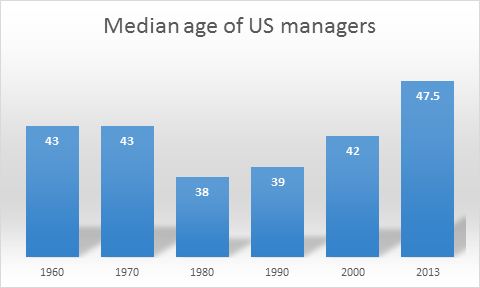
The influx of less able managers in the 1970s, as shown by a five-year reduction in the median age of US managers in the chart below, accounted for 20% of the observed productivity slowdown and resurgence in the 1970s and 1980s according to Feyrer. To fill vacancies, employers had to drop their hiring standards for managers.
Source: Jim Feyrer The US Productivity Slowdown, the Baby Boom, and Management Quality, Journal of Population Economics (2011) and Bureau of Labor Statistics Employed persons by detailed occupation and age (2013).
When the median age of managers rose in the 1990s, and along with it the average of quality of management, this productivity slowdown was reversed. Both the increase in the decrease in the age of managers are random productivity shocks in the tradition of real business cycle theory.
The average age of the US manager was 38 in 1980 and 39 in 1990. There is no US managerial occupation with an average age of less than 40 in 2013. The fifth managerial occupation with the lowest managing age is food service managers. The highest outside of agriculture is chief executives,

Source: Bureau of Labour Statistics Employed persons by detailed occupation and age (2013).
One of the mocking tones directed at real business cycle theory is it was supposed to require a regular forgetting of technologies so that productivity fell and then the loss technologies were remembered a few years later to have a business cycle.
That forgetting and remembering is what happened with the average age of managers and labour productivity in the 1970s. Management quickly lost five years of experience then slowly regained it with matching productivity swings and roundabouts.
Feyrer is another addition to a long line showing that business cycles can arise from the sum of random shocks, rather than one big shock, as Prescott suggested in 1986:
Another Summers question is, Where are the technology shocks? Apparently, he wants some identifiable shock to account for each of the half dozen postwar recessions. But our finding is not that infrequent large shocks produce fluctuations; it is, rather, that small shocks do, every period.
@donal_curtin @smalltorquer Does competition law in high-tech markets help consumers?
14 Dec 2015 2 Comments
in applied price theory, economics of regulation, Gary Becker, industrial organisation, politics - New Zealand, politics - USA, Sam Peltzman Tags: Aaron Director, anti-trust law, cartels, competition law, creative destruction, entrepreneurial alertness, merger law enforcement, offsetting the, The fatal conceit, unintended consequences
New Zealand has decriminalised cartels. Price fixers cannot be sent to prison but can still be fined. Some agree, some disagree with the wisdom of this move.
Those that agreed with the wisdom of this move were christened cartel apologists by one of those that disagree with the removal of criminal penalties for cartels.
There is an infallible rule in competition law enforcement. It arises mostly crisply in merger law enforcement. If competitors oppose a merger, the merger must be pro-consumer. If the merger is anti-competitive, that merger will increase prices. The competing firms can follow those prices up and profit from the weakening of competition.
Under the collusion hypothesis, rivals of the merging firm benefit since there is a higher probability of successful collusion limits output and raises product prices. The share prices of these rival firms should increase in anticipation of enhanced cartel profits. As Eckbo explains:
Using Stigler (1964) theory of oligopoly, a horizontal merger can reduce the monitoring costs by reducing the number of independent producers in the industry. The fewer the members of the industry the more “visible” are each producers actions, and the higher is the probability of detecting members who try to cheat on the cartel by increasing output.
When was the last time an entrepreneur complained about his rivals putting their prices up? The entrepreneur can either match that price increase or undercut it to win more business. The real reason competitors oppose a merger is the merged firm will have lower costs, making it a fiercer competitor.

If the share prices of competitors fall on news of the merger, they are worse off as a result because they face a fiercer competitor. If their share prices rise, that suggests either that others in the industry are to benefit from higher prices or rival firms will soon replicate the cost savings discovered in the course of the merger. The latter is the information effect of mergers:
…since the production technologies of close competitors are (by definition) closely related, the news of a proposed efficient merger can also signal opportunities for the rivals to increase their productivity
Mergers are a high-risk way of securing higher prices unless there are offsetting cost saving of combining the two firms. Mergers disturb previously efficient firm sizes and risk diseconomies of scale and a burgeoning corporate hierarchy. A cartel is a safer way to raise prices by jointly agreeing to restrict output.

Cartels have few redeeming features. Cartels are inherently unstable because the history of cartels is the history of double-crossing. The best place in a cartel is to be on the outside undercutting it slightly to sell as you can at inflated cartel price.
The complication with cartels is competitors must sometimes coordinate their activities with their rivals in various ways such as agreeing product standards, undertaking joint ventures or licensing technologies to them.
Criminalisation of cartels may deter these business practices that promote consumer welfare. The process of innovation in new industries in particular often involves successful firms taking over the unsuccessful firms.
Serial competition is common in rapidly innovating industries with one dominant firm making hay for a while then quickly swept away. Merger law enforcement agencies do not handle the wake of creative destruction well.

There is no more cutthroat market than Hollywood. Yet the movie industry is riddled with collusion and joint ventures. Actors and producers can be collaborating on one film and also be making another film that will be its rival in the box office when released.
The movie industry would not work without this incestuous mix of competition and collaboration. Joint ventures are aplenty between otherwise direct competitors in the film industry. When do these joint ventures become cartels threatened with criminal penalties?
What should be another working rule in competition law enforcement is when there is reasons to stay your hand, that is usually a good idea even if you do not have the reasons worked out yet. When in doubt, stay your hand.
It goes back to that extremely famous 1984 essay by Frank Easterbrook on the limits of anti-trust law. The essay was about errors in competition policy and law enforcement:
- When a competition law enforcer makes a mistake and closes off an efficiency enhancing practice or stops a pro-consumer merger, there are few mechanisms to correct this mistake; and
- If a competition law enforcer inadvertently does not stop a anti-competitive merger or lets a collusive or inefficient practice get through, at least there is market processes that will slowly chip away at his mistake.
Easterbrook argued that courts and enforcers should craft liability and procedural rules to minimise the sum of competition law’s error and decision costs:
The legal system should be designed to minimize the total costs of (1) anticompetitive practices that escape condemnation; (2) competitive practices that are condemned or deterred; and (3) the system itself
Competition law enforcers and policymakers made plenty of errors in the past. Chastened by their follies aplenty in the past, competition law policymakers should not approach any issue with overconfidence. They have had a dismal track record in aligning competition law with applied price theory and the basics of the economics of industrial organisation.
That is at best only a good start for the competition law enforcement agencies. This is because the economics of industrial organisation spent a lot of time condemning practices that neither restricted output or increased prices.
It took many decades for consumer welfare to be the exclusive goal of competition. Time and again protecting competitors from competition was the priority of competition law enforcement agencies.

The ICT revolution coincided with a revolution in competition law economics and policy. That revolution consisted of basing competition law on applied price theory and not condemning every novel or as yet unexplained practice.
In the high-tech industries, competition law runs a high risk of chilling innovation. As Joshua Wright said:
Innovation is critical to economic growth. Incentives to innovate are at the heart of the antitrust enterprise in dynamically competitive industries, and, thus, getting antitrust policy right in high-tech markets is an increasingly important component of regulatory policy in the modern economy. While antitrust enforcement activity in high-tech markets in the United States and the rest of the world is ever-increasing, there remain significant disputes as to how to assess intervention in dynamically competitive markets.
The relentless pursuit of Microsoft by the US Department of Justice at the behest of its competitors such as Netscape is notorious example of the chilling of innovation.
You are showing your age if you even remember who Netscape was. Its complaint was that Microsoft by giving away its browser was engaging in predatory competition.

Netscape want to protect consumers from the scourge of lower prices – from not having to pay $49 for the Netscape browser. You are showing your age if you have ever paid to install a browser.
Netscape had the advantage of a senior US senator representing the state where it was based. He happened to sit on the committee overseeing the budget of the US Anti-trust enforcement agencies.

We are still waiting for the day when Microsoft finishes giving away its browser, excludes competition from the market for browsers, jacks up its price to make up for a good 20 years of giving away its browser and is not immediately threatened by new entry.
Facebook is now worth more than Walmart
buff.ly/1fuvV7V h/t @DKThomp
$FB $WMT buff.ly/1fuvSZB http://t.co/FtIIJP3EGN—
Ninja Economics (@NinjaEconomics) June 22, 2015
The intrepid competition law enforcers of the 1990s did not anticipate a business model where competitors profitably give their product away.
Thankfully, Facebook did not face competitors who charged for their social media. If Facebook had faced such competition, what would the US Department of Justice thought of this anti-competitive practice of giving social media away. The scourge of lower prices again. That great bugbear of competition law enforcement agencies.
10 years ago today Facebook was founded by Mark Zuckerberg and his college friends http://t.co/IVFDFvu2VM—
History Pics (@HistoryPixs) February 04, 2014
Facebook is doing the exact same thing that Microsoft did when it gave away the Internet Explorer browser. To this day, competition law enforcement agencies including the New Zealand Commerce Commission do not accept lower prices to be lawful in all cases without exception.

A test of how imbibed you are with the fatal conceit about competition law is to cast your mind back as to what your attitude was to the Department of Justice anti-trust lawsuit against Microsoft.
If you thought the anti-trust lawsuit against Microsoft was well-founded, you are an optimist about the efficient scope of competition law. To quote McKenzie and Shughart:
Microsoft’s critics come far closer to the mark when they complain that Microsoft has been “brutally competitive” than when they claim Microsoft is a “monopoly.” From our perspective, it appears that once again the Justice Department is using the antitrust laws to thwart competition by a highly successful American firm. To protect unsuccessful competitors, it is squelching competition.
A long time has passed since that suit. People can reflect upon the extent to which Microsoft have successfully monopolised browsing the Internet. It hasn’t. As Gary Becker said:
Anti trust policy should recognize that dynamic competition is often a powerful force when static competition is weak. The big policy question then is whether it is worthwhile to bring expensive and time consuming anti trust cases against still innovating firms that have considerable profits and monopoly power, given the significant probability that new competitors will before long greatly erode this power through different products? I believe the answer to that is no, and that policy should often rely on dynamic competition, even when that allows dominant firms only temporarily to enjoy economic power.
The law and economics of competition has been a bit of a glass house for the last 50 years. People should be careful about criticising new idea and attempts to be more modest about the positive contribution the competition law makes to society.
Competition law can subvert competition by stymieing the introduction of new goods and the temporary monopoly often necessary to recoup their invention costs and induce innovation. Sam Peltzman, when reflecting on the contributions of Aaron Director to the law and economics of competition said:
There are the myriad of ways in which real world business practices behave differently from the caricaturing in textbooks. Those differences sometimes arouses suspicious responses from economists. Visions of market power and deadweight loss triangles dance their heads, and some of the suspect practices have been constrained by anti-trust policy. Director rejected this kind of intellectual laziness, and he sought, sometimes successfully, to inoculate those around him against it.
Director approached all business practices with the methodology that entailed asking very basic questions and answering them in a rigorous logic that it appealed ultimately to facts. The style was verbal – some combination of Socratic dialogue and Adam Smith. This style had the disadvantage of producing few closed-form solutions. But it had the advantage of permitting analysis of the kind of problems that eluded simple solutions.
Indeed I believe that one reason for Director’s lasting influence he was able to show that simple judgements about business practices often cannot withstand rigorous scrutiny.
Economic theory and empirical evidence are full of examples of business conduct that reduce choice but increase consumer welfare through lower prices, more innovation, or higher quality products and services. Manne and Wright noted in the paper, Innovation and the Limits of Antitrust that:
Both product and business innovations involve novel practices, and such practices generally result in monopoly explanations from the economics profession followed by hostility from the courts (though sometimes in reverse order) and then a subsequent, more nuanced economic understanding of the business practice usually recognizing its pro-competitive virtues.
Competition law enforcement agencies are suing Google because it is anti-competitive. The dead hands of the competitors to Google are buried somewhere in those suits. Is there no learning. There is certainly no modesty about past mistakes about the proper scope of competition law.

Are CEOs denied their labour surplus?
11 Dec 2015 Leave a comment
in applied price theory, entrepreneurship, fisheries economics, human capital, industrial organisation, labour economics, labour supply, managerial economics, occupational choice, organisational economics, personnel economics, survivor principle Tags: CEO pay, moral hazard, promotion tournaments, superstar, superstar wages
Bang Dang Nguyen and Kasper Meisner Nielsen looked at how share prices reacted to 149 cases of the chief executive or another prominent manager dying suddenly in American companies between 1991 and 2008.
If the shares rise on an executive’s death, he was overpaid; if they fall, he was not. Only 42% of the bosses studied were overpaid. Those with the bigger pay packages gave the best value for money as measured by the share-price slump when they passed away unexpectedly.
Share prices do speak to the value of the company and the contribution of its CEO. The share price of Apple went up and down by billions on the back of rumours about the health of Steve Jobs.
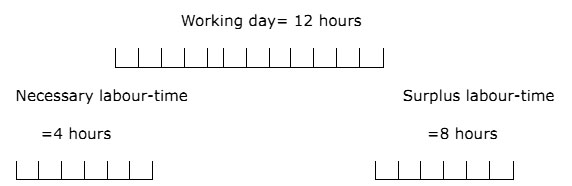
In terms of splitting of what some call the labour surplus increase from a firm hiring an executive, these employees retain on average about 71% and their employer keeps 29%. Others call this rent sharing.

71% going to the CEO might initially sound high, “but it’s not like he’s taking home more than he produced for the company,” says Nguyen.

The exploitation of CEOs gets worse when you consider the extensive use of promotion tournaments by their employers when setting their wages. They are thrust into rat races. Promotion tournaments are an integral and often invisible part of their workplaces.
Executive level employees are often ranked by their employers relative to each other and promoted not for being good at their jobs but for being better than their rivals. These promotion tournaments sent one employee against another – one worker against another – to the profit of the owners of the firm.
The rat race set up by the owners of the firm are so cutthroat that in competitions to determine promotions the capitalists who own the firm may find that their employees discover that the most efficient way of winning a promotion is by sabotaging the efforts of their rivals.
Lazear and Rozen’s tournament theory of executive pay has stood the test of time. The key to this rat race is the larger is your boss’s pay, the bigger the motivation for you as an underling to work for a promotion. As Lazear wrote in his book, Personnel Economics for Managers
The salary of the vice president acts not so much as motivation for the vice president as it does as motivation for the assistant vice presidents.
The coalition of obsolete industries needs your support
10 Dec 2015 Leave a comment
in applied price theory, economic history, entrepreneurship, industrial organisation, survivor principle
The obvious reason for the popularity of behavioural economics
10 Dec 2015 Leave a comment
in applied price theory, behavioural economics, comparative institutional analysis, economics of bureaucracy, Public Choice, rentseeking Tags: expressive voting, rational ignorance, rational irrationality, special interests

The minimum wage increases the gender wage gap at the bottom
09 Dec 2015 1 Comment
in applied price theory, discrimination, economic history, gender, minimum wage, politics - New Zealand, politics - USA
Geoff Simmons is one of many to argue that the gender wage gap is smaller at the bottom end of the labour market because of the minimum wage. For example, the explanation of the Economic Policy Institute for greater gender pay equality at the bottom is the minimum wage:
The minimum wage is partially responsible for this greater equality among the lowest earners—it sets a wage floor that applies to everyone, which means that people near the bottom of the distribution are likely to make more equal wages. Also, low-wage workers are disproportionately women, which means that the minimum wage particularly bolsters women’s wages.
This is plainly wrong as a question of economic theory and political history. One effect of minimum wages is it lowers the cost of discrimination against the employment of less-preferred workers. Since the employer has to pay the minimum wage hour no matter whom he hires, the cost of discriminating on the basis of sex or race is less.
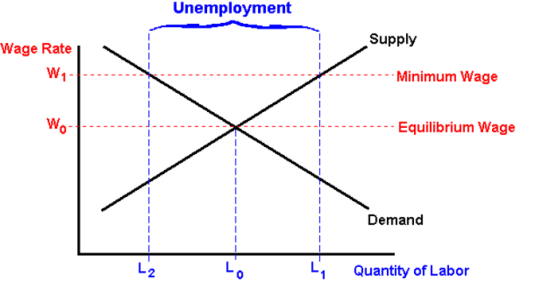
That is why South African whites at the beginning of and all through the apartheid era demanded that blacks be paid the minimum wage: they wanted to cheapen the cost of discrimination.
Minimum wages were initially introduced in the USA shortly after 1900 solely for women and children. The express aim was to price women out of jobs and raise men’s wages by enough so that they could provide for their families.
Tim Leonard in Protecting Family and Race The Progressive Case for Regulating Women’s Work showed that these women-only minimum wages were justified by political progressive including women on grounds that they would:
(1) Protect the biologically weaker sex from the hazards of market work;
(2) Protect working women from the temptation of prostitution;
(3) Protect male heads of household from the economic competition of women; and
(4) Ensure that women could better carry out their eugenic duties as “mothers of the race.”
These days some argue that minimum wages actually increase employment. Times change, and the slopes of supply and demand curves for labour must change with them.
If there is a minimum wage, the cost to employers of indulging their conscious prejudices or an unconscious bias are less. This is because a minimum wage set above the market clearing wage will cause unemployment. Because jobs must be rationed, the costs of indulging a prejudice or succumbing to an unconscious bias are reduced and along with that the market mechanisms that wear down discrimination by employers.
Part of the explanation of the gender wage gap is interruptions in labour force participation because of motherhood reduces the time available to them for job shopping. The first 10 to 15 years of most careers, most working lives, is spent job shopping.
Job shopping is where wages grow through the accumulation of search capital. By moving between 6 to 10 jobs in their first 10 to 15 years in the workforce, a worker finds better and better matches for their skills and talents. They worked their way into the better paying job simply because they have had more time to find a good job match between the changing array of vacancies and their idiosyncratic set of skills and work history.
Great quote on the cruelty of the minimum wage from Nobel economist Vernon Smith, illustrated by Henry Payne https://t.co/Lwch51acEY—
Mark J. Perry (@Mark_J_Perry) October 24, 2015
The minimum wage frustrates this job shopping by denying some women their initial stepping stone into the labour market both when they are a teenager and when they are returning from time spent caring for children. This is in addition to the minimum wage increasing the gender wage gap from reducing the costs of discrimination to employers.
The minimum wage reduces women’s opportunities to get a foothold in the labour market and build on that foothold through job shopping.
Are women just too smart to be computer scientists?
08 Dec 2015 Leave a comment
in applied price theory, discrimination, economics of education, gender, human capital, labour economics, managerial economics, occupational choice, organisational economics, personnel economics, politics - Australia, politics - New Zealand, politics - USA Tags: economics of personality traits, gender wage gap, reversing gender gap


Women started drifting away from computer science in the mid-1980s. The interpretation put forward by the professional grievance industry, that is, by National Public Radio in the USA is:
The share of women in computer science started falling at roughly the same moment when personal computers started showing up in U.S. homes in significant numbers.
These early personal computers weren’t much more than toys. You could play pong or simple shooting games, maybe do some word processing.
And these toys were marketed almost entirely to men and boys. This idea that computers are for boys became a narrative. It became the story we told ourselves about the computing revolution. It helped define who geeks were, and it created techie culture.
 Source: NPR
Another interpretation is there are systematic differences between teenage boys and teenage girls in verbal and written skills. Young women moved away from enrolling in computer…
View original post 224 more words
Rejoinder to @geoffsimmonz and Jess Berentson-Shaw on are we all sexists – Part 1
07 Dec 2015 1 Comment
in applied price theory, discrimination, econometerics, gender, job search and matching, labour economics Tags: Armen Alchian, Gary Becker, gender wage gap, unconscious bias
Morgan Foundation researchers Jess Berentson-Shaw and Geoff Simmons were good enough to write a long reply to my recent post on the role of unconscious bias in the gender wage gap. My post was in reply to a Friday whiteboard session by Geoff Simmons.
I thought the best way to start is to summarise their reply in terms of how my rejoinder will be structured:
- There is a persistent, known but unexploited entrepreneurial opportunity for pure profit arising from employers not hiring women on merit because of an unconscious bias against them. This unconscious bias among employers against women explains 20-30% of the gender wage gap. Most of the rest of that gap is due to factors such as differences in occupation and education.
- The gender wage gap is smaller at the bottom of the labour market because of the minimum wage.
- The gender wage is smaller in the middle than at the top of the labour because of “far more standard contracts in the middle”. I take this to mean recruiting firms set a hiring standard and make a wage offer. This does not mean they have a free hand in their wage posting. A higher wage offer attracts better qualified applicants. Posting a low wage attracts fewer candidates that meet their hiring standard from other jobs and from the ranks of the unemployed. The available evidence suggests that one-third of job matches are based on wage bargaining and two-thirds through wage posting. Wage posting is more common in larger firms, the public sector and where there is collective bargaining. Wage bargaining is more profitable for occupations and jobs with a high dispersion in workers’ skills and productivity and in tighter labour markets.
- The gender pay gap is largest for the top 10% of female wage earners because “… what scientific evidence supports the argument that better paid women have the ability to negotiate pay & conditions better? The very fact that there is a consistent and large gap between highly paid men and women suggests that where MORE negotiation, discretion, more complex selection processes are involved the more women are discriminated against”. The available evidence is wage posting is less common the more skilled is the worker. It pays to invest more in scrutinising recruits against hiring standards and to consider offer matching when the wage is higher for applicants and for employees threatening to quit. The payoff from a longer job search is greater the higher is the wage. There is a greater chance of higher skilled jobseeker of finding a better paid match between their more idiosyncratic skills and backgrounds in vacancies elsewhere or which might appear later. Low skilled jobseekers invest less in job search because one vacancy is frequently as good as another in their occupational and industry labour markets. The higher skilled are also more geographically mobile than the low skilled and more likely to live in cities and earn the urban wage premium.
- “Better paid professional women may have more options than lower paid women but they still have fewer than their male equivalents.” I take this to mean the greater the ability of workers to move from employer to employer, the better are they paid. Women have a weaker average attachment to the labour market. The human capital interpretation of this is woman and mothers in particular have lower productivity because they have spent less time accumulating on-the-job human capital. In the search and matching interpretation, women have less search capital. Workers start out as job shoppers: the longer a worker shops around, the more likely after a succession of job matches that they chance upon better paying job and occupational matches. Women through career interruptions for motherhood spend less time in the labour market, accumulate less search capital and are therefore are paid less. Women find it harder to work their way into the better-paying job matches.
- “Removing unconscious bias requires cultural change and will take time to resolve but it is possible to do with concerted effort.” This as example of what Adam Smith called the overweening conceit of youth.
My reply to the original Friday whiteboard session by Geoff Simmons relied on invisible hand explanations. Nozick argued that invisible hand explanations of social phenomena must have a filter and an equilibrating mechanism.
Geoff Simmons’ hypothesis about the gender wage gap is an invisible hand explanation: 20-30% of the gender wage gap is driven by unconscious bias. There could be no greater an invisible hand than an unconscious one.
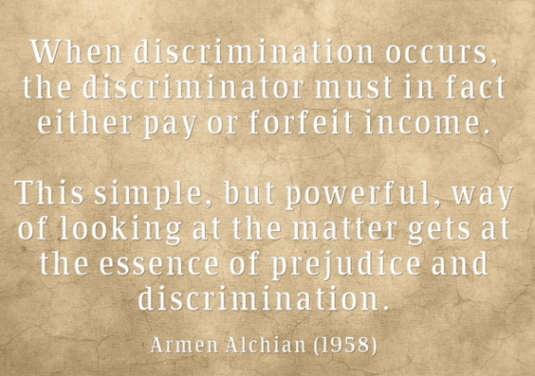
There must be a mechanism in Geoff Simmons’ hypothesis that guides market participants to not hire and not promote women on merit. Not hiring on merit forfeits profit. There must be a filter that penalise hiring on merit.
The market has a filter and an equilibrating mechanism that constitute its invisible hand. The equilibrating mechanism – the mechanism that prompts people to hire on merit – is price signals. Prices are a signal wrapped in an incentive. If prices go up, buy less and look for other options, if they go down, buying more is profitable. The filter, which is more of an invisible punch than an invisible hand, is profits and losses. Higher costs, lower profits, loss of market share, insolvency and bankruptcy drive out the entrepreneurs who fail to hire on merit.
Entrepreneurs that hire on merit are more likely to survive in market competition than those that do not. Entrepreneurs must adapt or die.
There is no similar institutional filter in Geoff Simmons hypothesis to ensure that not hiring on merit is the unintended outcome from the decentralised behaviour of countless employers and job seekers trying to improve their own circumstances. Self-interested employers are not prompted by price signals to not hire on merit. More importantly, their chances are surviving in market competition are increased rather than are reduced if employers resist the temptations arising from their unconscious biases against women.
This institutional context is the reverse of what should be for unconscious bias against women to survive in market competition as suggested by Geoff Simmons. Firms that hire on merit should have a lower probability of survival, not a higher chance of staying in business if the unconscious bias hypothesis is to prevail in the face of market competition.
Geoff Simmons and Jess Berentson-Shaw is they didn’t address my extensive comments about the market as an evolutionary process. They did not explain how market competition would not penalise employers who fail to hire on merit for any reason including unconscious bias. That is the fundamental flaw, a fatal flaw in their reply to my comment on their Friday whiteboard session.
Most of all, Geoff Simmons and Jess Berentson-Shaw succumb to what Robert Nozick christened normative sociology. This is the study of what the causes of social problems ought to be.

For Geoff Simmons and Jess Berentson-Shaw, the gender wage gap ought not be the result of the conscious choices of women making the best they can do what they have. The gender wage gap must be the result of the bad motivations of employers and other external forces. The bad motivations must be unconscious because conscious prejudice is rare these days.
The unconscious bias hypothesis suffers from the same floors as the occupational crowding and occupational segregation hypotheses. Neither the unintentional bias hypothesis nor the occupational crowding and segregation hypotheses have a filter and an equilibrating mechanism that guides employers into make unprofitable choices about hiring. These hypotheses must explain how unconsciously biased employers survive in competition with less unconsciously biased employers.
Central to Gary Becker’s theory of prejudice based discrimination is competition in the market will slowly wear down prejudice-based discrimination in the same way that it drives out any other practices inconsistent with profit maximisation and cost minimisation. Profit maximisation gets no respect in the theory of unconscious bias and the gender wage gap put forward by Geoff Simmons and Jess Berentson-Shaw.
If there are sufficient number of less unconsciously biased employers, there will be segregation. Some employers will hire a large number of women because they have the pick of the crop and will be more profitable to boot at least in the short run.
The more unconsciously biased employers will have a large number of men working for them and will be less profitable and more likely to fail. At worst, men and women will be paid to same but most women will work for these less unconsciously biased employers. The possibility of labour market segregation rather than gender wage gap was not considered in the unconscious bias hypothesis.
Unconscious bias is a preference-based explanation of the gender wage gap. The young are the last to notice the rapid social change that came before them. Cultural and preference based explanations underrate the rapid social change in the 20th century. As Gary Becker explains:
… major economic and technological changes frequently trump culture in the sense that they induce enormous changes not only in behaviour but also in beliefs. A clear illustration of this is the huge effects of technological change and economic development on behaviour and beliefs regarding many aspects of the family.
Attitudes and behaviour regarding family size, marriage and divorce, care of elderly parents, premarital sex, men and women living together and having children without being married, and gays and lesbians have all undergone profound changes during the past 50 years. Invariably, when countries with very different cultures experienced significant economic growth, women’s education increased greatly, and the number of children in a typical family plummeted from three or more to often much less than two.
Goldin (2006) showed that women adapted rapidly over the 20th century to changing returns to working and education as compared to options outside the market. Their labour force participation and occupational choices changed rapidly into long duration professional educations and more specialised training in the 1960s and 1970s as many more women worked and pursued careers. The large increase in tertiary education by New Zealand after 1990 and their move into many traditionally male occupations is another example.
The main drivers of the gender wage gap are unknown to recruiting employers such as whether a would-be recruit is married, how many children they have, whether their partner is present to share childcare, how many of children are under 12, and how many years between the births of children. Spacing out the births is a major driver of the gender pay gap but this information is unknown to employers when hiring. As Polachek explains:
The gender wage gap for never marrieds is a mere 2.8%, compared with over 20% for marrieds. The gender wage gap for young workers is less than 5%, but about 25% for 55–64-year-old men and women. If gender discrimination were the issue, one would need to explain why businesses pay single men and single women comparable salaries. The same applies to young men and young women.
One would need to explain why businesses discriminate against older women, but not against younger women. If corporations discriminate by gender, why are these employers paying any groups of men and women roughly equal pay? Why is there no discrimination against young single women, but large amounts of discrimination against older married women?
… Each type of possible discrimination is inconsistent with negligible wage differences among single and younger employees compared with the large gap among married men and women (especially those with children, and even more so for those who space children widely apart).
The main drivers of the gender wage gap are of no relevance to entrepreneurs making a profit. These findings are devastating to the notion that there is some sort of discrimination against women on the demand side of the labour market.
Employers lack the necessary information to implement any unconscious bias they might have against women in fact is mainly a bias against older women and mothers and mothers in particular the space out the births of their children. The emergence of the gender wage gap is through the supply-side choices of women because employers lack the necessary information to drive the emergence of a gender pay gap.
The career cost of a family is central to the emergence and size of the gender pay gap because it leads to self-selection on the supply-side in terms of human capital to mitigate the cost of careers breaks.
The gender gap is fairly minor before the age of 30. The female full-time employment rate drops by 10 percentage points after women enter their 30s before recovering by the time women reach the age of 50 (Johnston 2005). The gender wage gap also widens between the ages 35 to 64 when women are raising children; the biggest gap is for the ages of 44 to 44; a wage gap of 22 per cent (MWA 2010). The first child is estimated to reduce New Zealand female earnings by 7 per cent and second child reduces earnings by 10 per cent (Dixon 2000, 2001).
This self-selection of females into occupations with more durable human capital, and into more general educations and more mobile training that allows women to change jobs more often and move in and out of the workforce at less cost to earning power and skills sets. Chiswick (2006) and Becker (1985, 1993) then suggest that these supply side choices about education and careers are made against a background of a gendered division of labour and effort in the home, and in particular, in housework and the raising of children. These choices in turn reflect how individual preferences and social roles are formed and evolve in society.
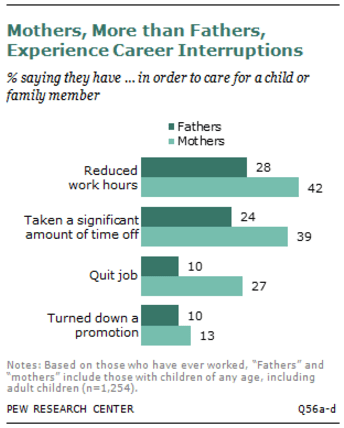
Source: On Equal Pay Day, key facts about the gender pay gap | Pew Research Center.
Tiny differences in comparative advantage such as in child rearing immediately after birth can lead to large differences in specialisation in the market work and in market-related human capital and home production related work and household human capital (Becker 1985, 1993). These specialisations are reinforced by learning by doing where large differences in market and household human capital emerge despite tiny differences at the outset (Becker 1985, 1993).
Many women choose educational and occupational paths that give them more control over their hours worked, and lowers the cost of time spent on maternity leave and the associated depreciation of skills during career breaks and reduced hours (Polachek 1978, 1981; Bertrand, Goldin and Katz 2010; Katz 2006; Sasser 2005). Women over the entire run of the 20th century often end up in jobs that reduced the career cost of a family and rapidly changed their plans when new opportunities emerge (Katz 2006).
The prospect of children drives the early choices of women on education and occupations. Careers requiring continuous commitment, long hours and great sacrifices do not attract and retain as many women (Bertrand, Goldin and Katz 2010; Goldin 2006). Goldin and Katz (2011) found that differences in the reductions on the cost of career breaks was a major driver in the influx of women into previously male dominated occupations.
The key is what drives the rapid changes in the labour force participation and occupational choices of women. Some of the factors are global technology trends such rising wages and the emergence of household technologies and safe contraception and antidiscrimination laws. All of these increased the returns to working and investing in specialised education and training.
Up until the mid-20th century, women invested in becoming a teacher, nurse, librarian or secretary because these skills were general and did not deprecate as much during breaks. When expectations among women of still working at the age of 35 doubled, there were massive increases in female labour force participation and female investments in higher education and specialised skills (Goldin and Katz 2006).
In summary, Geoff Simmons and Jess Berentson-Shaw put forward an invisible hand explanation of the residual in the gender wage gap that lacks that all-important invisible punch. There is no market mechanism which penalises employers who rise above their unconscious bias against women to hire on merit. The invisible hand rewards employers that hire on merit with higher profits and penalises those that indulge a bias of whatever origin. The invisible hand consists of an invisible finger and an invisible punch. The invisible finger points the way forward through price signals; the invisible punch slaps down those entrepreneurs whose attentions wander from their bottom line when deciding who to hire and promote.
Part two of this reply will address the particulars of the reply of Geoff Simmons and Jess Berentson-Shaw. In particular, the search and matching aspects of their explanation and whether we are all sexists.
@suemoroney more generous maternity leave increases the gender wage gap @JanLogie
07 Dec 2015 Leave a comment
in applied price theory, discrimination, economics of love and marriage, gender, labour economics, labour supply, law and economics, occupational choice, politics - New Zealand Tags: do gooders, expressive voting, female labour force participation, gender wage gap, maternal labour supply, maternity leave, The fatal conceit, unintended consequences

Source: Why Are Women Paid Less? – The Atlantic.
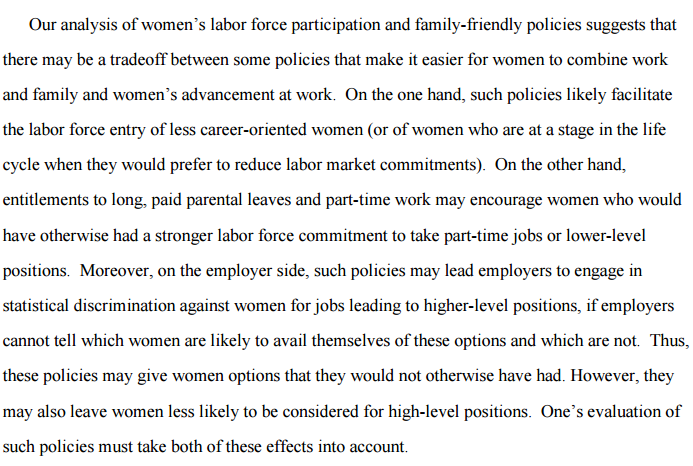
Source: AEAweb: AER (103,3) p. 251 – Female Labor Supply: Why Is the United States Falling Behind?


Recent Comments