Mises on entrepreneurs and consumer sovereignty
21 Sep 2015 Leave a comment
in applied price theory, Austrian economics, economic history, industrial organisation, Ludwig von Mises, survivor principle Tags: competition and monopoly, consumer sovereignty, creative destruction, entrepreneurial alertness, market selection, The meaning of competition
Stigler on economics as a big tent @RusselNorman @NZGreens @GreenpeaceNZ @Mark_J_Perry
21 Sep 2015 1 Comment

The dangerous left-wing bias of economists strikes again
21 Sep 2015 2 Comments
in applied price theory, budget deficits, business cycles, economics of regulation, history of economic thought, occupational choice, politics - USA
The left-wing bias of economists must be taken into account in public policy-making. Any suggestions to regulate the economy, spend our way out of a recession, increase the top tax rate and so on must be discounted for that well-known but little publicised political bias.
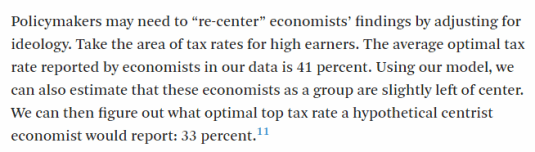
Source: Economists Aren’t As Nonpartisan As We Think | FiveThirtyEight
As is not well-known enough, Cardiff and Klein (2005) used voter registration data to rank disciplines at Californian Ivy League universities by Democrat to Republican ratios. Economics is the most conservative social science, with a Democrat to Republican ratio of a mere 2.8 to 1. This can be contrasted with sociology (44 to 1), political science (6.5 to 1) and anthropology (10.5 to 1). 40% of Americans are Democrats, 32% are independents with the balance Republicans.

Zubin Jelveh, Bruce Kogut, and Suresh Naidu confirmed that bias: that the typical economist is a moderate Democrat. They found a 60–40 liberal conservative bias

Jelveh, Kogut, and Naidu also reminded, as many have before them that economics is the most politically diverse of academic professions. Sociology is a notorious left-wing echo chamber as an example. Their most likely view of Jeremy Corbyn is he is a bit of a Tory. Oddly enough, sociologists are the first to point the finger at economists for political bias.

Jelveh, Kogut, and Naidu correlated political donations of more than $200 in the Federal Elections Commission database with the language used in 18,000 journal articles back to the 1970s.

More interestingly, they correlated political bias with the estimates of quantitative effects such as the top tax rate and its impact on labour supply and investment:
We found a (significant) correlation when we compared the ideologies of authors with the numerical results in their papers. That means that a left-leaning economist is more likely to report numerical results aligned with liberal ideology (and the same is true for right-leaning economists and conservative ideology)… liberals think the fiscal multiplier is high, meaning the government can improve economic growth by increasing spending, while conservatives believe the multiplier is close to zero or negative.
They are not suggesting a rigging of the results. Economists tend to sort into the fields that suit their ideologies:
It’s more likely that these correlations are driven by research areas and the methodologies employed by economists of differing political stripe. Economics involves both methodological and normative judgments, and it is difficult to imagine that any social science could completely erase correlations between these two… macroeconomists and financial economists are more right-leaning on average while labour economists tend to be left-leaning. Economists at business schools, no matter their specialty, lean conservative. Apparently, there is “political sorting” in the academic labour market.
Before you start writing out the indictment that economic policy and the global financial crisis is the product of a vast left-wing conspiracy within the economics profession you should remember the wise words of George Stigler.
Stigler argued that ideas about economic reform needed to wait for a market. He contended that economists exert a minor and scarcely detectable independent influence on the societies in which they live. As is well known, Stigler in the 1970s toasted Milton Friedman at a dinner in his honour by saying:
Milton, if you hadn’t been born, it wouldn’t have made any difference.
Stigler said that if Richard Cobden had spoken only Yiddish, and with a stammer, and Robert Peel had been a narrow, stupid man, England would have still have repealed the Corn Laws in the 1840s. England would still have moved towards free trade in grain as its agricultural classes declined and its manufacturing and commercial classes grew in the 1840s onwards because of the industrial revolution.
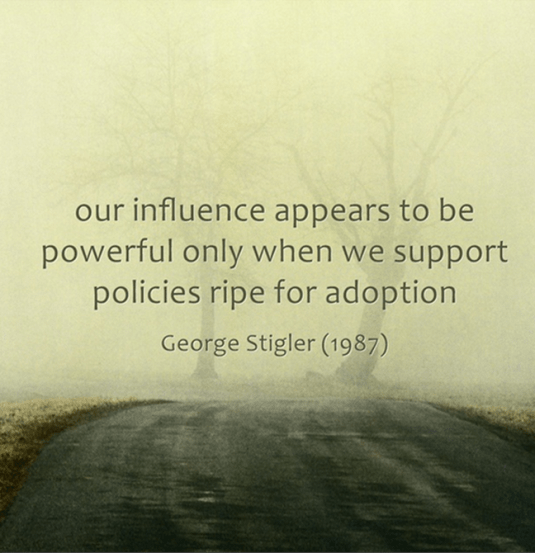
As Stigler noted, when their day comes, economists seem to be the leaders of public opinion. But when the views of economists are not so congenial to the current requirements of special interest groups, these economists are left to be the writers of letters to the editor in provincial newspapers. These days, they would run an angry blog.
Socialism is destroying the Amazon basin
19 Sep 2015 Leave a comment
in applied price theory, property rights, resource economics Tags: Amazon basin, deforestation, privatisation, public ownership
Robert Hare on treating psychopaths @EricCrampton @ATabarrok @ryanhmurphy
17 Sep 2015 Leave a comment
in applied price theory, economics of crime Tags: cognitive psychology, crime and punishment, criminal deterrence, economics of personality traits, psychiatry, psychopaths, Robert Hare, social psychology

@DavidLeyonhjelm on deregulating the Australian labour market
17 Sep 2015 1 Comment
in applied price theory, economic history, economics of regulation, industrial organisation, job search and matching, labour economics, minimum wage, survivor principle, unions Tags: Australia, employment law, employment protection law, federalism, labour market deregulation, labour market regulation, union power, unions
Creative destruction in psychic powers
17 Sep 2015 Leave a comment
in applied price theory, economic history, industrial organisation, survivor principle Tags: conjecture refutation, copyright, cranks, creative destruction, intellectual property rights, quackery, superstitions
The herd immunity role of #vaccinations explained
16 Sep 2015 Leave a comment
in applied price theory, applied welfare economics, health economics, politics - New Zealand, public economics Tags: Anti-Science left, anti-vaccination movement, best shot public goods, cheap riders, common law, free-riders, good shot public goods, herd immunity, measles, New Zealand Greens, public goods, quackery, tort law, vaccinations, vaccines
Some public goods can be not provided much at all if even a few do not contribute – free ride. These are called weakest shot public goods. The link in the chain is only as strong as the weakest link for some public goods. The fighting against communicable diseases is an example of that.

The classic example given by that brilliant applied price theorist Jack Hirschleifer is a dyke or a levee wall around a town. It is only as good as the laziest person contributing to its maintenance on their part of the levee wall. Vicary (1990, p. 376) lists other examples:
Similar examples would be the protection of a military front, taking a convoy across the ocean going at the speed of the slowest ship, or maintaining an attractive village/landscape (one eyesore spoils the view).
Many instances of teamwork involve weak-link elements, for example moving a pile of bricks by hand along a chain or providing a theatrical or orchestral performance (one bad individual effort spoils the whole effect.)
Another example of weakest shot public goods is community cooperation after disasters. The quality of the public good provided is equal to the contribution of the weakest person who may start a criminal rampage despite the good efforts of everyone else.
 People tend to be more cooperative after natural disasters. They realise their contribution is more important than normal to the maintaining of the social fabric which is currently hanging by a thread.

Vaccinations are example of a weakest shot public good. The quality of herd immunity depends fundamentally on just about everybody contributing by getting vaccinated. Not all public goods depend on the some of those contributions made. In some cases just a few people choosing to free ride can greatly undermine the public interest.
The reverse of a weakest shot public good is best shot public goods. Example of this is the development of vaccines themselves. The public good is only as good as the best effort at developing the new vaccine with all the others efforts pointless because the best of the vaccines is chosen.
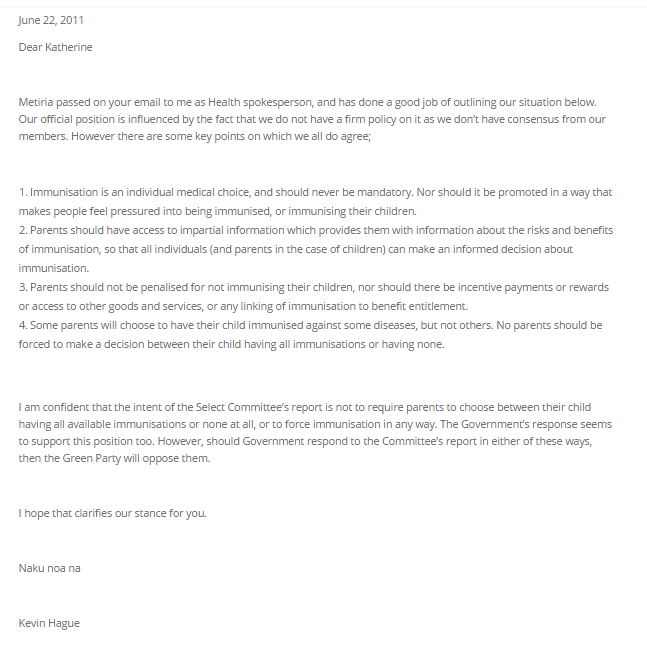
The most curious people in New Zealand to oppose measures to address the under provision of weakest shot public goods are the New Zealand Greens.
https://twitter.com/KevinHague/status/642505850360213505
The Greens are usually the 1st to stress the importance of communities working together for the common good.
https://twitter.com/KevinHague/status/642530277177192448
Herd immunity protects those who cannot be safely vaccinated including new babies, those for whom the vaccine fails, which occasionally happens, and those with compromised immunity such as adults receiving chemotherapy.
Deliriously hot @guardian sim shows why anti-measles jabs help protect your whole community gu.com/p/45f7e/stw http://t.co/H31ZKbXkqg—
Info=Beautiful (@infobeautiful) February 05, 2015
We are all in this together. It is time for the New Zealand Greens to stop pandering to those are only think of themselves and what a free ride on others including the very sick and new babies.

Source: NOVA | What is Herd Immunity?
Herd immunity requires vaccination rates of about 94%. The near universal vaccination rates required for herd immunity are to smaller margin to pander to an awkward squad who do not want to vaccinate despite the harm they do to others.
Harm to others is grounds and has always been grounds for public policy and public health interventions. Instead, the Greens are anti-science, anti-public health.
Measles is the most contagious disease known to man. Seven children died in New Zealand in the last measles outbreak in 1991. The dead are already too many from the anti-vaccination quacks and cranks.
Hayek on the division of knowledge
15 Sep 2015 Leave a comment
in applied price theory, Austrian economics, economics of information, F.A. Hayek, industrial organisation, survivor principle Tags: capitalism and freedom, competition as a discovery procedure, The meaning of competition, The pretence to knowledge
The most dangerous monopoly: When caution kills
13 Sep 2015 Leave a comment
in applied price theory, applied welfare economics, economics of bureaucracy, economics of regulation Tags: adverse selection, Competition as a discovery, drug lags, moral hazard, The meaning of competition
Hayek explains the inexplicable value of capitalism and traditions
13 Sep 2015 Leave a comment
in applied price theory, applied welfare economics, comparative institutional analysis, constitutional political economy, F.A. Hayek, liberalism Tags: capitalism and freedom, market selection, spontaneous order, The meaning of competition

Is sociology really irrelevant in policy debates?
03 Sep 2015 Leave a comment
in applied price theory, applied welfare economics, comparative institutional analysis, constitutional political economy, economics of bureaucracy, economics of media and culture, income redistribution, labour economics, occupational choice, Public Choice, rentseeking Tags: compensating differentials, evidence-based policy, media bias, offsetting behaviour, public intellectuals, sociology, The fatal conceit, The pretence to knowledge, unintended consequences
Is sociology really irrelevant in policy debates? @familyunequal does a better job with the #s blog.contexts.org/2015/01/25/soc… http://t.co/c4E25DTCmm—
(@SocImages) February 04, 2015


Recent Comments