How they resolved spats before Twitter existed
thepoke.co.uk/2015/07/26/res… http://t.co/a04CTYT2aX—
The Poke (@ThePoke) July 27, 2015
There is an economic literature on feuds and duelling
07 Aug 2015 Leave a comment
in applied price theory, comparative institutional analysis, economic history, economics of media and culture Tags: adverse selection, asymmetric information, competition as a discovery procedure, duals, feuds, game theory, moral hazard, screening, signalling
I’m worried! I’m sympathising with organic farmers over a land use conflict!
06 Aug 2015 1 Comment
in applied price theory, applied welfare economics, economics of regulation, industrial organisation, law and economics, politics - New Zealand, property rights, Public Choice, rentseeking, Richard Epstein, survivor principle Tags: common law, economics of agriculture, food snobs, green rent seeking, land use conflicts, land use planning, law of nuisance, noise pollution, nuisance, old common law, organic farming, Richard Epstein, William Blackstone, zoning
Writing this blog of sound mind and sober disposition, I still have considerable sympathy with two organic farmers over a land use conflict they have with the neighbouring gun range.

Local land use regulations allows a gun club to set up 600 m away with competitive shooting days all day for 88 days a year. That is a voluntary self restraint. They could hold shooting competitions every day of the year. The local land use regulations allow the use of guns on rural land. The gun club used this absence of a prohibition on the use of guns in the frequency of use to set up a gun range to fire guns all day long on rural land.

Now here is the rub. There something wrong with the concept of quiet enjoyment of your land if a neighbour can fire off a large amount of noises continuously. The occasional noise, the occasional gunshot yes, but all day? I live near the airport, but I knew it was there when we bought the property and the lands was a little cheaper because of that.
The organic farmers are unusually pristine and prissy about what they want by neighbours to protect the sacredness of their more expensive snob food. I’m not too sure whether they would want to grant their neighbours an equal right to unusual land uses such as opening a gun range. That said, the organic farmers do have a point about a very noisy neighbouring land use that can be heard some distance away.
The organic farmers, of course, could have negotiated with their neighbours for covenants to restrict land use that undermine there are unusually pristine requirements for quiet enjoyment of their land and their neighbours land too. Easy to do when the land is first unused, but once economic activity accumulates, not so easy in terms of transaction costs and hold-outs.

The Left opposed airline deregulation
05 Aug 2015 Leave a comment
in applied price theory, applied welfare economics, comparative institutional analysis, economic history, economics of regulation, entrepreneurship, income redistribution, industrial organisation, politics - Australia, politics - New Zealand, politics - USA, Public Choice, rentseeking, survivor principle Tags: airline deregulation, antimarket bias, bootleggers and baptists, expressive voting, Leftover Left, rational ignorance, rational irrationality
CHART: US average airfares 1979 to 2014 measured in number of hours work at the average wage. @chartoftheday http://t.co/q7Phz3VkU0—
Mark J. Perry (@Mark_J_Perry) August 02, 2015
An internal inconsistency in certain leading conspiracy theories
05 Aug 2015 Leave a comment
in applied price theory, comparative institutional analysis, economics of bureaucracy, economics of media and culture, health economics, Public Choice, rentseeking Tags: antiscience left, climate alarmism, conspiracy theories, conspiracy theorists, GMOs, political psychology
North and South Korea in the 20th century
03 Aug 2015 Leave a comment
in applied price theory, applied welfare economics, comparative institutional analysis, constitutional political economy, development economics, economic history, economics of bureaucracy, growth disasters, growth miracles, income redistribution, Marxist economics, Public Choice, rentseeking Tags: central planning, North Korea, South Korea
Some basics about opinion polls and polling results
03 Aug 2015 Leave a comment
in applied price theory, econometerics, Public Choice Tags: data mining, media bias, opinion polls, sampling errors, statistics, voter demographics
Common mistakes in polling and poll results, from PhD Comics…. phdcomics.com/comics.php http://t.co/JIvuPqFVRs—
(@SocImages) August 02, 2015
Has Africa Outgrown Development Aid?
03 Aug 2015 Leave a comment
in applied price theory, development economics, economic history, economics of bureaucracy, growth disasters, growth miracles, Public Choice, rentseeking Tags: Africa, capitalism and democracy, capitalism and freedom, rule of law, The Great Fact
Deirdre McCloskey’s speech on ‘Bourgeois Dignity’
03 Aug 2015 Leave a comment
in applied price theory, applied welfare economics, comparative institutional analysis, constitutional political economy, economic history, entrepreneurship, industrial organisation, law and economics, property rights, survivor principle Tags: Deirdre McCloskey, entrepreneurial alertness, industrial revolution, The Great Enrichment, The Great Fact

Using Enron to explain Bedford’s law of forensics statistics
02 Aug 2015 Leave a comment
in applied price theory, economics of crime, law and economics Tags: Benford's law, crime and punishment, forensics statistics
Some frauds are sometimes easier to uncover. For example, in a recent Iranian presidential election, the governing candidate led by 2 to 1 votes all night. Next to no variation despite returns coming in from the more liberal cities and the rather conservative country ballot boxes.
Bedford’s law is used to uncover fraud through peculiarity in the occurrence of numbers. The law states that in many naturally occurring collections of numbers, the small digits occur disproportionately often as leading significant digits such as the number one.
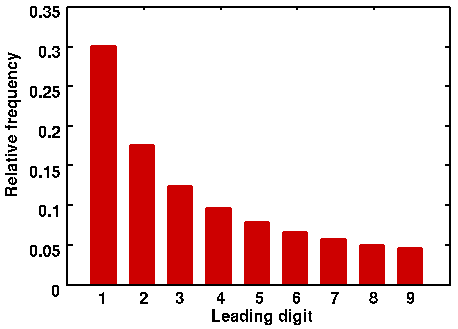
In the finest traditions of Stephen Stigler’s law of scientific epiphany, Benford was the second person to discover it and he got credit for it rather than the first (Simon Newcomb) by undertaking a proper analysis:
Newcomb didn’t provide any sort of explanation for his finding. He noted it as a curiosity, and in the face of a general lack of interest it was quickly forgotten.
That was until 1938, when Frank Benford, a physicist at the general electric company, noticed the same pattern. Fascinated by this discovery, Benford set out to see exactly how well numbers from the real world corresponded to the law. He collected an enormous set of data including baseball statistics, areas of river catchments, and the addresses of the first 342 people listed in the book American Men of Science.
Benford observed that even using such a menagerie of data, the numbers were a good approximation to the law that Newcomb had discovered half a century before.
About 30% began with 1, 18% with 2 and so on. His analysis was evidence for the existence of the law, but Benford, also, was unable to explain quite why this should be so.
If someone tries to falsify numbers, they will have to invent some data. They use too many numbers starting with digits in the mid range, 5,6,7 and not enough numbers starting with 1. This violation of Bedford’s Law, suggesting the possibility such as at Enron.
The alternative to orchestrating a vast conspiracy
02 Aug 2015 1 Comment
in applied price theory, economic history, health economics Tags: conspiracy theories, GMOs, moon landing
The fates of two islands under constant threat from a neighbouring military colossus
01 Aug 2015 Leave a comment
in applied price theory, applied welfare economics, Austrian economics, comparative institutional analysis, constitutional political economy, development economics, economics of media and culture, economics of regulation, growth disasters, growth miracles, income redistribution, industrial organisation, law and economics, liberalism, Marxist economics, property rights, Public Choice, rentseeking, survivor principle Tags: anticapitalist mentality, antimarket bias, capitalism and freedom, China, Cuba, expressive voting, Hong Kong, Leftover Left, public intellectuals, rational ignorance, rational irrationality, Twitter left
Cumulative Growth in Average Inflation-Adjusted After-Tax Income by Before-Tax Income Group, 1979 to 2011 with 1% annual adjustment for inflation measurement bias
01 Aug 2015 Leave a comment
in applied price theory, applied welfare economics, economic history, politics - USA Tags: CPI bias, living standards, measurement errors, The Great Enrichment
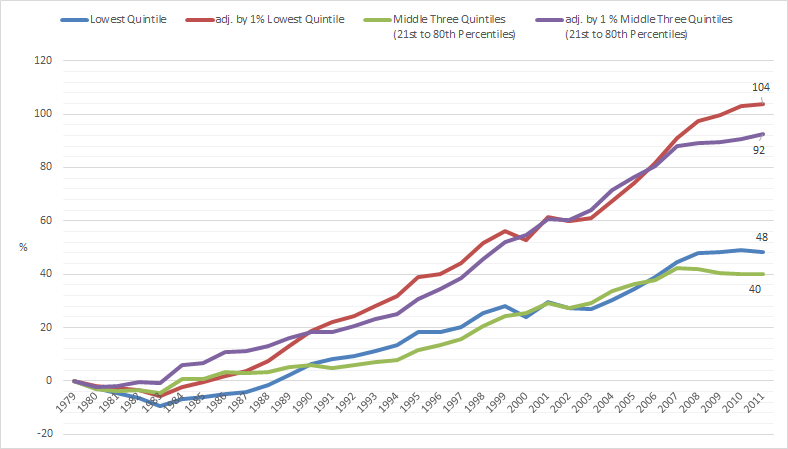
The Congressional Budget Office did its best to adjust after-tax incomes for inflation between 1979 in 2011. In figure 1, I added an extra 1% inflation adjustment in every year from 1979. 1% per annum is a common estimate of the inflation bias introduced by the inability of most measures of inflation to account for new goods and upgrades in the quality of existing goods to name but a few bias is in the measurement of consumer price inflation.
Figure 1: Cumulative Growth in Average Inflation-Adjusted After-Tax Income, by Before-Tax Income Group, USA, 1979 to 2011, 1% upward annual adjustment for inflation bias for new goods and quality upgrades
Source: derived from Congressional Budget Office, The Distribution of Household Income and Federal Taxes, 2011.
As can be seen from figure 1, with a 1% up left for measurement bias, instead of increases of 48% and 40% in the incomes of the lowest quartile in the middle three quartiles respectively, their after-tax, after inflation incomes about doubled since 1979.
"The rich got richer, true. But…" —@DeirdreMcClosk buff.ly/1Imdv4o http://t.co/M3ERx3JTIn—
HumanProgress.org (@humanprogress) June 28, 2015
Well done, capitalism. Everyone was on a working class income in the 1970s is now on a middle-class income. Such are the joys of compounding 1% per year over more than 30 years.
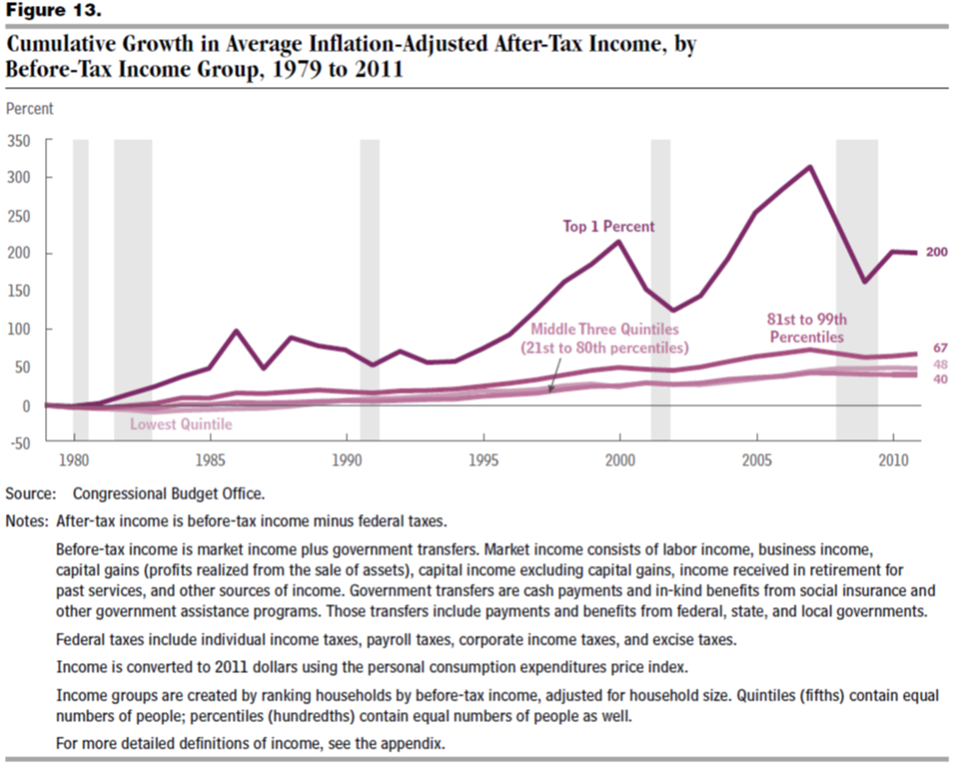
Source: Congressional Budget Office, The Distribution of Household Income and Federal Taxes, 2011.
The original Congressional Budget Office diagram above with the higher income quartiles is presented for comparison. I didn’t present the top quartiles in figure 1 because it made it unreadable because of the dominant influence of the top 1%’s increase in income.
The lesson for the day is small inaccuracies in the measurement of prosperity can over several decades through compounding lead to massive misunderstandings of the increases in prosperity.
Trigger warning for the Twitter Left
31 Jul 2015 Leave a comment
in applied price theory, applied welfare economics, constitutional political economy, income redistribution, politics - Australia, politics - New Zealand, politics - USA, Public Choice, public economics, rentseeking Tags: antimarket bias, endogenous growth theory, expressive voting, laffer curve, Leftover Left, taxation and entrepreneurship, taxation and human capital, taxation and investment, taxation and the labour supply, top 1%, Twitter left


Recent Comments