

via The funny, surprisingly successful tactic some police are using to catch drug dealers – Vox.
Celebrating humanity's flourishing through the spread of capitalism and the rule of law
15 Aug 2015 2 Comments
in applied price theory, economics of bureaucracy, economics of crime, history of economic thought, industrial organisation, law and economics, liberalism, Milton Friedman, Public Choice Tags: cartel theory, crime and punishment, criminal deterrence, organised crime, war on drugs
15 Aug 2015 Leave a comment
in applied price theory, economics of information, economics of media and culture, environmental economics, global warming Tags: climate change, conjecture and refutation, global warming, philosophy of science, political psychology
by Andy West
Climate culture versus knowing disbelief.
View original post 2,438 more words
15 Aug 2015 Leave a comment
in applied price theory, applied welfare economics, comparative institutional analysis, constitutional political economy, economics of bureaucracy, Public Choice Tags: Catholic Church, The fatal conceit, The pretense to knowledge
What’s the greatest economic tragedy in modern history?
The obvious answer is communism, which produced tens of millions of needless deaths and untold misery for ordinary people. 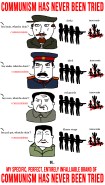 Just compare living standards in North Korea and South Korea, or Chile and Cuba.
But if there was a second-place prize for the world’s biggest economic failure, Argentina would be a strong contender.
Here’s one fact that tells you everything you need to know. In 1946, when Juan Perón came to power, Argentina was one of the 10-richest nations in the world. Economic policy certainly wasn’t perfect, but government wasn’t overly large are markets generally were allowed to function. Combined with an abundance of natural resources, that enabled considerable prosperity.
But Perón decided to conduct an experiment in statism.
Here’s how Wikipedia describes his economic policy.
Campaigning among workers with promises of land, higher wages, and social security, he won…
View original post 630 more words
15 Aug 2015 Leave a comment
in applied price theory, development economics, economic history, industrial organisation, politics - USA, public economics, rentseeking, survivor principle Tags: Puerto Rico
(Co-authored with Ben Zipperer. Posted at Washington Center for Equitable Growth)
Puerto Rico today faces a serious debt crisis, recently defaulting on a bond payment. The proximate cause is a slowdown in economic growth since the mid-2000s, which has reduced tax revenues, and a declining labor market, where employment growth has been mostly in the red since 2007.
There are many explanations for the economic downturn and the resulting fiscal crisis, but some commentators have incorrectly blamed the island’s high minimum wage. To be sure, the federal minimum wage—which has applied to Puerto Rico since 1983—is much more binding there than it is on the mainland. Because hourly wages are substantially lower in Puerto Rico compared to the U.S. mainland, the federal minimum wage policy affects more of the workforce there. In 2014, for example, the federal minimum wage stood at 77 percent of the median hourly wage in Puerto Rico…
View original post 117 more words
15 Aug 2015 Leave a comment
in applied price theory, applied welfare economics, economic history, entrepreneurship, industrial organisation, survivor principle Tags: antimarket bias, entrepreneurial alertness, superstar wages, superstars, top 0.1%, top 1%, top wage earners
How many of the richest Americans inherited their fortune? Find out. buff.ly/1DNM3g2 http://t.co/QlarE5yAdT—
HumanProgress.org (@humanprogress) August 14, 2015
15 Aug 2015 Leave a comment
in applied price theory, applied welfare economics, international economics, liberalism Tags: antiforeign bias, expressive voting, John Stuart Mill, protectionism, rational ignorance, rational irrationality, tariffs and quotas
14 Aug 2015 Leave a comment
in applied price theory, income redistribution, labour economics, politics - New Zealand, poverty and inequality, Public Choice, public economics Tags: child poverty, Director's Law, family poverty, family tax credits, welfare state
One group with negative net tax liability is low- to middle-income households with dependent children. For example, single-earner families with two children can earn up to around $60,000 pa before they pay any net tax.
Around half of all households with children receive more in welfare benefits and tax credits than they pay in income tax.

13 Aug 2015 Leave a comment
in applied price theory, applied welfare economics, economic history, economics of media and culture, income redistribution, labour economics, politics - New Zealand, poverty and inequality, Public Choice Tags: capitalism and freedom, Leftover Left, The Great Enrichment, The Great Fact, top 1%, Twitter left
Bill Rosenberg at the Council of Trade Unions was good enough to tweet a Treasury chart that shows next to no increases in inequality in New Zealand for at least 20 years.
A brief history of inequality-from Treasury paper Fig4. Note Employment Contracts Act,GST,income tax,benefit cuts,WFF http://t.co/y4w3cUsgjD—
Bill Rosenberg (@WJRosenbergCTU) June 27, 2015
Inequality in both market and disposable incomes has been stable for a good 20 years, as the above tweet shows, while inequality in consumption has been falling. To back this interpretation of mine up, coincidentally today Bryan Perry published his annual report on income and inequality under the banner of the Ministry of Social Development.

His report showed that there be no significant increase in New Zealand in at least 20 years.
13 Aug 2015 Leave a comment
in applied price theory, applied welfare economics, Austrian economics Tags: competition is a discovery procedure, market process, The meaning of competition
12 Aug 2015 Leave a comment
in applied price theory, applied welfare economics, environmental economics, global warming, politics - Australia, politics - New Zealand, politics - USA, Public Choice, rentseeking Tags: Australia, China, climate alarmism, climate change treaties, free-riders, game theory, global warming, international free riders, international public goods, public goods
12 Aug 2015 Leave a comment
The anti-hunting choir has a lot to answer for. #auspol http://t.co/2FGgC11VZp—
David Leyonhjelm (@DavidLeyonhjelm) August 17, 2015
 Zimbabwe has its ban on lion, leopard and elephant hunting that it imposed after the illegal killing of the beloved “Cecil the Lion” by Minnesota Dentist Walter Palmer. Hunting companies were told that they could start to line up wealthy trophy hunters again for bag the big game. In the meantime, conservationists have come forward to defend trophy hunting as a needed source of revenue for these parks.
View original post 165 more words
11 Aug 2015 Leave a comment
in applied price theory, applied welfare economics, comparative institutional analysis, development economics, growth disasters, growth miracles, health and safety, human capital, industrial organisation, international economics, labour economics, survivor principle Tags: agricultural economics, expressive voting, fair trade, rational irrationality
10 Aug 2015 1 Comment
in applied price theory, applied welfare economics, comparative institutional analysis, currency unions, economic growth, economic history, economics of regulation, entrepreneurship, Euro crisis, fiscal policy, global financial crisis (GFC), income redistribution, labour economics, labour supply, macroeconomics, Marxist economics, poverty and inequality, Public Choice, public economics, rentseeking Tags: British disease, entrepreneurial alertness, Eurosclerosis, France, German unification, Germany, growth of government, sick man of Europe, social insurance, Sweden, taxation and entrepreneurship, taxation and investment, taxation and labour supply, welfare state
The Washington Centre for Equitable Growth recently tweeted that inequality harms growth in the USA as compared to Sweden, France, Germany and the UK. It was relying on some dodgy OECD research.
.@OECD sees continued rise in growth-harming inequality, reports @PaulHannon29 on.wsj.com/1EZpq1S http://t.co/xt4heZysXT—
Equitable Growth (@equitablegrowth) May 21, 2015
The Washington Centre for Equitable Growth did not check their inequality ratios they tweeted against trends in economic growth and economic policy since 1970, which I have reproduced in figure 1. Germany is not included in figure 1 because German data on growth is thrown askew by German unification.
Figure 1: Real GDP per British, French and Swede aged 15-64, 2014 US$ (converted to 2014 price level with updated 2011 PPPs), 1.9 per cent detrended, 1970-2013
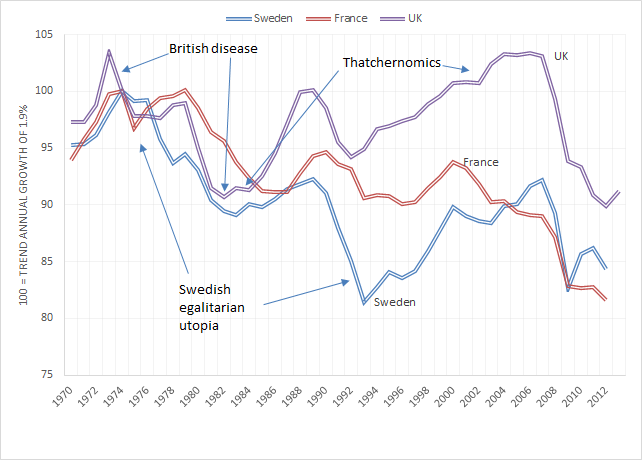
Source: Computed from OECD Stat Extract and The Conference Board. 2015. The Conference Board Total Economy Database™, May 2015, http://www.conference-board.org/data/economydatabase/
Figure 1 shows that France has been in a long-term decline since the late 1970s despite the blessings of a more equal society than the USA as championed by the Washington Centre for Equitable Growth. In figure 1, a flat line is growth in real GDP per working age person, PPP, at the same rate as the USA for the 20th century, which was 1.9% per year. A falling line in figure 1 indicates growth of less than 1.9% while a rising line indicates growth in real GDP per working age person, PPP, in excess of 1.9%. In figure 1, France hardly ever grew at the trend rate of growth for the USA of 1.9% per year and was frequently well below that rate.

Sweden tells a slightly different story in figure 1 because of regime change in the early 1990s when Sweden adopted more liberal economic policies where taxes and government spending were reduced:
The rapid growth of the state in the late 1960s and 1970s led to a large decline in Sweden’s relative economic performance. In 1975, Sweden was the 4th richest industrialised country in terms of GDP per head. By 1993, it had fallen to 14th.
@alexvoronov använda smygfinansiering av Generell Välfärd är alltid av ondo. @NimaSanandaji: bit.ly/1Nar2eV http://t.co/wD0YEgncIE—
Old Whig (@aClassicLiberal) August 05, 2015
That regime change reversed a long economic decline since 1970 under the egalitarian policies of the Swedish Social Democratic Party. Under the Swedish Social Democratic Party, Sweden was almost always growing at less than the trend rate of growth of the USA, which was 1.9%. That position reversed only when there was a turn away from big government and high taxes.

Figure 1 tells a similar story for the British economy: a long economic decline in the 1970s when Britain was the sick man of Europe. Under Thatchernomics, Europe had a long economic boom for 20 years or more – see figure 1.
In the 1970s, under the high taxes of the Heath, Callaghan and Wilson administrations, as figure 1 shows, Britain was the sick man of Europe. With the election of the Thatcher Government, Britain soon grew at better than the US trend growth rate for nearly 20 years through few exceptions.
Graph of the Day: The UK has among the lowest total tax rates on businesses in the G7 http://t.co/l6mMhN9yLD—
CPS Think Tank (@CPSThinkTank) August 04, 2015
10 Aug 2015 Leave a comment
in applied price theory, economics of education, economics of media and culture, gender, human capital, labour economics, personnel economics Tags: cognitive psychology, Dunning-Kruger effect, economics of personality traits, reversing gender gap
Great scientists know what they don't know. 1st step to learning. Female economists winning. blogs.lse.ac.uk/impactofsocial… http://t.co/xcfCvMNU3U—
S Dynarski (@dynarski) July 03, 2015
08 Aug 2015 Leave a comment
in Adam Smith, applied price theory, comparative institutional analysis, economic history, economics of regulation, entrepreneurship, industrial organisation Tags: creative destruction, entrepreneurial alertness, offsetting behaviour, The meaning of competition
Celebrating humanity's flourishing through the spread of capitalism and the rule of law
Celebrating humanity's flourishing through the spread of capitalism and the rule of law
Celebrating humanity's flourishing through the spread of capitalism and the rule of law
Celebrating humanity's flourishing through the spread of capitalism and the rule of law
Celebrating humanity's flourishing through the spread of capitalism and the rule of law
Celebrating humanity's flourishing through the spread of capitalism and the rule of law
Celebrating humanity's flourishing through the spread of capitalism and the rule of law
Celebrating humanity's flourishing through the spread of capitalism and the rule of law
A History of the Alt-Right
Econ Prof at George Mason University, Economic Historian, Québécois
Celebrating humanity's flourishing through the spread of capitalism and the rule of law
Scholarly commentary on law, economics, and more
Beatrice Cherrier's blog
Celebrating humanity's flourishing through the spread of capitalism and the rule of law
Celebrating humanity's flourishing through the spread of capitalism and the rule of law
Celebrating humanity's flourishing through the spread of capitalism and the rule of law
Why Evolution is True is a blog written by Jerry Coyne, centered on evolution and biology but also dealing with diverse topics like politics, culture, and cats.
Celebrating humanity's flourishing through the spread of capitalism and the rule of law
A rural perspective with a blue tint by Ele Ludemann
DPF's Kiwiblog - Fomenting Happy Mischief since 2003
Celebrating humanity's flourishing through the spread of capitalism and the rule of law
The world's most viewed site on global warming and climate change
Tim Harding's writings on rationality, informal logic and skepticism
A window into Doc Freiberger's library
Let's examine hard decisions!
Commentary on monetary policy in the spirit of R. G. Hawtrey
Thoughts on public policy and the media
Celebrating humanity's flourishing through the spread of capitalism and the rule of law
Politics and the economy
A blog (primarily) on Canadian and Commonwealth political history and institutions
Reading between the lines, and underneath the hype.
Economics, and such stuff as dreams are made on
"The British constitution has always been puzzling, and always will be." --Queen Elizabeth II
Celebrating humanity's flourishing through the spread of capitalism and the rule of law
Celebrating humanity's flourishing through the spread of capitalism and the rule of law
WORLD WAR II, MUSIC, HISTORY, HOLOCAUST
Undisciplined scholar, recovering academic
Celebrating humanity's flourishing through the spread of capitalism and the rule of law
Res ipsa loquitur - The thing itself speaks
In Hume’s spirit, I will attempt to serve as an ambassador from my world of economics, and help in “finding topics of conversation fit for the entertainment of rational creatures.”
Researching the House of Commons, 1832-1868
Reflections on books and art
Posts on the History of Law, Crime, and Justice
Celebrating humanity's flourishing through the spread of capitalism and the rule of law
Exploring the Monarchs of Europe
Cutting edge science you can dice with


Recent Comments