Henry Hazlett on why economics is so difficult
20 Aug 2015 Leave a comment
in applied price theory, applied welfare economics, comparative institutional analysis, constitutional political economy, economics of bureaucracy, income redistribution, Public Choice, rentseeking Tags: antiforeign bias, antimarket bias, bootleggers and baptists, green rent seeking, Henry Hazlett, makework bias, methodology of economics, philosophy of economics
Why Is The NRA So Powerful
19 Aug 2015 Leave a comment
in applied price theory, constitutional political economy, economics of regulation, Public Choice Tags: competition for political influence, gun control, lobby groups, median voter theorem, rational ignorance, special interests, voter demographics
What does U.S. gun ownership really look like? Load up with #PollPosition’s @Johnnydontlike: bit.ly/1y2EMjX http://t.co/fn5EpM75U7—
(@PJTV) March 25, 2015


@NZGreens @GreenpeaceNZ Senator Leyonhjelm on the blood on the hands of the modern Luddites
19 Aug 2015 Leave a comment
in applied price theory, development economics, economic history, economics of information, economics of media and culture, economics of regulation, environmental economics, environmentalism, growth disasters, growth miracles, health economics, liberalism Tags: Anti-Science left, expressive voting, GMOs, golden rice, Greenpeace, Luddites, New Zealand Greens, precautionary principle, rational ignorance, rational irrationality, The Great Escape
Good as Gold: Can Golden Rice and Other Biofortified Crops Prevent Malnutrition? ow.ly/QQ1VT #Harvard http://t.co/O3SwpGhsXD—
Golden Rice (@Golden_Rice) August 13, 2015
INFOGRAPHICS: The Impacts of #Biotechnology: A Close Look at the Latest Study ow.ly/GUi4U @FoodInsight http://t.co/JQsmrm2Lv1—
Golden Rice (@Golden_Rice) January 07, 2015
Anti-Golden Rice keyboard
Used by opponent to debate against supporters of #goldenrice
@EcoSenseNow @Golden_Rice http://t.co/q6xt5j7hb1—
Golden Rice Now (@paulevans18) August 21, 2015
.@gpph If this girl could have eaten #goldenrice for lunch, she would not be blind today. ALLOW GOLDEN RICE NOW http://t.co/3UlwHAdWdZ—
Golden Rice Now (@paulevans18) July 29, 2015
Should We Subsidize Scientific Research?
18 Aug 2015 Leave a comment
in applied price theory, applied welfare economics, entrepreneurship, industrial organisation, Public Choice, rentseeking, survivor principle Tags: competition as a discovery procedure, economics of science, industry policy, losers, picking winners, R&D, The meaning of competition, The pretence the knowledge
Julian Simon and William Buckley on Cross–Fire
18 Aug 2015 Leave a comment
in applied price theory, applied welfare economics, economic history, energy economics, entrepreneurship, environmental economics, environmentalism, liberalism, resource economics Tags: commodity prices, creative destruction, entrepreneurial alertness, Julian Simon, peak oil, The Great Enrichment, The Great Escape, The Great Fact, William Buckley
On the inefficiency of fuel efficiency standards
17 Aug 2015 Leave a comment
in applied price theory, applied welfare economics, economics of regulation, energy economics, environmental economics Tags: fuel efficiency standards, offsetting behaviour, The fatal conceit, The pretense to knowledge, unintended consequences
If Someone Replaced Your Car with a Prius, Would You Drive More?
17 Aug 2015 Leave a comment
in applied price theory, energy economics, entrepreneurship, environmental economics, industrial organisation Tags: offsetting behaviour, The fatal conceit, The pretense to knowledge, unintended consequences
The benefits and costs of the @NZSuperFund since its inception
17 Aug 2015 Leave a comment
in applied price theory, applied welfare economics, economic growth, economic history, entrepreneurship, financial economics, fiscal policy, industrial organisation, labour economics, labour supply, macroeconomics, politics - New Zealand, public economics Tags: ageing society, company tax rate, deadweight cost of taxes, demographic crisis, efficient markets hypothesis, laffer curve, New Zealand superannuation fund, old age pensions, retirement savings, social insurance, sovereign wealth funds, taxation and entrepreneurship, taxation and investment, taxation and labour supply
Most mutual funds still can't beat their benchmark read.bi/1GkTig1 http://t.co/r7ezoDGJbV—
BI Chart of the Day (@chartoftheday) June 03, 2015
The New Zealand Superannuation Fund, the sovereign wealth fund part funding New Zealand’s old-age pension from 2029/2030 onwards, has been a bit of a wild ride. Sometimes the earnings of the Fund were well below and sometimes earning well above the long-term bond rate.

Source: New Zealand Superannuation Fund Annual Report 2014.
Since its inception, the Fund earned an average annual return of 9.78%, which was 5.06% above the long-term bond rate, and 1.03% above its reference portfolio.

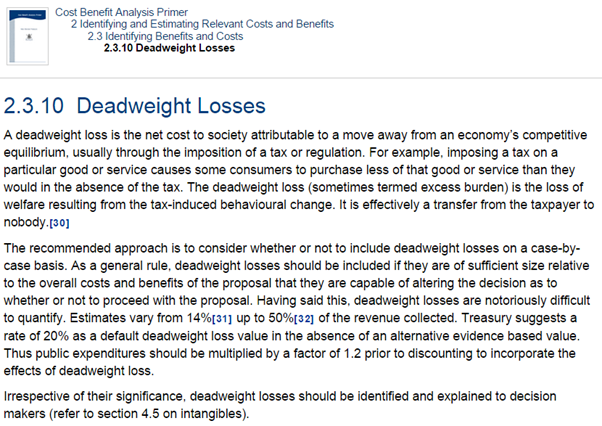
No information was given in the annual report of the New Zealand Superannuation Fund on the marginal dead weight cost of the taxes raised to fund the New Zealand Superannuation Fund to see whether there is any net benefit to taxpayers from its establishment and continued operation.
The New Zealand Government has contributed $14.88 billion to the fund from prior its inception in 2001 to the suspension of contributions in 2009 by the incoming National Party Government.
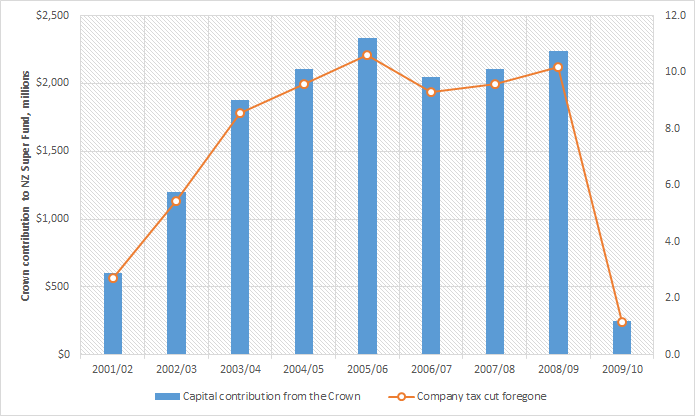
Source: New Zealand Treasury.
Over the nine years in which contributions were made, the company tax rate of 28% could have easily been up to 10 percentage points lower.
The New Zealand Treasury estimates that a one percentage point cut in the company tax costs about $220 million in forgone revenue if there are no other changes to the tax system. These are static estimates that do not include any feedback from greater investment and higher growth.
The New Zealand Superannuation Fund must beat the market every single year to make up for the deadweight cost of its funding, a premium for the investment risk added to the Crown’s portfolio and the cost to New Zealand’s growth rate of higher than otherwise taxes on income, entrepreneurship and investment.
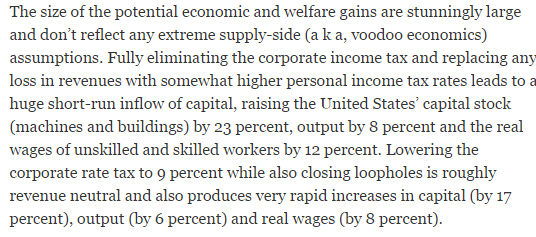
Source: Abolish the Corporate Income Tax – The New York Times.
Mises on the role of statistics
16 Aug 2015 Leave a comment
in applied price theory, applied welfare economics, comparative institutional analysis, econometerics, economic history, Ludwig von Mises Tags: methodology of economics, philosophy of economics, statistics
The Battle Over Global Warming Is All in Your Head
16 Aug 2015 Leave a comment
in applied price theory, applied welfare economics, economics of information, economics of media and culture, energy economics, environmental economics, global warming Tags: climate alarmism, doomsday prophecies, global warming, political psychology
UK has the lowest company tax rate in the G20
16 Aug 2015 Leave a comment
in applied price theory, economic growth, fiscal policy, macroeconomics, politics - Australia, politics - New Zealand, politics - USA, Public Choice, public economics Tags: British economy, company tax rate, company taxation, optimal tax theory, race to the top, tax competition
IFS Friday Figure: UK has the lowest corporate tax rate in the G20 #Budget2015 announced a 2% cut by 2020 #IFSFriFig http://t.co/T4Oq6ZXYd4—
IFS (@TheIFS) July 24, 2015
Why we shouldn’t rely too much on GDP and Human development index to tell us how we are doing
15 Aug 2015 Leave a comment
in applied price theory, applied welfare economics, development economics, economic history, economics of media and culture Tags: measurement error, The Great Enrichment, The Great Escape, The Great Fact

Up to now, I personally think we are yet to come up with a more accurate and adequate way of measuring our welfare, our quality or standard of living, that is, how happy we feel in our lives or how enjoyable and satisfying our lives are. If this is what we are measuring GDP (output) is in so many ways an inadequate measure of welfare because it is concentrating on output, it focuses more on commodities therefore GDP does not capture the happiness and joy got from family and social networks. So some economists have tried to come up with new ways to better measure GDP as a measure of our welfare, and they have broken down welfare into three things that they believe constitute welfare. Firstly, welfare has something to do with consumption of goods and services giving us utility, pleasure, or happiness. Secondly, it also has something to…
View original post 722 more words
“Family silver’ looking a bit tarnished
15 Aug 2015 Leave a comment
in applied price theory, industrial organisation, politics - New Zealand, public economics Tags: privatisation, state owned enterprises
In the editorial today in the Dominion Post on the Solid Energy fiasco, the editorial writer made quite an extraordinary statement:
“Ideologues of the Right will claim that the whole sad fiasco shows the dangers of the state getting into business. This is simple-minded. Not all SOEs have ended up hundreds of millions of dollars in debt. Some SOEs have been well run; some have not.”
It is absurd to claim that making a $20 million net profit on a portfolio of $30 billion in state owned enterprises in 2013 is some sort of reasonable investment for the taxpayer.

Opponents to the sale of minority shareholdings in a few state owned assets would have us believe that the government is selling the family silver.
Treasury’s annual portfolio return shows that silver isn’t returning much:
Government businesses with assets worth $45 billion made a total net profit of just $20 million in the year to June 30, according to the Treasury’s annual portfolio report.
The assets don’t include Meridian Energy, Air New Zealand and Mighty RiverPower, which were partially privatised, but cover troubled entities like KiwiRail, Solid Energy and New Zealand Post, which are all struggling to make their business models work.
The annual review covers Crown-owned assets valued at $125b.
A return of just $20 million on $125b is lamentably low.
“For the residual commercial priority portfolio, overall performance (with some notable exceptions) was mediocre,” the Treasury’s Crown Ownership Monitoring Unit says in the report. . .
Total shareholder…
View original post 332 more words


Recent Comments