The life of an economist. http://t.co/gvBLa9Tk3h—
Justin Wolfers (@JustinWolfers) March 02, 2015
The pretence to knowledge has a supply and a demand
01 May 2015 Leave a comment
in applied price theory, Austrian economics, F.A. Hayek, labour supply, occupational choice, Public Choice, rentseeking Tags: consultants, rent seeking, The pretence to knowledge
Democrat voters are turning against the idea of lower prices for ordinary families
29 Apr 2015 Leave a comment
in applied price theory, applied welfare economics, international economics, politics - USA, Public Choice, rentseeking Tags: antiforeign bias, expressive voting, rational ignorance, rational irrationality, voter demographics
As America inches towards a big trade deal with Asia, Obama faces a showdown with his party econ.st/1JJMJAE http://t.co/6qmt9GegWF—
The Economist (@EconBizFin) April 27, 2015
Persuasive power of quoting a number
29 Apr 2015 Leave a comment
in applied price theory, applied welfare economics, behavioural economics, econometerics, economic history, economics of information Tags: cognitive biases, cognitive psychology, data mining, economics of persuasion, evidence-based policy
Politicians & statistics. My proposal in today's @FT : ft.com/cms/s/0/dcf46a… http://t.co/HYbV4V2ps2—
Jonathan Portes (@jdportes) January 26, 2015
Are White Republicans More Racist Than White Democrats? | FiveThirtyEight
28 Apr 2015 Leave a comment
in applied price theory, economic history, politics - USA Tags: Democratic party racism, racism, republicanism, Southern racism


Milton Friedman on evidence-based policy
27 Apr 2015 Leave a comment
in applied price theory, applied welfare economics, comparative institutional analysis, Milton Friedman Tags: evidence-based policy, offsetting behaviour, The fatal conceit, The pretence to knowledge, unintended consequences
Murphy’s Law of Economic Policy
26 Apr 2015 Leave a comment
in applied price theory, applied welfare economics, comparative institutional analysis, constitutional political economy, economic history, economics of bureaucracy, Public Choice, rentseeking Tags: Alan Blinder, evidence-based policy, expressive politics, free trade, protectionism, rational ignorance, rational irrationality, rent seeking
Greg Mankiw on one of the few things economists agree on: free trade. That's the problem. nyti.ms/1GrLisQ http://t.co/WrLuP3oBSW—
The Upshot (@UpshotNYT) April 25, 2015
Maybe the European Union membership isn’t that bad after all, especially if you’re a former Eastern Bloc country
24 Apr 2015 Leave a comment
in applied price theory, applied welfare economics, comparative institutional analysis, constitutional political economy, development economics, growth disasters, growth miracles Tags: European Union, transitional economies
Still further evidence of the rise and rise of the working rich
21 Apr 2015 Leave a comment
in applied price theory, entrepreneurship, income redistribution, industrial organisation, survivor principle Tags: capitalism and freedom, entrepreneurial alertness, The Great Enrichment, top 1%, working rich
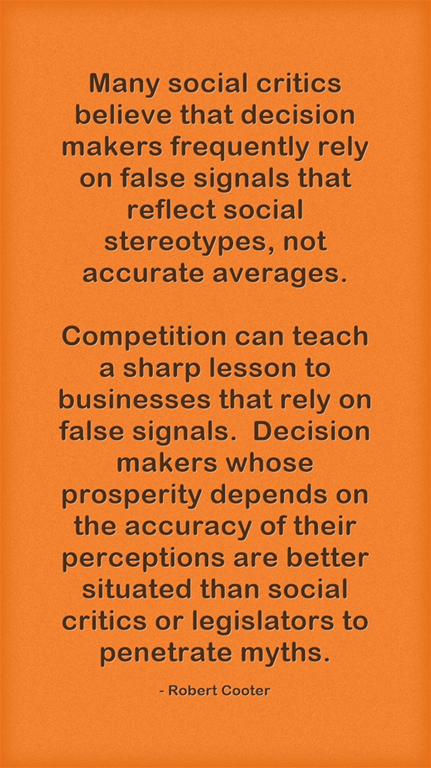
The comparative institutional analysis of stereotypes
21 Apr 2015 Leave a comment
in applied price theory, discrimination, economics of bureaucracy, entrepreneurship, gender, industrial organisation, labour economics, Public Choice, survivor principle Tags: labour market discrimination, markets selection, signaling and screening, stereotypes, The meaning of competition
50% more R&D since the 60s, but still no growth dividend?
18 Apr 2015 1 Comment
in applied price theory, economic growth, economics of education, entrepreneurship, history of economic thought, human capital, industrial organisation, macroeconomics, occupational choice, survivor principle Tags: Ben Jones, Chad Jones, creative destruction, endogenous growth theory, innovation, R&D
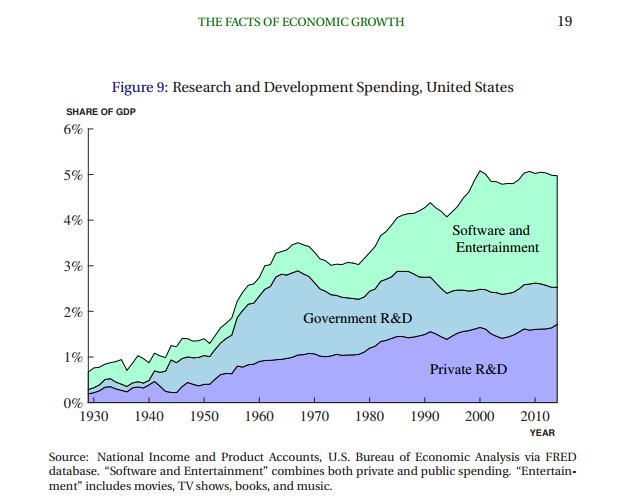
Spending on intellectual property products has risen in the USA from 1% in 1950 to 5% now. Public R&D spending in the USA has been pretty static for 60 years. Intellectual property products in the chart below includes traditional research and development, spending on computer software, and spending on entertainment such as movies, TV shows, books, and music. Spending on software and entertainment was only recently measured in the US national accounts. This inclusion of intangible capital investments will radically change the story of economic growth and the business cycle in the 20th century.
Source: Chad Jones (2015).
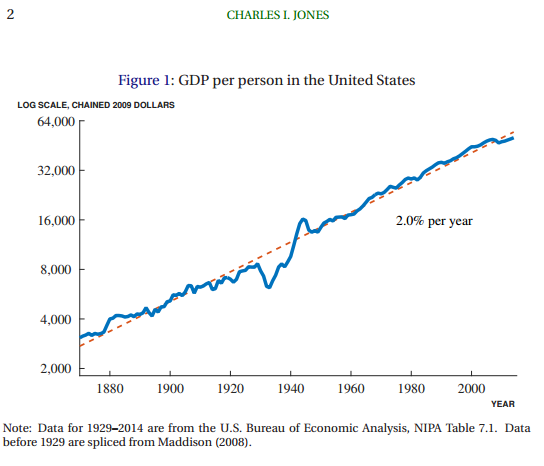
The growth rate in the USA hasn’t changed much despite this massive increase in intellectual property property product production. Is innovation getting harder? R&D is supposed to boost the growth rate, if you are to believe politicians bearing subsidies for it wherever they find it.
Source: Chad Jones (2015).
Ben Jones in The Burden of Knowledge and the Death of the Renaissance Man: Is Innovation Getting Harder? found that as knowledge accumulates as technology advances, successive generations of innovators may face an increasing educational burden. Innovators can compensate through lengthening their time in education and narrowing expertise, but these responses come at the cost of reducing individual innovative capacities. This has implications for the organization of innovative activity – a greater reliance on teamwork – and has negative implications for economic growth.
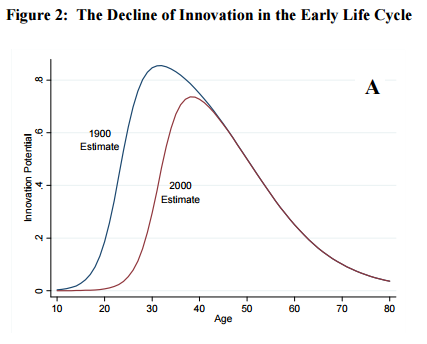
This longer period of education and initial study is not compensated by inventors innovating for longer spans of their lifestyle. This rising burden of knowledge is cutting into their best years of their lives. Jones found a broad and dramatic declines in early life-cycle productivity among great minds and ordinary inventors, and a close relationship of these trends with increased training duration.
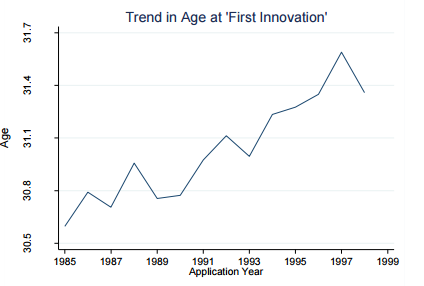
Jones found that the age at first invention, specialisation, and teamwork increased over time in a large micro-data set of inventors. Upward trends in academic collaboration and lengthening doctorates can also be explained in his framework of innovation getting harder because of a rising burden of knowledge. Co-authorship in academic literature has increased, including physics, biology, chemistry, mathematics, psychology, and economics. This measure of teamwork has increased 17% per decade.
Using data on Nobel Prize winners, Jones found that the mean age at which the innovations are produced to win the Prize has increased by 6 years over the 20th Century.
- Before 1901, two-thirds of the Nobel laureates did their prize-winning work before the age of 40 and 20 per cent did it before age of 30.
- By 2000, however, great achievements seldom occurred before the age of 40.
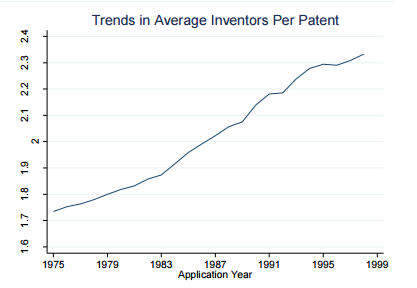
It’s now taking longer for scientists to get their basic training and start their careers. There is simply more to learn because knowledge in all fields has grown by quantum leaps in the past century. Nobels are being handed out for different types of work than a century ago.
- There has been a trend away from awarding prizes for abstract, theoretical ideas.
- Now more honours are being bestowed on people who have made discoveries through painstaking lab work and experimentation – which takes a lot of time to do.
Jones’ theory provides an explanation for why productivity growth rates did not accelerate through the 20th century despite an enormous expansion in collective research effort and levels of education and many more graduates. Innovation is getting harder?
Creative destruction in CD sales
17 Apr 2015 Leave a comment
in applied price theory, economic history, economics of media and culture, entrepreneurship, industrial organisation, Music, survivor principle Tags: creative destruction, entrepreneurial alertness
Digital music sales have exceeded those from CDs for the first time: on.wsj.com/1yp37FW http://t.co/LDOdrgGap9—
Wall Street Journal (@WSJ) April 15, 2015
The merits of different options to combat global warming
14 Apr 2015 Leave a comment
in applied price theory, applied welfare economics, economics of regulation, energy economics, entrepreneurship, environmental economics, global warming Tags: climate alarmism, cost benefit analysis, evidence-based policy, global warming



Recent Comments