The Left and Right approaches to poverty
01 Feb 2015 Leave a comment
in applied price theory, applied welfare economics, comparative institutional analysis, liberalism, poverty and inequality, welfare reform Tags: capitalism and freedom, Leftover Left, poverty and inequality, The Great Enrichment
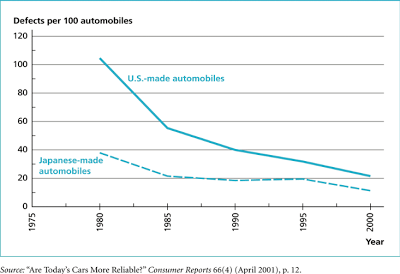
Quality control in Japanese and American car manufacturing compared
31 Jan 2015 Leave a comment
in applied price theory, development economics, economic history, entrepreneurship, growth miracles Tags: creative destruction, Japanese manufacturing, quality control
Spurious correlations alert: executions and murder rates – updated
30 Jan 2015 Leave a comment
in applied price theory, economics of crime, labour economics, labour supply, law and economics, occupational choice Tags: crime and punishment, death penalty, deterrence, occupational hazards, prison conditions, punishment
– Updated
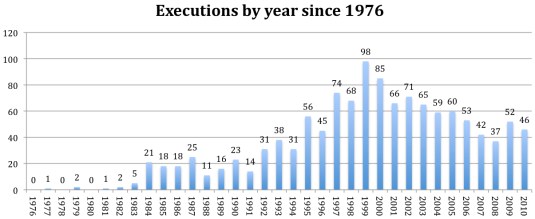
Many a data shyster will make hay with the above chart on the simple correlation between executions and the drop in the US murder rate.

The reality is there are so few executions and they are so infrequent with the exception of Texas that any purported correlation between the death penalty and murder rates requires careful study.

Indeed, for some condemned prisoners, gang bangers are an example, their life expectancy may be increased by the long time they spend on death row versus been murdered by a business associated or a business rival on the streets. As Levitt noted:
no rational criminal should be deterred by the death penalty, since the punishment is too distant and too unlikely to merit much attention.
As such, economists who argue that the death penalty works are put in the uncomfortable position of having to argue that criminals are irrationally overreacting when they are deterred by it.
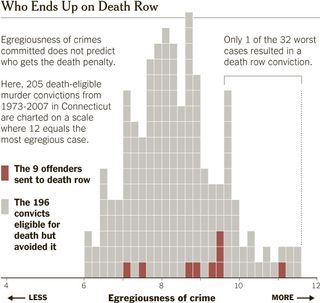
The occupational hazard of been murdered by business rival for gang bangers is higher than the chance of them been arrested, tried , convicted, and condemned to death and then executed after a long appeals process. Not surprisingly, Levitt argued that:
…the quality of life in prison is likely to have a greater impact on criminal behaviour than the death penalty.
Using state-level panel data covering the period 1950–90, we demonstrate that the death rate among prisoners (the best available proxy for prison conditions) is negatively correlated with crime rates, consistent with deterrence. This finding is shown to be quite robust.
In contrast, there is little systematic evidence that the execution rate influences crime rates in this time period.
Rise and Fall of Smoking
30 Jan 2015 Leave a comment
Robert D. Tollison on the main positive contribution of economists to public policy
30 Jan 2015 Leave a comment

Is surge pricing by Uber another name for overtime and weekend pay
28 Jan 2015 Leave a comment
in applied price theory, economics of media and culture, economics of regulation, Public Choice, rentseeking, transport economics Tags: barriers to entry, compensating differentials, peakload pricing, taxi regulation, Uber

Uber is in strife of late for charging more at peak times - Uber calls it surge pricing. We don’t object paying more for a meal at a restaurant at dinner time rather than at lunchtime but the same people object to paying more for the taxi late at night where the driver must risk the dangers of solitary night-time work and picking up strangers who might have had a few too many.

Under Uber’s now-national policy, price surging is capped during disasters and states of emergency at the fourth-highest nonemergency surge seen in the previous two months.

We all expect to pay more for air tickets at peak times, such as school holidays and Christmas. Indeed, one reason we are able to delay booking is we know seats will be available because they are selling at a premium for those who booked late. Others who make their plans early quite enjoy getting the cheaper for early bird bookings.

Is surge pricing another name for over time and night and weekend pay? Union contracts provide for overtime pay, if you work more than the specified 8 hours a day.
The Holidays Act in New Zealand provides that if an employee works at the weekends, they are paid at 150% of the normal rate; and double party on public holidays. Not many employees object of this wage premium for work in it inconvenient times. Cafes and restaurants routinely charge of 10-15% price premium on public holidays to cover this overtime pay.

As would be expected under the theory of compensating differentials, there are wage premiums for jobs where the worker must work at inconvenient or unsocial times, in jobs with a greater risk of injury, or otherwise work more unpleasant than the average.

Viscusi estimated the wage premium for hazardous jobs to be rather large in the United States:
The extra pay for job hazards, in effect, establishes the price employers must pay for an unsafe workplace.
Wage premiums paid to U.S. workers for risking injury are huge; they amount to about $245 billion annually (in 2004 dollars), more than 2 percent of the gross domestic product and 5 percent of total wages paid. These wage premiums give firms an incentive to invest in job safety because an employer who makes the workplace safer can reduce the wages he pays.
Those who don’t like Uber’s surge pricing can always hail a cab. As I remember from American TV programmes, at peak times, prospective customers on the side of the road hail cabs at peak times with several fingers raised to indicate how much more than the standard fare, they are willing to pay.

There is nothing new under the sun. Uber’s app allows you to do the price bidding for a taxi on your cellphone rather than out in the cold
I, Smartphone
28 Jan 2015 Leave a comment
in applied price theory, applied welfare economics, economics of media and culture, industrial organisation, survivor principle Tags: IPencil, Iphone
Based on Leonard Read’s famous essay “I, Pencil,” this short video beautifully illustrates the vast complexity that we carry in our pockets.
No one person could ever make a smartphone. It required the spontaneous cooperation of millions across all countries. The world could never be reinvented by a single mind, but rather requires the coordination of plans made possible only through private property and the price system.
HT: http://tucker.liberty.me/2015/01/27/15-great-lessons-on-commerce-and-entrepreneurship/#.VMfl-ZUvGGA.facebook




Hsieh and Moretti on Allocations across Cities
23 Jan 2015 Leave a comment
in applied price theory, applied welfare economics, economics of regulation, geography, law and economics, politics - New Zealand, politics - USA, rentseeking, urban economics Tags: agglomeration, green rent seeking, land supply, zoning
the implied cost of housing restrictions across the whole U.S., and Chang and Enrico find that aggregate output is lower by about 10-14% because of them.


Last post on the NBER growth session. Chang-Tai Hsieh (Chicago) and Enrico Moretti (Berkeley) presented a paper on wage dispersion across cities in the U.S. Wage dispersion (New Yorkers earn more than people in Cleveland) either represents compensation for living costs (housing in New York is more expensive than in Cleveland), a real difference in productivity (New Yorkers are more productive than Clevelanders), or some combination of the two.
What Chang and Enrico find is that the increase in wage dispersion across cities in the U.S. over the last thirty-ish years is due almost entirely to rising house prices in six cities: NY, DC, Boston, San Fran, San Jose, and Seattle. Wages have gone up rapidly in those cities, but that is basically just compensating their citizens for the higher costs of living.
Now, given the costs of living, the allocation of population across cities in the U.S. is…
View original post 274 more words


Recent Comments