 \
HT: David-k-Levine
Celebrating humanity's flourishing through the spread of capitalism and the rule of law
03 Nov 2014 Leave a comment
in applied price theory, applied welfare economics, behavioural economics, Public Choice, rentseeking Tags: behavioural economics, do gooders, The fatal conceit, The pretence to knowledge
\
HT: David-k-Levine
03 Nov 2014 Leave a comment
in applied price theory, behavioural economics Tags: behavioural economics, Nudging
Here is Mark Pennington in his second post as our guest-blogger this week.
“Private versus Public Nudging” by Mark Pennington
Last week I attended a speech by Richard Thaler, of ‘Nudge’ fame.
Professor Thaler is an engaging speaker. His assertion that ‘libertarian paternalism’ is merely an extension of methods widely adopted in daily life is a beguilingly simple, yet ultimately dangerous one. According to Thaler since good mothers constantly attempt to ‘nudge’ their offspring in the ‘right direction’ then we should not worry about governmental nudging. Whether it is ‘fat taxes’ to discourage unhealthy eating induced by ‘weakness of will’ or compulsory enrolment in savings schemes to induce less ‘short-sighted’ and more thrifty conduct, people should learn to love a government that coaxes them towards what they themselves would recognise is in their own best interests.
The classical liberal tradition is not, and never has been suspicious of the idea…
View original post 981 more words
31 Oct 2014 Leave a comment

31 Oct 2014 Leave a comment

30 Oct 2014 Leave a comment
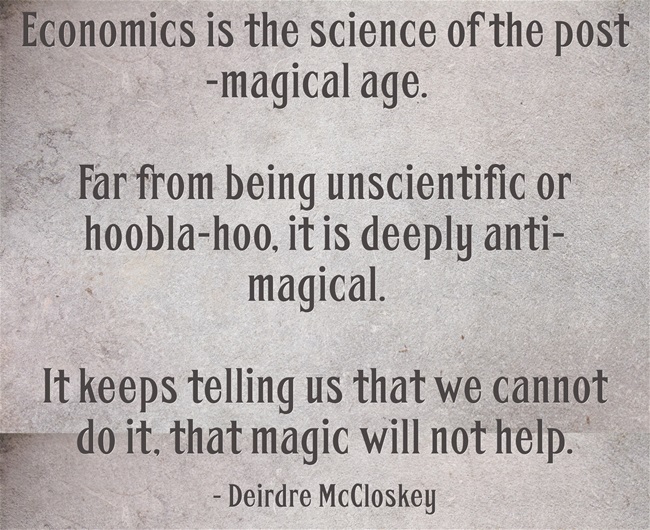
in applied price theory, applied welfare economics, comparative institutional analysis, development economics, entrepreneurship, liberalism Tags: Deirdre McCloskey, The fatal conceit, The pretence to knowledge
HT: Cafe Hayek
30 Oct 2014 Leave a comment
in applied price theory Tags: Jack Hirschleifer

|
Optimization problems |
Equilibrium problems |
|
1. Should I buy a new car or keep my old one a while longer? |
1. Are new car prices likely to be lower next year? |
|
2. Will I be happier working, or should I drop out of the rat race and live on hand-outs? |
2. Would generous “welfare” benefits for the unemployed raise the unemployment rate? |
|
3. Should I buy a condo or live in a rental apartment? |
3. What determines the ratio between the annual rental of an apartment and its purchase price as a condominium? |
|
4. Should narcotics laws be made stricter or more lenient? |
4. If use of narcotics were decriminalized, would drug usage increase? |
|
5. Should our union go on strike, or had we better accept management’s offer? |
5. Do strikes raise the wage of workers? |
29 Oct 2014 Leave a comment
in applied price theory, applied welfare economics, economic growth, industrial organisation Tags: economic growth, innovation, R&D, The fatal conceit, The pretence to knowledge

29 Oct 2014 Leave a comment
in applied price theory, applied welfare economics, economics of regulation, gender, income redistribution, minimum wage, politics - New Zealand, rentseeking Tags: gender wage gap, living wage, minimum wage, pay equity
I wonder who will pay for this? Caregiver wages are funded out of a fixed budget allocated by the government.
A higher wage will change the type of worker that the caregiving sector will seek to recruit, as happened after increases in the teenage went minimum wage.
When the teenage minimum wage went up in New Zealand, employment of 17 and 18-year-olds fell, while the employment of 18 to 19-year-olds increased because the latter were more mature and reliable than the younger contemporaries.

Media release: Pay Equity Challenge Coalition
28 October 2014
Coalition Celebrating Equal Pay Case Outcome
“The Court of Appeal’s decision declining the employers’ appeal in the Kristine Bartlett case is a huge victory for women workers” said Pay Equity Coalition Challenge spokesperson Angela McLeod.
“The Courts’ decision that equal pay may be determined across industries in female-dominated occupations revitalises the Equal Pay Act 1972 and will be a major factor in closing New Zealand’s stubborn 14 percent gender pay gap”.
The judgement by the Court of Appeal upholding the Employment Court decision again validates the work of caregivers and that they are underpaid, she said.
“We commend the Service and Food Workers Union Nga Ringa Tota in taking this case and exposing the underpayment and undervaluation of aged care workers. And the decision is a victory for all the women’s organisations who have never given up fighting for equal pay,”…
View original post 92 more words
29 Oct 2014 Leave a comment
in applied price theory, applied welfare economics, economics of regulation, labour economics, Marxist economics, minimum wage Tags: minimum wage
Celebrating humanity's flourishing through the spread of capitalism and the rule of law
Celebrating humanity's flourishing through the spread of capitalism and the rule of law
Celebrating humanity's flourishing through the spread of capitalism and the rule of law
Celebrating humanity's flourishing through the spread of capitalism and the rule of law
Celebrating humanity's flourishing through the spread of capitalism and the rule of law
Celebrating humanity's flourishing through the spread of capitalism and the rule of law
Celebrating humanity's flourishing through the spread of capitalism and the rule of law
Celebrating humanity's flourishing through the spread of capitalism and the rule of law
A History of the Alt-Right
Econ Prof at George Mason University, Economic Historian, Québécois
Celebrating humanity's flourishing through the spread of capitalism and the rule of law
Scholarly commentary on law, economics, and more
Beatrice Cherrier's blog
Celebrating humanity's flourishing through the spread of capitalism and the rule of law
Celebrating humanity's flourishing through the spread of capitalism and the rule of law
Celebrating humanity's flourishing through the spread of capitalism and the rule of law
Why Evolution is True is a blog written by Jerry Coyne, centered on evolution and biology but also dealing with diverse topics like politics, culture, and cats.
Celebrating humanity's flourishing through the spread of capitalism and the rule of law
A rural perspective with a blue tint by Ele Ludemann
DPF's Kiwiblog - Fomenting Happy Mischief since 2003
Celebrating humanity's flourishing through the spread of capitalism and the rule of law
The world's most viewed site on global warming and climate change
Tim Harding's writings on rationality, informal logic and skepticism
A window into Doc Freiberger's library
Let's examine hard decisions!
Commentary on monetary policy in the spirit of R. G. Hawtrey
Thoughts on public policy and the media
Celebrating humanity's flourishing through the spread of capitalism and the rule of law
Politics and the economy
A blog (primarily) on Canadian and Commonwealth political history and institutions
Reading between the lines, and underneath the hype.
Economics, and such stuff as dreams are made on
"The British constitution has always been puzzling, and always will be." --Queen Elizabeth II
Celebrating humanity's flourishing through the spread of capitalism and the rule of law
Celebrating humanity's flourishing through the spread of capitalism and the rule of law
WORLD WAR II, MUSIC, HISTORY, HOLOCAUST
Undisciplined scholar, recovering academic
Celebrating humanity's flourishing through the spread of capitalism and the rule of law
Res ipsa loquitur - The thing itself speaks
In Hume’s spirit, I will attempt to serve as an ambassador from my world of economics, and help in “finding topics of conversation fit for the entertainment of rational creatures.”
Researching the House of Commons, 1832-1868
Reflections on books and art
Posts on the History of Law, Crime, and Justice
Celebrating humanity's flourishing through the spread of capitalism and the rule of law
Exploring the Monarchs of Europe
Cutting edge science you can dice with


Recent Comments