In a recent Substack essay, “The progress movement needs a better theory of progress,” Brink Lindsey argues that the progress movement has settled for too thin a vision. It focuses on wealth creation and technological advance, he says, when it should adopt a “fuller conception of progress”—one that promotes “spiritual welfare” and thicker accounts of…
Many antitrust economists are wary of the efficacy of predatory pricing, the strategy of pricing below costs to drive a competitor out of a market. The usual counter-argument is that, for it to work, the inevitable losses this will entail must be recouped after the rival has exited. Recoupment requires higher prices … that can…
Chris Wilkins, Marta Rychert, and Robin van der Sanden (all Massey University) wrote an article in The Conversation last month about the price of methamphetamine:Methamphetamine has become dramatically cheaper over the past seven years, even as authorities report record seizures, according to the latest New Zealand Drug Trends Survey.The annual online survey of over 8,800…
Do market-oriented reforms cause economic growth? This paper revisits this question using a cross-country panel of reform episodes identified from various changes in well-known economic freedom and structural reform indices. We exploit the timing of reforms using distributed-lag and event-study frameworks that trace the dynamic response of per-capita GDP. We find little evidence of immediate…
TweetThis post by Oxford economist J. Zachary Mazlish is very good; I encourage you to read it. (HT David Levey) Nevertheless, there are two points that I think to be worth making in response to Mazlish’s post. I will here make one of these points. I’ll make the other of these points in a follow-up…
Tweet… is from page 47 of philosopher Christopher Freiman’s excellent contribution, titled “Utilitarianism,” to the 2016 collection edited by Aaron Ross Powell and Grant Babcock, Arguments for Liberty [original emphasis]: The great virtue of the market, from a utilitarian perspective, is that it leads us to promote the happiness of others without demanding that we…
The world’s big economic policy battle is not capitalism vs. socialism. Other than a few primitive backwater nations like Cuba and North Korea, genuine socialism has largely been vanquished. Instead, the battle in most countries largely revolves around the size of the welfare state. At the risk of over-simplifying, here are the three choices. Should […]
RNZ reports:An RNZ investigation into the tobacco blackmarket found packs of cigarettes and loose tobacco being sold brazenly over the counter at heavily discounted prices.By law, cigarettes have to include pictures and health warnings covering at least 75-percent of the front of the packs. But the cigarettes being sold on the blackmarket are a throw…
A few months ago, a high school econ student asked me to zoom with his class. I’m working against a tight deadline for Blockade, so I was inclined to decline. But the student’s list of questions was so ambitious that I decided to make the time. See for yourself:Here is the plan:- 5 minutes -WELCOME…
What determines whether and how regulations are reformed? We use a newly constructed data set of 3,590 successful and failed regulatory reforms in 189 countries, between 2005 and 2022, to address this question. We document that regulations have become more business friendly in some regulatory domains but not others. We also show that regulations are…
We do not know whether technological unemployment swept across England in the wake of the British Industrial Revolution. In this paper, I propose an approach to quantify jobs lost to, and created by, creative destruction in the 19th century. Using over 170 million individual records from the full-count British census (1851–1911), I generate sub-industry “task”…
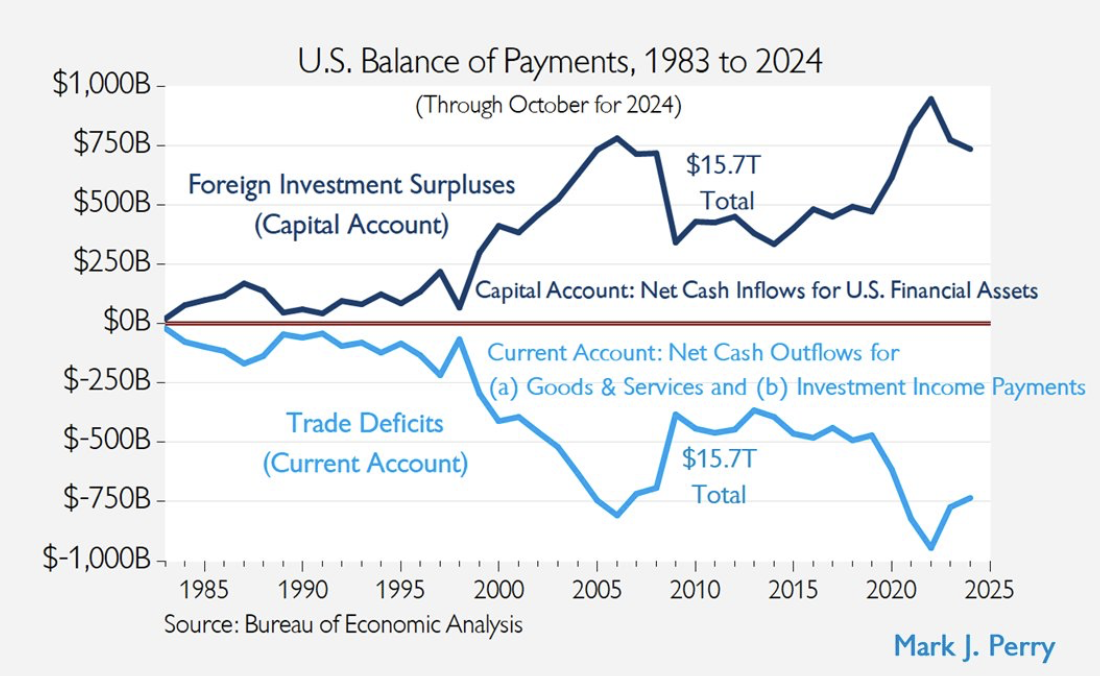
Tweet… is from this recent post at Marginal Revolution by my colleague Alex Tabarrok: The trade accounts are among the most pernicious statistics ever collected. The post Bonus Quotation of the Day… appeared first on Cafe Hayek.
Everyone knows the Luddites smashed looms. What is less appreciated is that the loom was the first serious programmable device — the direct ancestor of the computer. Thus, the Luddites weren’t just the first to resist automation. They were the first to attack AI. The Jacquard loom, introduced in France circa 1805, used a chain…
Tweet… is from page 815 of Richard Nelson’s and Richard Langlois’s February 1983 Science paper titled “Industrial Innovation Policy: Lessons from American History”: A quick reading of the case studies is enough to dash any supposition that technological change is somehow a cleanly plannable activity. In fact, it is an activity characterized as much by…
TweetOn page 13 of their 2017 brief in support of “green industrial policy,” Tilman Altenburg and Dani Rodrik write: However, it should be noted that consumers do not respond perfectly to price signals. Even when new products exist that are better in many ways and cheaper, many consumers stick to the bad old alternatives because…
Why Evolution is True is a blog written by Jerry Coyne, centered on evolution and biology but also dealing with diverse topics like politics, culture, and cats.
In Hume’s spirit, I will attempt to serve as an ambassador from my world of economics, and help in “finding topics of conversation fit for the entertainment of rational creatures.”
“We do not believe any group of men adequate enough or wise enough to operate without scrutiny or without criticism. We know that the only way to avoid error is to detect it, that the only way to detect it is to be free to inquire. We know that in secrecy error undetected will flourish and subvert”. - J Robert Oppenheimer.


 Utopia, you are standing in it!
Recent Comments