Deirdre McCloskey on corruption and economic development
13 Mar 2015 Leave a comment
in applied price theory, applied welfare economics, comparative institutional analysis, development economics, economic history, economics of crime, growth disasters, growth miracles, law and economics, Public Choice, rentseeking Tags: corruption, Deirdre McCloskey, The Industrial Revolution
The rise and rise of the working rich in the top 1% in the USA
10 Mar 2015 1 Comment
in applied welfare economics, politics - USA
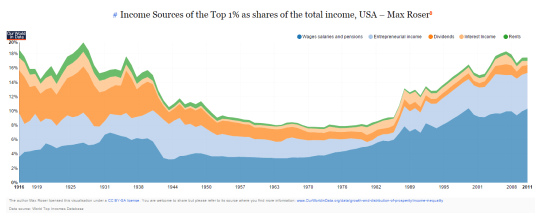
Most of the income of the top 1% in the USA is now from wages, salaries and entrepreneurial income. They make it themselves. They do not sit back and collect dividends from passive investments.


Australian top 1% has dropped the ball in the class struggle
10 Mar 2015 Leave a comment
in applied welfare economics, economic growth, economic history, labour economics, liberalism, poverty and inequality, Rawls and Nozick Tags: class struggle, immiseration of the proletariat, Leftover Left, top 1%
How is the immiseration of the proletariat going to occur any time soon, and with it, the workers will rise up because they have nothing to lose but their chains, if the Australian top 1% doesn’t lift its game.
There is a serious lack of greed and expropriation of labour surplus by the top 1% in Australia. Their share of income has been falling for many decades and only increased in the last few years and then only slightly.
The top 1% is supposed to be grinding the working class down, and causing crisis after financial crisis but there’s hardly any of evidence of that in Australian income inequality data.
Winston’s big port up North won’t have any business
10 Mar 2015 Leave a comment
in applied welfare economics, industrial organisation, politics - New Zealand, rentseeking, transport economics
In the first shot in the pork-barrelling for a by-election, veteran New Zealand populist Winston Peters wants to stop the expansion of the Port of Auckland and move the extra shipping traffic up north to the Port of Whangarei:
And we will upgrade the Auckland to Northland railway line and build the rail link to your port
The Port of Whangarei is about two hours north by car from Auckland. Auckland is a global city of approaching 2 million. Whangarei is the only city up North, with a population of 50,000.

45% of the import traffic to the Port of Auckland is cars. Around 90% of light vehicle imports in New Zealand come through the Port of Auckland. The rest may go through Littleton.
|
|
|
Jellicoe and Freyberg wharves are located between the two container terminals. |
Bledisloe multipurpose Wharf |
Striving to move some of this light vehicle imports from the Port of Auckland up north to the Port of Whangarei where they be unloaded from a ship onto trains for a short train ride to Auckland, unloaded again onto trucks all seems unnecessary expense.

Photo: Port of Whangarei.
Auckland appears to have spare container capacity up until at least 2035, so this port up North will simply not have much to do in terms of extra container traffic because it will have to compete on the basis of cost and proximity to markets.
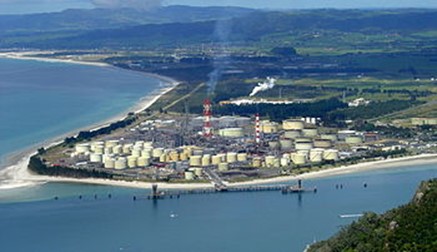
Photo: The Marsden Point Oil Refinery on the opposite shore of Whangarei Harbour.
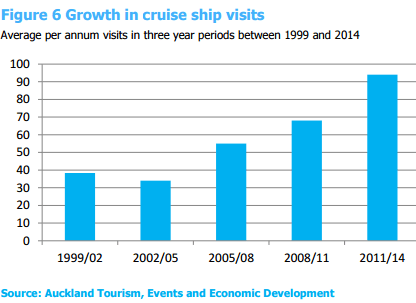
The traffic that is coming under pressure regarding capacity of the Port of Auckland is multi-cargo traffic such as building materials, vegetables, wheat, vehicles and other goods. The situation is further aggravated by the rapid increase in the number and increased size of cruise ships.
As a good part of the market for the multi cargo traffic is in Auckland, landing them away from their main market just makes no sense and will not happen unless the port of Auckland is prohibited by law from expanding and ships are not allowed to divert to ports such as Wellington and Christchurch.
The number of cruise ships visiting Auckland in the last 10 years to about 90 and is expected to reach one 20 by 2020 and 150 by 2030. That traffic cannot be diverted up north to the Port of Whangarei.
Any export traffic that would be viable to send through the Port of Whangarei up north will already be going through it. Export competitiveness is highly sensitive to costs as exporters must simply take the going price in the international market.

Capitalism and the abolition of extreme poverty – mobile phones addition
07 Mar 2015 Leave a comment
Moondoggle: The Forgotten Opposition to the Apollo Program – The Atlantic
05 Mar 2015 Leave a comment
in applied welfare economics, defence economics, economic history, politics - USA Tags: industry policy, picking winners, R&D, smart industry policy, space programme

…many people believe that Project Apollo was popular, probably because it garnered significant media attention, but the polls do not support a contention that Americans embraced the lunar landing mission.
Consistently throughout the 1960s a majority of Americans did not believe Apollo was worth the cost, with the one exception to this a poll taken at the time of the Apollo 11 lunar landing in July 1969.
And consistently throughout the decade 45-60 percent of Americans believed that the government was spending too much onspace, indicative of a lack of commitment to the spaceflight agenda. These data do not support a contention that most people approved of Apollo and thought it important to explore space.
HT: Moondoggle: The Forgotten Opposition to the Apollo Program – The Atlantic.
How Your Face Shapes Your Economic Chances – The Atlantic
04 Mar 2015 Leave a comment
in applied price theory, applied welfare economics, discrimination, gender, labour economics Tags: economics of beauty

- Attractive CEOs raise their company’s stock price when they first appear on television, according to a working paper by Joseph T. Halford and Hung-Chia Hsu at the University of Wisconsin.
- Taller people are richer. In fact, every inch between 5’7” and 6 feet is “worth” about 2 percent more in average annual earnings.
- Being better looking than at least 67 percent of your peers is worth about $230,000 over your lifetime.
- Having blond hair is worth as much as a year of school—for women.
- Being an obese white woman is particularly punishing for your potential lifetime earnings.
via How Your Face Shapes Your Economic Chances – The Atlantic.
Who sets wages? Is it just the employer?
04 Mar 2015 Leave a comment
in applied price theory, applied welfare economics, labour economics Tags: inherent inequality between workers and employers, labour markets, wage determination
David Friedman on global warming, population and problems with the externality argument
02 Mar 2015 Leave a comment
in applied price theory, applied welfare economics, comparative institutional analysis, constitutional political economy, David Friedman, economic history, economics of information, economics of regulation, environmental economics, environmentalism, global warming, law and economics, population economics, property rights Tags: climate alarmism, competition as a discovery procedure, David Friedman, externalities, global warming, population bomb, The fatal conceit, The pretence to knowledge


Recent Comments