There are some 950 million vegetarians in the world, 50 mln by choice, 900 mln because they can't afford meat https://t.co/RaSyDYCzV3
— Prof Dr Richard S.J. Tol MAE (@RichardTol) December 3, 2014
Who chooses to be a vegetarian?
06 Dec 2014 Leave a comment
in applied welfare economics, development economics, economics of media and culture, growth disasters, growth miracles, population economics, technological progress Tags: food snobs, growth disasters, growth miracles, The Great Escape, The Great Fact
10 Street Drugs That Used To Be Legal
05 Dec 2014 1 Comment
in applied welfare economics, economics of regulation, liberalism, libertarianism, political change, politics - New Zealand, politics - USA Tags: drug decriminalisation, marijuana decriminalisation
On the beneficial effects of climate change
05 Dec 2014 Leave a comment
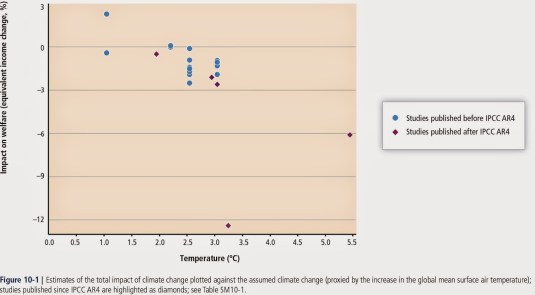
The above figure is as it appears in the final, published version of Chapter 10 of the Contribution of Working Group II to the Fifth Assessment Report of the Intergovernmental Panel on Climate Change.
via Richard Tol.

Is welfare dependence optimal for whom – part 1? The labour-leisure trade-off and the rewards for working
04 Dec 2014 2 Comments
in applied welfare economics, labour economics, labour supply, politics - New Zealand, welfare reform Tags: Labour leisure trade-off, welfare reform
The higher is the welfare benefit, the greater the probability that an individual will choose to go on welfare rather than work. Welfare dependency is the most rewarding leisure-labour trade-off for them.
The higher the wage on offer to a given worker in the labour market, the greater is the probability that they will choose to work rather than go on welfare. Working is the most rewarding leisure-labour trade-off for them.
Both the income and substitution effects of welfare benefits provide a disincentive to work. Higher income levels from generous welfare benefits induce higher consumption of all normal goods, including leisure. Income taxes and a high benefit abatement rate provides little incentive to work (the substitution effect) for lower paid workers and some second earners.
When confronted with the choice of a low-paying job and a generous welfare benefit, some will choose welfare over work. These workers are responding rationally to the (dis)incentives embedded in the labour market and welfare system. For them, welfare dependency is optimal.
This is particularly true for single parents with low labour market skills. One or more children may generate more net income (from increased welfare benefits) than working in the labour market and paying child care. If there is no expiry date for these welfare benefits, some individuals who go on welfare will stay on welfare for a long period of time.
Of course, the economics of crime comes up. A condition of receipt of welfare benefits in just about every welfare state is healthy adults must make themselves available for work and actively look for work.
Most of the essentials of the impact of welfare reform on labour-leisure trade-offs are captured, and most policy dilemmas are clearly defined within the framework in Figure 1. Figure 1 illustrates the position of two workers regarding whether to work (the participation decision) and how many hours to work.
Figure 1: The basic leisure-labour trade-off

The hourly wage rate represented by the symbol W in Figure 1 is traded-off against working fewer or no hours. This additional of leisure time includes: pure leisure; household production such as child care, cooking and cleaning; education and other human capital investments; and personal time such as self-care and sleep.
- Worker 1 in Figure 1 works 40 hours while worker 2 with different circumstances works part-time in Figure 1.
- Worker 1 could be a male with no dependents so not working full-time has a relatively high opportunity cost even if low paid.
- Women who higher qualifications are also more likely to be persistent workers alternating between full-time career and part-time work when there are child care responsibilities.
- Worker 2 in Figure 1 could be a sole parent or a second earner in a married couple with young children. For these workers, working can have a high opportunity cost because of the cost of child care, especially if the sole parent or second earner is low paid.
- For workers with a high opportunity cost of work and low wages from working, for them, welfare dependents can be quite optimal.
- Not so for society because the welfare benefits conditional on people making themselves available for work and taking steps to find it and stay in work.
The next few blogs will explain how various welfare reforms change the labour leisure trade-off for welfare recipients. There are three main parameters in any welfare system:
- the amount of the welfare benefit,
- the threshold for the benefit abatement on earned income, and
- the benefit reduction rate for income exceeding the abetement-free threshold.
This is not to ignore work testing and work requirements, these complications are postponed to later blogs. All of these parameters and the implications of changing them on labour supply will be discussed in future blogs.
The blogs so far
is-welfare-dependency-optimal-for-whom-part-3-abatement-free-income-thresholds-and-labour-supply
is-welfare-dependents-optimal-for-the-whom-part-4-in-work-tax-credits-and-labour-supply
is-welfare-dependence-optimal-for-whom-part-5-higher-abatement-rates-and-labour-supply
is-welfare-dependence-optimal-for-whom-part-6-mandatory-work-requirements-and-labour-supply
is-welfare-dependence-optimal-for-whom-part-7-the-role-of-tagging-in-welfare-benefits-system
Adjusting for transfers and taxes reduces income inequality between highest and lowest quintiles by 50% » AEI
02 Dec 2014 Leave a comment
in applied welfare economics, labour economics, poverty and inequality, welfare reform Tags: poverty and inequlaity

Lindsay Mitchell – Labour’s Carmel Sepuloni: be careful what you ask for
01 Dec 2014 Leave a comment
in applied welfare economics, labour economics, labour supply, minimum wage, politics - New Zealand, poverty and inequality, welfare reform Tags: Carmel Sepuloni, inequality and poverty, James Heckman, James Julius Wilson, labour economics, Roland Fryer, welfare reform

Lindsay Mitchell has a nice blog today on the views of the new Labour Party spokesman on social development – the New Zealand ministerial portfolio covering social security and social welfare
Carmen Sepuloni disagrees with National Party’s policy of requiring solo mothers to look for work. She believed there should be support for sole parents to return to work, but not a strict compulsion:
It is a case by case basis. I don’t think it should be so stringent because it’s not necessarily to the benefit of their children.
The American sociologist James Julius Wilson in The Truly Disadvantaged (1987) and When Work Disappears (1996) wrote about how more children are growing-up without a working father living in the home and thereby gleaning the awareness that work is a central expectation of adult life:
. . . where jobs are scarce, where people rarely, if ever, have the opportunity to help their friends and neighbors find jobs. . . many people eventually lose their feeling of connectedness to work in the formal economy; they no longer expect work to be a regular, and regulating, force in their lives.
In the case of young people, they may grow up in an environment that lacks the idea of work as a central experience of adult life — they have little or no labor force attachment.
Carmel Sepuloni appears to believe that work is not a central expectation of adult life. Hard work used to be a core value of the Labour Party.
The toughest week of door knocking for the Labour Party in the 2011 general elections was after the Party promised that the in-work family tax credit should also be paid to welfare beneficiaries.
Voters in strong Labour Party areas were repulsed by the idea. These working-class Labour voters thought that the in-work family tax credit was for those that worked because they had earnt it through working on a regular basis. The party vote of the Labour Party in the 2011 New Zealand general election fell to its lowest level since its foundation in 1919 which was the year where it first contested an election.
When Sepuloni was on the Backbenchers TV show prior to the recent NZ general election, she was asked by the host whether she would support a $40 per hour minimum wage if that would mean equality. She did not hesitate to say yes.
Sepuloni does not seem to have noticed that wages must have something to do with the value of what you produce and the ability of your employer to sell it at a price that covers costs.
The economic literatures (Heckman 2011; Fryer 201o) and sociological literatures (Wilson 1978, 1987, 2009, 2011), particularly in the U.S. is suggesting that skill disparities resulting from a lower quality education and less access to good parenting, peer and neighbourhood environments produce most of the income gaps of racial and ethnic minorities rather than factors such as labour market discrimination.
Grounds for optimism about the effectiveness of welfare reform in overcoming barriers to employment lie in the success of the 1996 federal welfare reforms in the USA.
The subsequent declines in welfare participation rates and gains in employment were largest among the single mothers previously thought to be most disadvantaged: young (ages 18-29), mothers with children aged under seven, high school drop-outs, and black and Hispanic mothers. These low-skilled single mothers who were thought to face the greatest barriers to employment. Blank (2002) found that:
At the same time as major changes in program structure occurred during the 1990s, there were also stunning changes in behavior. Strong adjectives are appropriate to describe these behavioral changes.
Nobody of any political persuasion-predicted or would have believed possible the magnitude
of change that occurred in the behavior of low-income single-parent families over this decade.
People have repeatedly shown great ability to adapt and find jobs when the rewards of working increase and eligibility for welfare benefits tighten.
via Lindsay Mitchell: Carmel Sepuloni: be careful what you ask for.
Benjamin Powell, In Defense of “Sweatshops”
29 Nov 2014 1 Comment
in applied welfare economics, development economics, growth disasters, growth miracles, human capital, labour economics, labour supply, occupational regulation Tags: Ben Powell, development economics, do gooders, sweatshops

The last word on Piketty: Deirdre McCloskey, John McTernan, Chris Giles Panel
29 Nov 2014 Leave a comment
in applied price theory, applied welfare economics, poverty and inequality Tags: Deidre McCloskey, Piketty
Million dollar taxi licenses under pressure from Uber at last
28 Nov 2014 Leave a comment
in applied price theory, applied welfare economics, comparative institutional analysis, economics of regulation, industrial organisation Tags: rent seeking, taxi regulation, Uber
Treat scientific advice on global warming like advice from your doctor
28 Nov 2014 Leave a comment
in applied price theory, applied welfare economics, environmental economics, global warming Tags: climate alarmism, cost benefit analysis, evidence-based policy, global warming

1. Physicians may not agree on the medical condition causing the symptoms the patient presents.
2. Even if physicians agree on their diagnoses, they often do not agree on the efficacy of alternative responses — for example, surgery or medical management for lower-back pain.
3. The reason patients seek advice and treatment is that they expect physicians to have vastly superior knowledge about the proper diagnosis and efficacy of treatment.
4. Medicine proceeds on the basis of double blind trials and other small field experiments. Control and treatment groups are used before any treatment is applied widely.
5. Medicine is not perfect as was the case with the misdiagnosis of the causes of stomach ulcers.
6. The lag between cause and effect are short as would be the case if you rejected emergency treatment after a car accident or cancer treatment.
7. Medicine tests the efficacy of invasive treatments, weighs side-effects and encourages adaptation and prevention.
8. The staying power of self-interest in medicine is well-known: much higher rates of surgery when there is fee for service and much lower rates of surgery if the patient is a doctor or his partner. The efforts of the medical profession to suppress competition is well-known.






Recent Comments