Why do the innocent plead guilty?
03 Jun 2016 Leave a comment
in applied price theory, applied welfare economics, economics of crime, law and economics Tags: over-criminalisation
Walter Williams discusses market versus political solutions to the problems of racism and private property
03 Jun 2016 Leave a comment
in applied price theory, applied welfare economics, comparative institutional analysis, constitutional political economy, discrimination, industrial organisation, labour economics Tags: racial discrimination, Walter Williams
Few of the top 50 billionaires inherited their wealth
01 Jun 2016 Leave a comment
in applied price theory, applied welfare economics, economic history, entrepreneurship, financial economics, human capital, labour economics, poverty and inequality, unions Tags: entrepreneurial alertness, inherited wealth, superstar wages, superstars, top 0.1%, top 1%
Of the 15 inheritance based billionaires, three are from the Walton family, two are the Koch brothers and another three are from the Mars family.
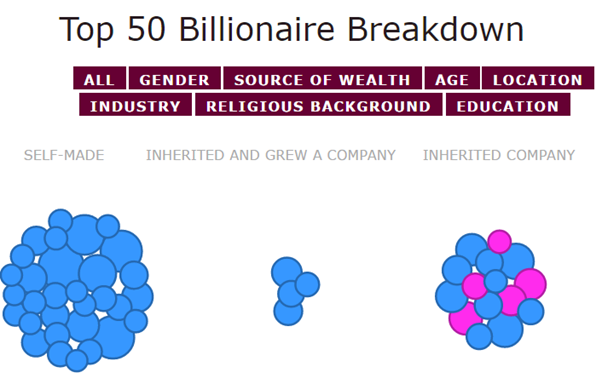
Source: The world’s top 50 billionaires: A demographic breakdown.
@RealDonaldTrump @BernieSanders are wrong on taxing imports
31 May 2016 Leave a comment
in applied price theory, applied welfare economics, economic history, international economics Tags: 2016 presidential election, left-wing populists, right-wing populists
BS @WorldBank that #climateaction = no sacrifice 4 poor countries @cjsnowdon @RichardTol @BjornLomborg @WBG_Climate
30 May 2016 Leave a comment
in applied welfare economics, development economics, economics, economics of media and culture, energy economics, environmental economics, global warming, growth disasters, growth miracles Tags: climate alarmism, The Great Escape
Night-light maps shows huge need 4 #infrastructure investment in African #cities. Video: wrld.bg/Ufzpy https://t.co/BJXzwAZPyE—
World Bank (@WorldBank) November 10, 2015
Frederic Bastiat on the Seen and Unseen
29 May 2016 Leave a comment
in applied price theory, applied welfare economics, Austrian economics, economics, economics of regulation, history of economic thought Tags: Frederic Bastiat
How Do We Make Society Better? Left vs. Right
29 May 2016 Leave a comment
in applied price theory, applied welfare economics, economics of media and culture Tags: expressive voting, rational irrationality
Are the Poor Getting Poorer?
28 May 2016 Leave a comment
in applied price theory, applied welfare economics, economic history, economics, labour economics, poverty and inequality Tags: pessimism bias, The Great Enrichment
% of top incomes from wages, salaries and pensions
23 May 2016 Leave a comment
in applied price theory, applied welfare economics, economic history, entrepreneurship, human capital, industrial organisation, labour economics, labour supply, occupational choice, poverty and inequality, survivor principle Tags: entrepreneurial alertness, envy, superstar wages, superstars, top 1%, top incomes
Everybody from the top 10% to the top 0.01% have to work for their living these days with much of their income coming from wages.
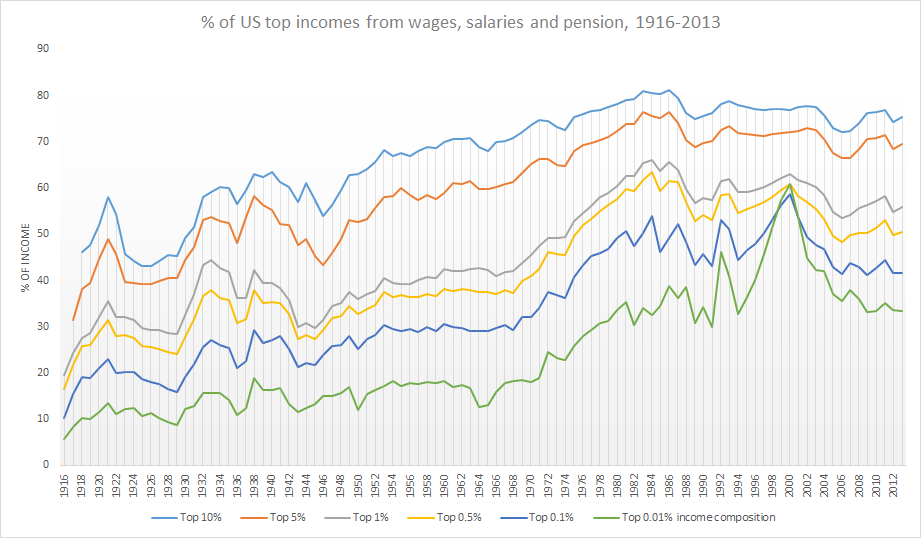
Source: The World Wealth and Income Database.
Bryan Bruce’s boy’s own memories of pre-neoliberal #NewZealand @Child_PovertyNZ
23 May 2016 Leave a comment
in applied welfare economics, comparative institutional analysis, economic history, economics of regulation, income redistribution, industrial organisation, politics - New Zealand, poverty and inequality, Public Choice, rentseeking Tags: child poverty, conspiracy theories, expressive voting, family poverty, Leftover Left, living standards, neoliberalism, Old Left, pessimism bias, rational irrationality, reactionary left, top 1%
New work by Chris Ball and John Creedy shows substantial *declines* in NZ inequality.
initiativeblog.com/2015/06/24/ine… http://t.co/f94fw4Bhae—
Eric Crampton (@EricCrampton) June 24, 2015
You really are still fighting the 1990 New Zealand general election if Max Rashbrooke makes more sense than you on the good old days before the virus of neoliberalism beset New Zealand from 1984 onwards.
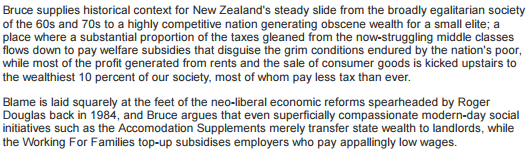
Source: Mind the Gap: Why most of us are poor | Stuff.co.nz.
Bryan Bruce in the caption looks upon the New Zealand of the 1960s and 70s as “broadly egalitarian”. Even Max Rashbrooke had to admit that was not so if you were Maori or female.
The present rate of technology adoption is nearly a vertical line —@blackrock https://t.co/3oS3YAI4ld—
Vala Afshar (@ValaAfshar) January 22, 2016
Maybe 65% of the population of those good old days before the virus of neoliberalism. were missing out on that broadly egalitarian society championed by Bryan Bruce.
As is typical for the embittered left, the reactionary left, gender analysis and the sociology of race is not for their memories of their good old days. New Zealand has the smallest gender wage gap of any of the industrialised countries.
The 20 years of wage stagnation that proceeded the passage of the Employment Contracts Act and the wages boom also goes down the reactionary left memory hole.
That wage stagnation in New Zealand in the 1970s and early 80s coincided with a decline in the incomes of the top 10%. When their income share started growing again, so did the wages of everybody after 20 years of stagnation. The top 10% in New Zealand managed to restore their income share of the early 1970s and indeed the 1960s. That it is hardly the rich getting richer.
Money makes people right-wing and inegalitarian
21 May 2016 Leave a comment
in applied price theory, applied welfare economics, public economics Tags: taxation and investment, taxation and labour supply
Figure 1. Evidence on switchers: The percentage of people who switched right (conservative), and previously did not vote conservative, after a lottery win

Source: Money makes people right-wing and inegalitarian | VOX, CEPR’s Policy Portal.
 Utopia, you are standing in it!
Recent Comments