Dr Mark Pennington – ‘Robust Political Economy’
20 May 2016 Leave a comment
in applied price theory, applied welfare economics, comparative institutional analysis, constitutional political economy, economics of media and culture, economics of regulation, entrepreneurship, environmental economics, industrial organisation, liberalism Tags: offsetting behaviour, The fatal conceit, The pretence to knowledge
Can private enterprise save our public lands?
17 May 2016 Leave a comment
in applied price theory, applied welfare economics, environmental economics, industrial organisation, privatisation, survivor principle Tags: economics of national parks
Rockefeller: The Richest American Who Ever Lived
16 May 2016 Leave a comment
in applied price theory, applied welfare economics, economic history, entrepreneurship Tags: superstars
Brexit: the Movie
15 May 2016 Leave a comment
in applied price theory, applied welfare economics, comparative institutional analysis, constitutional political economy, economic history, economics of regulation, industrial organisation, international economics Tags: Brexit, Common market
What If There Were No Prices? Railroad Thought Experiment
15 May 2016 Leave a comment
in applied price theory, applied welfare economics, Austrian economics, comparative institutional analysis, constitutional political economy, entrepreneurship Tags: market process
Basic Facts of Growth and Development
12 May 2016 Leave a comment
in applied welfare economics, development economics, economic history, economics of media and culture, growth disasters, growth miracles Tags: The Great Enrichment, The Great Escape, The Great Fact
Household penetration of major electrical appliances, 1963, USA, Western Europe and Down Under
10 May 2016 Leave a comment
in applied welfare economics, economic history, technological progress Tags: good old days, pessimism bias, the standards
Michael Reddell stumbled across a fascinating 1965 research paper in an old bookshop. In addition to re-blogging his post, I charted the data he found on household penetration of major electrical appliances in the good old days of the regressive left when everyone was equal, in a union and happy.
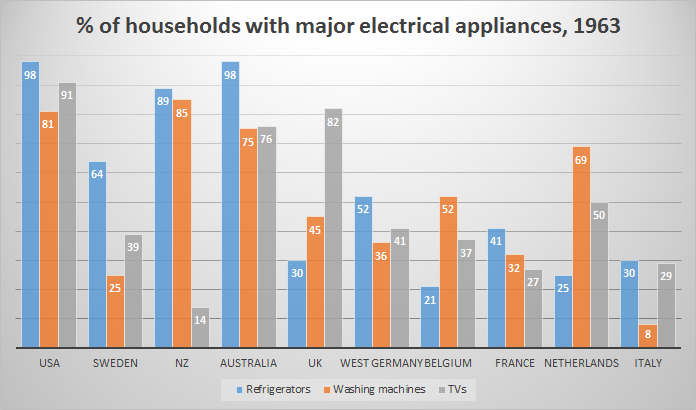
Source: New Zealand Institute of Economic Research (1965), Electric Household Durable Goods: Economic Aspects of their Manufacture in New Zealand via Twenty companies manufacturing TVs | croaking cassandra.
In the early 1960s, there were really big differences not only the number of TV sets, but much more basic appliances we take for granted such as refrigerators and washing machine.
The three indicators in the chart above suggest that life was much better in the USA, Australia and New Zealand than in Western Europe. Television aside, New Zealand seemed to be better off than Australia.
Watch the video by Hans Rosling about what happened when a washing machine first came to his parent’s house. Truly insightful about how living standards are so much better than those of our parents and grandparents.
Trekonomics: The Final Frontier (w/ Manu Saadia)
09 May 2016 Leave a comment
in applied price theory, applied welfare economics, Austrian economics, comparative institutional analysis, constitutional political economy, development economics, economics of regulation, environmental economics, history of economic thought, industrial organisation, international economics, law and economics, property rights Tags: star trek
With friends like these, the #UBI will not live to face its enemies @jordNZ
09 May 2016 Leave a comment
in applied price theory, applied welfare economics, politics - New Zealand, politics - USA, public economics, rentseeking Tags: universal basic income
Running around saying that Universal Basic Income will make work optional leaves open the question of who will be the suckers who actually do the work and pay enormous taxes to fund the idyllic lifestyle of the bohemian rest.

Source: What If Everybody Didn’t Have to Work to Get Paid? – The Atlantic.
@BernieSanders should be the @realdonaldtrump’s running mate
08 May 2016 Leave a comment
in applied price theory, applied welfare economics, international economics, politics - USA Tags: 2016 presidential election, comparative advantage, free trade, left-wing popularism, rational ignorance, rational rationality, right-wing popularism
The Coase Theorem
08 May 2016 Leave a comment
in applied price theory, applied welfare economics, Austrian economics, comparative institutional analysis, constitutional political economy, economics of regulation, environmental economics, history of economic thought, industrial organisation, law and economics, property rights, Ronald Coase Tags: Coase theorem
Pierre Desrochers explains why the ‘buy local’ food movement overstates environmental benefits
08 May 2016 Leave a comment
in applied price theory, applied welfare economics, development economics, economic history, economics of media and culture, environmental economics, growth disasters, growth miracles, health economics, industrial organisation, transport economics Tags: food miles
@AndrewLittleMP all but admits rents to go up after Healthy Homes Bill?
08 May 2016 Leave a comment
in applied price theory, applied welfare economics, economics of regulation, Public Choice, rentseeking Tags: economics of housing, economics of mandates, expressive voting, fatal conceit, rent controls, The pretense to knowledge
Opposition Leader Andrew Little accepts that mandating insulation and heat pumps into rental properties will increase their value. But he denies that this will affect rents!
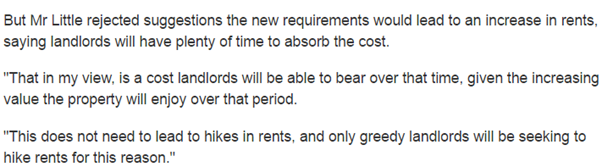
Source: Healthy Homes Bill won’t up rents Little | Politics | Newshub.
An upgrade increases the value of a rental property if the improvements that increase its rental value. You cannot have the increase in the value of the asset without the increase in rent.
I will contract out the rest of my answer to David Friedman’s superb book Laws Order:
For an application of economics to a different part of the law, consider the nonwaivable warranty of habitability, a legal doctrine under which some courts hold that apartments must meet court-defined standards with regard to features such as heating, hot water, sometimes even air conditioning, whether or not such terms are provided in the lease—indeed, even if the lease specifically denies that it includes them.
The immediate effect is that certain tenants get services that their landlords might not otherwise have provided. Some landlords are worse off as a result; some tenants are better off. It seems as though supporting or opposing the rule should depend mainly on whose side you are on.
In the longer run, the effect is quite different. Every lease now automatically includes a quality guarantee. This makes rentals more attractive to tenants and more costly to landlords. The supply curve, the demand curve, and the price, the rent on an apartment, all shift up. The question, from the standpoint of a tenant, is not whether the features mandated by the court are worth anything but whether they are worth what they will cost.
The answer may well be no. If those features were worth more to the tenants than they cost landlords to provide, landlords should already be including them in their leases—and charging for them. If they cost the landlord more than they are worth to the tenant, then requiring them and letting rents adjust accordingly is likely to make both landlord and tenant worse off. It is particularly likely to make poorer tenants worse off, since they are the ones least likely to value the additional features at more than their cost.
A cynical observer might conclude that the real function of the doctrine is to squeeze poor people out of jurisdictions that adopt it by making it illegal, in those jurisdictions, to provide housing of the quality they can afford to rent.
If my analysis of the effect of this legal doctrine seems implausible, consider the analogous case of a law requiring that all cars be equipped with sunroofs and CD changers. Some customers—those who would have purchased those features anyway—are unaffected. Others find that they are getting features worth less to them than they cost and paying for them in the increased price of the car.
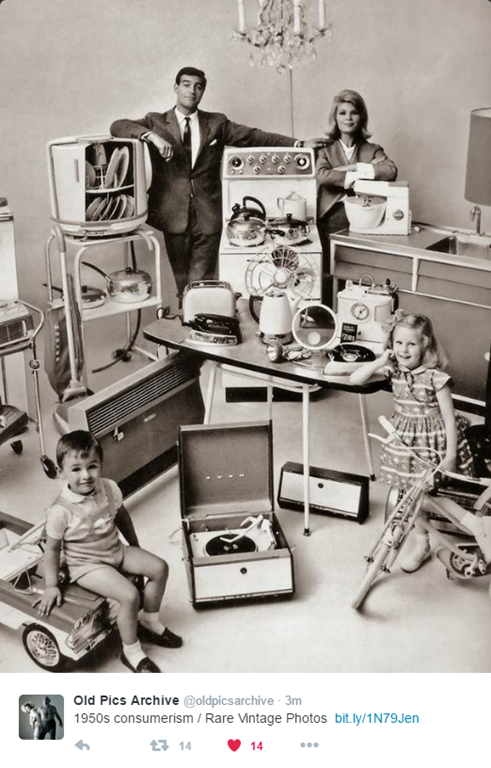
 Utopia, you are standing in it!
Recent Comments